Software
Houzz Logo Print
mitchelltrashmail

Leave the roots?

9 years ago
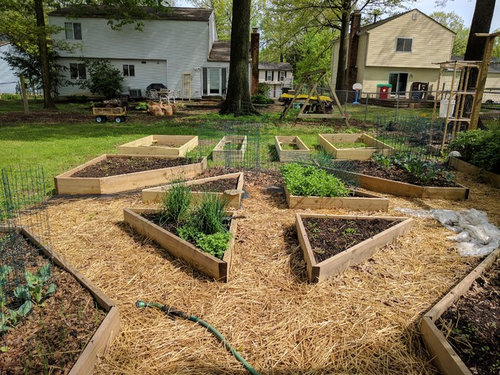
Might be the wrong forum. So I've been watching a lot of videos lately about growing crops like alfalfa to amend the soil. I've also been researching a no till approach to gardening. I garden in raised beds. The soil I used to fill the first phase of the garden was a garden blend that looked great when it was dumped and isn't terrible a year later, but definitely is headed to becoming difficult to work with. I noticed that on the beds that I put a top mulch on over winter are a lot better than the ones I didn't. I always mulch during the growing season, but that mulch in the winter really helped a lot. I used to turn the mulch into the soil in the spring. After watching The Gardening Guy, Paul, simply aerate the bed, I used this approach this spring instead of turning. I don't have one of the tools he had, but I used my pitch fork which seemed to work ok. I think it disturbs the soil less. I am seeing more worms in the beds which is great.


So I get to the point. I love composting and in the fall rip out the plants, cut them up and add them to the pile. One of my favorite things is to see how long the roots on the maters are which get quite lengthy, like 4 ft. I'm thinking of just cutting the plant off at the ground level and leaving the roots in the bed to break down naturally. Curious if others have tried this and what their results are. I'm definitely top dressing the beds at the end of the season. :)


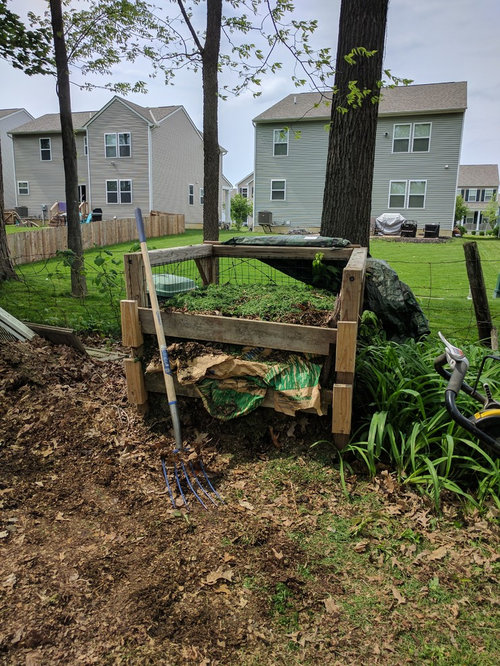
Here's a couple pics just cause. Phase one of garden is the straw. Adding four new beds in phase 2. One of three compost piles.

Comments (10)

  • 9 years ago
    last modified: 9 years ago

    I'm thinking of just cutting the plant off at the ground level and
    leaving the roots in the bed to break down naturally. Curious if others
    have tried this and what their results are.

    I usually do this - with things like okra you can't pull the plants out. It's like working around a tree stump.

    In the fall, slice everything off at or just below ground level and mulch the beds. Over the winter the snow and rain will soak the beds and rot the roots.

    If the roots are a nuisance when you are planting the next spring, they are usually easy to remove.

    My results: a lot less work, and the decaying roots can leave organic matter and aeration channels 4-6 feet in the ground.

  • 9 years ago

    @Barrie, the purpose for leaving the roots wasn't mainly for improving soil organic matter. I have tons of compost for that. I just want to try disturbing the soil as little as possible to promote soil structure. I've hear of planting a fall crop to improve soil but I've never heard it done in raised beds. I figure I'll give it a try. If the root mass impedes planting next spring, I can remove the roots then.

  • 9 years ago

    Tillage radishes are a nice cover crop to grow in the fall if you have any open beds come late August. They grow quickly, have 3' long tap roots that mine the sub soil for nitrogen, and have 12-18" pretty tasty roots. And if you leave them in thru the winter they will rot and release the nitrogen for your spring crops. They do smell a little when they are rotting in a warm spell.

    But your idea to leave the roots from you summer crops is fine. Some types of roots like many of your brassicas won't rot very well as Barrie mentioned so you would probably have to remove those in the spring.

  • 9 years ago

    We don't think of the roots of our annual garden plants as a source of organic matter/material but in fact they are a huge resevoir. Many annual plants have a much greater mass and weight below the ground than above.

    As the root mass decomposes in place, not only are many valuable elements released back into the soil but the tiny channels that were occupied by those roots remain, increasing and then sustaining soil porosity.


  • 9 years ago

    "With those cover crops you could crimp the above ground growth in the Spring and do the notill planting."

    Have you looked at the growing areas we are discussing? He'd have to crimp it with a hair-crimper.

  • 9 years ago

    This is interesting ...an entire book on roots of vegetable crops. The root mass is impressive, even for lettuce.

    "The taproots had extended
    their depths from about 3.5 feet to the 6- to 7.5-foot level.

    As before, however, relatively few long branches originated below
    the first 10 inches. The large laterals, which formerly had reached
    a depth of only about 2 feet, now extended well into the fourth
    foot of soil.
    Some occupied the fifth foot also, and a few of
    the longest reached a depthof over 6 feet. That growth was still
    occurring was shown by the long, unbranched, turgid root ends.
    The number of branches filling the soil was much greater than
    formerly and sublaterals were much more abundant. The total spread,
    however, had not been increased since the preceding examination.
    Thus a volume of soil, with a surface area of over 9 square feet
    and a depth of at least 5 feet-nearly 50 cubic feet-was thoroughly
    ramified by the roots of a single plant."


    http://soilandhealth.org/wp-content/uploads/01aglibrary/010137veg.roots/010137toc.html

  • 9 years ago

    " I just want to try disturbing the soil as little as possible to promote soil structure."

    Could you explain exactly what your understanding, your goal, of that statement in more detail, how you see that promoting improved soil structure?

    I mean your soil is still going to have to be amended regularly anyway and that requires at least some soil disturbance. It would be easy to do in such small beds . It is basically big container gardening rather than in ground gardening and while I understand the benefits of no-till in large scale AG, it doesn't typically have an effective role in small scale gardening. How do you plan to deal with the natural compaction over time, with the water and nutrient retention issues that normally develop in beds such as you have?

    I do both large container and in ground gardening and there is a BIG difference between leaving the root mass in both. I do it routinely in the in ground beds but it is a big negative when it comes to contained soil.

    Dave

  • 9 years ago

    I remove roots but that is because I am plagued with root knot nematodes. If I knew my roots were healthy I would leave them.

  • 9 years ago

    @Dave So in the beds I built from last year, I used a premium builk topsoil from a bulk supplier. I had them include some leaf mulch as well, but it wasn't really mixed very well. We have clay soil which was used in the premium topsoil so some of the beds over the last year have become harder. The beds that I topped dressed with mulch over the winter are a lot more loose, contain a lot more living organisms and overall appear a lot healthier. When I til the beds, I'm disturbing the soil, the organisms living in it (cutting worms in half, if there are any) and who knows what the tilling might be doing to any bacteria and funguys that are in the soil. I'm going to try to just continue to add a topdressing continually and see how that changes the soil below.

    I've done this with the areas around oak trees that we have. The oaks shade the ground too much for grass to grow. I just use chopped leaves as a ground cover to retain soil moisture. The leaves break down and turn to a loam. After a few years, It's hard to tell where the mulch starts and the natural soil starts. The mulching has changed the soil to that degree.