Software
Houzz Logo Print
heimdall83

Figuring out drip irrigation layout

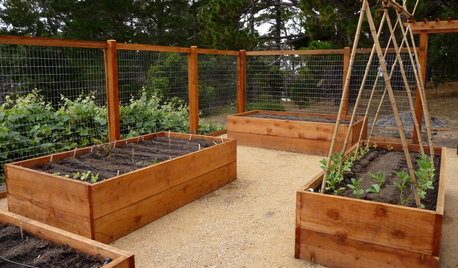
I'm in-process of putting together a raised vegetable garden. I have two 5x10 beds, 21.25" high (three 2x8s). I've a bunch of seeds started indoors and additional seeds to start outdoors, but I haven't quite settled on everything to be planted.

I'm going to install drip irrigation, likely from this company, mainly because I can get it locally so I can just run out if I need parts or additions.

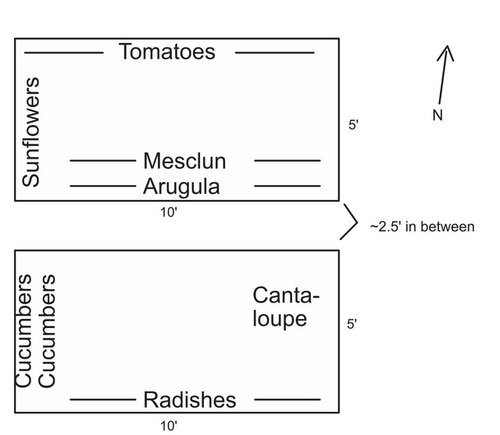
Below is my tentative layout, to change as I get new plants or find out why my current layout is idiotic. The tomatoes will be grown on a 6' trellis I've already built, and the cucumbers will grow in a double row on an A-frame (two-sided) trellis, yet to be built. The sunflowers are where they are so that they don't loom over other things.

I'll probably be sticking some nasturtiums in there, but otherwise it'll be what strikes my fancy and also fits in.

The current thought: 1/2" main line going to the first bed (which is 19 feet from the faucet), with a T leading to a line up into the first bed and another line over to the second, elbows making more 1/2" lines running n/s on the east end.

1/4" soaker hoses will run east-west along the rows with the southernmost in each box making a 90' at the west end to run along the n/s rows (doubling back with the cucumbers, since that's a double row). The specs on the 1/4" drip lines have a 33' max run per line, so I'm well inside that. I'd probably use this kit.

So. Not all plants need the same amount of water. The drip hose puts out 0.5 gph (at 1' intervals). Would I be underwatering certain plants, especially the tomatoes? Should I put a different sort line along the tomato row, at 1 gph, or maybe double-up the line? Would the same frequency (number of days watering/week) work for everything, if I could adjust the amount per hour?

Comments (7)

  • 9 years ago
    last modified: 9 years ago

    I am by no means an expert, and I am currently working out
    my plans for drip irrigation in my garden myself, but I think I would try to keep
    it as simple as possible. By simple I don’t
    mean the easiest or cheapest, I mean grouping out the watering by plant
    type.

    I’d probably go the double line route for the water lovers
    (tomatoes, cukes, and cantaloupe), and then a single line to the others
    (sunflowers, mesculan, etc). Instead of
    snaking a line around the entire bed, have one run go to each type of plant
    (i.e. one line hits the sunflowers, one line hits the tomatoes (doubled over if
    you wanted), etc. That way you could put
    shut off valves on some of the runs as you get ready to harvest (for instance
    cantaloupe does not like being watered after fruit has set) or when those
    spaces are no longer in use.

    For frequency, you can probably get by with the same
    frequency for all of the plants.
    Infrequent, deep watering is almost always better than consistent,
    shallow watering. You'll have to do some experimentation on how frequent and how many minutes/hours to run each time.

  • 9 years ago

    Thanks for the reply. Just to clarify what I meant, I was going to do a separate line per row (tap off of the 1/2" at each row), but in order to get to the rows that run n/s along the western side, I was going to let the southernmost row extend north at that end. I suppose I can run a 1/4" non-drip line along that southern edge (itself watering nothing) then run a drip line up and down each line of the cucumbers and a single one for the sunflowers.

    Reading further, I think I'll need more space for the cantaloupe, probably extent it the whole length of the bed, considering how much space each plant needs (I think I have four, though I'll have to double check).

  • 9 years ago

    I use in line shut offs at the start of each run...that way I can shut off the lines to the plants that don't need water, and water what needs it deeply.

    The best plan for you, though, is to bring your plans to the drip store and have them look at the plans. I didn't have that option, but if they are close, why not tap into their experience?

  • 9 years ago

    My plan was to put it on a timer, so manual shut offs won't help that

    I just have a retailer that stocks the product, nothing more.

  • 9 years ago

    @Scott good to see a fellow Long Islander. I am also setting up a drip system on timers. You could use different nozzles that have different flow rates that way plants that need more H2O would get it but you would still only need one timer.

  • 9 years ago

    Hi, Steve. What drip system were you going to use? The particular item I'd mentioned, Mister Landscaper's Vegetable Garden kit, only comes with drip tubing. I thought that the simplest way to deal with the thirstier crops would be doubling the line. Everything I'm doing would be from a single water source (thus one timer) but it's where I go from there that I'm getting bogged down in details.

    The company has three water devices: drip tubing, drippers, and microsprays. The drip tubing puts out a fixed 1/2 gph, at 1' intervals. With the drippers, you can choose 1/2, 1, or 2 gph at intervals you choose, Then there are the microsprays, which I think all deliver 10 gph (and a pretty big coverage area, 5-7' minimum). I don't think the microspray is spray is what I need for these raised beds (WHY does my autocorrect insist on turning "microspray" into "micxospray"?).

    From what I gather, the drippers are sort of aimed at delivering water to a particular plant, and are less useful for watering a ROW of plants. You attach them to one end of a 1/4" (non-drip) line, then attach the other end to the 1/2" main, doing this one at a time. The 1/4" drip line attaches to the 1/2" main and runs along the whole row. The drippers are more flexible in both placement (attach them at whatever intervals you want) and flow (three gph selections), but the drip line covers a row of vegetables much more quickly, if you don't need such control.

    So if you wanted to water, say, radishes, it's clear that the 1/4 drip line would be best: have the 1/2" line just run n/s along the eastern edges, then tap in to the 1/2" main and just run it down the row. But if you're doing tomatoes... that's where it muddles. Assuming you want more gph, you could run that 1/4" drip line down on one side of the plants, then do a 180 at the end and run it back on the other side. To use drippers, though, you'd have to run the 1/2" line down the whole row (east-west), then run individual 1/4" lines off it to each plant, with 1 gph drippers at each end.

Sponsored
Peabody Landscape Group
Average rating: 3.5 out of 5 stars8 Reviews
Franklin County's Reliable Landscape Design & Contracting