Software
Houzz Logo Print
j_bron

Retaining wall near log cabin, any ideas?

9 years ago

We recently cleared some land behind our log cabin on our farm to make room for a storm shelter and a patio area, and we had intended on using railroad ties as a retaining wall. Now I'm like.... I'm so sick of the wood! We have wood everywhere, literally. It's pretty, but a girl can only take so much. I'm wondering if you all have any ideas for other designs/materials? Hubby says no to boulders, he says it'll be too expensive to get them hauled in. He's interested in building a concrete wall and hiring someone to put some rock facing on it, but only natural-looking rocks, nothing with straight lines or clashing with the natural theme. But I'm trying to think of more options. We live in rural Tennessee, and the wall at it's lowest point will be about 2 feet and as it goes across will get higher up to 6 feet. Another issue is that it's just so much wall, like 70 feet of wall. Now that it's dug out I'm worried it's too much wall! Is there a way to break it up? Please help. I'm so lost and getting fed up with this.

Comments (8)

  • 9 years ago

    A picture always helps. Starting with materials. I don't recommend a 70 foot concrete wall. For starters that won't be cheap either. Even if you mixed it yourself with a rented mixer you'd be spending weeks setting up forms. And that amount of concrete wouldn't be cheap either. To preventing shifting and cracking you'll need to excavate, preferably to the frost line, and then put down an appropriate base of sand and crushed rock. Not to mention buying all the wood to make the forms and rebar to ensure the concrete doesn't crack. A six foot retaining wall is performing a massive amount of work and must be constructed accordingly. You'll need to backfill with crushed rock and incorporate a drainage system to ensure water doesn't buildup. And..concrete repairs aren't easy either.

    Of course you can pay someone to do this but that size wall is the same linear feet of a small house's foundation. That can easily cost 10-20k depending. If you're concerned about cost this won't be your answer. Then to pay someone to clad it?

    In the alternative, I have two recommendations. The first is...boulders. Here's the thing. It doesn't need to be "boulders" or huge rocks. Larger rocks are often priced by weight so you can get farther using smaller rocks. Think cantaloupe or basketball size instead of something 2-3 feet across. And because rocks don't crack with frost you can get away with not excavating and putting a base down, at least on the low spots (people will quibble with me on this point and ideally you would but for cost and time reasons you can do without it for shorter sections). Here's another thing about rocks. Apart from being nearly unbreakable, nearly maintenance free, and relatively preparation minimal, they are far more "natural" than building a wall and putting rock cladding on it.

    My other recommendation is a gabion wall. It won't look as natural as you're envisioning, but if you're on this site you probably have some taste for alternative ideas. It's basically a cage that you fill with rocks. The advantages are that you can use smaller stones than you would with freestanding rocks and it keeps the form you want, so it automatically becomes the wall you need, rather than worrying about placing the rocks just right so they form a vertical face and flat top.

    To break up a huge wall like this you'll need to find a place to a set of stairs that connect the two levels. You can also create alcoves or peninsulas on the wall where you can put a tree, sitting area, or garden highlight.


    Good luck!

  • PRO
    9 years ago
    last modified: 9 years ago

    Installing a block wall and then facing it is a very expensive way to go.

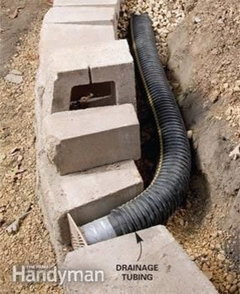
    A retaining wall this long requires proper anchoring and landscaping drainage to allow water that will build up behind the wall to escape. Using an anchor wall with a decorative face will be easier to install

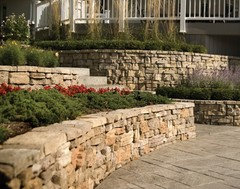
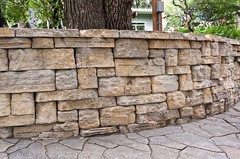
    As the wall increases in height, you'll want to create multiple levels. This image below is Belvidere Retaining Wall so you can build the wall and have the decorative face in one step not two. Additionally they offer a cap for the top of the wall.

  • PRO
    9 years ago

    That's some wall! It is way too big to DIY unless you are a soils engineer with access to a backhoe and other large earth moving equipment. Walls of that size will have enormous pressures behind them, and if improperly built, they can fail disastrously. And spectacularly. As in a giant landslide. I hope you consult the proper professionals immediately! It really is life or death.

  • PRO
    9 years ago

    Kudos to you for building a storm shelter. That is an investment in your safety that we hope you never need. I hope you can also persuade your hubby to invest in the long term value of your property by spending just a bit more than the bare minimum to upgrade the wall. I suggest lots of local research by actively looking at existing retaining walls, both successful and failing, to figure out what works. Cost concerns are an issue with a project of this size, but nothing is more expensive than a failed project that must be rebuilt.

    There's no cheap way to handle retaining walls of that size. Concrete is probably the lowest cost unless you have other materials available at below market price. You could make the wall look nicer than basic concrete with brick or stone molds and tinted concrete cheaper than you could face it with another product.


  • PRO
    9 years ago

    I'm really curious - out of everyone who's commented so far, how many walls have y'all built? Because there's some serious misinformation happening.

    to the OP - find a landscape designer in your area to work with. You'll end up with a more attractive wall, a better idea of what works with your site and your budget, and something that will actually work and not fall over and kill Great Aunt Mildred.

    "you can get away with not excavating and putting a base down" oh my god just no. I'm so not comfortable with so much here.

  • PRO
    9 years ago

    The OP stated that the wall was 2 feet going up to 6 feet. That's nothing to mess around with, as there's probably a decent amount of water moving on a slope behind the wall. If it's one contiguous build, building a portion of it on an inadequate foundation has the potential to cause the entire thing to fail. An 18-24" wall in New England's much more forgiving sandy soils (FYI, I grew up building and rehabbing drystacked stone walls in southeastern New England) just isn't the same animal as a wall that increases in height to 6' in soils that we don't know about. Thus my concern.

    Those walls that are 100+ years old were still built with solid technique and building principles. I can promise you that any that weren't, what you're seeing is the second time (at least) those rocks have been stacked.

    I think when someone is on a budget, those folks are the ones who can least afford to cut corners on the fundamentals. I've been on plenty of calls to talk to people about failed walls, patios, etc., and they rarely have the money or bandwidth to do it a second time, even if I'm walking them through how to do it themselves. I'm sorry you felt singled out.

  • PRO
    9 years ago

    Raising my hand, .....I have stacked a flagstone wall, my first was about started at nothing and went to 4-5 ft. It lasted a pretty long time and then finally blew out, so I understand about the necessary anchoring and drainage required. It was about 30 ft. and I would never undertake it again and would leave it to professionals who are responsible for doing a professional job.