Software
Houzz Logo Print
adayinthegarden48

Oregon Grape Ivy

Not sure if this belongs on this forum, but it is a weed to me. It grows wild all over my property. I would like to turn a couple of the areas into rose beds, but have a feeling this thug will be coming up under my roses for years to come. Is digging to China the only solution?

Comments (13)

  • 9 years ago
    last modified: 9 years ago

    Can you post a picture? I know of no Plant called Oregon Grape Ivy. Do you mean Oregon Grape, Mahonia aquifolium? If so it's a native shrub and most people would encourage it. Otherwise you could either dig it or try a brush killer.

  • 9 years ago

    There is also M. repens, which is a suckering vine, which may be what she's got. That is also native to PNW, but has been called invasive in other areas, supposedly. It spreads by those #(*$&% underground rhizomes-y things, like clethra and bindweed. We do need a picture, OP.

  • 9 years ago

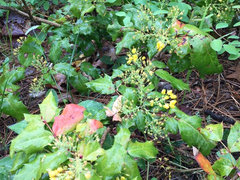
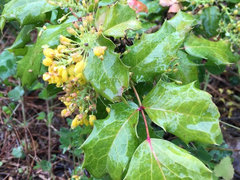
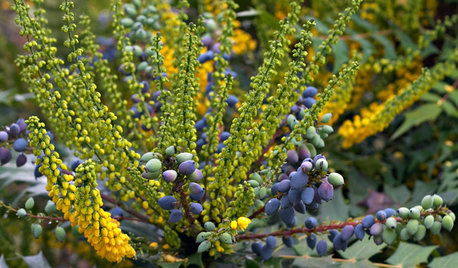
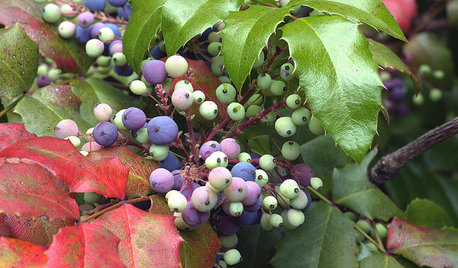
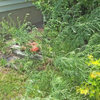
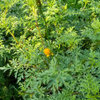
    Floral, you are right - it is Oregon Grape, Mahonia aquifolium. I meant to say holly, not ivy. Glossy, dark green holly type leaves, yellow flowers, and dark blue/black fruit. There is so much of it on my property, it is a bit invasive. I don't want to get rid of all of it, just where I want to plant some roses. I took these photos a few minutes ago.

  • 9 years ago
    last modified: 9 years ago

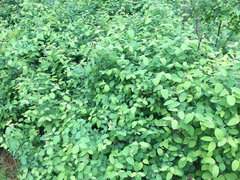
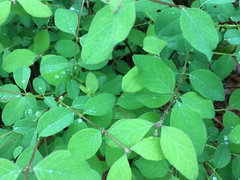
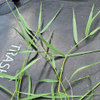
    As you can see in the photos above, there is another weedy plant in that area. Close up photos below. I don't know what it is but it is just as invasive as the mahonia. Can you tell me what it is and if it can it be gotten rid of without using chemicals? Possibly solarization for the entire area? However, it's a large area, and I would like to make a garden bed there this year. I'm gradually getting all this brush and scruffy stuff cleaned up. Your help is much appreciated!

  • 9 years ago

    floral is ALWAYS right; the depth of her knowledge is astounding.

    The MOBOT page on M. aquifolium (http://www.missouribotanicalgarden.org/PlantFinder/PlantFinderDetails.aspx?kempercode=c291) says that

    Unless naturalizing, suckers should be promptly removed as they appear.
    Single specimen shrubs fruit poorly. Grow more than one shrub together
    for best fruit production (single specimens with no other pollinator in
    the area fruit poorly if at all).


    I would guess that other gardeners have had issues with keeping it in bounds as well. You can pull up the suckers until you have room for your roses, but it will be an ongoing battle, and you will have to keep an eye on it and pull the suckers up often. You will probably want to do this anyway, unless you want your whole yard to be swallowed up.


  • 9 years ago

    In reading the link, I was surprised to learn they prefer shade. Mine are in full sun. According to the link, mine are healthy and produce a lot of fruit because there are many of them, all growing happily together.

  • 9 years ago

    I agree this might not be the best place for a rose garden. I called these plants invasive because they're hard to get rid of and multiply and spread where they're not wanted. But, I understand they're not truly invasives.

    I grow about 150 roses in my main garden without the use of chemicals, although sometimes, I'm tempted to. I use some flowers as garnishes and my cat nibbles on bouquets, so I like to keep them chemical free. Also, I'm in an area where most homes are on wells.

    Coralberry. Hmm, I've never seen berries on it, but, considering it's not bad looking, I think I'll bypass this area, let the coralberry and mahonia do their thing, and garden elsewhere.

    Thank you, floral and lisanti for helping me think through this. Thank you for taking the time.

  • 9 years ago
    last modified: 9 years ago

    Mahonia repens is not a vine (climbing plant) either. What is the deer situation there? I would think in that wild looking of a setting these would be murder on garden roses, unless the shrubs were grown inside an effectively fenced compound. If you already have any cleared areas, near the house (and sources of irrigation water) that are not immovably dedicated to other uses these would be the best places to make rose plantings. Instead of trying to spread them out through what is basically still native forest vegetation, including young and small coniferous trees that will do their best to interfere with the plantings.

    flowersaremusic z5 Eastern WA thanked Embothrium
  • 9 years ago
    last modified: 9 years ago

    Embothrium, there is a heavy deer population, and deer live on the property, however, I have deer fencing on much of it. Yes, the deer were murder on my roses before the fence installation. The entire property is tall pines and native forest vegetation. We cleared a portion of it for gardens including irrigation, but I plan to expand on that. I need more garden area as my rose collection grows. My driveway is very long, and I had planned to line it with roses, adding a semi circular area for planting to break the repetitiveness. The mahonia and coralberry grow most heavily in a patch along the driveway. With floral's and lisanti's helpful comments, I now think I may continue with roses along the driveway, skipping the wild area (since it's really not too bad looking) and continue the roses again on the other side of it down the driveway. I'll just add that my current garden was once native forest vegetation until I cleared it. It can be done, but I'm not as eager to do that again.

  • 9 years ago

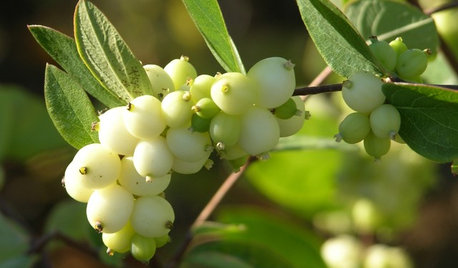
    I'd go with Symphoricarpus albus or snowberry for the second plant - a very common woodland native the PNW. S. orbiculatus is far more likely to be found in the eastern half of the country.

    FWIW, since both are northwest native plants, neither are considered invasive. And the presence of both in close proximity would seem to indicate that it is an area that is not overly conducive to growing roses, as floral mentions. These are by nature woodland plants although quite tolerant of a fair amount of sun. But for roses to thrive in the northwest, a rich soil and as much sun (8+ hours) as possible is necessary.........not a woodland setting and not among tall conifers.

    flowersaremusic z5 Eastern WA thanked gardengal48 (PNW Z8/9)
  • 9 years ago

    I'd be happy with S albus. I didn't know about the distribution in the .US. And the leaves do have the flimsier texture of albus.

    flowersaremusic z5 Eastern WA thanked floral_uk z.8/9 SW UK
  • 9 years ago
    last modified: 9 years ago

    Thank you, gardengal, for the info. I will have to watch for berries on that mysterious plant to help identify it. I should find a better word than invasive. They are undesirable because of their propensity to spread and their difficulty to remove.

    While technically, this is the PNW, this side of WA is very hot and very dry during the growing season, nothing like the Seattle area. Yes, this is somewhat of a woodland setting and there are tall conifers, however, we had many of the tall pines - 40+ - felled to let in more sunlight and we have amended the soil to be able to grow roses. We now have good soil that the roses seem to like. It is possible to grow roses in this setting. One of the most well known rose growers, Northland Rosarium, is in this area, also an extensive, popular rose garden at Manito Park.

    Since these non-invasive, but undesirable, plants are here, and not bad looking, I will just go around them for the expansion of my garden, giving them plenty of latitude so they do not become part of my garden.