Software
Houzz Logo Print
macswim

New Hood meets frustrating new city code for MUA/CFM

9 years ago

I have spent the morning reading through old threads here and am still a little confused.

My new hood arrived yesterday (Victory Twister Max 400/600/800/1000CFM) with a 8" duct to go with the 36"BlueStar range ordered, and my contractor called this morning to say that it will be an additional 4500 dollars to put in a unit in the basement for MUA bc of a new (to me) city code that says the max CFM is 399. This was news to me bc in our current house we have a BS range with a 3 speed Independent Hood (now BS) that I believe goes up to at least 650CFMs and we've never had a problem.

We do cook a lot but rarely use more then 2 burners at a time, and if we use 4 at a time (on rare occassion) 3 are usually just to simmer while searing on the 4th.

We can't afford the extra 4500 at this point in our project. I called BS dealer and he said 800 CFM is what is suggested but 600 would be fine. That still would be over the new code.

I am really at a loss for what to do.

Comments (16)

  • 9 years ago
    last modified: 9 years ago

    What kind of information are you looking for? The codes are there for a reason, having a powerful hood without looking at the building envelope is a safety issue. Just because you safely installed a powerful hood in one house without other considerations doesn't mean the same will be true in a different house. Your options are:

    1. Pay for the makeup air, meet code

    2. Go with a less powerful hood and accept the less effective ventilation, meet code

    3. Violate code and make sure it won't be a safety issue for your particular situation. How tight is your house, do you have any gas appliances without sealed combustion, do you have a fireplace, etc.

  • 9 years ago

    Well I think you have spelled out my options that I am grappling with. The house is over 100 years old, but we are currently putting new walls and ceiling (installation too), so it will be less drafty. But the good news (in a weird way) is we have to keep all of the original windows (with one exception) so they are not sealed well at all. The vent is short and goes right outside. And we do not have a fireplaceI forgot to add above what prompted my question from a thread a few years ago from Kaskei:

    "If you have your contractor design the house so that combustion appliances, such as furnaces, water heaters, and gas dryers have their own MUA and are isolated from the kitchen (i.e., in a room of their own), then the safety-based MUA requirement is met, and simple passive devices such as the Broan damper scheme should be adequate if conditioned air is not needed."

    Does this mean I could make a room and solve the problem?


  • 9 years ago

    A: probably not. Only your inspector could tell you for sure.

    I would want to know what I'm getting for $4500 since that seems like a lot of money to supply that 200-300cfm to make up for things above 400cfm.

    What location? Florida is different from Minnesota. (basically, do you need to heat the MUA.)

  • 9 years ago

    Michigan. I am so frustrated!

  • 9 years ago

    With all the rage being putting commercial level appliances in residential kitchens, the codes will likely start to change for everyone. Unfortunately there is no getting around it, well, not legally anyway. But it certainly is worth finding out _exactly_ what the code says and infers.

    Let us know how this plays out.

    Joe

  • 9 years ago
    last modified: 9 years ago

    $4500 doesn't surprise me at all. I'm assuming this is powered MUA. The cost to buy the unit, the contractor's markup, then the need to run ductwork, plus heat. Those things use powerful electric resistance heaters too, so there might be extra electrical work to accommodate that.

    Bottom line is nobody on this forum is going to tell you it's safe to violate code in your situation, if that's what you're looking for. Even if it sounds like it probably would be OK. We don't know you, we've never been to your house, we aren't going to assume that kind of liability.

    One thing you could do is get a nice big hood, but put a small blower on it so you get 400 CFM of exhaust (you would need to do something like this anyway to pass the inspection, if you were going to violate code). Have the contractor set things up so that MUA could easily be added later. Try things out for a while and see how this setup works with your style of cooking. If you're satisfied, great. If not, you can upgrade the blower and add MUA.

    Passive MUA would be another option, if safe for your situation.

  • 9 years ago

    Yes, I will. We do a lot of cooking because of health issues so our range isn't just for looks (or for caterers, lol).

    I'm reading something now about Fantech.

    One issue I think that adds to the cost is we have old fashioned radiators, and not a central air system.

  • 9 years ago

    Of course. I am not asking you all to tell me to violate the code. Just hoping to hear some suggestions that I would never think of, or some stories of how people found solutions who were in a similar situation.

  • 9 years ago

    Ok I will look that link up and see what I find.

    I am not sure I understand your comment about the last comment "Introducing makeup air into your furnace return in a cold climate isn't a good idea, it can lead to premature failure of the heat exchanger." Could you explain that in relation to the radiator heat (water not steam)?

  • 9 years ago
    last modified: 9 years ago

    Oops, I mistyped. I said you were missing much, I meant to say you're NOT missing much.

    You don't need to worry about it, since you have radiant heat, and thus the makeup air would need its own ductwork.

    My point is that IF you had forced air heat, using its ductwork for makeup air wouldn't be the best idea for the longevity of the furnace in a cold climate. So you aren't missing anything by not having forced air heat.

    Macswim thanked User
  • 9 years ago

    What you can do to achieve safety may not be congruent with what the Code requires you to do because someone who wrote the code wasn't thinking of the originating requirement, but of a derived requirement. The functional requirements are (a) avoid back-drafting combustion appliances, and (b), keep the house pressure close enough to the exterior pressure to allow the ventilation hood blower to pull the needed airflow (and also not pull dust and whatever through cracks in the walls). In cold climates, there is an additional requirement to condition the air so one doesn't freeze, although I think requiring that is over-reach by nannies; most people would tailor the length of their high flow rate needed cooking to a short period given the rapid chilling of the household.

    If you have to go whole-hog, MUA-wise, then there will be a set of cost elements as hvtech42 noted. If active MUA is needed, and it will be if you want to filter the intake air in the presence of combustion appliances, then you might want to check out Fantech, which has a set of such systems for various flow rates.

    I concur on the utility of investigating the exact wording of the Code requirement. Some locales take notice of whether back-drafting is a risk or not in their Code requirements.

    Macswim thanked kaseki
  • 9 years ago

    We installed the Broan damper and it works great. We're in Ohio and have no problem with it being unheated. Actually the humidity in the summer is more annoying, but not a big deal. The damper is located in the basement, right under the kitchen. We don't have a code requirement and debated installing MUA or not. At the last minute we installed this and so glad we did. Our hood is variable up to 1200 CFM (although we rarely have it on anything other than the lowest speed). Great price and easy for the contractors to figure out.

    Macswim thanked stavishwatson
  • 9 years ago

    well Stavishwatson, that sure looks like an easy solution! But I believe I have to get something to heat the air that is being made up..but I will ask my contractor again. Thanks!

  • 9 years ago

    A bank of heating coils hanging in the air flow path will have relatively low pressure loss, particularly if the diameter of the heating assembly is somewhat larger than the duct diameter to make up for the obstructions. If you use a heat exchanger (car radiator style) fed by a loop from your hydronic heating system, there will be greater pressure loss and an MUA blower will be needed. Also a filter would be necessary to keep bugs and lint from gagging the heat exchanger over time.

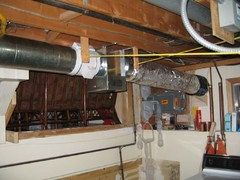
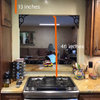
    Here is a photo provided by cooksnsews of what I recall to be a coil type heater MUA system. The system description appears toward the end in the 2012 thread linked below. I think electrical heating is much easier to implement in most circumstances, whereas hydronic heating (from an oil burner) will be more economical (lower marginal cost of each BTU of air heating). Both approaches deserve analysis because there are myriad factors that may determine which is more practical and affordable, long term. Note that the pictured system also has a blower (white object).

    http://ths.gardenweb.com/discussions/2266424/does-this-sound-right-re-mua


    Macswim thanked kaseki
  • 9 years ago

    P.S. Where the MUA can be dumped into a basement, it may be feasible to heat the immediate basement air with a blower-driven hydronic heating module, such as the product line Grainger sells. This type of configuration avoids the complication of entangled systems. The heater is controlled by the local air temperature; the MUA duct need only be screened for critters larger than some tolerable size. An MUA blower is only needed if the filtering is restrictive. And one gains a heated basement. The duct will need a damper, of course.

    Macswim thanked kaseki