Software
Houzz Logo Print
dvargo71

Tomato cage ideas?

Store bought ones do not last and are a pain. My plants get HUGE. Had cherry tomato plants 15' long and beefsteak tomato's over 8' high.

Any ideas/plans for a diy one to build? I figure I can build a better longer lasting one.

Comments (28)

  • 9 years ago

    great idea!

  • 9 years ago

    We also use concrete reinforcing wire.

  • 9 years ago

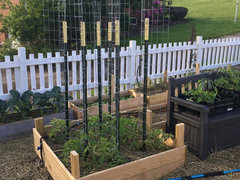
    I suggest bamboo. It is cheap,,,,often free and easy to lash together with inexpensive poly cord. Here is a pic of bamboo used for a container garden. The poly cord was recycled from the trash bin. It had originally held bales of hay together.

  • 9 years ago
    last modified: 9 years ago

    I built a few of those 'stake-a-cages' I saw on the internet this year. Metal 6 ft T post with galvanized welded wire fencing attached with zip ties. The fencing is 5 ft tall and I cut them at about 20 inches wide and let the natural curl of the fence form a semi circle around each plant.

    The cool thing about this setup is you can attach fencing higher up on the T-post so you can get support up to 6, 7, 8 feet if you'd like. I trim all the lower growth on the tomatoes anyway so don't need the cage at the ground anyway.

    I figure each one costs me about $5. ($3 per T-post, and a $50, 50 ft long roll of fencing can make around 25 trellises at $2 each).

    You could use CRW too.

  • 9 years ago
    last modified: 9 years ago

    If you have a bunch of those undersized store-bought wire ones, I've found that if you perch a medium sized one inverted on a large one (and secure it there with wire ties), you end up with a decent sized tomato cage. So while the other ideas are best if you're starting out with nothing, if you have a bunch of those store-bought wire cages, this might be a good way to go. I inherited a bunch of those store-bought cages, and I use them this way with some success.

  • 9 years ago

    Just remember, though, you want to be able to fit your hand through the wire.........which is also why I like the concrete reinforcing wire.

  • 9 years ago

    I gave up using the store bought ones years ago. They are too wimpy (bend under the weight) and way too short. I did find a company that was making really hefty cages at a trade show this past winter and they were extremely well built and 6'-8' tall? They came in different sizes. The only issue was sold by the pallet so way too expensive for me. I wish the local stores around me carried this produce from whatever manufacturer was exhibiting at that show as shipping charges were just too high for me to buy direct.

    Until then, I can build a better cage than the store bought versions. Most of the gardeners near me use those short 3 ringed cages that really are only fit for using on peonies although they call them tomato cages. The tomatoes easily get taller than that and then flop over as no support. Odd that anyone still would buy them (or even sell them).

  • 9 years ago

    Have you read through all the discussions of this question over on the Growing Tomatoes forum here? Many of them and most including photos. CRW cages are by far the most popular.

    Dave

  • 9 years ago

    I built CRW ones, they are inexpensive and sturdy, I leave them in place during the winter and they are still going strong and will work for many more years.

  • 9 years ago

    The store-bought tomato cages are good for peppers and eggplants - not much else. I do CRW, and one roll of the wire makes more than enough cages than I could ever want to maintain.

  • 9 years ago

    I use cwm cages, but have also considered building a few permanent cages. Check out a You Tube channel called "Hollis and Nancy's Homestead" for his videos on constructing and growing tomatoes in permanent cages made with 2 X4s.

  • 9 years ago

    There is a financial pivot point where one has so much $ involved in cages that a greenhouse frame may be the cheaper long term solution.

  • 9 years ago

    I like Kevin's semi-circular supports, although, with those poles and that square garden, I wonder if a simpler method would be to place the poles in the corners and use string to keep everything contained....


    Linda

  • 9 years ago
    last modified: 9 years ago

    I looked into building my own and cost and the inability to easily store them for winter led me to just buy the Texas Tomato cages. I love them and am so happy I found them.

    http://tomatocage.com/

  • 9 years ago

    Making cages from CRW or fence material is neat and all... my only issue that I've encountered (because I'm building my own right now)... how on earth am I going to weed inside them? If I need to dig that weed out..

  • 9 years ago
    last modified: 9 years ago

    mystearica.... the CRW has 6" x 6" openings between the wires. It's quite easy to reach in. That said... there's where mulch comes in. There are many options for mulch. I use long grass that I allow to grow 1' - 3' tall then cut with a swing blade (like a scythe) or hedge shears. The mulch keeps the weeds at bay. My plants are now pushing 4' and I think I've had maybe 3 weeds in the 18' bed. You put the mulch down, and then the cages.

  • 9 years ago

    Does it keep at bay those weeds that have roots deeper than a foot? I'm looking for straw mulch in the area but they don't deliver to my town. Oh well.

  • 9 years ago
    last modified: 9 years ago

    I keep my beds mulched all year round. Depending on the crop, and the time of year, different mulches are used for varied purposes.

    All my beds are covered in thick heavy mulches through the winter. I may eventually rotate a winter cover crop, but I'm still building the garden, so too many irons just makes for problems.

    In the winter, the beds set aside for tomatoes were covered in a very thick layer of unshredded leaves. In the early spring, I raked the leaves back and turned, amended, and fertilized. I then re-covered the beds with the leaves. Just before transplanting, I removed the leaves, put on some compost and fertilizer, and quickly incorporated those amendments. I then put in the plants. Next, I took my hedge shears (large scissors) and cut a bunch of tall grass and weeds - the handle on my swing blade was broken, so I had to make use of the shears. I simply put the cut grass around the plants. I then put the cages on. The mulch and cages were put on as I found time, and before the plants grew too tall.

    Following this routine is easy as can be. There's no reason to have to hurry in any of the stages except collecting the leaves before the city vacuum truck beats me to them. Even then I just make a big pile and add them to the beds as time allows.

    In order for a weed to put down a 1' root, it would need a lot of time to become that established. A weed poking through mulch is easy to see, and never has time to set deep roots. Mulch and cages work very well together. If there is any problem with the combination, it's that you should put down a deep enough layer of mulch for your climate. Mulch decomposes faster in warmer, wetter regions of the country. If my homemade mulch decomposes before the season ends, it can be difficult to put down such long strands of hay through the cages. So... if it becomes necessary, instead of the hay, I just toss an inch or 2 of my homemade compost as mulch right over the hay.

    In short, planning ahead helps keep work to a minimum, and allows the grower to not rely on commercial outlets for garden resources.

  • 9 years ago

    Yeah I see what you're saying... the problem is... the place I live at - had ONLY weeds growing since 2000 - so that's 17 years of weeds (that I know of - could be longer). I started vegetable gardening last year only.... so these weeds are extremely established and I have to weed daily really. If it's not giant weeds, then it's tall grass, then it's herb-like looking weed that spreads like fire. Also... no real leafy trees here only pine... I guess I need to think of something for next year then.

    I THINK I may try Kevin's idea... that way I can get around the plant to destroy the weeds. It's a brilliant idea and you can make more "cages" out of it - I got his fencing material. I just want to know how tall are those T-Posts are? I'm assuming you placed 1 foot deep under the ground?

    I have 6 foot fencing. Also did you cut the bottom of the fencing wire to form "spikes" into the ground.

    Thanks!

  • 9 years ago
    last modified: 9 years ago

    Whatever cages/supports you decide upon, pine needles make GREAT mulch.

  • 9 years ago

    They are 6 ft. I bury them 1 or 1.5 ft in the ground, then set the cages about the same height above the surface, so I'll end up with around 6 feet of height to train the tomatos. This is my first year doing them but I have high hopes after putting them in the ground.

  • 9 years ago

    wow thanks!! Product start then! Hmmm the $3 posts - where do you purchase that from? Home depot has the 6 ft @$5.43/post (unless I buy 75 LOL). I have a lot of bamboo sticks... I wonder if I tie them up together they should be sturdy enough... but digging them into rock solid ground will be hell.

  • 9 years ago

    I got mine from lowes... they may have been some change above $3 but they definitely were not $5.43.

    Bamboo should work. I'm actually going to be building a few more with some regular timber, rip a 2x4 in half and then cut the end into a point. Won't last as long as the metal but I have lots of scrap wood.

  • 9 years ago
    last modified: 9 years ago

    I should add to my comment about using those store-bought wire cages, if you find yourself with some. Yes, they work OK stacked up on each other, as the individual ones are much too small, but you MUST brace them. Drive a steel stake into the ground next to each one and tie it up. Once the tomatoes get tall and heavy, they'll want to fall over.

    I forgot to anchor one and yesterday the whole 6-foot tall structure tipped over. Kabloop! I managed to lift it back up, and hammered in an anchor. The plants were fine. Their stems are wonderfully flexible.

    Oh yeah, the anchor was a 6 foot fence post I just got at Lowes for $4. They come with a step for pushing them into the ground. I had a bunch of these, but I needed one more.

  • 9 years ago

    I put down red plastic mulch with a few holes I add and leave about an 8" hole for base of plant. This cuts down on most weeds, lets some water in and reflects best light for tomatoes. Put in before cages. Works great, still some weeds but far less and when plant is large very few weeds (not enough light).

  • 9 years ago

    @ Don - what did you end up going with as far as supports? I'm always interested in seeing what other people come up with DIY.

  • 9 years ago

    I bought some concrete mesh but have not used yet, that said I am positive it will work best, last and be the best bet. I take old pole supports from old cages and use smaller pieces crossing between areas to hold up more stuff, easy to place where needed.