Software
Houzz Logo Print
albert_135

How does hydrogen peroxide act as a fertilizer?

Hydrogen Peroxide For Plants – How To Use Hydrogen Peroxide In The Garden - Not only is this an environmentally friendly alternative to pesticides, but it has the added benefit of being anti-fungal and acts as a fertilizer.

Comments (22)

  • 9 years ago

    Most of the web sites that promote the use of Hydrogen Peroxide in the garden simply say it is good for plants without too much detail. H2O2 probably will control, if not kill, various fungi, both beneficial and disease causing, but other than very general statements about it being an insecticide I find no list of insects it might control. Some sites will talk about H2O2 increasing oxygen uptake by plants but plants take in CO2 and release oxygen, plants need CO2 to make the nutrients they need to grow.

    H2O2 may well be a cure looking for a problem to solve.

  • 9 years ago

    Hydrogen Peroxide is not a fertilizer because it does not supply macro-nutrients like nitrogen (N), phosphorus (P) or potassium (K). It may have some positive role for plants, but providing nutrients is not one of them.

    Also I don't know why you would put a general anit-fungal product in the soil when plant roots require fungus to transfer nutrients to the roots.

  • 9 years ago

    Also I think it is much more anti-bacterial than anti-fungal. We mushroom growers soak sawdust in diluted water peroxide because fungi are much more resistant to it. So maybe its role is to provide oxygen in compacted soils, and help restore a better fungi/bacteria ratio?

  • 9 years ago

    Liquid oxygen. Damn. Now I gotta look into it, and I had my week all planned out ;)

  • 9 years ago
    last modified: 9 years ago

    The linked article says: "To prevent pest infestation and for general fertilizing, spray the veggie garden after every rainfall or as needed. Not only is this an environmentally friendly alternative to pesticides, but it has the added benefit of being anti-fungal and acts as a fertilizer. "

    As Tom and Ray Magliozzi used to say on NPR's Car Talk, "Bo-o-o-o-gus!"

    I mean they admitted in the previous paragraph that it has 'the same atoms as water, H and O'. Where is fertilizer in that formula? Ugh.

    I sent them a message suggesting that the fertilizer statement be removed.

  • 9 years ago

    Man, you bring up even more worthy points of research. This is gonna be tiresome. But the probabilty of effectiveness seems lower by your post. Nothing like working against some garden problem and losing on bad info though..it teaches you about next year.

  • 9 years ago

    My garden already has plenty of atoms in it.

  • 9 years ago

    But wait, these atoms are special! Why? Because they're recommended in a blog, and they cost extra money!

  • 9 years ago

    Yeah, I'm not buying it. You know what they say, you should never trust an atom - they make up everything.

  • 9 years ago

    Oh lawd. That was good. I guess every dipole has its moment.

  • 9 years ago
    last modified: 9 years ago

    I got an email from gardeningknowhow.wrong with two messages (1) they are not going to correct it and (2) it is not in error.

    [I vaguely recall, on one other occasion, when I found what was believed to be an error on the internet.]

  • 9 years ago
    last modified: 9 years ago

    Good for Tomatoes? I imagine the PH is the antifungal part. They dont much like acidic environments as I understand.

  • 9 years ago

    to the contrary, high fungi tend to decrease pH, high bacteria tend to increase pH.

  • 9 years ago
    last modified: 9 years ago

    100% hydrogen peroxide is rocket fuel. 22% was used in the clinical lab for something and it will oxidize a hole in human skin. [Ask me how I know.] Walmart doesn't even sell 5% does it?

  • 9 years ago

    That's 35% and I used it in the lab. A splash would give you a whitish spot on your skin - instantly oxidized.

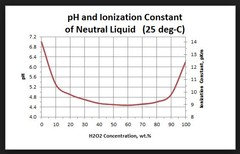
    As for its effect on pH, I doubt it has much if any effect on pH, especially when added to soil, since the amount added is so small. I'm not clear on what that graph is actually showing, but if it actually shows the pH of H2O2 vs. concentration, even if you're using 3% straight out of the bottle, that's about pH 6.5. Would it have any effect on anything being almost neutral? Peroxide kills cells by oxidizing organic material, chews it up just like bleach does. I think that is where the action is rather than pH.

  • 9 years ago

    As for the gardeningdon'tknowhow folks, I don't know whether to laugh or cry.

  • 9 years ago
    last modified: 9 years ago

    One utility shows gardenweb as having many more visitors than gardeningknowhow.NOT but they have larger Alexa rank, whatever the sam hill that means.


    ETA 28JUN17; apparently an larger Alexa rank is expected with a higher visitor count.

  • 9 years ago

    I find that gardeningknowhow.com comes up quite high in the list of Google results whenever I'm googling garden related subjects. They must have figured out some ways to game the Google algorithms just right. It keeps happening even though I learned pretty fast that it wasn't usually worth clicking on. I always thought it was kind of a dopey site but it's worse to learn that they are being wilfully ignorant when an error is pointed out to them.

  • 9 years ago

    I'd go argue with them for the fun of it but I'm getting a vibe that it wouldn't make any difference.

    "Alexa Internet, Inc. is a California-based company that provides commercial web traffic data and analytics. It is a wholly owned subsidiary of Amazon.com. Founded as an independent company in 1996, Alexa was acquired by Amazon in 1999."

  • 5 years ago

    @toxcrusadr actually plants only absorb co2 during the day, at night they actually absorb oxygen. Oxygen also helps plants to more efficiently photosynthesize. Peroxide might not be a fertilizer, but it helps plants to absorb macro/micro nutrients better.

  • 5 years ago

    I'd thought they absorb that through leaves?


    Root oxygenation is important--but only for root growth. Roots won't grow in oxygen-deprived soils, so some H2O2 might temporarily help, but... Well, if you're down to that point, simply aerating the soil in the pot would be far more effective. Or replacing the soil if it'sthat badly compacted. Establishment of a fungal network, if possible, might also help.

    That can be somewhat more challenging in a pot environment, but it can be done. People do regularly claim it can't but...been there, done that, observed it under a microscope.


    Outdoors, this should not be an issue except in a bog environment or a garden that's overtilled.