Software
Houzz Logo Print
bsmith0023

Need recomendation to fill in back fence area

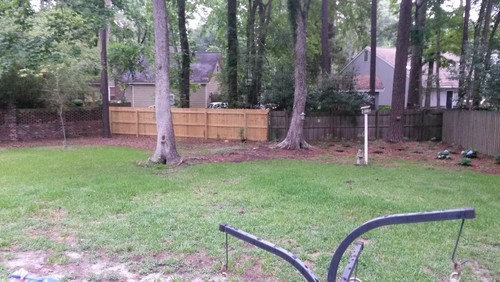
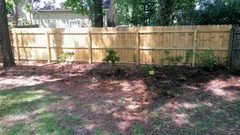
I have included an older picture, it looks rough but it is in the works. On the right side against the older looking fence i have planted all purple formosa azaleas for spring bloom. They were planted this spring and I haven't mulched much so I know it looks like weeds right now. I also have blue mophead hydrangeas on farthest right side in front of the azaleas for summer bloom. On the left is the brick wall which I somewhat like and don't mind leaving bare.

I am looking for help on filing in the area along the new fence. You can tell it's the part thats actually looks ok. The entire fence line is very spot shady. Mainly shade morning , mix sun during the day and some afternoon light but not much for long.

I am looking for evergreens that I can use for the back length of the new fence, something that will bloom or show some color at times, the colors just need to coordinate with existing plants if blooming during the same time. I have azaleas and hydrangeas so I am covered in late march / april and then again late may through july.

I am coastal SC, zone 8 with sandy soil. I want something possibly very early bloom, something to bloom in may while I have a current gap and maybe something in fall too.

I had considered a Forsythia because it blooms before my azaleas here and maybe fall blooming Camelias but that's as far as I got. I am open to many different design, maybe one species all along with two different species on either end. Maybe once big area in the corner and another going the length of the fence and a third at the end.

I would normally be more simple and pick one species and be done but I would like to branch out a little and consider two or three of these bloom periods. I just need help with the design of the area and the options of species of plants to consider. Being more shade area I struggle getting the size I want and the ability of blooming.

Thank you all in advance!


Comments (53)

  • 9 years ago

    Also, Camellia japonica or sasanqua might work, provided there is enough shade. They do grow slowly though. But the blooms should be amazing.

  • PRO
    9 years ago

    Hey Bsmith0023, I like the shrubs you have
    planted, it will look beautiful in a few years’ time!

    I did some research and found a couple of
    options for the new section of back fence. All these shrubs are native
    (indigenous) to SC so they will attract butterflies and other beneficial insects.

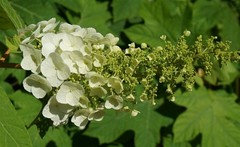
    Oakleaf
    Hydrangea
    , Hydrangea querifolia: 8’ tall,
    part-shade, white flowers in summer and gorgeous fall color. Deciduous.
    (picture below)

    Virginia
    Sweetspire
    , Itea virginia: 6’ tall with white
    flowers in late spring/early summer. Deciduous (sorry couldn’t find a picture
    of this one)

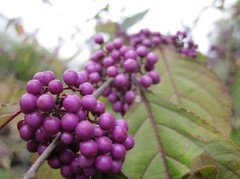
    Beauty
    Berry
    , Callicarpa Americana. 8’ tall with bright
    purple berries in late summer. Deciduous (picture below)

    Eastern
    Red Cedar
    , juniperus vigininiana. Evergreen tree,
    grows to 20’. Evergreen (picture below)

    And as an evergreen ground cover, consider
    this native fern, Christmas Fern, Polystichum acrostichoides. It tolerates dry
    shade under trees. More info here, SC Native Plant Society (sorry couldn’t find a picture)

    I suggest you install lawn edging between
    your lawn and the shrub bed, it prevents lawn grass growing into the bed and it
    keeps soil and mulch in place. Anything that cuts down on garden chores is a
    good thing!

  • 9 years ago
    last modified: 9 years ago

    But Dreamscape, all your suggestions are deciduous except for Juniper and it's likely not sunny enough for Juniper, besides it's very common and just not a refined small tree for a backyard.

  • 9 years ago

    How about some Rose of Sharon? They bloom later (mid July - late summer) here. They do get large though.

  • 9 years ago

    I like stir fry's suggestion. 4-gallon ROS are on sale at my local walmart.

  • 9 years ago

    Rose of Sharon under trees? I think not. And its deciduous.

  • 9 years ago
    last modified: 9 years ago

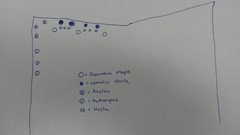
    Ok I think I have my plan ! Now for the critiquing.. You will see azaleas and hydrangeas on my plan, these are the same species as what is on the right side of my yard.. ES Original Hydrangeas and Formosa purple azaleas. My picture has no scale, but you get the idea. *edit* the camellias would be some dwarf japonica type that only get 4ft or so. I haven't chosen any specific variation except the hydrangeas and azaleas.

    Would you add anything, take out, change species of something ? I tried to kee psome symmetry between the right and left side and trying to keep some interest in 3 seasons.

    thanks for all the help so far by the way, this has helped me learn a lot.

  • 9 years ago

    My neighbor has a rose of sharon on our driveway border that is in "part sun" but probably only gets 3 hours at most, as it's under some sweet gum trees. I think it looks nice, but yes it is deciduous. I'll take a photo of it when I get home and share.

  • 9 years ago
    last modified: 9 years ago

    bsmith - looking good. Looks like your intent is for a more formal look, so I think this design works well. However, make sure dwarf really is dwarf when you get your plants. You have the concept of layering pretty down (trees, shrubs, low ground -- maybe just add a groundcover and you're good to go!)

    If you're trying to block headlights, the JMs won't help as much, because they tend to be less dense in the shade an they'll lose their leaves in the winter, when the shorter days means the headlights will be earlier in the day.

    If you want a look that's a little less formal, think less in terms of straight lines and more in terms of broader swaths/curves (slow arching lines, or slightly staggered plantings.)

    If you only plant japonicas and not sasanquas, you are missing a potentially fall-flowering plant. (You'll have the fall colors of JM and hydrangea however!) I'd go with the recommendations that others have said about Oakleaf Hydrangea.

    I would actually plant a serviceberry tree in the middle/back of the hydrangeas, or, maybe a seviceberry in the middle and two JMs on either side (where you currently have your three JMs marked). However, these won't help for blocking headlights either.

    You may want to think about a spreading groundcover for around the JMs and in front of the hostas -- I find that bugleweed grows quickly and thoroughly and doesn't seem to mind the JM roots near my JM. And they bloom purple in the spring. A lot of people hate bugleweed however.

    Oh, one other thing -- you could intersperse some daffodil bulbs with your hostas, that way, when the daffodils are done blooming and their foliage is all withery, the hostas will sprout up and cover the daffodil foliage.

  • 9 years ago
    last modified: 9 years ago

    Oh yes, lenten roses would also work well around your hostas and JMs - they bloom in winter (starting in Januaryish or so) and also spread rather quickly:

    (the whitish pink ones in the photo, mid-ground)

    http://extension.msstate.edu/news/southern-gardening/2011/discover-lenten-rose-for-the-shade-garden

  • 9 years ago

    Bleeding hearts are fun plants too for spring and they love shade.

  • 9 years ago

    Blueberries for the birds.

  • 9 years ago

    Ryan, ive never seen those Lenten roses in person but they look pretty neat, love the pic ! I will look into those.

    I was planning on the sasanquas for the back fence. I have japonica in the front yard so I was going to mix it up.

  • 9 years ago


    Oh I just read the post above saying Japanese Maples may get less dense in more shade, AND they're not evergreen!? That may be a stopper. I think I need evergreen.

    At this point i just need a good lush evergreen that gets 8-10ft, something I can prune so that I can have maybe 5ft of bare tree before getting to the beginning of the leaf area. That way I can have my under shrubs and ground cover not touching. If it has any type of bloom, berry or color changing leaves that would be a plus but not a deal breaker.

    Dave, I'm going to go back and look at your recommendations but are there any of your choices better to be pruned like I want ? I really like the wax myrtle a lot so far. I just normally see them in full sun and this is a shaded morning and mixed afternoon sun with only an hour of direct light. Is there any variety of it that would work for me?

  • 9 years ago

    Camellia japonica

  • 9 years ago

    I've got camellias going in another spot close by with less sun.


    Does the Wax Myrtle have to be in full sun or can it be in partial shade ?

  • 9 years ago

    Wax myrtle will take the shade just fine.

  • 9 years ago

    Whst about ligustrum, how's that in partial shsde. It was recomended to me by a friend

  • 9 years ago

    Wax Myrtle is native and would be preferred over the ligustrum.


  • 9 years ago
    last modified: 9 years ago

    Another vote for wax myrtle, plant several of them in fact, great aromatic foliage.

  • 9 years ago
    last modified: 9 years ago

    What is spacing like in between them ? I would prune them to tree form

  • 9 years ago

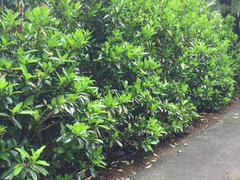
    Just to throw in some other ideas - you might consider Aucuba japonica. It is a wonder southern evergreen. Although there is no flower, there are variegated varieties that add a great deal of light in a shaded setting. All green varieties are also available. Some aucubas get as large as 8-10 ft (although they are very easy to prune and keep lower) and many varieties that are in the 3-4 ft. range.

    There are 2 Camellia japonica varieties that I strongly recommend. C. sasanqua 'Setsugekku' is a large shrub/small tree with single white flowers. C. sasanqua 'Shishigashira' is a slow-growing, spreading form with deep pink, double flowers. It stayed around 2 1/2 ft for me in Raleigh. You might get more height on the SC coast. (We're in Colorado now, but I gardened in Raleigh for almost 30 years.)

    Unless you have already purchased and planted the Endless Summer hydrangeas, you might want to reconsider. They have been 'endless disappointment' for many people. Not sure about the coast, however.

    Drift roses create a very nice edging. They come in a number of colors and bloom 7-8 months or more. Cut them back to about 4" in February/March and they will maintain a really nice shape.

    I've included a picture to give you an idea of the impact of variegated aucubas. Just an aside - I would strongly recommend that you deepen the bed to include the innermost tree. You have a very pretty area back there!

    bsmith0023 (z8b coastal SC) thanked marshaaa (5b CO, Castle Rock)
  • 9 years ago

    Ligustrum is horribly invasive and has overly-sweet smelling flowers that sicken most people. Educate your friend. Ligustrum is only fit for containers. Plant the wax myrtle.

  • 9 years ago

    While I never found Ligustrum to be invasive in the least, there are much better shrubs to consider. Wax myrtle tends to sucker, even when pruned into tree form, especially if anything is planted around them. They can also get out of hand very quickly. You will have fewer headaches if you keep the evergreens next to the fence fairly maintenance-free. Then you can focus on the pretty things in front of them!

  • 9 years ago

    "While I never found Ligustrum to be invasive in the least,"

    https://www.invasiveplantatlas.org/subject.html?sub=3035

  • 9 years ago
    last modified: 9 years ago

    "Ligustrum is horribly invasive and has overly-sweet smelling flowers
    that sicken most people. Educate your friend. Ligustrum is only fit for
    containers. Plant the wax myrtle."

    Such hatred. Did a ligustrum kill your puppy? I had inflexible opinions when I was young, too. I learned better.

    They are fine plants in the right place and smell great to me.

  • 9 years ago
    last modified: 9 years ago

    marshaaaa - thank you for your recommendations. I just got a chance to read over it all. I will look into the Aucuba, if its evergreen then that's great. I have already planted the endless summers and the formosas on the back right though, but I love the drawing and now you got me thinking about that middle area ! haha I love the idea of roses, ive never heard of drift roses but I will definitely look into those too!

    I think I am pretty set on the Wax Myrtle, it seems to be ok for the area, smell good and I read that birds like the fruit and helps the wildlife a little. How far apart should I plant the wax myrtle's though ?

  • 9 years ago

    That all depends on what you want out of the wax myrtle. Do you want a row of small, multi-trunk trees, a row of informal shrubs, or a sheared hedge? Drift roses are small, mounding roses that grow along the ground. Roses are not shade plants.

  • 9 years ago

    Yes, roses are not shade plants/ However, it appears that there would be sun along the outside edge of the bed, which is where the drift roses would be planted.

  • 9 years ago
    last modified: 9 years ago

    The wax myrtle I will prune to be tree like. Eventually prune it so it is all trunk until it gets to about 5-6ft and then let it grow the leaves.

    As far as the roses, yes I should have some area for them, I will have to plan it out right. I haven't looked into them yet, but I do like them a lot.

  • 9 years ago

    I have total 26ft of room, just measured. I can get one formosa azalea and two trees for sure, but can I get three trees in a row?

  • 9 years ago

    Last option and i am done.. Wax Myrtle or Tea Olive for being more shade tolerant ??

  • 9 years ago

    Wax myrtle is very shade tolerant. I wouldn't worry about tea olive........ you're just straying from the path.

  • 9 years ago

    Haha ok fine, I'm done. How far apart for spacing in tree form though? 6-8ft enough ?

  • 9 years ago

    I would go about 6 feet because you want it to be dense at the top

  • 9 years ago

    Ok, that should give me enough room for my Oakleafs in between right?

  • 9 years ago
    last modified: 9 years ago

    Aucubas can probably get 6 to 9 feet high over time in the south (more with great age), given good watering. I would probably put in two Chindo viburnums where you want the most height, and then fill in with Aucubas in between. Add a few camellias for color. Wax myrtle will not be naturally dense in deep shade without regular pruning I don't think. If you want a 'set-it-and-forget-it' planting, Chindos and Aucubas would be it.

    Harder to find, but Daphniphyllum or Trochodendron would do well in part shade as well. Both are spreading small trees that probably won't get much over 14 feet unless extremely old.

  • 9 years ago

    "Ok, that should give me enough room for my Oakleafs in between right?"

    Those are just two plants, that in my opinion, don't go together. I'm guessing you mean oakleaf hydrangea, right? If I wanted a hydrangea there, I would go with 'Annabelle'. You could also underplant with purple-leaved loropetalums, they thrive in the shade.

  • 9 years ago
    last modified: 9 years ago

    Dave, Are you saying the Chindo Viburnum is more shade tolerant ? Or why do you recommend it more ?

    Logan, Are you suggesting the Annabelle AND loropetalums ? Or just one of the two ? I chose Oakleaf because the area has a lot more shade and I don't think an Annabelle will get enough sun.

    If you look at my picture above, i measured out the clean looking new fence line and I have 26 feet long before it hits the older fence area. So i probably only need 2 trees on that new fence line.

    I would like to start from left to right with one formosa, then tree, then two oakleaf, then tree, then a couple new shrubs of some sort.. I hoping to tie the Formosa area I have on the right side of the yard into the left side as well, just only two plants on the left side. is that weird or think it will look ok ?

  • 9 years ago

    "Logan, Are you suggesting the Annabelle AND loropetalums ? Or just one of the two ? I chose Oakleaf because the area has a lot more shade and I don't think an Annabelle will get enough sun."

    The only place I see nice hydrangeas is in the shade. You could choose only one, or you could alternate between the two. Loropetalum will provide winter interest with purple leaves, and brightly colored, fragrant flowers in the spring. Hydrangea ('Annabelle') will provide summer interest with it's large flowers. Wax myrtle will provide fall/winter interest as well with its berries and evergreen foliage. I would only put one shrub between each tree (both of my suggestions can get big, cluttering won't look good in this space) but I would move them out a bit farther than the wax myrtles so they don't grow together. The loropetalums can be tip- pruned or lightly sheared annually after bloom. Once they grow to be too big, they take well to hard pruning every so many years to produce flowers and good foliage color. Hydrangeas do not really take well to pruning, but they can be tip-pruned in early spring before they leaf out to encourage them to grow a bit more evenly. Wax myrtle can be "topped" crepe murder style to make it dense, and formal (if that's your thing), but takes better to light tip-pruning. It can also be sheared, if you desire. I would just ignore Dave. He always suggests chindo viburnum to people who ask for screening plant suggestions. Viburnums are not screening plants (mostly because the flowers smell like dirty socks).


  • 9 years ago
    last modified: 9 years ago

    '...Are you saying the Chindo Viburnum is more shade tolerant ? Or why do you recommend it more ?....'

    Yes, I'm saying Chindo Viburnum is shade tolerant and should be more dense (and more upright) than Wax myrtle in a shady location, with a minimum of maintenance. Since you want these plants to create an evergreen screen year-round, I would think you'd want something as dense as it can be. Chindo also has very polished, leathery leaves.

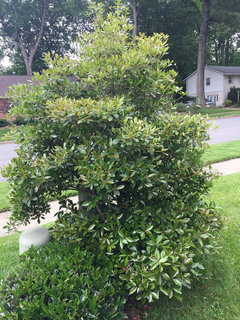
    These Chindos below are growing in a fairly shady area and create a fairly dense screen. These are only about 10 ft high -- they would grow faster in the south than up here.

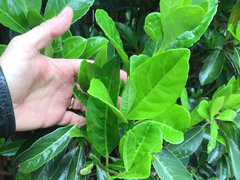
    Closeup of glossy foliage:

    Another great choice would be Ternstroemia. It also likes a bit of shade. Refined glossy foliage. Doesn't grow quite as quickly as Chindo though.

  • 9 years ago
    last modified: 9 years ago

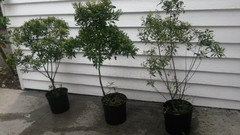
    Well I went with the Wax Myrtles. Others in my area said they work well with my light and i hear birds like the berries a lot so here we go ! first things getting planted..

    Now how do I know if it's a female or male ? I heard only female plants have berries?

  • 9 years ago

    You'll know when, or if, it gets berries. Only 3?

  • 9 years ago

    Haha I guess so. Yea I've only got 25 ft to work with and when I placed these out there they seem to cover what I want eventually. I also need some spacing in between the trees for bigger shrubs, so they had to be 6ft apart. That gives me two outside shrubs and two iterior shrubs

  • 9 years ago

    I would go with 4, but I suppose 3 would work. It'll just be less dense.

    bsmith0023 (z8b coastal SC) thanked Logan L Johnson
  • 9 years ago

    I am adding the oakleaf hydrangea in between the trees, you think I should have the trees closer to the back fence and the hydrangeas in front of thr trees, or hydrangeas closer to fence and trees in front ?

  • 9 years ago

    The hydrangea should be behind the trees. Although, I don't like the oakleaf. I don't think that mixes with wax myrtle.

  • 9 years ago
    last modified: 9 years ago

    Flowing bed shape shown calls for informal drifts of shrubs etc. and not rows, triangles or other geometric arranging. Bases of trees should be furnished ("faced down") with evergreen shrubs. And to produce a generally filled and substantial appearance majority of planting should consist of evergreen shrubs, with a comparatively small percentage of deciduous kinds used for contrast and added interest. An exception would be if the planting is to feature herbaceous plants, in which case those should occupy half or more of the bed space, with deciduous shrubs used to form a visual transition element between the herbaceous plants and the evergreen shrubs. And the "flowers" should be concentrated behind where the lawn extends into the bed, and not vice versa. With evergreen shrubs being planted instead where the lawn retreats and the bed comes forward, into the grass.

    Climbing shrubs on the fence behind and maybe the long bare tree trunks as well would also be desirable.

  • 9 years ago

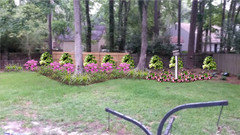
    Ok here it is, trees are in. First one is 9 ft from the left pine tree. Then 6.5ft spacing between them. The sun comes from the left and runs along the back this time a day making it spotty and hard for a good picture.

    I haven't had a chance to read the posts above, sorry I have to clean myself up.. too hot out today!

    Now I have to decide on the hydrangeas for the center.