Software
Houzz Logo Print
hairmetal4ever

Drip irrigation setup

9 years ago

I’m trying to at least begin the design process for drip irrigation (probably starting next spring). I’ve calculated that, if I plant what I expect to, I’d need around 280 – 330 linear feet of drip tape or line all together.


Here is what I can’t seem to find a cut and dry answer to…

Say you have drip tape rated for 40 GPH per 100’. My soil drains/percolates well enough that I can use the higher-capacity tape.

I am on a well, and if I open my hose spigot full blast without a nozzle, I can fill a 5-gallon bucket in a bit under a minute. If the tape ran exactly as advertised, in one hour, at 300’ of tape, I’d use 120 gallons of water, or 2 GPM. So my well and pump are far more than capable of doing that.

The tapes are usually rated based on somewhere from 8-15 PSI.

How do I really know what my water output is? If I run 100’ vs 300’, will the tape put out more water, or is it somewhat “self-regulating”? I realize that any way you slice it, my well and pump are capable of putting out far more water than the drip system would let it put out, which is good, but I guess I’m just confused as to where to begin and how to know how much water I will really be putting out.


Is it as simple as setting the whole thing up, sitting a pan under one of the emitters, and seeing what happens?


Comments (16)

  • 9 years ago

    "Is it as simple as setting the whole thing up, sitting a pan under one of the emitters, and seeing what happens?"

    That can sure help you get a valid idea of the time needed to run to get the specific amount of water wanted.

    " If I run 100’ vs 300’, will the tape put out more water, or is it somewhat “self-regulating”?"

    The emitters are self regulating. They will only put out their gph set amount. Using a lower pressure regulator just means it takes them longer to put out that same amount. IOW and 8 PSI pressure regulator takes a little longer time to deliver 1 gph than a 10 PSI regulator.

    You can't really compare your well PSI to the hose as you will be reducing the well PSI even further with the hose and then the hose pressure regulator. You'd need to know the well's exact PSI, then measure the PSI at the end of the hose and subtract that as it is affe4cted by both elevation and length of hose, and then measure the PSI coming out of the end of the hose with the pressure regulator attached to calculate it that way.

    But you don't need to. All that matters is the PSI coming out of the pressure regulator - 5-10-15 PSI. I prefer using 10 PSI as i have blown the tape once in awhile using 15 PSI.

    http://irrigation.wsu.edu/Content/Calculators/Residential/Garden-Hose-Flow.php

    Dave

  • 9 years ago
    last modified: 9 years ago

    I will be feeding the line with a 200' hose. How much does that long of a run affect pressure?

  • 9 years ago

    Also, I can't imagine 300' of tape would have the same pressure as 100' with the same regulator. That just doesn't make sense.

  • 9 years ago

    As you can tell from the calculator I linked above a 5/8" 200 foot hose on level ground will deliver approx. 20% of the origin PSI. You lose approx. 20% of your original pressure for every 50' and the amount of time needed to deliver the same amount of water increases proportionately. But that is calculated only to the end of the supply hose.

    As for the tape itself, if it begins with 10 PSI of course that PSI will continue to decline along the length just as the PSI of the supply hose declines but not at the same rate because of the emitters.

    It would be difficult to imagine anyone running a 300 foot long drip tape in the average home garden - commercial growers may have rows that long but they add booster pumps along the way. 50-60' max runs is the common recommendation for uniform delivery. Beyond that you'd have to compensate the plants at the far end in some fashion.

    I assume you understand that you can't water the entire garden - if it is of any size at all - all at one time with only 1 supply hose? Plus you wouldn't want to since different plants have different water needs anyway and you'd separate your crops and your tape accordingly.

    Dave

  • 9 years ago
    last modified: 9 years ago

    It's 300' total, not 300' all in a single row.

    My plan is to have a few "zones" for the reasons you stated. That said, too many zones, and I'd have to retire from my job to keep moving the damn hose around.

    My 200' of hose in my example is a pretty notable downward slope, FWIW.

  • 9 years ago

    I have found it is not really technical. I use Deere Ro-Drip tape. Max single run this year is about 100' and I have it double back so it's 200' total. That one is on a Sellinger 10psi reducer off of hose bib fed by 1 1/4" poly pipe. I also have multiple rows that run off 1 1/2" hose and I set pressure by turning a gate valve just until I get a good looking drip. I got my drip tape from local farmer who told me they look for 8psi at the end of the line for the tape I'm using. I've used long pieces ~500' for watering some trees and short lengths under 10'. I don't see a noticeable difference in the amount of water emitted from one end to the other - it seems to "self regulating". I do have a separate well for my irrigation (the old well that used to be for my house). 1 hp submersible pump hung on 1" poly pipe. I'm also on a gentle slope. The 1 1/4" supply runs uphill and then the tapes run downhill.

  • 9 years ago

    "It's 300' total, not 300' all in a single row."

    Ok, I misunderstood this post then. The pressure difference would only matter if you were going to run 300'.

    "Also, I can't imagine 300' of tape would have the same pressure as 100' with the same regulator. That just doesn't make sense."

    ____________

    "off of hose bib fed by 1 1/4" poly pipe. I also have multiple rows that run off 1 1/2" hose and I set pressure by turning a gate valve just until I get a good looking drip. I got my drip tape from local farmer who told me they look for 8psi at the end of the line for the tape I'm using. I've used long pieces ~500' for watering some trees"

    Yeah with feeder pipe and hoses that big you can get away with much longer runs of tape and still get good pressure. But those diameters are 2x the normal size of supply lines and hoses.

    Dave


  • 9 years ago

    It's doubtful I'll have any single run longer than 25' FWIW.

  • 9 years ago

    i've run 400' of drip tape simultaneously on a 10lb regulator fed by a well through 200' of 1/2" hose with no problem.

  • 9 years ago

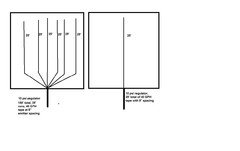
    So this is what I’m still unsure about. This is a VERY crude diagram, I know, and I realize that this isn’t exactly how it’s done, but the idea is, I could either have a single drip tape, or multiple tapes connected to the same “distribution tubing” (I’m still learning the terminology) a little bit like this diagram.


    In the scenario on the left, would each emitter put out the same amount of water as the emitters would in the situation on the right?

  • 9 years ago

    Yes, because you are maintaining a constant pressure. Think of it like you would for electric output: if you have 10 same wattage lightbulbs in a house the lights each put out the same light provided the amperage is adequate. For water the flow rate is similar to amps and pressure is the voltage. Total water use is like the wattage. In the left photo you are using a lot more water overall.

    I would do as Happy Hill Farm noted and use the standard 1 1/4" header line. You can then easily tap into it with control valves that adapt to each dripline. They cost about $2 each and will last many years. At the opposite end of each row just tie the dripline to a short stake leaving 8" beyond the knot. Then fold the driptape in half horizontally and then twice onto itself before sliding a cut 4" piece of driptape over the folded driptape.

    I run 220' lines frequently. The one problem with any slope in the line is that when you turn the water off the water in the driptape continues to flow downhill due to gravity and therefore the lower end always gets a little more water.

  • 9 years ago

    Can you use a 1 1/4" header line when your supply is only standard 1/2" or 5/8" hose on a 1/2" spigot?

    Keep in mind my garden is 200 feet from the spigot on the house.

    I also assume that even if you maintain constant pressure, you still cannot exceed the max output that the water supply is capable of, no matter what. Nor do I want to, because I don't want to drain down my well.

  • 9 years ago

    Are you drip tape users covering the tape lines with black plastic?

    If so, that is a lot of expense and trouble it seems to me unless you do it commercially.


  • 9 years ago

    Yes,& yes Wayne. I grow for farmers' market sales. I figure I paid for this year's driptape in the first 10 minutes in yesterday's market tomato sales.

  • 9 years ago

    Mine are covered with all the hay mulch I lay down rather than black plastic.

    hairmetal - have you considered spitting (your diagram on the left above) into 3 separate zones of 2 lines each? Better for the crops and for your limited well.

    Dave

Sponsored
Haus Studio
Average rating: 4.8 out of 5 stars28 Reviews
Franklin County's Preferred Custom Cabinetry & Design Studio