

Mulch
Last year, I made an awful mistake with Mulch.
I'm not even certain what kind I bought, but it "leaked" dye everywhere. The bottom of my silvermound was dyed brown. If that wasn't enough, within 3 weeks I had a glorious garden of mushrooms.
What kind of Mulch do you use?
I don't believe what I experienced was normal for mulch...but I currently have nothing in there. I spent a long time during fall painstakingly removing it all.
I'd like to put mulch in both large beds next week, as the rain is absolutely making a mucky mess of everything.
Any suggestions would be so greatly appreciated :)
Comments (63)
Gillian (zone 5b/6a) Ontario, Canada
Original Author9 years agoThank you for the recommendations :)
Because I'm out "in the boonies" (about 40mins or so away from any cities) there are few options for delivery. I've called two places, and both deliver only locally. I'll check the garden centers in the morning.
However, the garden centers here do sell dyed mulches. But one carries a pine "mixture" ...I'll see what it is tomorrow.
Thanks again :)
 9 years ago
If you have a truck or a SUV for towing, you can get a small utility trailer very cheap. I got mine used from a backstreet sale for $100. It's a 4x8, it can carry 1.5 yard each load. Last fall I got 6 loads, $25 per load.
Gillian (zone 5b/6a) Ontario, Canada thanked summersrhythm_z6aRelated Professionals
West Palm Beach Landscape Architects & Landscape Designers · Detroit Landscape Architects & Landscape Designers · Flint Landscape Contractors · Santa Rosa Landscape Contractors · Farmington Landscape Contractors · Rapid City Landscape Contractors · Carbondale Home Builders · Houma Home Builders · Westminster Home Builders · Omaha Home Builders · Akron Home Builders · Grand Junction Home Builders · Sterling Home Builders · Helena Home Builders · Everett Home BuildersGillian (zone 5b/6a) Ontario, Canada
Original Author9 years agoSummersrhythm, awesome idea! Thank you! :)
Samuel - Great video! Thank you very much for the link!
 9 years agolast modified: 9 years ago
Gillian,
There's a big difference between wood mulches (dyed, hardwood, cypress, etc.,..), and bark mulches.
Wood mulches decompose very quickly, be they softwood or hardwood mulches. In one year's time, for medium sized wood chunks...quicker for smaller chunks, your wood mulches are now decomposed into compost, which is good, being a soil builder, but it no longer functions as a mulch. It is now part of the soil.
Dyed mulches are frequently recycled commercial wood products, chopped up. Chopped up shipping pallets are often made into dyed mulch. Toxic attributes which the mulch may contain are not listed on the bags of dyed wood mulches.
Bark mulches, mostly southern yellow pine, occasionally fir or spruce, are the protective outer layer of evergreen trees. Cork, not usually used as mulch, is the bark of oak trees. Cork is an example of a bark that decomposes very, very slowly.
Slow decomposing bark mulch, such as the readily available pine bark mulches...available in a range of sizes, is ideal. It functions as a mulch much longer than wood mulches. It's initial cost is more expensive, but cheaper in the long run since it lasts considerably longer the wood mulch, and needs only periodic topping off to keep it at its optimal depth of 2-3".
Moses
Gillian (zone 5b/6a) Ontario, Canada thanked Moses, Pitt PA, cold W & warm/humid S z6 9 years ago
"Cheaper in the long run" may be only just an assumption. Wood chip mulches are often available for free from arborists, tree trimmers and utility right of way maintenance crews. Asplundh, a national organization, holds the contracts for DOT and utility company right of way maintenance for much of the country. If in your area (look for their bright orange trucks), they will happily dump a load of wood chips in your driveway if requested.
Here is a summation of the advantages wood chip mulches have over other forms of mulch:
"In areas where trees are a dominant
feature of the landscape, arborist wood
chips represent one of the best mulch
choices for trees and shrubs. A 1990
study evaluated the landscape mulch
potential of 15 organic materials,
including grass clippings, leaves,
composts, yard wastes, bark, and wood
chips. Wood chips were one of the
best performers in terms of moisture
retention, temperature moderation, weed
control, and sustainability. In many
urban areas, arborist wood chips are
available for free, representing one of the
most economically practical choices.
Unlike the uniform nature of
sawdust and bark mulches, wood chips
include bark, wood, and often leaves.
The chemical and physical diversity
of these materials resists the tendency
towards compaction seen in sawdust and
bark. Additionally, the materials vary
in their size and decomposition rate,
creating a more diverse environment that
is subsequently colonized by a diverse
soil biota. A biologically diverse soil
biota is more resistant to environmental
disturbance and will in turn support a
diverse and healthy plant population.
Wood chips are considered to be
slow decomposers, as their tissues are
rich in lignin, suberin, tannins, and other decomposition-resistant, natural
compounds. Thus, wood chips supply
nutrients slowly to the system; at the same
time they absorb significant amounts
of water that is slowly released to the
soil. It is not surprising that wood chips
have been cited as superior mulches for
enhanced plant productivity."This - from a science based, horticultural website - would seem to contradict most of the assertions made above.
Gillian (zone 5b/6a) Ontario, Canada thanked gardengal48 (PNW Z8/9)- 9 years agolast modified: 9 years ago
Gardengal,
Thank you for your input, but your quote on wood mulch is incorrect in so many places it would be pointless to address them in this post.
Gillian, the original poster is not located where delivery is available to her reasonably priced. Our responses would be most helpful with bearing this in mind.
My statements on mulch are derived from years of personal experience.
Municipal wood chips are rife with harmful pathogens and insects that upon being introduced into your garden can wreak havoc. That is why I would never recommend their use. I know people use wood chips as mulch. That is their prerogative.
Moses
- 9 years ago
When it comes to pine bark mulch I have seen it both shredded and in nuggets. I have had the nugget kind before but because of the size I wasn't happy with it in my perennial bed.
Is the shredded pine bark also durable, or will it's increased surface area cause it to break down relatively quickly like wood mulches?
Thanks!
- 9 years ago
"Thank you for your input, but your quote on wood mulch is incorrect in so many places it would be pointless to address them in this post."
LOL!! Incorrect?? Are you seriously questioning the research done by a PhD in Horticulture (with minors in biochemistry and botany)?? She is a professor of urban horticulture and was previously head of the entire state extension service and is widely published (and peer reviewed) on a whole host of horticultural issues Please, feel free to educate us with your supposed superior knowledge of these matters!!
Your personal experience aside, your assumptions - and yes, they are ONLY assumptions - of the supposed problems with wood chip mulches are NOT borne out by scientific study. The value of wood chips - even very fresh wood chips - as a superior type of mulch product is widely documented by any number of science based sources.
Don't imagine that you are the only one with "years of personal experience". Many of us have that and more, including the educational background as well as professional experience in urban horticulture. While we are all entitled to our own opinions, opinions never trump tested, documented scientific evidence and trying to impress us with just 'experience' as your only weapon, is sorry to say, pretty pathetic.
- 9 years agolast modified: 9 years ago
P TW,
All wood chip and bark mulches decompose eventually.
The smaller the size of the pine bark pieces the quicker they decompose. The shredded pine bark obviously decomposes the quickest. If you look carefully at the shredded pine bark it contains a lot of wood shreds also. I believe the shredded pine bark is the remnant of bark nearest the wood trunk, the final scrapings off of the trunks before they are sent to the buzz saw.
I find the shredded pine bark unattractive, and too quick to decompose to be a good value. They will decompose almost as quickly as the average Asplundh tree service wood chips. However they function very well as a mulch while they last.
The huge pine bark chunks, often 6" across, have lasted 6+ years in my garden. They are also not particularly appropriate, curb appeal wise, for rose or perennial beds, but if you like the look, they will work just fine.
I like the pine bark mulch that is about the size of domino pieces (the table game, not the pizza pie). They look nice and last about 3 years with yearly top offs to bring the mulch up to its 2-3" optimal depth.
Wherever you get your pine bark mulch, examine it carefully before you buy. Open a bag if you're at a big box store. Sometimes chips and chunks of wood make up quite a bit of the bag's content along with the pine bark. This is not quality pine bark mulch. Shop elsewhere.
Moses
 9 years ago
I'm hoping to use arborist wood chips from my own yard when I have to take a tree down that was struck by lightning. I gather the chips fade to a weathered gray over time. It is true this forum has a lot of real experts, Moses.
Gillian (zone 5b/6a) Ontario, Canada
Original Author9 years agoThank you very much Moses, that's incredibly helpful :)
I'll stick with the pine bark mulch, it's to be picked up tomorrow morning! Hopefully this dreadful heatwave will end soon, it's making everything droopy, including me! (Lol)
 9 years ago
Sheila, I did the same with an oak of mine and have been thrilled with the results. I've put on a REALLY thick layer to suppress weeds and it's had the added benefit of keeping the soil really moist without any watering, while seeming to protect my perennials from rotting. The only downside is the pile of chips in my yard! : )
Here's an action shot of the chipper to get the scale, a pic of the resulting pile and a recent shot of it half-finished. I'm using it much faster than anticipated and just wish I had more! I'd like to say it was free, but it cost a lot to take down those limbs. (This isn't even the entire tree.) They've become a really nice dark colour over these past months.
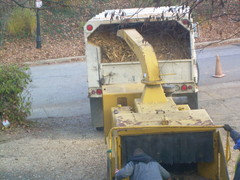
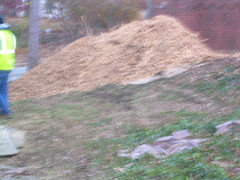 There's plenty of ways to do the same thing. I didn't even know there might be a "wrong" way to mulch.
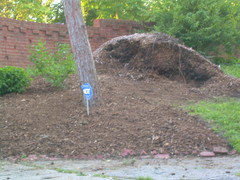 Gillian (zone 5b/6a) Ontario, Canada thanked Vaporvac Z6-OhioRiverValley
Gillian (zone 5b/6a) Ontario, Canada
Original Author9 years agoThat looks awesome Vaporvac! Love the action shots too! :)
 9 years ago
Just to add a little something against the quote below:
"Municipal wood chips are rife with harmful pathogens and insects that upon being introduced into your garden can wreak havoc. "
That may be the case if your garden contains trees of the same species which were chipped up. Most insect pests and disease organisms are rather specific. If you see a stand of mixed trees, you won't find the same diseases and pests affecting all of them. Additionally, most of those diseases and pests feed on live tissue. If you don't have those same species growing in your garden, they'll die off -- and if you garden by "feeding the soil", those critters will make short work of those starving organisms, and work on turning the mulch into soil improvement. And finally -- at least where I am -- spotting those municipal wood chippers means they're cutting trees in my neighborhood, or even on my street. If "harmful pathogens and insects" proving a danger to my garden were present in the wood chips, they were already close by before.
Of course, if you practice a lot of "better gardening through chemistry", your desire for mulch will probably be more about its mechanical function of covering the soil to keep it cool and moist. If that's the case, I can understand why you'd prefer long-lasting mulch. Personally, I prefer adding a fresh top-dressing every year, because it smothers anything lingering on top from last season. If you're spraying insecticides, fungicides, and using pre-emergent herbicides and synthetic fertilizer, the benefits of yearly mulch additions may not seem necessary. But I wonder if you're really saving money -- while I am mulching yearly, I'm also not buying all that other stuff.
I will say that in my neighborhood, fresh municipal wood chips and Autumn leaves do contain a very minor danger -- weed seeds. Every Spring I pull up baby Alianthus altissima by the hundreds. But they'd get blown in by the wind, anyway. They come out easily when I do the early pruning, and I get the last big chunk of them when I plant the annuals.
:-)
~ChristopherGillian (zone 5b/6a) Ontario, Canada thanked AquaEyes 7a NJ- 9 years ago
Ahh, this is a kind of painful subject for me.I tried wood chips, but found them impractical. They were very expensive. They are very heavy,so trying to mulch my huge garden with them took too long and was physically exhausting. Then I found that they do NOT last more than one season really! they decompose quickly; not as quickly as leaves, but they don't really last more than a year. You'd have to keep topping them off, and if I could afford this physically and financially and temporally,it would be one thing...but I can't! If you can get them free, if you have only a fairly small, flat area to keep, then I'd say they are fine,as long as you're willing to keep topping them up every year.
Gillian (zone 5b/6a) Ontario, Canada thanked User  9 years ago
This always seems to be a varying opinion topic. Before reading threads on the forum & hearing what people used in their gardens, I just assumed mulch was wood chip mulch. But now I see mulch can be many things to different gardeners. Anyways, I agree any mulch needs to be topped up annually or stretched to maybe 2 years. It can get costly & it's a pain when doing large areas. My first year I made a lot of new gardens. I ordered a truck load - 8 yards of black (dyed omg!) shedded mulch. Because I only had 3 options for mulch by the yard - red, brown & black. So I went with black because it's the prettiest in my opinion. I had no adverse effects of using 3-4 inches of dyed mulch in my yard on any of my plants. I do leave space between the base of plants and the mulch, maybe an inch or two. Now that things have filled in more; I buy bags here and there to top dress with. But this gets costly & I find I try & stretch it too thin to cover more area. So that is not really effective either. But to get loads of the mulch you have to pay for the delivery charge which here is $60 plus the cost per yard. It really does help retain moisture and keep weeds down. I did not do any real mulching this year and I regret it because the weeds are worse this year. I did top dress with pure compost this spring, but I should have ordered shredded mulch. By the way I have very sandy loamy soil & the layers of mulch have helped to improve the soil after just 2 seasons.
Gillian (zone 5b/6a) Ontario, Canada thanked HalloBlondie (zone5a) Ontario, Canada- 9 years ago
bart_2015,
You have discovered the same thing that I did: wood mulch (unless you can get free stuff from chipped trees) is expensive if you need a lot, and the amount of labour involved is a bit depressing.
So what I finally started doing this year is planting more groundcover to act as a living mulch. Saves money, time, and effort in the long run (I hope). Right now I am experimenting with a variety of groundcovers to see what works well. I am using Pachysandra (Japanese Spurge) in shadier areas, and in part-sun or sunny areas I am trying Campanula (Bellflower) and some creeping Veronica. I also use my old stand-by of Cranesbills in sun or shade areas. Those are tough plants!
I still need mulch but next year I should need about 10% less. If this works then as the groundcover fills in I hope to need less and less each year.
 9 years ago
It's not valuable enough to ship long distances, so mulch is going to be local material. "Pine straw" in the southern US, nut shells near nut growing areas, etc. Here we get ground composted Eucalyptus most of the time.
Part of the reason bagged stuff is more expensive is because it is usually from somewhere more distant (that and the cost of bagging). The dyed stuff is often shredded wooden pallets; that is an issue because some pallets from Asia were bringing in insect pests and causing problems with new alien pests. Or the pallets were used for toxic chemicals and the wood was soaked with the chemicals and is toxic as well. Imagine growing vegetables in soil mulched with that. Another good reason to avoid dyed mulch.
What works best is also climate-specific. For example, one poster said bark decomposed too swiftly; here it is the longest lasting material.
Then there is the size of the material. Larger chunks last longer, but the fine composted stuff has a more uniform look, and can be mixed into the soil when planting without having to rake away the mulch first.
Just some things to consider.
Gillian (zone 5b/6a) Ontario, Canada thanked hoovb zone 9 sunset 23- 9 years ago
PTW,I hope eventually to do as you are doing: create living mulch with groundcovers,but it's gonna take a while. In the mean time I'm using cut grass from a friend's field. It'll decompose fast,and doubtless is full of weed seeds, but it's light to carry,and quick to put down, and a lot less costly. For example, last Wednesday afternoon I got about 15 little trees mulched, while I was watering them-in a couple of hours it was done. Whereas before, with the chips, in the course of a YEAR, I only got four of them mulched! My garden is just too big,and these trees are at the foot of the sharp slope of my land...I just didn't get around to doing it! lugging the heavy chips down there,with all the other stuff I have to do...So I'm hoping to find someone who can sell me bales of straw or something,so in the future I can keep topping off my grass mulch. And simultaneously work on the living mulch, of course.
- 9 years agolast modified: 9 years ago
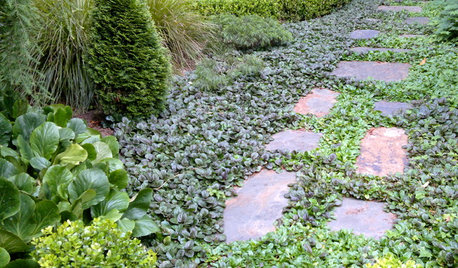
Ground-covers?!? I made a mistake.......it's out of control.
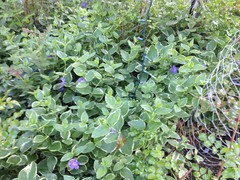
- 9 years ago
summersrythm_ I tried the ground cover method as well. Did not work. It looked super messy and crowded out my roses. I'm slowly pulling it all out except the ones that stayed in bounds. I'll stick to mulch.
- 9 years agolast modified: 9 years ago
I think having success with a living mulch in between roses is going to be difficult except in special cases.
May I suggest Sempervivum, Hens and Chicks, as a bordering groundcover.
Nutrient needs are minimal, so is watering. Root competition is minimal. They grow so slowly keeping them in bounds presents few problems. They can function as a living mulch. They are evergreen, too.
On the flip side, Sempervivum need full sun. Growing them in between roses could present problems, but what ground cover wouldn't. I am thinking the best use for Sempervivum is as a ground cover in a transitional area, like growing upon the soil between a rose bed and a walk or lawn where that area would otherwise be mulched with wood chips or bark pieces.
Sempervivums can be a refuge for slugs and pillbugs.
Now, creeping Sedums may grow too quickly to be easily managed as a living, bordering ground cover, and just one leaf broken off can make a new plant. They need full sun or grow scraggly. An established clump of sedum has a pretty dense root system and may interfere with the adjacent roses nutrient/water needs.
The supplemental watering we give our roses will make Sedum grow rampantly. Sempervivum, even at top growth speed, accidentally getting more water than they need through their proximity to the roses, is still slow.
Moses
 9 years ago
As PTW says, I don't typically use wood mulch because it's too expensive for all my roses. I agree that the best mulch is something that's locally available, since it's what your soil has adapted to. I love pine needles but there aren't that many pines in Nebraska, so I use good ol' deciduous tree leaves. They're EVERYWHERE here in the fall and totally free. In fact people in my neighborhood so kindly bag them up for the taking and I got enough to mulch my roses several times over for the year in one day last fall. I use the filled bags lying down at the edge of beds or stood up around the truly wimpy roses as winter protection, then pull them off to pile them in a back corner of the yard in spring.
I use them for the post-winter mulch and replace them several times during the summer with the leftovers. I think they don't rate as well on the reference that was posted earlier because they break down more quickly than wood mulch, but hey - we WANT the leaves to break down to add organic material to the soil. I've had some lasagna beds that were rock-hard clay muck that became lovely loose soil in the spring after laying down a thick layer of leaves in the fall. I think the light brown color of the leaves complements the rose bushes and flowers nicely, and if you have enough roses (well, one can never really have ENOUGH) the leaves stay in place without any particular help. At the edges of the beds, having some sturdy annuals or perennials helps as well to hold things in place. They stay put better if you shred them but I'm way too lazy for that unless they come preshredded in the bags.
Summers - yep, you have the dreaded perennial vinca. Lovely but it crowds out nearly anything else in the bed and is quite difficult to remove. I tried to plant some bulbs as a favor for a neighbor who had vinca throughout her front beds and I couldn't even get my super shovel with the teeth into the soil (much less a trowel) without standing and jumping on the thing. Sympathies on the situation.
Cynthia
- 9 years ago
Appreciate the comments,which do voice some of my concerns about the idea, but I still think it's definitely worth a try. At bottom, how does it differ from "companion planting"? True, vincas (I guess that's what's being shown in summers......'photos) are probably not a very good choice,since they root along the stems, etc. But campanulas don't seem to be excessively aggressive so far, nor does iberis. Ajuga took off well last year but seems to be daunted by the heat and drought of this summer. Planting creeping thyme in early spring of 2016 was a failure,but I want to try again, maybe planting it a bit later,since I'm beginning to think that-incredible as it may seem-some of these herb-type plants actually prefer the dry heat to get established (to confirm).
My plants- roses included- get no supplemental watering once established.
- 9 years ago
bart- part of the problem is that the extra fertilizer we give our roses makes many of the ground covers grow like they're on steroids and they will take over the garden. Plants that clump are different but anything that spreads by roots is going to cause a problem similar to weeds. You could interplant with plants like Astilbes if they will be sun tolerant where you live, with plants like short Veronicas, Daylilies or any plant that knows its boundaries. Even lamium which I love was removed since it became too invasive. Geraniums went crazy. I just think our rose bed soil is too nutrient rich to keep ground cover plants in check.
Sharon
 9 years ago
I use pine bark and pine wood chip mulch. It helps acidify my alkaline soil, protect stems from sunburn and conserve water during the 'dog' days of summer.
 9 years agolast modified: 9 years ago
My favorite mulch for my gardens is anything organic that I can get for a reasonable price. Last year I bought peanut hulls that came from a local peanut plant. This year I was lucky and am receiving free mulch from a company hired to clear the power lines.
Without mulch in sunny, hot Florida, the sun burns out the organics in the soil leaving either white beach sand or a horrible sticky grey gumbo clay. Last house had gumbo clay, this house has beach sand.
At work we use pine bark mulch for our clients, it is long lasting and just needs some "topping off" every year or so. The roses love it, and it has little effect on the soil ph. Pine bark, if applied too aggressively for many years, can raise the height of the planting. Beds can become higher than walkways, making a border of the beds a necessity to keep the walkways clean. We have a client that mulch raised the height of their beds higher than finished floor and thus causes flooding in the house.
Bart, I am also growing groundcovers to act as a living mulch. My favorite so far is a low growing heirloom strawberry. I have to pull it away from the base of the plants twice a year but that is nothing compared with replenishing mulch. I also am planning on trying oregano, here it grows as a tight, ground hugging plant. Most of my bed have annuals and perennial flowering plants planted among my roses.
.
- 9 years ago
Thank you Valrose for your encouraging comment. I know that some groundcovers can get a bit agressive, but ,sorry: pulling out extra plants just is not as hard work as is lugging mulch around, re-applying it yearly, etc. My soil is poor, and in the areas that I planted up before I'd learned about how to do decent soil improvement are going to need to be mulched for a while, I think, just to improve the soil,but my long-term aim is for a garden that is not going to need constant fussing. There's also the fact that most of my roses are climbers; plants that are very vigorous in their own right,and that just aren't going to be swamped easily. Actually the worst bullying I've seen is when annuals are grown too close to immature roses. Besides, there are groundcovers and groundcovers. perhaps I should've just said that I aim to use "evergreen companion plants" as my living mulch!
 9 years ago
I like the idea and the look of living mulch, but I am still new to gardening so I don't know how practical it is.
How about planting edibles as living mulch? Guessing lettuce and arugula would not be too invasive, but I wouldn't really know from personal experience.
 9 years ago
I use pine bark nuggets when I can and the regular red store bought stuff when it goes on sale once a year for $1. The trick is to put down cardboard before applying the mulch. This helps greatly by creating a biodegradable solid layer so grasses and the like have to push through it AND the nuggets. Also, I find that the weeds that germinate in my mulch are much easier to pull and upturn. I just shuffle the mulch a bit and all those little sprouting weeds lose their footing and die.
Good luck,
Adrian.
 9 years ago
I have need using alysum as a living mulch/ground cover. It doesn't try to get too crazy snd here it blooms until nov. I pull it out in the spring and shake the seeds out. Within a few weeks it is back. It is very manerly.
 9 years ago
I also want to move from bark mulch to companion plants as living mulch. I planted a bunch of different things this spring. They are all pretty small and nothing has gotten out of control yet. Sedum Lime Zinger and Veronica Georgia blue are my favorites so far.
- 9 years ago
Ooh, I've been wanting to try alysum...I love Veronica G.Blue,and want to add more plants...
- 9 years ago
That IS interesting. Especially because I am beginning to get the impression that, for example, when doing soil improvement, I get much, much better results if the "organic matter" I incorporate includes a mixture of grass clipping,heterogenous trimmings from various plants,not just alfalfa hay and manure. Likewise I have this sneaking suspicion that, though my roses were overjoyed to be mulched, using only cardboard and wood chips may have depleted my already not good soil in some areas in some way that I find hard to express : like, too much carbon???
Roses in one sense are like humans: I think they do best with a "wide variety diet"!
- 9 years ago
Bart, I recently researched mulching with cardboard and there's a problem owing to lack of oxygen in the soil beneath the cardboard. What I found on two university websites was that cardboard affects the beneficial effects of the mulch, and the population of microorganisms is depressed. Sorry I didn't save links; I don't make a habit of that b/c research is always ongoing and doing a new search is the best way to get current information.I have a feeling that gardeners may think finding a population of worms beneath the cardboard means that the cardboard is beneficial, when actually the worms are probably just desperately coming up or air!
This same lively discussion is going on at the arboretum where I volunteer. We are fortunate to have wood chip delivered from other city parks, so the mulch chip is quite diverse. Some is pine with lots of green, some sweet gum with leaves, and one truckload obviously cedar.
- 9 years ago
I used cardboard under the mulch -- but just for starting new beds. The purpose was to smother weeds/grass underneath. Any negative effect on the organisms below would go away within about a month, or at most two -- the time it takes for the cardboard to break down in my conditions. Whenever I see references to negative effects of using cardboard under mulch, I feel I need to ask two questions -- was the cardboard applied repeatedly as earlier layers broke down, and what's the average rainfall for the area where this was tested? Using cardboard as I have done here has worked very well, and the soil in areas where this was how I started the beds is teeming with life.
:-)
~Christopher - 9 years ago
I'm with Chris on the cardboard. In my area we get a massive amount of rain and the cardboard breaks down quickly. It is the only thing that has slowed the infestation of crab grass that has historically overtaken my garden during the summer. When I dig up dearly-departed roses in my beds there is always good moist earth worm infested soil underneath. Perhaps cardboard is not ideal for all locations.
On the matter of living mulches, this is my second year trying it. Last year turned into a mess when the lantanas I planted turned into super bushes that overtook everything. This year I'm trying vincas and mexican heather. I'll post pics later to provide context.
-Adrian.
- 9 years ago
With interplanting and living mulch, sometimes l feel like an artist creating levels and boundaries with my shears. My perennial salvia that had grown too high have just been cut ruthlessly. Zinnias, cosmos and marigolds that come up all over the place are pulled out if I don't like where they are growing. In this way I feed my creative spirit and keep a harmonious disorder on my garden.
- 9 years ago
Ooh, that's where I'd like to arrive, Valrose! But I still have such a long way to go. The soil amongst my roses is weed-infested. I've been working on it for the past 2-3 years,but it is slow going. It's been frustrating: I bought those heavy, expensive wod chips, worked so, so hard covering with cardboard and covering the cardboard with the chips,dragging heavy rocks into place to make stepping stones; everything looked great and I was so proud. But then the badgers came: by the end of summer, they had managed to destroy all that I'd done, moving the stones, digging all over the place....hateful animals.So this last year-and-a half much of my time has been spent constructing anti-badger fencing all around the base of my very large garden. I had little or no time for mulching, and by now much of the garden is once more a weedy mess. Now I'm in the process of trying to re-cardboard and re-mulch, this time using the cut grass. It is just SO MUCH more practical than the chips, in so many ways,and hopefully it will be feasible to kep the garden mulched with this more practical material.
I agree with Christopher and Adrian about the cardboard. Alas and alack, we don't get "massive amounts of rain",but if we're lucky and get the traditional autumn/winter rains,the cardboard does break down. Ideally, I'd be "cardboarding" my entire garden in mid-winter after a nice long wet season,so by spring the whole garden would be card-boarded with organic mulch on top. Thus the mulch would maintain the soil moisture level for a longer time during the spring and summer.
- 9 years ago
Badgers? Holy moly. Where do you live? I had never even considered badgers as an issue. Can't they be pretty mean?
- 9 years ago
I too like cardboard, I use it when I am taming a new area. 4 years I got a "do over", we moved to a new property. I now make sure that my beds are weed free before I plant. Almost everyday, during the growing season, I spent time with my hoe in my garden keeping the weeds under control, hey its good exercise and I save all kinds of money not going to a gym.
Bart I glad that I don't have to contend with badgers, once I have the neighbors cows get loose in my garden, saved me from spring pruning that year.
- 9 years ago
I'm in Tuscany, Italy. My garden is in a woodland,so I have some pretty intense beastie problems at times. I hate badgers.Yes, I think they can be very mean.
Gillian (zone 5b/6a) Ontario, Canada
Original Author9 years agoI have lots of beasties here too Bart! Badgers, gophers, raccoons, etc.
We live out in a wooded area as well, but thankfully everything, with the exclusion of the Raccoons have left the garden alone. The raccoons enjoy playing under the hydrangeas, and crushing them in the process :) since they have absolutely no fear of humans, I've given up trying to chase them off!
I'm terribly sorry about your garden, Badgers are nasty little things.
 9 years ago
What about the rubber mulch that Scotts sells. It is expensive but never breaks down so would not need to be replaced?
- 9 years ago
Rubber mulch does nothing towards improving soil conditions like an organic mulch would, actually blocks water and nutrient delivery to the soil and there are valid concerns that it leaches plasticizers, accelerators, heavy metals and organic contaminants that may be hazardous to the environment and human health (made from recycled tires). It is also flammable (contains petroleum products), far more so than a natural mulch.
Rubber mulch is best used in a playground setting..........NOT in a garden.
btw, it does break down, although quite slowly, so is not considered a permanent solution.






lenarufus