

What do you use to aerate?
No, I'm not going to do it now, but in the fall.
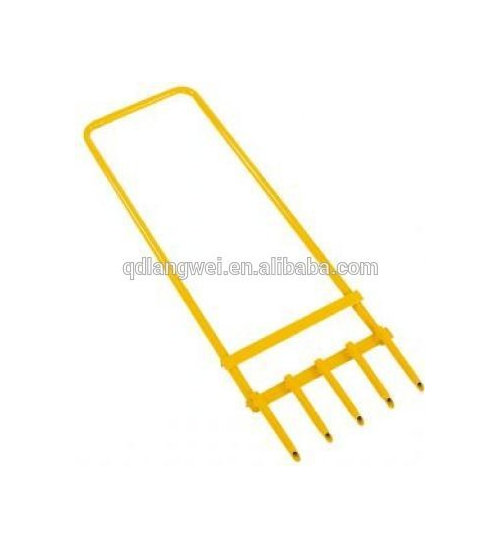
I had been using this:
Comments (64)
 9 years ago
Whatever motorized model is available at your local equipment rental outlet :-)) All core aerators work pretty much the same...the only difference may be in the depth and diameter of the cores. Get whatever may have the longest and widest cores (usually the rental outfits will have only a couple of very similar models available).
Related Professionals
Orlando Landscape Architects & Landscape Designers · Florence Landscape Architects & Landscape Designers · Longview Landscape Architects & Landscape Designers · North Adams Landscape Architects & Landscape Designers · Omaha Landscape Architects & Landscape Designers · Eau Claire Landscape Architects & Landscape Designers · Bozeman Landscape Architects & Landscape Designers · Houma Landscape Contractors · Chicago Landscape Contractors · Trenton Landscape Contractors · Madison Landscape Contractors · Fort Collins Landscape Contractors · Richmond Home Builders · Carlsbad Home Builders · Fort Collins Home Builders 9 years ago
I can only say that core aeration is not typically done in my area. Not because it isn't beneficial but it just isn't common practice. I will say that in my development, I probably have the top lawn. Those who core aerate every year do not have higher quality lawns compared to those who don't. You certainly don't need it in order to get a high quality lawn. My lawn is better than it was when I core aerated once or twice a year. I feel at least 3 apps of organic based fert is key. Since I don't core aerate, weed infiltration is a lot less and I no longer need pre-emergent applications.
- 9 years ago
I am not sure you can make any direct correlation between an organically managed lawn and lack of compaction nor the lack of weeds resulting from no aeration.
Natural or organic lawn care is very strongly encouraged in my area due to pollution issues and quite widely followed. Still, all local 'official' lawn care websites suggest annual core aeration and top dressing with OM.
It is extremely easy to determine if you have compacted soil under your lawn. When the soil is dry, try pushing a pencil into the lawn and soil. If you can only get an inch or two into the soil, you have compaction.
I think you will find that regardless of where one is located, core aeration is still routinely practiced and routinely recommended. And for very valid reasons. If one chooses not to aerate, that is certainly their choice but that can hardly be extrapolated into a blanket panning of ALL core aeration.

Joe BigBlue
Original Author9 years agoWhen I took soil last week for my soil test, I had to stand on the shovel to get it into the ground.
I take it my soil is compacted lol- 9 years ago
Im surprised gardengal. Most academics report weed issues as a risk of doing core aeration. Every practice has downsides. Core aeration is not only recommended for compaction. It also aides with dealing with thatch which is why I mentioned organic fertilizer. Like danielj feels, in spring and fall, the worms will do their own form of aeration. I definitely value core aeration for some and have recommended it to others. My only issue is with your blanket recommendation that core aeration is "required". My cool season grasses don't seem to require it at all and not relying on pre-emergents is a huge plus. Too each his own.
- 9 years agolast modified: 9 years ago
Most academics report weed issues as a risk of doing core aeration.
How about some links/citations to those academic reports.
 9 years ago
I have sandy loam and I sink in it while walking across, definitely need no core aeration here. I think that the need for core aeration really depends on soil type and condition. I learned a boatload of stuff from A&M regarding chemical usage and aeration, but some of it seemed very commercialized and not suited to actual conditions.
- 9 years ago
Ridgerunner, this is just in talking with people at the local extension. In particular, I would question the benefits of aerating during the summer season when lawns are half dormant, as gardengal has suggested.
Joe BigBlue
Original Author9 years agoLast question:
If I am going to aerate, do I have to rent one of those things? I did it when I redid my lawn and they are extremely heavy and annoying.
Can the hand one with hollow tines like I posted a pic of work, or another smaller device?
Thank you!
- 9 years ago
Joe, I don't know what your lawn size is but it will take you forever to use a hand device if you make sufficient cores--not to mention taking a toll on your body.
 9 years ago
I use the heavy machine one and yes they're brutal when you're 5'5 130 Lol but I do it
Joe BigBlue
Original Author9 years agohttp://www.homedepot.com/tool-truck-rental/Aerator/CA-18HD/
This is what I used 3 years ago......$62 for 4 hours seems a bit pricey, and it's a mad dash to get it home, use it, and get it back in time.
Sure, $89 gives you the whole day... expensive.
To buy one is a couple of thousand....a used one is at least $1500.....
I just can't wrap my head around it; I guess I'm obtuse that way. 9 years agolast modified: 9 years ago
It's always interesting to see what I've missed after being away for a couple of days. Gardengal predicted that someone would suggest using shampoo instead of core aerating. After a couple days of being away, here I am with that suggestion.
The reason for using shampoo, as is done in the golf industry, was to replace
the process of core and tine aeration. It works better than mechanical aeration.As Gardengal has said, compaction is the absence of air and capillary structure in soil.
However, I believe she hasn't said enough, or maybe doesn't realize, that walking on dry soil has minimal effect to removing air or destruction of the soil structure. The soil structure is caused by the activity of organic matter such as roots and microbes living in the soil. Roots obviously push soil around. When the roots die, the dead root is decomposed by the natural soil biology leaving an opening to be filled with the surrounding soil particles and microbes. The way that happens results in a capillary structure which allows air and water to freely pass in and out.When organic matter is applied to the surface, Gardengal says that there is no method of "moving" the OM into the soil. While the stuff at the surface cannot penetrate directly into the soil, it doesn't need to. The benefit of the OM at the surface is that the microbes at the surface decompose it followed by the deeper microbes that decompose the top level microbes followed by the deeper microbes that decompose the second level microbes followed by ... until the 100,000 species of microbes, or so, have benefited from the OM which was originally applied at the surface. This is how OM, principally organic fertilizer but sometimes compost benefits the soil.
Soil fungi are interesting creatures. Under the right conditions they can grow extremely fast. Have you ever forgotten about a bag of bread and come back to find it full of a green mass of fuzz? Those are fungal hyphae. They can fill a bag in a day or two once the mold starts on the bread. In the soil some of the best of of these fungi will attach to plant roots and grow sending their hyphae structures off to collect food and water. And again, they can do it very quickly when the conditions are right. These hyphae push soil particles apart which results in the opening of the soil. This happens best when the soil environment is moist and relatively cool. Of course rain is the natural method of refreshing the soil fungi, but you can help the process along by the occasional deep watering. When Gardengal says the soil compacts simply by walking on it, I would suggest that the beneficial soil fungi are right behind you opening up the soil again after you stop compressing it. Just add water.
Because these soil fungi are attached to the roots, the roots also benefit from the fungus. These beneficial fungi can reach much, much deeper into the soil than the roots of the plants. When the fungi are moist, they expand slightly pushing away the soil particles. When they dry out, they shrink slightly opening up more room for air and water exchange. Also when they are wet they seem to allow some comprehensibility in the soil. You feel this as a softness when you walk on it. When the soil is dry, there is virtually no perceptible softness.
True compaction requires the mechanical working of soil which is under water. For example when livestock are allowed to walk into a water pond, the soil at the apron of the pond will become compacted as the animals plunge their hooves into the wet soil. When they step down, air is pushed out and any capillary structure is destroyed. When they lift their hoof back up, water and soil particles fills in the void. Livestock managers will scramble to avoid "pugging" the soil in their paddocks by designating one paddock to be their waste paddock. Then when it rains, they will hustle the livestock in to the waste paddock where the soil is already ruined. Compaction can also be caused by heavy equipment driving on wet soil following a heavy rain event. Fortunately most construction workers abandon the job during rain events, so the soil at least has some time to dry out a little. But driving over dry soil will not compact anything...usually. Parking a car on soil will compact it over time because the car gets parked in the same spot, rain or shine.
Hard soil, on the other hand, is a different thing. Hard soil is caused by the lack of beneficial fungi that normally soften the soil. Core aeration does nothing to help the fungi. Shampoo helps by moistening the soil to a deeper depth and helping to maintain steady temperatures and moisture levels throughout the soil. These are needed for the fungi to thrive. These fungi cannot thrive in hot, desiccated soil. When the soil is not watered or rained upon, it usually leads to the depopulation of the helpful fungi. When the fungi are not there to swell and shrink, the soil feels hard all the time, but it is not technically compacted. The structure is still there.
The science backing up the shampoo idea has been done at the request of the golf industry. The surfactant they use is called Cascade Plus (no relation to the dish washing soap). If you have access to an academic search engine, use the terms, "golf," "aerator," and "cascade plus" to home in on the studies. In test after test they find that the surfactant works as well as or better than core or tine aeration. But when you read the entire study, the problem they are fighting is not soil compaction. They are trying to restore water penetration which is being blocked by another fungus living on the surface of the turf. So just as the industry has brought surfactants to the masses, it did so for the wrong reason. Furthermore I would suggest that the golf industry has been used by the equipment and fertilizer industries to sell products based on misunderstanding what they are really doing. They are not aerating to reduce compaction; they are aerating to improve water penetration above the grass so it can get to the soil.
So while I usually agree with Gardengal on other topics, on this one we disagree. If you want to spend 50 cents and try shampoo spray on your lawn first, the shampoo application rate is 3 ounces per 1,000 square feet. Give it 3 full weeks to see the improvement. Do the pencil test before and after. I would use a screwdriver instead of a pencil. If the shampoo does not work for you, you can either try it again or spend $250 to have it aerated or $75 to rent an aerator for half a day.
I have owned nine lawns over 50 years. I core aerated once and honestly never saw an improvement. The shampoo spray in 2012 worked for me. It still gets soft with every rain shower. In all the neighborhoods I've lived in (SoCal, Dayton, San Antonio and vicinity)), I have rarely seen a homeowner do core aeration.
Joe BigBlue thanked dchall_san_antonio- 9 years ago
Up north, core aeration definitely has benefit. Kentucky bluegrass is king and highly prone to thatch. Most use standard fertilizer and many water superficially. Both ultimately lead to thatch problems. And with thatch can come disease and pests. I think organic-based fertilization, if you are willing to buy in, can minimize need for pesiticides and mechanical aeration. Academia has no incentive to study the effect of earthworm activity in aeration and soil health (turf), but what is out there is promising. In conjuction with renovating with improved/elite grasses, you can have a relatively low maintenance lawn that is also the envy of the neighborhood.
Joe BigBlue thanked mishmosh Joe BigBlue
Original Author9 years agodchall-
Thanks for that extremely detailed post.
I will try shampoo; what do I have to lose? I just want you to understand: I had to stand on my shovel to get it into the lawn.....the shampoo will penetrate that?
Of course I have to add: in my neighborhood where there are those with very nice lawns, I have never seen them using core aerators, or spraying baby shampoo. However, maybe I just am not around when it's happening.:)
- 9 years ago
If worms and fungus were effective ways to combat soil compaction, you should be able to pull over on the nearest freeway where this stuff has been going on for decades and do some digging on the side there, see how fluffy the soil is.
- 9 years ago
is mother nature feeding the freeway pasture organic fertilizer on a regular basis?? if you don't provide what the earthworm need (both food and conditions), there won't be enough to make an appreciable effect.
- 9 years ago
is mother nature feeding the freeway pasture organic fertilizer on a regular basis??
Absolutely. There's hundreds of pounds of dead grass blades, animal droppings, insects etc. decomposing courtesy of Mother Nature. Same for our lawns, if you mulch the clippings are organic fertilizer.
- 9 years agolast modified: 9 years ago
grass clippings and animal poop aren't even enough to self sustain a lawn and you are saying its equivalent? hardly.
Try living off a couple crackers and water and see where that gets you. its not enough.
- 9 years ago
Joe Bigblue, core aerators leave signs that they have been used. Also I
did not mention to follow up the shampoo with 1/2 to 1 inch of
irrigation or rain. That will wash the shampoo down into the soil. If
you get runoff before you get that much water, then stop watering
immediately and wait 30 minutes for the water to soak in. Then resume
watering stopping as often as you need to to prevent runoff. Once the
shampoo has worked its miracle, then runoff should be a thing of the
past. "...extremely detailed post," LOLOLOLOLOL. More like an essay.jrc11, The nearest freeway is not the best example. Freeways were constructed on concrete often with asphalt on top. The sides of the road are special materials which are compacted by machines to support traffic that has to pull off for some reason. Perhaps a better example would be a pasture where livestock are raised more or less naturally (no insecticides, no deworming medicines, no additional fertilizers, etc.).
mishmosh, I think if you look at that other forum you and I are both members of, you'll see that they use their custom blend of powdered surfactants as an alternative to aeration. Shampoo is easier and less expensive unless you are in the lawn care business. Many of those members in the north and northeast use it exclusively and have virtually unlimited soil penetration with a screwdriver. Andy once reported to the forum that a windstorm knocked a limb off his tree and embedded itself 26 inches into the soil.
- 9 years agolast modified: 9 years ago
dcall, i haven't followed that other forum in a couple years. that said, core aeration solves more than just water penetration. shampoo will not have the same effect as core aeration on thatch in particular.
my lawn shows no signs of localized dry spots so don't see the need for surfactants. years ago, i tried shampoo on a pile of hard subsoil I dug up. To my surprise it initially did loosen things up to allow a screwdriver to penetrate but after a couple of weeks it was back to being a hard pile of soil. And I applied much more than you would apply on a lawn. Im just not sold on liquid aeration.
- 9 years ago
grass clippings and animal poop aren't even enough to self sustain a lawn and you are saying its equivalent? hardly.
Well, plants have only been around for 25 million years and we've only been throwing fertilizer down for about 10,000 years, so obviously it must be enough, they're thriving all over the world. Not enough for a high quality residential lawn, but the larger point is about soil aeration regardless of grass species.
There's hundreds of pounds worth of organic matter from root exudates, grass clippings, animal droppings, insects etc. being put into the soil by Mother Nature yearly. If there was a significant aeration effect from worms and fungus, we would have seen it since there would be millenniums worth of that.
Perhaps a better example would be a pasture where livestock are raised more or less naturally (no insecticides, no deworming medicines, no additional fertilizers, etc.).
I didn't want to pick a pasture because there's hoofs compacting the soil but you're right side of freeway is not the best example. I don't know, just any natural field of grass not constantly being grazed by large amounts of livestock.
- 9 years agolast modified: 9 years ago
Worms aren't indigenous to North America. Where are you getting that there would be "millenniums worth" of effect?
Edit: at least worms up north where I live.
- 9 years agolast modified: 9 years ago
It doesn't matter, find a spot anywhere in the world with continuous earthworm presence. They've been around for a billion years. There's no fields of fluffy soil anywhere.
- 9 years ago
You don't get fluffy soil with core aeration. So what's your point? I'm merely talking about another option that I feel is just as effective. Obviously, you are not a fan of organic based fertilizer but what I spend in higher organic based fertilizer costs, I save in the chemical products and cultural practices you are forced to embrace.
- 9 years agolast modified: 9 years ago
Shampoo makes no difference when used on Houston Black clay soils. All it does is add more chemicals to the lawn. Yearly core aeration is really needed here since compaction is a common issue. Compaction gets so bad that a large pick is required to break the clay loose when dry!
In fact, we have to moisten the soil before we can plant anything.
- 9 years ago
Joe said: I will try shampoo; what do I have to lose? I just want you to
understand: I had to stand on my shovel to get it into the lawn.....the
shampoo will penetrate that?I don't think there is a strong correlation between aerated soil and getting a shovel in the ground. I'm not 100% on that so I could be wrong, but I like the example of the sponge. A sponge is full of holes but when it is dry it is hard. You can stand on it and not compress it. Wet it down and it gets spongy. Same thing with the soil. So the fact that your shovel doesn't go in may just mean that your soil is not wet. If it is wet, then maybe you have low organic content. I'm just not sure it necessarily means you have compaction if the shovel doesn't go in. In my first year of sampling I bought a T bar sampling tube that you push into the ground. When I first sampled I had to literally pound the thing into the ground with a mallet. The next year I had a Homer Simpson moment when I realized that when the soil is saturated with water I can practically push it in with one finger in some spots. In addition to the water, though, I think the soap and organic amendments I had been adding helped.
So, Joe, I wonder if you can try something. Push your shovel in the ground and note how far it goes and how difficult it was. Now go aerate the lawn and do the shovel test again. Do you really think there is going to be a difference? If not, what does that tell you?
@j4: Take a walk in the woods. Push the leaves aside and stand on the soil. If it feels like a trampoline it is because of decades or centuries of leaf humus build up. Humus is what is left over when the organic portion is consumed. That's what we're trying to create a little bit of with organic amendments.
@gardengal: I think dchall replied to your post sufficiently, but I think one of the reasons there is so much disagreement is due to ignorance. We all have our pet theories but how many of those ideas are tested out in a scientifically rigorous way? Not many. For instance, I don't understand how rain drops can cause compaction if the force of the drop is being absorbed by the thick grass blades. I doubt a gentle percolation of rain water causes much in the way of compaction. Unless there is evidence to the contrary, rainwater compacting thick lawns is an idea I'm comfortable dismissing. On the other hand, it appears to me that walking repeatedly on one section of lawn can cause some compaction. I have a spot next to the grass I walk on and it looks more packed down. If I planted seeds there and treated it like a lawn I'm confident the compaction would loosen itself up.
- 9 years ago
You don't get fluffy soil with core aeration. So what's your point? I'm merely talking about another option that I feel is just as effective
My point is that there's no evidence that in a no-till situation applying organic matter on the surface has any significant effect on relieving soil compaction in the 1"-4" range where the majority of the grass roots are located. And especially when we're talking about minor amounts of organic matter, 30-40 lbs a year.
but what I spend in higher organic based fertilizer costs, I save in the chemical products and cultural practices you are forced to embrace.
I'm not sure what that means, I don't know what cultural practices would be eliminated if I applied organic fertilizer.
Shampoo makes no difference when used on Houston Black clay soils.
dchall will come along shortly to tell you you don't have any clay :-)
- 9 years ago
I was expecting dchall to comment on the liquid aeration when I made that comment. He and I have a bit of history on this subject and we have - I think - agreed to disagree on the subject :-)
As to the issue of rainwater or irrigation contributing to compaction, it is a pretty well established phenomenon. Individual raindrops certainly don't amount to much of an impact, but when you multiply them by the thousands, it adds up. And there is also the force behind them........a light drizzly rain versus a heavy downpour. One is going to have a much greater impact than the other.
btw, ANY weight or pressure on the soil regardless if the soil is wet or dry will contribute to compaction. Wet soils will compact more readily but even dry soils will compact when you routinely walk on them.
- 9 years agolast modified: 9 years ago
Once again, wetting agents have nothing to do with aerification. Learn to use the right tool for the job at hand. Speaking of the right tool, shampoo is a poor choice for a soil wetting agent. Use a commercial product, but chose wisely. Do the research.
- 9 years ago
dchall will come along shortly to tell you you don't have any clay :-)
I would be interested to hear that. We have geotechnical data on our site and the soil is confirmed Houston Black clay with a high clay content (50%+). Our building is built on structural fill and deep set piers to resist the effects of the expansive Houston Black. Even our driveway is built with reinforced concrete and meshing to reduce cracking from the soil!
Walk through an old Fox and Jacobs house in Carrollton, TX and you will see the effects of these clays! haha
- 9 years agolast modified: 9 years ago
What do you recommend for compacted soil?
You likely wont be satisfied with this, but my answer is: analysis.
If the soil IS compacted, the only cure is aeration.
However:
If the soil is hard, it could be due to compaction, lack of moisture or a chemical/nutrient imbalance.
In addition to the causes given by gardengal, compaction could be due to parking a car, boat, or even walking on the lawn when wet.
Lack of moisture could be due to a number of factors, from just not watering sufficiently to having a sodic soil.
A chemical imbalance could be due to a soil magnesium content in excess of 600ppm or greater than 20% of base.
Eliminate and address what is left.
IMO healthy turf results from healthy soil and the most important component of both plant health and soil health is abundant plant root. So I'd recommend concentrating on promoting root growth once you eliminate the other above possible sources of impediment.
Turf (or any plant) roots will proliferate in areas of soil where moisture and nutrients are found. Consequently, I have experienced significant improvement of turf in poor soil through core aeration (18+ cores per sq ft) followed by fertilization with a balanced fertilizer (triple NPK) with a finish topdressing of peat moss for increased OM and water retention. Greater rooting will improve soil tilth, which will reduce the incidence of compaction. The bottom line is better turf, much better.
Let your wallet and your back be your guide. A 3-cu ft Sphagnum Peat Moss bag will be needed for every 2-400 sq ft of lawn and will run you about $14. You already know the cost of an aerator and you'll want to do at least 2 passes, 3 would be better. T20NPK is about $20-25 for 50# which will cover 10k.
This is just my opinion based on my experience. I did this two consecutive years, and according to my neighbors, the results were spectacular. Take it or leave it as you wish.
- 9 years ago
dchall will come along shortly to tell you you don't have any clay :-)
I would be interested to hear that. We have geotechnical data on our
site and the soil is confirmed Houston Black clay with a high clay
content (50%+).I will acknowledge that there are sporadic pockets of clay in Texas. There are several spots in San Antonio known for shifting soil blamed on clay. Houses break away from their plumbing and roads have to be rebuilt every 10 years or so. And in the rural town of D'Hannis there is enough clay to support a brick factory. 99.999% of the time I can get away with telling people they don't have any clay.
But...tech biker, have you done a jar test on your soil? Just because your original area is clayey, that does not mean that the fill they used to finish grade the houses is clay. I have to moisten my soil to dig it, too, but I have no clay. (now I have to go out and do my own jar test, because I just moved to the Hill Country a couple years ago).
- 9 years agolast modified: 9 years ago
Ive got one similar to the one you have pictured and use it in for my core areation.I do have a pretty decent size lawn so what I do is do the aerating in sections.Also another tip is to do it after a rain when the ground is soft.Will be alot easier on you and the aerator wont get stopped up. I do have red clay.Ive got about 1/2 inch of brown good dirt and then solid red clay underneath. My plugs are half brown and half orange hehe.
Also I would think aerating would be bad in the summer time.Because it will dry out more since this summer heat can penetrate in the holes??I guess you could but make sure to water it alot??
- 9 years ago
@tech biker: Would you have any interest in doing a soil jar test? It would be interesting because I've seen results differ from what the lab says. I recall seeing somebody's jar test here that showed no clay, but when Logan Labs did the analysis it showed a significant fraction of clay. Of course this test is more interesting if we know 100% that you are sampling soil with high clay. My interest was to see if the actual clay soil jar test jives with what is supposed to happen.
- 9 years ago
I thing Ridgerunner has a good perspective on the issue in his last post.
I don't think we are talking about the same thing when one person says rain causes compaction and another person says cattle hooves in mud cause compaction. It is my thought that a soil with good structure can handle the day to day light compaction issues like rain or foot traffic. If you have a cattle drive come by your lawn then you might want to aerate.
@gardengal: I can't seem to get off the subject of rain. I have to ask you again. If I have a plot of ground with no grass and another plot with 4" high thick KBG is it your contention that both will become compacted from rain equally? How do you know that rain compacts good quality soil to the degree that aeration is eventually necessary. Is it just you opinion based on 30 years of experience?
- 9 years ago
Let me say it again.........ANY repeated impact or pressure on the lawn or any soil will cause compaction. I don't know how to be any more clear that that! Obviously there will be difference in the degrees of the impact - there is a lot more impact or pressure from cattle walking on mud than there will be from you walking on dry soil and even less from raindrops so compaction may be more rapid and more severe from one source than it is from another and under varying conditions. And keep in mind that this does not happen overnight or necessarily from a single cause. You do mow your lawn routinely, yes? And apply ferts or pesticides? Edge planting beds? Rake up leaves in fall? Walk from one area to another? Any kids or pets that play on the lawn? They will all contribute to compaction.
And of course bare soil and a planted lawn soil will not compact equally. That is just common sense. But water IS a contributor to soil compaction. And that is not just my opinion but the common consensus of agronomists and horticulturists across the globe and over many years.
Joe BigBlue
Original Author9 years agoIf I threw a bunch of cinder blocks repeatedly onto my lawn from my 3rd floor window, would that cause compaction?
:)
Sorry.....felt this thread needed a little levity....- 9 years ago
@gardengal, it seems we're not going to have the discussion I thought we might. What you have been saying is basically, "Trust what I'm saying because I've been doing it for 30 years and everybody in the industry agrees with me." While observation over time is valuable in some respects, and shouldn't be dismissed, at the same time it isn't exactly scientific. I feel much more comfortable taking advice from people who can back up their claims with some kind of study. For instance, I bought some seed from a recommended sod farmer on the phone. This was an older guy who has spent a lifetime growing sod. When he heard that I have been mulching in the fall hickory tree leaves in my yard, he strongly warned me that this was not a good idea because they are too fibrous to break down. He said leaves belong in the forest, not in your grass. Well, four years of hickory leaves later and I can't find a hint of a leaf in my soil as they have been completely broken down. He was wrong. I have no idea why he holds on to this belief, but my point is "show me the data." Had I trusted him just because he said so, I'd be out there bagging my leaves for no good reason. So I'm not trying to challenge anybody's expertise or just be rude. It's just not smart to believe things people say just because the say them. The sod guy is just one example of many. Hopefully you will take my comments in that light.
You said something above that I can't wrap my head around. You said, "Just an FYI but the soil under a lawn is typically ALWAYS
compacted........or will tend to become compacted. And it has nothing to
do with the quality/friability of the soil or the populations of
invertebrates that reside therein."How can the degree of compaction not be affected in any way by the critters living in the soil? I look at the issue of compaction as a "steady state equilibrium." Let's look at a 10' by 10' patch of bare earth. There certain forces that push down on the soil to compact it. People walking on it, tire tracks, rain, mower wheels, dogs, etc.. On the other hand we have certain forces that counteract this downward force. Growing grass on that plot will cause roots to grow and die and grow again. Fungi do the same thing. Worms populate our test plot and burrow up through the soil to grab pieces of leaf mulch. The owner of the plot adds organic matter, encouraging additional micro bio life in the soil and improving the soil structure. Peds, etc.
So let's say our virgin bare earth test plot started out at a 5 out of 10 where 0 is no compaction and 10 is maximum compaction. If you added the compacting forces without anything to counteract them, you might end up with a 9 eventually. Conversely, if you are able to protect the plot so that only the "anti" compaction factors are at play, maybe you get to a 2 on compaction. In reality, I say that the compacting forces and the "anti" compacting forces will reach an equilibrium over time. When you throw them all together maybe you end up at a 6 out of 10. Add more variables that counteract compaction and you might bring it down to 4, and so on. I'm suggesting that by doing the right things, you can bring your lawn to a long term equilibrium in which mechanical aeration is not only unnecessary, but might also be harmful.
What you seem to be saying is that there's nothing you can do about compaction other than mechanically aerate and add compost to the holes. Eventually every lawn suffers to some degree without mechanical aeration. I would be shocked to learn that the thousands of worms burrowing in my soil (invertebrates, as you say), popping out occasionally for a leaf snack, are not aerating the soil. Are you really saying that, and do you have any evidence for your position?
I would agree with you and ridge that if you really have compacted soil then go ahead and aerate, add organic matter, peat moss, and whatever. My interest is more in your idea that it is kind of hopeless to expect a lawn to keep itself from becoming compacted through good practices.
Obviously I don't have all the answers and continue to learn, but some or your statements just seem a little over the top, which is why I was hoping you could produce any kind of lab or university studies on the matter.
- 9 years ago
Joe said: If I threw a bunch of cinder blocks repeatedly onto my lawn from my 3rd floor window, would that cause compaction?
Hey Joe, if you want to be some kind of comedian, why don't you go start your own thread? :O)
- 9 years ago
The point is not worth arguing.
TL:DR
All soil is compacted. You want to aerate, go ahead and aerate. You don't want to aerate, don't aerate.
- 9 years agolast modified: 9 years ago
Daniel, you raise some good points ... but the problem here is that once you have a compacted soil, all the "counter forces" you mention cannot really do the work needed to alleviate the compaction. Roots can't grow in compacted soil, worms won't dig through it, etc. When a soil has compacted, there is no air. When the air space is gone, the soil life will die and the countering acting forces will die off or find greener pastures (heh).
All things on this planet are compelled to the wcore of the Earth by gravity by the path of least resistance. Soil is no different. When you pickup a shovel full of soil and drop it, it falls to the ground. There it will rest - on top of all the other soil - because that's the closest it can get to the core without some other force intervening.
Due to the shape of the soil particles, there will naturally be air between the soil thrown from the shovel and the soil that was already on the ground. Then, you step on the soil... physically pushing the particles closer together than they were. The soil compacts (air displaced) in proportion to the force exerted on it. It's like taking fluffy snow and squeezing it in your hand... the harder you squeeze, the harder the packed snow becomes.
Certain types of soil are more prone to compaction than others, such as shrink-swell. When dry, it will shrink (constrict)... and when wet, it will expand. When shrink-swell soil becomes compacted, it has a harder time getting wet... and therefore, it has a harder time expanding. It will stay constricted, especially when the top layers are baked by high heat from the summer sun.
I think a lot of people confuse constricted soil with compacted soil. I see a lot of people talking about wetting agents, etc. --- those are solutions for hard, constricted soil to help water penetrate deeper so the soil will expand.
The problem is that the wetting agents will not deal with the issue of compaction. If you simply manage to get compact soil wet.... congratulations, you now have anaerobic soil.. Just like the soil thrown from a shovel, the wetting agent and subsequent water will take the path of least resistance (read: the path with the most air).
To deal with compacted soil, core aeration can open up the soil so that, when the holes naturally fill back in, those holes are starting at a "0" on your scale of 0-10. However, the aeration is only so effective... with plugs being maybe 1-3 inches deep, and generally only affecting about 20% of the soil surface area. This is why it should be done routinely.
To deal with compacted, constricted soil... it seems that both an aeration and a wetting agent would help the soil in terms of softening it (water penetration) and relieving compaction (improving air/gas exchange).
Joe BigBlue
Original Author9 years agoI went with the easiest route: baby shampoo.
Never did it before so I eagerly await the results.
- 9 years agolast modified: 9 years ago
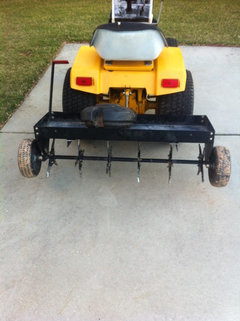
No. I paid $550 for the Cub Cadet 1450 and $150 for the Brinly aerator. $100 for the sleeve hitch + $15 for the yoke + $15 for the angle iron to make the sleeve hitch setup which is optional. Plus some labor. I can also mow, plow, till etc. with the tractor.
Oh, and let's not forget pull a sweeper. Saves me so much labor when seeding time comes and I have to scalp. I'm done in 10 minutes vs hours of raking.





gardengal48 (PNW Z8/9)