Software
Houzz Logo Print
nickerham

Need Quiet and Effective Hood Liner for 59.25" Lacanche Range

9 years ago

Good morning. I am pulling my hair out trying to figure out which range hood liner would be best over my 59.25" Lacanche Citeaux and I'm hoping you guys can direct me to the best option. The salesman at the appliance store is telling me that the internally mounted VentAHood will be quieter and more effective than an externally mounted Wolf (he sells both). My HVAC/Vent guy says just the opposite. This is part of an addition and the range is on an external side wall of the house so we have mounting options. My current Dacor vent is so loud I cannot hear anyone 5' away when I'm cooking, which makes me feel very isolated! It is also very ineffective so our fire alarm goes off every time I sear a steak! Another issue is with width. The widest Wolf liner PL582212 is 58" although Wolf insists that it is the right size for their 60" range. The VAH has a 66" Premier Magic Lung model BH464PSLD that would be wider than my range by a few inches (actually 64.375"). I don't really fry but I do sear meat. Thanks in advance for your help!

Comments (11)

  • 9 years ago

    Wider and deeper is almost always better for capture. How wide and deep depends on the stove configuration. The real requirement is to intercept the rising and expanding cooking plume, and this plume is emitted from hot pan bottoms. Most of the effluent is within a 10-degree to vertical zone, so given pan configurations and hood height, one can analyze the needed overlap from the pan bases.

    With a configurable range like the Lacanche Citeaux, effluent volume and velocity can be highly dependent on just what burners are where, and which you intend to use to sear or use for other high temperature operations. If these tasks are allocated to more central burners, and the outers used for cooking vegetables, boiling eggs, warming chocolate, etc., the hood could be less wide than if the outer burners will be used for searing, wokking, and heavy frying.

    There should also be consideration for cross drafts; even a modest air conditioning diffuser or people moving about can cause the plume to bend into the down-wind direction. So you may appreciate that there is no simple answer unless using a commercial hood, which will be large enough, even at seven feet above the floor.

    Containment requires adequate flow rate per square foot of hood entrance aperture. I suggest 90 CFM/sq. ft. for baffled hoods; that may also work for VaH. (The issue is that hot greasy cooking can generate a plume that rises at more than a meter per second. When this reaches a set of baffles, or the structure inside a VaH, conservation of momentum can lead to plume reflections. Enough blower induced velocity is needed to keep these from exiting the hood.

    Note that 90 CFM/sq. ft. is the achieved CFM considering all losses in the ducting and in the make-up air path, applied to the blower's fan curve. The VaH has an advantage with no baffles, but a disadvantage in that its blower type has a greater drop in flow rate with increasing restriction than more conventional residential hood blowers. So it will come down to your MUA setup. Practical restriction values may lead to needing a rated CFM of 1.5X the value calculated.

    If the option is a blower inside the insert vs. one six inches away on the other side of a wall, then there won't be any sound reduction from a long duct, or from the more effective means of reducing noise -- a suppressor in the duct path. The type of blower used may make a difference, but one would need to compare actual configurations to be sure of a valid result.

    (I think Wolf's 58-inch liner is expecting to be in a 60-inch cabinet outer dimension, and be trapped between two cabinets separated by 60 inches that help direct the edge plumes into the hood. I would consider that to be a marginal condition for ideal performance, but it may well be adequate if pan positioning is based on cooking type, and if flow rate is sufficient to cause a slight hood edge effect.

    I would tend to believe an experienced HVAC guy over a magic lung salesperson.

    kas

  • 9 years ago

    Thanks Kas. Good point about the burner. My sear burners will be on the outside edge and there will be no upper cabinet immediately adjacent to the hood, so it seems that it would be much better to have a hood that is a bit wider than the range. It also seems that I will not get any benefit from an external blower since it will be right on the other side of the wall rather than on the roof, etc. Wolf doesn't make a liner wide enough. The VAH is only 22.5" Deep. Are there other options for 66"wide x 27"deep liner with internal blower? I called ModernAire and they quoted over $4k for a 66" wide liner with internal blower. Twice the VAH cost. Any other suggestions?

  • 9 years ago

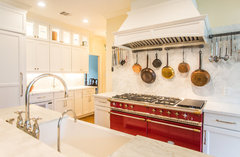
    We've had our Sully for a couple of years now. It is slightly narrower than your Citeaux at 55 5/16". We decided to go with a 58" Wolf liner and external (roof-mounted) 1200 CFM blower. The blower is regulated by a rheostat so can be run at lower speeds when desired. It is certainly effective, even when cooking in a wok or on a griddle, but can be loud when running full bore. Overall, this isn't generally a problem for us since full capacity isn't required very often and, even when it is, it isn't for long periods.

    Braeswood · More Info

    Hope this helps.

    Jim

  • 9 years ago

    Wow Jim gorgeous kitchen! Love the red lacanche against all that white!! thanks for your help. Wish we could do external blower.

  • 9 years ago

    So besides ModernAire what are my options for a liner that is 66"W x 27"D with an internal blower, venting directly out the back (our custom hood will not go to the ceiling and will only be about 18" or so high so there is no room for venting inside beyond the guts of the blower/liner/decorative metal hood surround). Sadly MA can't make the hood style that we want otherwise would get liner plus hood together from them. . .

  • 9 years ago
    last modified: 9 years ago

    I would like to add one refinement to Trevor's No. 1 suggestion. Unless the wood interior is painted with a very durable coating, the potential grease build up could become unsightly, and cleaning the wood difficult. When the wood interior is exposed to the cooking plumes, I would add stainless steel panels on the inside to cover the wood (maybe even overlapping the very bottom of the hood in case of a Hindenburg level flambe). Such panels can be thin stainless and easily sheared to the size you need by a sheet metal shop.

    As may be seen in the image above, the interior exposed wood is modest and painted, and the assembly itself is rather high and likely very safe.

    Nice kitchen, sonny.

  • 9 years ago

    thanks Kas. Our hood will not have any wood. It will be made from stainless and brass. At the moment I'm leaning towards a custom liner from ModernAire so that I can get optimal coverage for my range. I've lived with suboptimal range ventilation before and I want to make sure I get it right this time around! I had planned to get external blower but now realize in our application that would not provide any benefit and will actually make more noise!

  • 9 years ago
    last modified: 9 years ago

    OK, so with a liner, it's normal for the dimensions to be less than the range. The dimensions of the actual custom hood will match up with the range. If you look closely at a regular hood it's the same deal, the hood will be as wide as the range but the actual mesh/baffles will be smaller.

    No powerful hood will ever be truly "quiet" - the best you can do is quietER, though as mentioned above, with a short duct run the opportunities for this are limited.

    Joe Blow thanked User
  • 9 years ago

    I think I missed something above. Is this a case of needing separately fabricated hood and liner for some reason I haven't discerned?

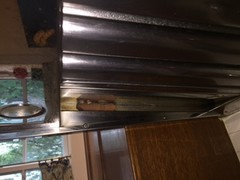
    Normally, a metal hood includes its own liner; or sometimes a metal hood is its own liner depending on how you define it. (See image for an apparently different inner.) For my Wolf Pro Island hood, the sheet metal visible on the inside is not the same as on the outside up to a foot or so.

    Image from http://www.handcraftedmetal.com/

  • 9 years ago

    Joe Blow-You will love your Modern Aire hood. We have a 42" 1200 cfm hood over our LaCanche Volnay and it's fantastic. Ours vents directly out the back through a 6" wall. The fan and motor aren't loud at all. We use it almost exclusively at it's lowest setting, unless searing or cooking stir fry. I've never used it at 1200 cfm. It does get loud at higher settings, but it's the movement of the air, not the machine making the noise and there's no getting away from that.

    One thing I will caution you on. I have propped up one of the metal "fillers" next to the baffles (there's one on each side) with a small piece of wood because it makes a whistling noise if I don't. I never called Modern Aire about it to find out a better solution or why this is happening but you might want to mention it. Despite that, I love the hood and am putting one in my new beach house kitchen this year. I especially like the infinitely variable speed and light controls and how easy it is to remove the baffles to clean them in the DW.