Software
Houzz Logo Print
jacoblockcuff

Hay Herbicide Contamination

9 years ago
last modified: 9 years ago

Hello! I hope everyone is having a great day. I like to use hay or straw as a garden mulch, more specifically to hill up my potatoes. However, I have read of them containing herbicide contamination affecting mainly broad leaf vegetable plants (for example tomatoes) and killing them. Has anybody had any experience with this issue? How can I tell whether it has been sprayed? I imagine I can buy certified organic hay, but it costs so much!


Thanks,

Jacob

Comments (18)

  • 9 years ago
    last modified: 9 years ago

    Some suppliers can let you know the farm it came from, so the first thing is to just ask if they know who they source it from. This is going to favor local suppliers though.

    If you have a good sized piece of land, cutting your own isn't hard. I have a small lot, and I make a hay that I use as a mulch throughout the garden by letting a stand of grass and weeds grow up about 1' - 3' tall. Just before anything goes to seed, I take a swing blade and cut it off at the base. It becomes a perfect mulch of various consistency. I apply it right after it's cut and it's flexible and goes right where I want it. If it's too tall, I take a swing at half-height to shorten the length. It takes no time to get quite a lot. You can do it with a weedeater if you like, I just no longer use power tools... well except the chainsaw... and a tiller to break new ground.

    If you live in a rural area, don't be afraid to look around for old bales of hay. They make great mulch, and farmers are often glad to get rid of old bales of hay. Just ask them if they use herbicides.

    Some people who live near the ocean have access to salt hay. It makes a very good mulch, and I doubt it's been sprayed.

    To test anything you might be concerned about, you could plant a few cucumber seeds and mulch them with the hay. Water through the hay onto the seedlings. If you see twisting, or other signs of deformed growth, herbicide is possible/probable.

    jacoblockcuff (z5b/6a CNTRL Missouri thanked rgreen48
  • 9 years ago
    last modified: 9 years ago

    Thanks for the quick responses. rgreen48, I really like your idea of cutting some grass to use. We have an acre lot here, and there are quite a few places that we don't even mow because you just don't even see the areas because of trees blocking. Is there a specific grass that I'd need to grow to apply as mulch, or would any mix (primarily weeds here) work the same?

  • 9 years ago

    I use just the mix of grasses and weeds that come up in my yard lol. I've never seeded any grass, so it's just that mix of grasses, clover, dandelion, weeds, etc... that comes up in non-maintained areas. My yard was over-grazed pasture a few decades back, so the mix of plants that make up the yard is basically a mix of everything.


    If you wanted, you could over-sow an area with alfalfa, or clover, etc... and you'll get a richer blend of plants, but it's not necessary. Really, the blend of plants is good. Different leaves and stalks will bring various levels of nutrients and will break down at different rates. Just be sure to apply it fairly thick. In warmer, wetter climates plant matter breaks down quite fast.

  • 9 years ago

    I think I'm going to try this. We have sections of yard that are just overgrown due to rock gardens and the such and the grass (though in the shade of the forest) commonly grows at least 2 feet tall. This could be a good way to put those sections to use...

  • 9 years ago
    last modified: 9 years ago

    BTW... I know it's silly, but I even have a name for the technique. Every year when I cut my mulch I think fondly of my Great Grandmother. She had an old saying... you can't borrow from Peter to pay Paul. So, when people see my tall grass and wonder why the garden looks so maintained, but the grass is just wild and completely unkempt, I tell them I'm borrowing from Peter to pay Paul. They still think I need to get a lawn mower, but too bad... my beneficials like my tall grass, and I like my mulch! I have no idea what I'll do when the entire yard is fully under cultivation lol, but that's still a few years away.

  • 9 years ago

    We're bad about mowing. Sometimes it doesn't get mowed until it's a foot tall or so! There are just too many other things worth worrying about...


    Another idea I had was to grow a cover crop such as winter rye this fall in the garden and cut it in early spring to use as mulch. This would work very well I imagine...

  • 9 years ago

    I should reiterate that at least with straw, and to some extent with properly harvested hay, you don't have seeds. If you just mow random stuff, you're going to end up mulching with seeds of random stuff. It depends on how much you hate weeding. Growing a cover crop and harvesting before it seeds (thereby making hay) is a good idea.

    jacoblockcuff (z5b/6a CNTRL Missouri thanked daninthedirt (USDA 9a, HZ9, CentTX, Sunset z30, Cfa)
  • 9 years ago

    That's a valid point. I didn't think of the horrible Bermuda grass we have here. The same grass I've had my garden covered with cardboard to kill for the last few months!! Is there another cover crop other than rye that anyone would recommend?

  • 9 years ago
    last modified: 9 years ago

    Oh gawd, don't mulch with chopped up Bermuda grass. You'll just transplant Bermuda grass everywhere! That's not even about seeds.

    The rule of thumb about cover crops is, to prevent soil erosion, plant rye or oats. For adding organic matter to the soil, rye and winter wheat are good. Buckwheat, oats and rye grow quickly and suppress other weeds. Of course, you're not really trying to grow a cover crop, but just stuff that you can mulch with.

    jacoblockcuff (z5b/6a CNTRL Missouri thanked daninthedirt (USDA 9a, HZ9, CentTX, Sunset z30, Cfa)
  • 9 years ago
    last modified: 9 years ago

    I've been using the weeds and grass technique for years. I'm sorry, but the idea that it brings weed seeds is both true and false. First, as I said in my original comment on the subject, I try to cut it before seeds form. However, some plants have seeds when I use it, and I see no resulting weed invasion. Why? Well, we know the theory... that tall weeds and grass used as hay mulch brings weed seeds, and it's true that it can... but let's look at how it works in practice.

    As I also said in my original comment, it is applied thickly. I put it down anywhere from 3" - 8" thick, leaning towards the heavier amount. Sorry, but regardless of how many there are, if you have an 8" layer of such material, seeds are just not going to find the conditions right for sprouting. In fact, I have many more weeds in the beds where I use compost than where I use the homemade hay. You could pour packages and packages of seeds on the soil, cover it with 8" of material, and you will not get many weeds at all. ANDDDD... because the soil stays moist, and doesn't compact under the mulch, the weed seeds that do sprout are so easy to pull that the dozen or so that I get in such beds each year are a nothing problem.

    Also, in practicality, by the time the mulch begins breaking down, the plants are so robust, that weeds do not get sunlight. Right now under my tomatoes the mulch is nearly gone and I really need more. However, there are no weeds under that jungle of plants! Potatoes - RE: the OP - are a very good example of a vigorous plant that has little problem with weeds.

    So, when would these weed seeds sprout? In the winter? Nope. Why? Because I have have the beds covered under leaves - not to mention the cold. Or... as I may do this year, the beds will be blanketed by a winter cover crop... still no sprouting weed seeds. Okay... then the weed seeds must be sprouting for all they're worth in spring. NOPE! Why? Because the beds that weren't turned in fall, to be ready for the earliest spring plantings, will be turned in spring, and re-covered with leaves until planting time... then mulched again immediately! The beds that were turned in fall are under mulch all winter anyway.

    So, while I don't wish to be too disagreeable, although the idea is that using weeds and grass as mulch sounds like it will cause problems, and many people will tell you it does, these, by and large, are people who have never tried it and are simply repeating what is told time and time again.

    In practicality, weed seeds are EVERYWHERE! They are in your garden soil right now. When do people have weed problems? WHEN THEY DON'T MULCH! Don't leave your soil bare and you won't have weed problems. If you do have an area that is not feasible to mulch, then my homemade mulch isn't an issue, and you either run a hoe of some sort, or a cultivator. But, if you want a weed free experience, mulch thickly. As long as you don't leave the soil bare, you will not have a weed problem.

    If you are concerned, don't do it. But, if you are brave, and willing to give it a go, try it on a small planting... I guarantee you will not have a problem. Even Bermuda grass will not find purchase when it is mixed into 8" of material and needs to find the proper conditions to propagate.

    jacoblockcuff (z5b/6a CNTRL Missouri thanked rgreen48
  • 9 years ago

    Fair point about seeds. But an 8-inch layer of mulch won't stay that thick. As it degrades, it'll thin out and seeds can germinate. So yes, if your mulch has seeds, you're pretty much obligated to maintain a thick layer, because those seeds will last a long time. Certainly, if you cut your random stuff early enough, you can avoid a lot of seeds.

    Bermuda certainly grows on mulch. It does for me. In fact, it pops up from beneath a deep layer of mulch. Mulch does not stop Bermuda.

  • 9 years ago
    last modified: 9 years ago

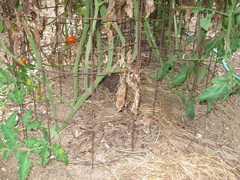
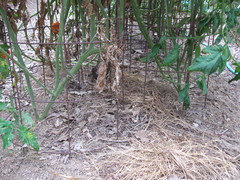
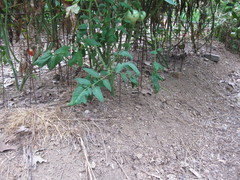
    I just ran out and took a few pics of what it looks like under my tomato beds right now. Like I said, my mulch has disintegrated to nothing. I really should put something down, but who knows, I have so many other things to do... like commenting on GardenWeb lol, that I may not add anything.


    Bermuda grass was definitely a part of the mix of materials put down as mulch. It's gone. And yes, I know that I need to clean up the dead leaves from off the plants, but alas... here I type. I'll have more maters than I have room in the freezer, or can eat. I even sell the extras and will still wind up throwing some away because I couldn't use them before they rotted on the counter top. And still no weeds lol.

  • 9 years ago

    Off topic, but your tomatoes look great, rgreen! How do you keep the blight off of them? Mine have died from it and leaf spot this year!

  • 9 years ago
    last modified: 9 years ago

    I kept the blight off them with camera angles Jacob LOL. You can see, especially in the top photo, some blight on those leaves. Later today I'll try to get pics, but early blight and septoria were vicious this year. In an attempt to control the spread, when the leaves become infected, I remove them. However, this year the blight was so bad, I couldn't risk removing all the infected leaves or too many of the fruit would have suffered sunscald. I lost a few fruits to sunscald, harvested some early, and even sold a couple of the ones that were too exposed to a neighbor who wanted green tomatoes lol.

    Every one of my determinates were taken out by disease just as the tomatoes were ripening. The indeterminates are doing better now - I only lost 2 of those to disease. The last few weeks have been way too dry for gardening, but it did have the benefit of putting a hold on diseases.

    But mine get hit so bad for 4 basic reasons... I live in an area that is well known for tomato production. Many of the big commercial companies (Hunts, Del Monte, etc...) lease farms all around me. The county just across the lake has a big tomato festival every year. It's this weekend come to think about it. They even got Charlie Daniel's band playing a free concert! Tomatoes there are the number one industry. That county does have a grocery store though... wait, they have two. Their biggest attraction at the festival is 2 days of tomato wars. They have so many tomatoes that they divide up attendees into teams and have a big tomato fight lol.

    Anyway, because tomato farming is so prevalent, there are a lot of diseases. The Ag. Ext. Agent came to visit me this year and was telling me that the larger companies are having a tough time. They've sprayed so heavily that they've bred strains of disease that are unaffected by fungicides. They are now having to rotate fungicides so to slow the developing immunity. It's a serious issue.

    The second reason I have a lot of disease is that I don't spray. The 3rd... I crowd my plants too close together. And the 4th is simple... the same climate that offers perfect conditions for tomatoes, also offers perfect conditions for the diseases that favor tomatoes lol.

    Did you lose all your plants?

  • 9 years ago

    Most yeah. They were beautiful until last month, when leaf spot and blight hit. It took only a few days after it arrived to kill most of the plants. Going to pull them and put a fall crop of beans in! This has happened to us every year for the past 4 years with tomatoes though, crop rotation and all...

  • 9 years ago
    last modified: 9 years ago

    Trying to narrow down the cause of your disease issues may take some work. If you lost all the plants in a few days, it wasn't just leaf spot and early blight. It was one of the more serious of problems. You'll have to examine each step of your process to give the plants their best opportunity to fend off problems.

    First step for next year starts this year. Don't compost or turn under any of the plant material. Either toss every tiny leaf in the trash can, or burn it down wind of your garden space.

    Next, treat next year's space as an entirely different garden. Don't just run the tiller through the garden all at once. Do the main part of the garden, and then mix up a bottle of bleach and water and spray down all parts of the tiller that contact the ground, brush it while you spray. If you use a turning fork, do the same type of sanitizing of your tools. Break new ground if you need. Keep that sanitizing procedure in place for at least 4 years, never re-growing in the same ground for 4 or more years. I go a step further and don't plant any solanaceae in the same space under the 4 year rotation. After the 4 years are up, you should be able to slack off a little.

    But next year, don't buy plants. Raise your own from seed and sanitize your tools and equipment. If your situation is as bad as you describe, you may, at least until you get the conditions under control, need to find varieties that offer some resistance. In my area, because of the fungicide immunity problem, many of the farms are switching to specially grafted plants where the root stock has resistance. Most home gardeners don't need to go that far, but that will depend on your issues.

    Next... transplant with wide spacing and mulch thickly. Whether you choose my mulching method, or any other, you want to prevent soil splashing.

    Next... use fungicides from day one, and trim off any leaves touching the mulch. As the plants get taller, trim off any leaves below 1' - 2' feet. This is mostly for indeterminates. You don't have much choice with determinates, all you can do is the same for indeterminates... provide good support keeping them up off the ground, and allow the branches to spread for good air circulation.

    You may even need to prune out branches to provide extra air flow. Many greenhouse growers prune out of necessity.

    If you see disease, prune off leaflets keeping your scissors/pruners clean while you do so.

    If you have to water, and you don't use ground level irrigation, do all you can to keep the plants themselves dry. Water when any surface moisture can dry off quickly. Follow a good watering regimen, promoting deep, well-established roots.

    One tactic is to learn how to cope under poor conditions. If you know that you've done all you can, then you switch to a different level of tolerance. You grow fast maturing varieties, and you get an early harvest and pretty much expect the plants to fall to disease.

    Anyway... I know the topic was a little different, but I sure hope you can figure out how to deal with such a problem. It's very frustrating when it happens year after year.

  • 9 years ago
    last modified: 9 years ago

    Thanks for the tips. I think another thing I'll do as well is plant different plants and varieties at different times. I may start some early maturing determinate in as late as July so that while the older plants are taking the hit, my hope is that the younger plants, in pots, will power through and set fruit when the blight is gone in fall....I would also like to put plants scattered everywhere in both my back and front garden rather than all next to each other, so that if one gets hit, it won't as easily spread to all the others. I've tried being very cleanly these last few years but it still doesn't seem to be enough. This year our plants fared so much better than the last 3 years still, so that gives me hope. Of course, I'll do preventative sprays as well more than likely. The only problem is that it gets too expensive to keep buying spray for preventative, so I may try baking soda as a preventative spray as my grandpa and aunt do.

    Something I'd like to clarify is that the plants didn't actually die within a few days, but that they might as well have because the blight/leaf spot had spread to almost every leaf!!


    Oh how this thread has gone off topic lol