Software
Houzz Logo Print
hyacin

Soil Test Recommendations

9 years ago

Hey all,

I'd like to get a thorough test done and thought I'd ask for suggestions as to a source. What testing business do you use and why? I figure it is easier to ask a bunch of people who do them often.

I live near Seattle if that makes a difference.

Thanks.

Comments (19)

  • 9 years ago

    I would recommend A&L Western Labs, Portland office (established specifically for analysis of Northwestern soils). They are accredited and one of the few labs in the country to fully participate in and be accredited by the North American Proficiency and ALP Programs which insures quality testing for accuracy and repeatability. One of the best labs in the country IMO.

    You can select individual suites of tests but I would recommend the S3C ($35 w/recommendations) which is fully comprehensive except for a buffer pH test which you would want to request if the results of your soil test return reporting a pH of less than pH 6 ($10 additional fee).

    http://www.al-labs-west.com/services.php?section=Soil%20Analysis

  • 8 years ago
    last modified: 8 years ago

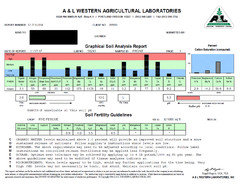
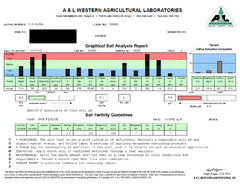
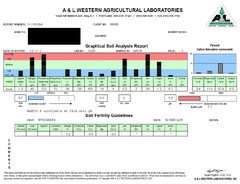
    Hello. I finally sent off some samples and it looks like I have some work to do. Any interpretations are appreciated. The order of the results for the areas is FRONT (850 sq ft), SIDE (708 sq ft), BACK (1700 sq ft). Milorganite may account for the nitrogen/phosphorus. I ran it on the heavy side this year.


  • PRO
    8 years ago
    What is grass type?
  • 8 years ago

    Cool Season. Mostly Rye & fine fescues. KGB in some random spots

  • 8 years ago
    last modified: 8 years ago

    If you do future soil tests (you should do one again next Fall or the year after subsequent to making adjustments), you only need to do one as all areas are nearly identical. Take a minimum of 8 soil samples evenly distributed throughout the lawn, mix them together well before taking a portion to send for testing.

    I would suggest that you request a buffer pH test. You only need one. I'd suggest the sample you sent from the front. A&L will give you a recommendation oh the amount of total lime needed to raise soil pH to mid 6s based on a lime CCE of 70. There are charts available on the net to calculate the 70 CCE recommendation to determine the amount of lime to apply based on the CCE of the lime you purchase. A pH in the mid to low 6s is a good compromise for nutrient availability and improved microbiology activity. Lime will also increase Calcium levels and improve Ca:Mg ratios (percentage of base saturation)

    NO3 is a bit high at >49 ppm. Values greater than 20-30 have often been observed to result in poor performing turf. Recommended N schedules for fescue is 3# per year. 1# on 6/1, 1# about 9/1 and a final pound as a winterizer. Adjust your N schedule.

    Phosphorous level of >88ppm is approaching maximums/excessive. At high levels P can result in a lack of AM fungus which helps supply the turf plant roots with micro-nutrients and improved soil structure. Adjust/eliminate your P inputs.

    Raising soil potassium content by following A&L recommendations will bring your Mg;K ratios towards recommended values (increase BS% towards 5-7%) and supplying the K, the turf needs. Apply a total of 8# of potassium sulfate at a rate of 2# per app spaced through a year. e.g. 2# this Fall, 2# next Spring, 2# at the end of Summer and 2# next Fall.

    EC is below 1, so soil salt content is not an issue. This allows chemical fertilizer additions with less possibility of adverse impact.

    Sulfur is a bit low (recommended level 20-30 ppm). Applying sulfate containing fertilizers will improve levels. Fortunately, use of the potassium sulfate will help raise this level w/o lowering your already low pH.

    Manganese and Boron MAY be a little low. Soils are almost never so deficient of trace elements to be detrimental to turf. Raw OM (leaves, alfalfa, mulch mowing etc) is a good and easy source of most trace elements. Once you raise pH, you should have an environment conducive to microbes for OM processing. There are other sources for trace elements (products for gardens, special fertilizer formulations at Site One, or some commercial organic fertilizers. However, use them sparingly, per package instructions for surface application. Better not to add some trace elements at all than to overdose.

    If I missed anything or been unclear, please ask.

  • 8 years ago

    There are buffer pHs noted: 6.9, 6.9, and 7.1. The lab didn't make a recommendation for lime. I would say it needs some because the pHs are low, especially the 5.2 one. The buffer pHs are high so apparently it won't take a lot of lime to increase the pH. I suggest calling the lab and asking them why they didn't recommend lime. Ask them how much it would take to raise your pH to 6.5. And ask what CCE their lime recommendation assumes.

  • 8 years ago
    last modified: 8 years ago

    I recommended a Buffer pH as I very strongly suspect one was not performed for the following reasons:

    1. No lime recommendation was made for soil water solutions reported at pH <6.

    2. The test results report Buffer pHs of 6.9, 6.9 and 7.1.

    3. Experience tells me that a soil water solution pH of 5.6 or less is not going to result in a Buffer pH of 6.9 absent some really strange circumstances like a nearly complete absence of CEC or a major soil sampling error (taking a sample following an acidifying amendment application), etc.

    4. A&L employs the SMP/Sikora Buffer pH test that uses a reagent solution buffered to pH 7.0. A 7.1 pH result should only occur if the test were made on an alkaline soil. A test on an acidic soil should result in a reported Buffer pH of <7. A reported Buffer pH of 7.1 indicates either that the soil water solution test pH of <6 is wrong and the soil water solution pH rest was improperly performed (a nice check btw), or the Buffer pH procedure was not properly performed. OR, a Buffer test was not performed, see below.

    5. I also know from past inquiries that as these reports are computer generated, if the report is set up to report Buffer pH and no Buffer pH results are entered into the program, the program will default to a buffer pH at or near the Buffer reagent nuetral pH value. Exactly why the program doesn't always just default to 7.0 rather than say 6.9 or 7.1 is unknown to me, as per inquiries: it's evidently a glitch.

    Now watch hyacin prove me wrong. Lol

  • 8 years ago

    Very good observations, Ridgerunner. It seemed strange to me that soil with CEC of around 10 would be so highly buffered. Hyacin, you should contact the lab and get a buffer test done (maybe they still have your samples). You need to know how much lime to put down.

  • 8 years ago

    I guess hyacin is going to leave us hanging.

  • 8 years ago

    I need to make a correction. Current pH buffered value guidlines for SMP is 7.5 and either 7.5 or 7.7 for Sikora. I'm sure this has been keeping many of you up at night.

  • 8 years ago

    Well, they checked the buffers and pH again....and they came back basically the same. I talked to the lab and the issue is that I have extremely sandy soil. He recommended 30-40 lbs of lime per 1,000 for the front and side, and up to 50 for the back, but recheck in 6 months because the application may leach quickly.


    This is making a lot of sense. I use milorganite now, but simple nitrogen applications were extremely short lived...30 days MAX in the grass, maybe 3 weeks. It is probably leaching down past the root zone. Also, my soil tends to dry out really quick. I really can't get away with once week watering in the sunny sections.

  • 8 years ago
    last modified: 8 years ago

    Thanks for checking with A&L and getting back. A&L would know what they are talking about. This will teach me not to put so much faith between the assumed relationship between CEC and soil texture. I have more to learn as a number of items here puzzle me somewhat. If you get a chance to look it up, could you post your soil type (e.g. andisol, kaolinite - from the USGS etc)? I'd like to read up on it. I'm not sufficiently familiar with NW soils and it is apparent that they have some special qualities. Maybe gardengal48 will stop by to give you more accurate advice. She's from the PNW and has had training.

    Thanks again for giving me the opportunity to continue learning.

    Have a great Thanksgiving.

  • 8 years ago

    With sandy soil, you should add as much organic material to the lawn as you can, including grass clippings, all leaves and all your neighbor's leaves, clean sawdust, etc.

  • 8 years ago

    riderunner said:

    I need to make a correction. Current pH buffered value guidlines for SMP
    is 7.5 and either 7.5 or 7.7 for Sikora. I'm sure this has been
    keeping many of you up at night.

    I was getting a little panicky for awhile there, but I'm better now.

    What is your point about CEC and soil structure that you were mistaken about? A CEC at or below 10 as we see here is pretty low and indicates sandy soil, no? My CEC is pretty much the same, maybe a bit over 10 and I have sandy soil as well (albeit with a higher organic %). What is off kilter?

  • 8 years ago

    I've done nothing but mulch mow this entire year. Mid-April I will be doing an aerate/detach/topdress/overseed to address building up more organic material.

  • 8 years ago

    Don't dethatch unless you have thatch. If you have thatch then something is wrong. Aerating and dethatching is something of a hot topic here. Many people have great lawns and have never dethatched or aerated. If your soil is in good shape then you don't need those things. On the other hand, if you simply must do it because everybody says so, then it won't really hurt. It's just more work. And who knows, maybe it will help.

    Take a shovel and stick it straight down in the lawn. Wiggle the shovel to create a gap and then pry up a section of the lawn so you can see a profile of the roots and soil. If you don't have thatch, then don't dethatch the lawn. Post the pic here if you want help. Remember, grass clippings and leaf mulch on the top section of the lawn are not thatch. Thatch is fibrous roots that form a mat and can eventually prevent nutrients and water from getting into the soil. It is sometimes a symptom of watering shallow and frequently.

  • 8 years ago

    I don't worry about CEC unless it's under 5. Under 5, nutrients leach and it's best to spoon feed and rely more on soil life rather than the soil itself to hold onto anything. Between 5 and 10, it leaches more than you'd like but is not as bad as under 5. 10-20 is great. Above 20 you've got soil that holds lots and lots of nutrients. It also likely has a lot of clay and may have drainage issues. CEC of 10 is a normal number.

  • 8 years ago
    last modified: 8 years ago

    What is your point about CEC and soil structure that you were mistaken
    about? A CEC at or below 10 as we see here is pretty low and indicates
    sandy soil, no? My CEC is pretty much the same, maybe a bit over 10 and
    I have sandy soil as well (albeit with a higher organic %). What is
    off kilter?

    Don't really have time to adequately explain right now, I'll give it a shot sometime later.

    Short answer:

    Don't confuse me with the facts when my mind is already made up!!!

    Happy Thanksgiving, all.