Software
Houzz Logo Print
l_d_g

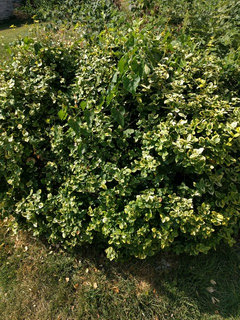
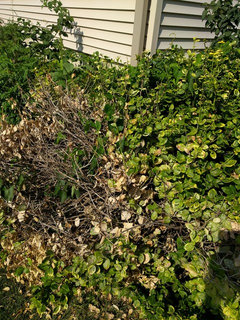
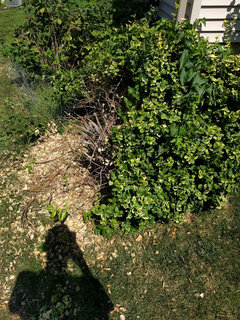
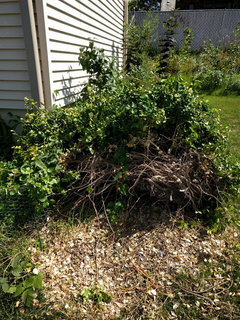
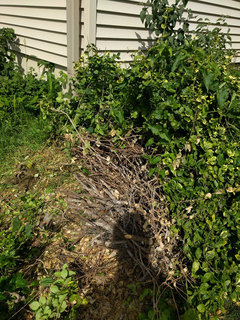
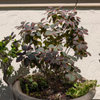
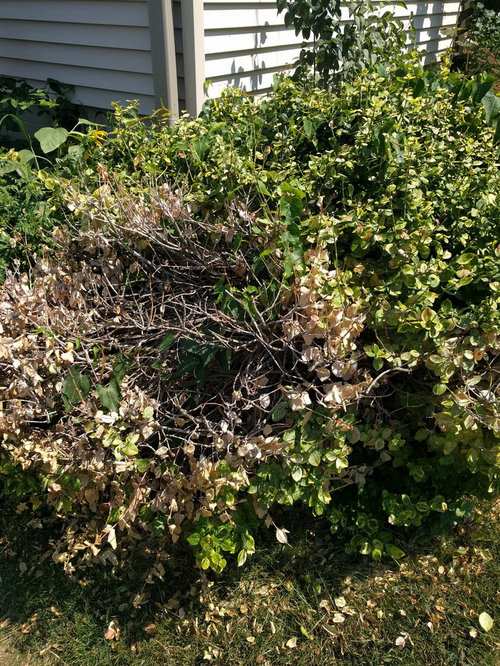
Is this dehydration?

9 years ago

Plants · More Info
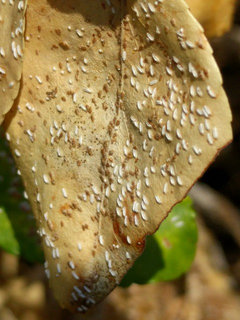
The dead leaves also have a bunch of white dots. Look a lot like aphids, but white. Did it not get enough water this year or is this some sort of disease?

Comments (19)

  • 9 years ago

    Is that a boxwood? If so, probably leaf miner damage. Mine were hit hard this year.

  • 9 years ago

    I would never recommend removal until the plant is positively ID'd as well as the issue.

  • 9 years ago

    Well, large chunks of it appear to be dying, so leaving it in place is probably not a great idea. I'd agree that we need clearer and closer photos to ID but there's a lot of dead wood visible that is unlikely to regenerate and that pruning out will probably not help. Removal is a very viable and reasonable option.

  • 9 years ago

    we need pix of leaves.. close enough to ID the plant.. perhaps with a scale ...


    but when you get the ID.. consider that it will most likely be cheaper to remove the darn thing.. rather than spend twice as much to cure it.. than it would to buy something else ...


    especially if its a boxwood ... they just have so many problems ... or even if Euonymus ... as scale is just as big a problem


    always keep the cost/benefit ratio in mind ...


    ken


  • 9 years ago

    Finding white dots on a Euonymus this time of year is virtually 100% Euonymus scale. Watering it well and treating it with a systemic pesticide may be enough to save the rest of it.

    My experiences with Euonymus scale is that it flies under the radar until the plant starts dying after which things happen very quickly.

  • 9 years ago

    Dave..I enlarged the pic and can see why you're thinking euonymous..I was focused on all the dead and it reminded me of all the pics I've seen on GW of dying boxwoods..I would still remove it..life is too short to put up with sickly plants..

  • 9 years ago

    Could be a boxwood...no idea. It was already planted by the time we came along. We have 2 dogs. I'm not opposed to removing it...just need ideas for a replacement (preferably something that flowers).

    Plants · More Info

    Plants · More Info

    Plants · More Info


  • 9 years ago

    Yep, a euonymus and with a good case of scale (enlarging photos, you can see it covering the stems as well). There is also some sort of weedy vine growing up through it as well. Since the scale has already decimated a significant portion of the plant, I wouldn't hesitate to rip it out. And would inspect its neighbors to see how badly they are affected. A wholesale relandscaping effort for this area may be called for :-))

  • 9 years ago

    I have young lilacs next to this. No damage is evident...how do I make sure they don't get hit?

  • 9 years ago

    euonymus scale is a problem on euonymus. hence the name. it's rather species specific. If you have euonymus, you'll have scale. It's not necessarily hard to take care of...a couple applications of dormant oil. It's also not something that always needs to be dealt with.

    spots like this aren't uncommon in euonymus. You can prune out effected areas...the plant will generally regrow, hard to predict how quickly. Causes are sometimes difficult to pin down to a single cause...scale, spider mite, dog pee, rodent browsing...all are possibilities.

  • 9 years ago

    I'm going to disagree with the above. With an infestation of scale such as is showing in your shrub, there is no coming back from that degree of damage. It will only get worse. I would also disagree that it doesn't always need treating - if you have scale, you need to treat or be prepared for more of the above.

    And euonymus scale is not restricted only to euonymus - it can also affect a number of other plants including your neighboring lilac, hibiscus, hollies, pachysandra, honeysuckles, camellias, ligustrum (privet), ivy and pachysandra.

    It is also an armored scale so it is not just a matter of spraying with a horticultural oil but when - you have to time the applications to coincide with the vulnerable stages of the scale insect.

  • 9 years ago

    I latched onto it being a boxwood and thought euonymus was the disease. I should perhaps note that it did the same thing last year at least. Don't remember previous years. That vine has been trying to consume it the entire time and that bare spot is not endearing me to it. I just don't know what would make the most sense-fixing it or ripping it out.

  • 9 years ago

    Update: we cut it back a bit. We'll see if it recovers.

    Plants · More Info

    Plants · More Info

  • 9 years ago

    That only helps if you treat for scale insects on the rest of the shrub (or confirm it doesn't have ANY scale). If not, the rest of it will follow the part you cut off in 1-2 years.

  • 9 years ago

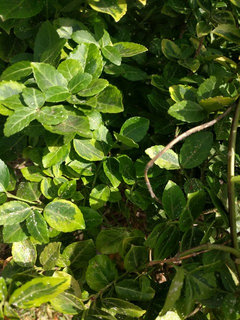
    You need to take pics close up of the green leaves. There may be scale on those as well, undersurfaces, stems, etc.


  • 9 years ago

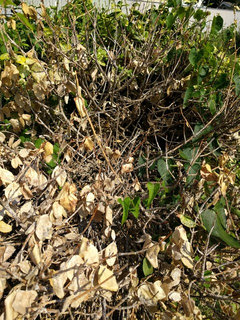
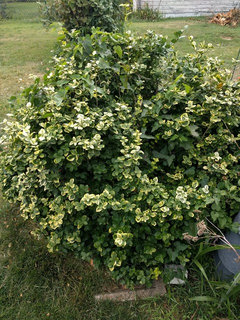
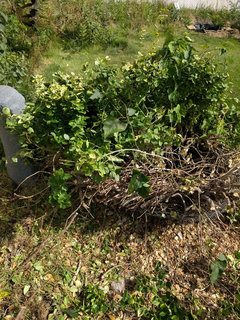
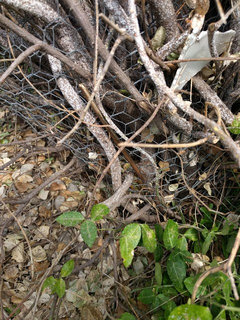
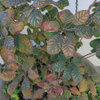
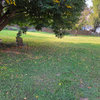
    Here are some more shots. I cut back more...not sure if I missed the first time or it spread. Hate to see it die like this, bit not sure what I can do to help (seems late in the season to do much).


    Plants · More Info

    Plants · More Info

    Plants · More Info

    Plants · More Info

    Plants · More Info

    Plants · More Info

  • 9 years ago
    last modified: 9 years ago

    Euonymus scale is an insect so it is reasonable to believe that it exists in lower numbers on healthy parts of the shrub. Over the next 1-2 seasons (without treatment), the scale will reproduce to numbers that will cause damage and death to the remainder of the shrub. Cutting off the dead bits was just an aesthetic treatment, not a practical one.

    Treatment next spring with a systemic pesticide is probably the most effective way to kill the scale insect (other than removing the shrub completely).

  • 9 years ago

    Scale is still very apparent on leaves and bare stems. You will never get this completely under control and it will reappear - in spades - on any new growth that is generated.

    I would very seriously consider removing ALL these plants and replacing with something else less inclined to this issue.