Software
Houzz Logo Print
ladychroe

They are very ill

9 years ago
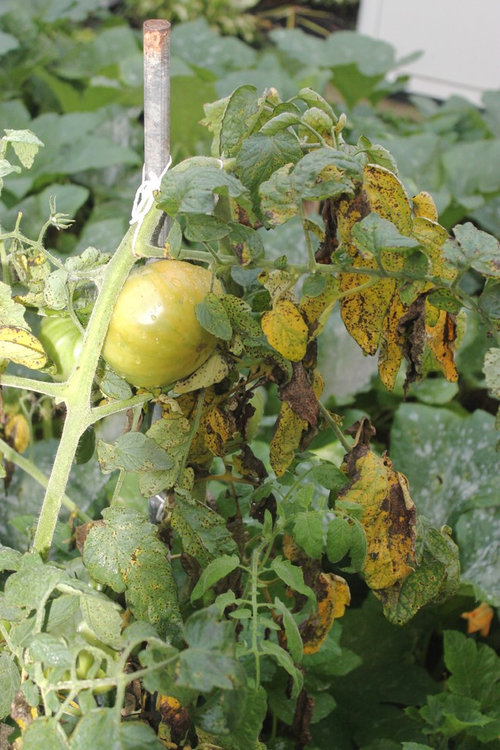
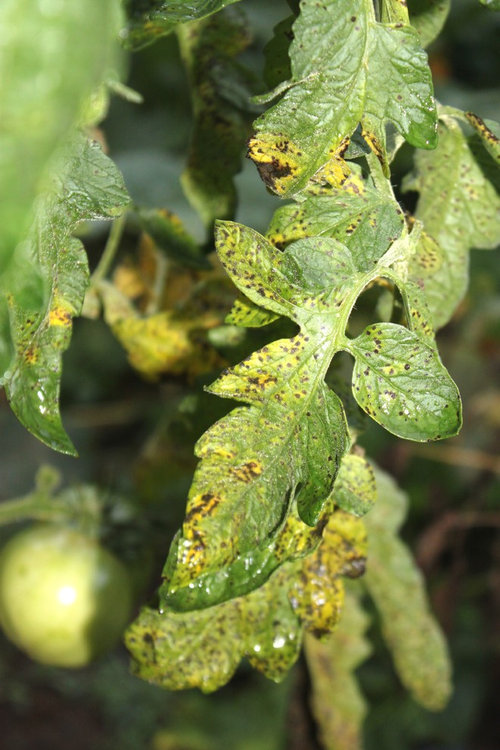
Hi. My tomatoes are not well. They started off great, but have been slowly dying from the ground up. I gave them some organic fertilizer (no improvement), and they have lots of rain this year. Half the leaves are dead, the rest look like this:


Thanks!


Comments (12)

  • 9 years ago
    last modified: 9 years ago

    Yeah they are badly diseased. Looks like Bacterial Spot. Have you done any disease control - removing infected foliage and spraying with fungicides - on them? If not then it may be too late to save them now as treatment is usually started at the first signs of disease. But you can give it a try. Strip off the worst of the infected foliage, bag it and dispose of it away from the garden and then get your hands on one of the many good fungicides you can find locally (the ones with copper in them work best on bacterial diseases) and follow the label directions for regular spraying.

    Are they in ground or in containers? Have you only fed them the one time? With what?

    Dave

  • 9 years ago

    I can try a fungicide. I was hoping to stay organic which is why I didn't do anything about them earlier. They are in the ground, and all of them (9) have this problem to some extent. 2 are dead, several are affected but are growing and putting out new growth from top as well as some suckers at the bottom. I usually keep them pinched to a central leader or two, but I am encouraging this new growth because it's healthy (for now.)


    I fed them a few times with an organic fertilizer, I'll try to check the brand and numbers.

  • 9 years ago

    Agree with rhizo - you need to learn more about how to garden organically if that is your goal. It isn't something one can just jump into blindly. It requires far more of an investment in learning than so-called synthetic gardening does. It also requires greater preparation, regular monitoring, and much faster intervention on the part of the gardener.

    Things like diseases, pests, and proper plant nutrition are all common garden problems no matter which approach one chooses to take and both organic and synthetic controls are available for all of them.

    Dave

  • 9 years ago
    last modified: 9 years ago

    That's why I'm here: to learn. Thanks

  • 9 years ago

    I'm an organic farmer in Maryland, also zone 6 like you ladychroe, and despite spraying my field tomatoes regularly, they look awful this year. I think copper based products are the best fungicides to use on tomatoes, but I alternate with Serenade and Milstop. Many of my fellow organic farmers think that copper isn't allowed in the NOP, but it is, as long as you aren't using such a high concentration so as to act as an herbicide. I've had at least 2 organic farmers tell me that I'm not allowed to use copper, but my certifier has approved Liqui-Cop.

    We have so much humidity in the Mid-Atlantic that it can be a real battle in the field. We've also had a lot of rain this year, and I've had trouble finding dry times to even spray. I planted my field tomatoes late in the season and started spraying as soon as I put them in the ground, but it's horrible out there this year. The tomatoes in my high tunnel are doing great. I'm at the point where I may not bother with field tomatoes anymore.

  • 9 years ago

    Thanks, MD. I'm going to try the copper spray. Here in NJ it has been raining heavily 1x or 2x a week all summer, I have not needed to water my lawn or garden at all. This is unheard of here, and I'm sure in MD as well. Thank you for sharing your experience and I hope things pick up for you!


    If it's not one thing, it's another.

  • 9 years ago

    And if you get fed up, Daconil will stop the disease from progressing.

  • 9 years ago

    >> Looks like Bacterial Spot. Have you done any disease control - removing infected foliage and spraying with fungicides - on them?

    How will a fungicide help 'bacterial spot'?

    I expect it is indeed a fungal blight but what do I know. Other than the fact that I think my whole garden has a longstanding Fusarium (fungal blight) infection. :-D

  • 9 years ago

    I was thinking it is Septoria. Those 2 look so similiar it is hard for me to tell.

  • 9 years ago

    "Daconil will stop the disease from progressing."

    No Daconil does not stop any disease from progressing once it is established on the plant. It can prevent the disease if applied regularly from the day of plant out but otherwise it can only slow down the progression when applied to new not-yet-infected foliage. Which is why removing the worst of the already infected foliage is also recommended.

    "How will a fungicide help 'bacterial spot'?"

    Note I said above - the ones with copper in them work best on bacterial diseases - as the copper-based fungicides have proven to be quite effective against bacterial diseases as copper is also a strong bactericide. It is a big advantage they have over Daconil as it does little for bacterial diseases.

    "I was thinking it is Septoria. Those 2 look so similiar it is hard for me to tell."

    It's possible but the crucial difference is that Septoria spots are normally raised and puffy on the leaf surface while bacterial spot and speck normally have a sunken or recessed appearance on the leaf surface. In the photos these don't look puffy to me. But the treatment for both is the same.

    Dave

  • 9 years ago

    I was Keying on the wave front of dying leaf material which looks so much like a fungal ring.