Software
Houzz Logo Print
brunnette0

Dying veggie garden

9 years ago

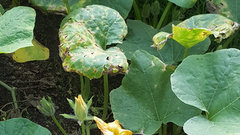
Hey guys, I am in desperate need of advice! I started a raised veggies garden last year and it did really well. I have two small beds next to each other and I planted tomatoes, cucumber, zucchini and peppers. My tomatoes are doing well and my pepper plants are still healthy looking butndont produce well. My cucumber and zucchini plants on the other hand have taken a turn for the worst :(. Let's start off with my cucumber plants! Up until 1 month ago they were huge, healthy and green and had tiny cucumbers all over. Now my two largest plants have dry vines and the leaves look like they were burned with a lighter. Yellow and crispy. Most of the fruit is yellowing before it grows. I have 3 other plants that look healthy but produce one fruit at a time. Same goes for my zucchini plants , I had to pull two plants and toss them because they died on me and the 4 I have left aren't really producing any frruit.

i think it's the powdery mildew that killed my plants and thebynsteadybweather we've had in Michigan. I couldn't seem to keep up with the white powery mildew this year. Sorry for my long rant but I am just frustrated l. Any advice would be appreciated it so I can take notes for next year.

Comments (32)

  • 9 years ago

    Generally Springtime planted cukes and squash are pretty much toast by late Aug in most places.

    brunnette0 thanked vgkg Z-7 Va
  • 9 years ago

    Not enough info to give much advice. If your problem is powdery mildew, then you need to deal with that. That doesn't make plants look like they were burned with a lighter, though. Do you fertilize? Do you water? Do you have SVBs on your squash?

    brunnette0 thanked daninthedirt (USDA 9a, HZ9, CentTX, Sunset z30, Cfa)
  • 9 years ago

    You can get the mosiac virus on curcubits real easy. Ask me how I know! These are winter squash with yet another disease that sounds like what you are experiencing and is what I believe is some virus as I use Daconil.

    brunnette0 thanked trickyputt
  • 9 years ago

    Dan, I water everyday at the same time, I fertilize ever 3-4 weeks and there are no signs of SVBs.

  • 9 years ago

    I expect cukes, zucchinis and green beans to wear out by mid August. We use succession planting to keep 'em going a little longer. Next year, plant a couple cuke seeds every two weeks instead of planting a whole row at once. Plant beans & summer squash twice, timed a couple weeks apart.

    brunnette0 thanked cecily
  • 9 years ago

    Thank you for the advice. I will try it next year. Luckily I will have a couple plants that are healthy

  • 9 years ago

    Of course, you could water just a little bit every day. That would avoid "overwatering", which would leach soil nutrients and drown roots, but yes, you'd then get shallow roots, and wet surface soil (and perhaps wet plants as well) that would harbor disease.

    That's why the best watering strategy is a lot, infrequently.

  • 9 years ago

    That's good to know Dan, when I water it's usually a little and in the morning. I will avoid watering everyday. Any tips on how to handled powdery mildew?

  • 9 years ago

    Re powdery mildew, once you have it, it's hard to eradicate. Lots of home remedies for preventing it. Like spraying with baking soda solution (sodium bicarbonate). That works. I have not tried it myself, but I understand that spraying with a potassium bicarbonate solution is effective at getting rid of powdery mildew. You can get that stuff at brewer-supply houses, and maybe also at health food stores.

  • 9 years ago

    The standard treatment for Powdery Mildew is one of the many fungicides available on the market. They come in both organic and synthetic forms. Homemade concoctions often do as much damage to the plant as the PM does and sodium bicarb is notorious for burning plant leaves. But as already mentioned, once it is established there is no cure, only a slowing down effect at best. That's why it is vital to catch it early. Removing as much of the badly infected foliage also helps keep it from spreading.

    As for the watering it isn't just avoiding daily watering as even every other day is often too much. But rather deep watering and doing it much less often. You want to shoot for no more than once a week except in the high heat of summer and then maybe 2x a week max but you need to get the water deep into the soil - until it runs out the bottom of the bed - and avoid wetting the foliage. As Dan said, "the best watering strategy is a lot [of it], infrequently."

    Dave

  • 9 years ago

    Dave, do you have any experience with potassium bicarbonate? I agree that bicarb solutions are not easy on leaves (they tend to be pretty alkaline), but I have heard that potassium bicarb actually kills powdery mildew. Maybe just a myth.

  • 9 years ago

    tricky, Daconil will have zero control over any virus. There are no chemicals that can treat a plant virus. I urge you to get the diseases diagnosed properly before you spray.

    Powdery mildew is a pecular disease. It's not a water borne fungus though thrives in humidity. One way of preventing infection is to syringe the leaves off every day, in the morning. This act rinses the live propagules off before they can infect the plant cells.

    Neem oil sprays can prevent and cure infections, as can other horticultural oils. Of course, one must be cautious of using oils in the heat of summer.

    Many have reported success with sodium or potassium bicarbs. They are tried and true treatments, but be sure to research rates, etc.

    I use a combination of water syringes plus Surround caolin clay applications.


  • 9 years ago
    last modified: 9 years ago

    My understanding is that sodium bicarb is a preventative. Doesn't kill the PM. Potassium bicarb, "it is said" works better. I have not tried it myself.

    Here is one research reference that suggests that potassium bicarb "controls" PM better than sodium bicarb.

    https://attra.ncat.org/attra-pub/viewhtml.php?id=126

    Potassium bicarbonate is a standard ingredient for brewers and vintners to reduce acidity. Pretty cheap at homebrew stores.

  • 9 years ago

    Rhizo, I am finding that as I maintain a fungicidal spray program, those pesky viral problems come into a relief that does make them more identifiable. I has been so hot here I have not used neem oil. I am fairly sure its a bug born virus on those squash at this point.

  • 9 years ago
    last modified: 9 years ago

    I think sodium bicarbonate helps somewhat slow the progression of PM. My cucumbers get PM every year and I usually do nothing about it. At the first signs of it a few weeks back, I made a solution (about 1tbsp sod.bic. to a gallon of water) and sprayed several times a week. It seems to have slowed the spread of PM without being harsh on the leaves. Even though my cucumbers are under assault from a ton of aphids, have bacterial wilt on top of the PM and are definitely fast on the decline, they still look better then usual for this time of year. I guess this is only anecdotal evidence, but I though I'd mention it as I don't feel this concentration harmed the plant.

    OTOH, I may have overdone a soapy solution against aphids for one pepper plant, as it dropped a ton of foliage days after the spraying! :/

  • 9 years ago

    I was impressed with the effects of aspirin, which lead me to read about the studies of aspirin and its antifungal properties. It was strongly effective for 2 weeks in my garden, weakly effective in the 3rd, and needed to be resprayed by the 4 week. Rain impacted its effect, as the light, white residue remaining after spraying was the topically effective element. I used 4 325mg tablets per gallon of water.

  • 9 years ago

    If the primary action of bicarbonates is to change the pH to where the fungus isn't happy growing, then either sodium or potassium will work equally well. But maybe a high level of K+ does something so it works better than sodium bicarb.

    If it's a pH effect, it doesn't take much to change the pH of tap water to the 8.3 bicarbonate buffer pH. Most tap water is already over 7 to prevent corrosion in the pipes.

  • 9 years ago

    I read the problem was sodium build up versus potassium benefit in a long term program. The idea being potassium moving through soil but not as fast as N does.

  • 9 years ago

    That's correct that carbonates and bicarbonates effectively make things more alkaline. Not clear why potassium allegedly does a better job on PM than sodium, but the idea that potassium is more mobile in soil and would not build up as much as sodium is an interesting one.

    I believe the standard commercial treatment for PM is Armicarb, which is potassium bicarbonate, and acts as a broad spectrum fungicide. I suspect sodium bicarbonate is often used instead by small growers just because it is easier to come by and has some of the same effects.

    In that context, I can't imagine how aspirin would be of value. It will acidify.

  • 9 years ago

    It occurs to me that, if I remember correctly, aspirin (salicylic acid) actually helps strengthen plants against toxic stresses which, I assume, might include fungal disease. That is, it doesn't kill the fungus, but might render the plant better equipped to survive it. Not at all clear that foliar application is effective, though.

  • 9 years ago

    Actually it does both, but in different ways. Petri dish growth patterns indicated antifungal properties of aspirin via a contact mechanism in the same way a dusting or sprayed on film layer can serve as a preventative. The Tomato also will be stimulated internally to activate its own defensive mechanisms such as they are and as they behave. Neither process is effective for me on stronger pathogens such as bacterial wilt so I moved to stronger control -but aspirin controles ths powdery mildew for me quite well.

    I apologize for not tracking these source publications as I mainly read about my green hobby on my phone, but I can say this information came to me in some of the more intensely academic publications I was able to search out on the great google. I am not able to glean much from the most intensely mathmatical scientific works, as the language can be so dense that it loses me and thus the integrity of the message goes to static, but many are overview interperetations of academic studies and I find that I get more out of that broad and overview type written work than I do out of the hyper focused initial study type documentation.

  • 9 years ago

    No question that aspirin dust will kill stuff, but I guess the issue is whether it will kill leaf-surface fungi without killing the plants.

  • 9 years ago

    not in my experience, and this probably leads into its explosive popularity as a human medicine.

  • 9 years ago

    I have zucchini, crook neck yellow squash and cucumbers growing in the same raised bed as 3 tomato plants. Tomatoes are thirsty & it's impossible to confine watering in an enclosure to some plants. So everything was watered every other day. The squash had a couple yellow leaves underneath the upper green ones. I removed all the yellow leaves & they haven't come back. I'very seen other squash where fungus was so spread that the stems were transformed into goo. Maybe removing the wilted leaves kept them from affecting the rest of the plant, so getting it early is the key. Everyone tells me that watering early and watering the soil not the leaves helps.

  • 9 years ago

    Best way to deal with pain-in-the-butt veggies that require a ton of energy and frustration, is to buy them at the organic vendor at the local farmers market. Sometimes shopping is more fun.

  • 9 years ago

    Which "pain-in-the-butt" veggies were you referring to? Those mentioned are pretty easy to grow. There is probably a buy-your-own-veggies for fun forum, but this isn't it.

  • 9 years ago

    Hey Dan, I'm being sarcastic. I gave up squash due to all the bug problems. I'm about to give up green beans, too. I've had to fight off a ton of bugs, diseases and large rodents this year. As I age I am starting to give up those crops and flowers that take too much energy and frustration. Sooo...shopping for zuchini is more relaxing than growing it. How much of that stuff can you eat anyway.

    Onward...

  • 9 years ago
    last modified: 9 years ago

    For Brunette, the original poster. You will see that the weather and the animals and diseases will affect your plants and your emotions in the garden. Every year brings different results. Some years are very frustrating.

    As you get experience and knowledge, all these things will teach you what you want to grow and what isn't worth the effort. Gardening is supposed to be enjoyable and it's hard work too. You never stop learning. Unless you're growing for sale and profit (there is a professional gardening forum here), you may want to change what you grow so you can keep it organic and fairly successful. Finding insects and diseases is a (sometimes twice) daily chore. Trapping rodents is a daily chore I absolutely hate but it has to be done or I'd have no food.

    Plants have their seasons. As others said, cukes and zucchini like it warm, and it's been cool this summer. I've been gardening for 50 years of my life and this year the cukes are on their way out. I have a ton of them indoors waiting to be eaten, pickled or given away. So I'm satisfied.

    Most veggies need a deep watering (buy a rain gauge to stick in your garden), an inch a week, watering everyday just makes the plants' roots stay at the surface instead of going deep.

    Pick diseased leaves off the plants as you see them, especially the leaves close to the ground. Use an organic mulch like chopped up leaves and grass under the plants to conserve moisture and keep disease from splashing up onto the plants.

    Take out the diseased and dying plants and plant something else now that likes cold weather, like spinach and lettuce.

  • 9 years ago

    I am surprised that no one mentioned what is known to kill most squash and other cucurbits and that is the SVB - Squash Vine Borer - and it happens every year. There are also other diseases that beetles bring to cucurbits. Do a search for SVB to get more info on GW or other internet sites.

    Without pictures of those plants it is difficult to tell what the problems are and there are likely more than one problem. But it is also hard to say that over watering is a problem without know things such as 1. How much water 2. What type of soil 3. Weather conditions of that area 4. Whether plants are in soil or in pots 5. And prob some I have forgotten like how often but the OP did say daily.

    I water my plants (in the ground) daily during the heat of the summer and at times they may get water twice each day - depending on the weather, heat, rain, or lack of. I water deep using buckets of rain water.

    I don't experience any problems from watering daily. I do get bugs like anyone else but that is handled mostly by checking the leaves daily and either hand picking or using duct tape to remove them and any eggs spotted.

    As mentioned succession planting can help but then just how much squash or cukes do you need unless you are selling?

    Powdery Mildew is air born and impossible to prevent and does nothing to the fruit so I learned not to get excited about that. It was late coming this year but came none the less and is not as severe as some other years.

  • 9 years ago

    I mentioned SVBs way up at the top. Cukes are usually not threatened by those, though.


  • 9 years ago

    I agree with gummy. A little powdery mildew is not going to kill the plant. I usually just cut off those affected leaves and stalks. There are plenty to keep the plant healthy. It is more of an eye sore.