Software
Houzz Logo Print
hpsandiego

Difficult slope in backyard - design help

13 years ago
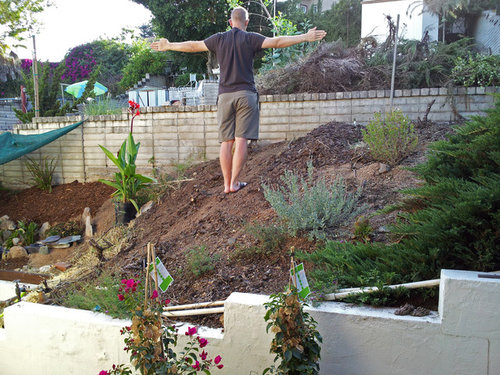
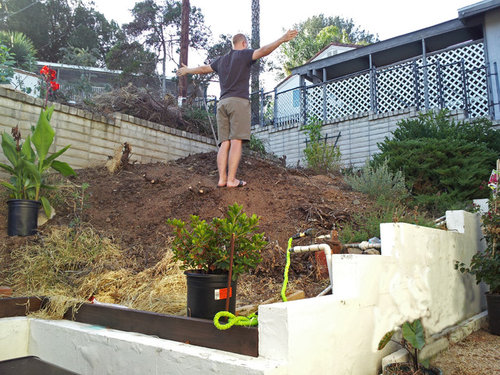
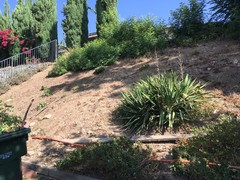
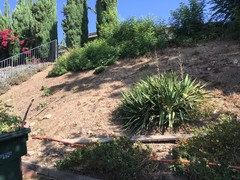
Just outside of our sliding glass doors from the dining room is a sloped area with retaining walls. The previous owner had juniper growing all over it, so now that we've pulled that out, we aren't sure what we want to do with the area.

Some ideas are:

We might like to plant a deciduous tree (somewhere in the middle) to allow some shade from the heavy sun that comes in from the west.

Do we keep it as a slope and just plant easy care plants over it?

Should we continue with the idea we had in the lower patio section (where we added a stained wood wall mimicking the white wall and help terrace out some of the slope? If so, where would you put said wood?

We considered a deck for a second, but we already have lots of seating areas in the other parts of the backyard....

I wish we had an easier access to the rest of the yard from the dining room (because at the moment, you have to go downstairs to come up the stairs that are on the other side of the yard) So we wondered if there was a way we could add stairs to get up there? There is only about 4 feet from the sliding doors to that first white retaining wall....I'm not sure how stairs would fit.

Any of your thoughts are greatly appreciated! :)

Comments (60)

  • PRO
    13 years ago
    I love the terracing idea. You could dig channels and then anchor your landscape timbers (or whatever other material you chose) using rebar pounded in. Landscape timbers are dead cheap at big box stores, and are fairly easy to work with on DIY projects.
  • PRO
    13 years ago
    Shelley, I think The angel of the north is a tiny bit bigger. And aren't you meant to be fighting the baddies?
  • 13 years ago
    No baddies tonight, Sauvignon blanc and les mis!
  • 13 years ago
    "Do we keep it as a slope and just plant easy care plants over it? " Yes!

    Here's a budget-minded idea ... forget terracing and retaining walls since you seem to have plenty of useful space already. Put a French drain in at the bottom of the slope to channel runoff. Then plant dramatic, low maintenance plants suitable to California. Look at Pride of Madeira, as an example. Here's a recent Ideabook on PoM:
    https://www.houzz.com/magazine/great-design-plant-pride-of-madeira-stsetivw-vs~8906861
  • 13 years ago
    @trebinje - the PoM is beautiful. It appears though that the slope is terraced as well.
  • 13 years ago
    @Roots and Rafters & ASVInteriors - Thank you for the ideas - I like the one pic of the walkway/veggie garden and like Roots and Rafters said to use wood which is kind of like we were doing down below. We used 2x6 which, if we could do it over again, a 2x8 or 10 would have been better height. We wedged with rebar behind. It worked out ok, but we live in a termite area, and the thought of more wood worries me. But I think with the design layout with the pathway, I can add at least one blocking area of terracing and fill in the rest with my tree and other CA Natives.
  • 13 years ago
    @trebinje - I love that plant! I'll have to look into that one - it would go great with my color scheme.
  • 13 years ago
    @Beth Bourque - actually, as this is a new home for us and we've been digging in other areas, turns out the whole hillside is covered in usable rock that we dig up - we are starting a pile :)
  • 13 years ago
    @rcmommy - thanks! Have you ever tried the shredded redwood? We have another area that is a hill and we mulched with that - it works really well since the shreddedness kind of works like velcro and holds them together. Much better than individual bark that rolls :)
  • 13 years ago
    @onthefence - thank you!!! It has been a real "treat" let me tell you! Maybe one day I'll share a pic of the whole yard. It has a lot of potential, but the previous owner really loved two things: CEMENT and JUNIPER.!!!! I think we've already pulled out close to 40 stumps of juniper already and also taken a jackhammer to some of the extracurricular cement pathways. :) Thank you for your pom poms :)
  • 13 years ago
    last modified: 13 years ago
    Would you consider a water feature or a pond?
  • 13 years ago
    last modified: 13 years ago
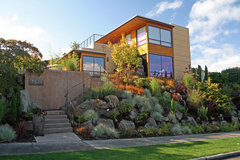
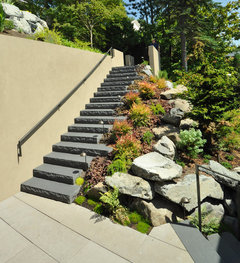
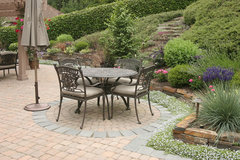
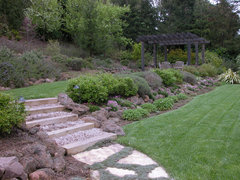
    I would seek advice first before removing or flattening the ground ( if you go that way) reason being is, usually soil close to a building structure acts as support for it. The other option is landscaping with rocks and a few bushes as in pages from Houzz here:

    Banyon Tree Design Portfolio · More Info


    Stairs · More Info


    Contemporary Patio · More Info
    ( we did something similar to this with a pond too at our holiday home)

    Lafayette · More Info


    Irvine · More Info
  • PRO
    13 years ago
    last modified: 13 years ago
    I really like the stone stabilizers idea in the photos above! Wood walls may not last, but could give your plants a chance to root. Replacing them in 5 years may or may not jeopardize the plants above them. Building code allows any wall under 48" (footing depth is counted as part of that height so 12-18" footing gives around 30 or so inches) total to be built without a permit. You could look at making a footing and putting in blocks for a small wall. If it curves that will give it some strength. There are many DIY plans for garden walls online. Good luck!
  • 13 years ago
    I agree with some kind of terracing . This will keep soil in its place and provide a wonderful area for your tree or other plants. Could even be an area for more seating.
  • 13 years ago
    Is there enough room for a terraced vegetable garden? That would make the slope useful. Otherwise I would add a local hardy ground cover and some of your rocks for decoration so you don't have to mess with it when you're done.
  • 13 years ago
    i think onthefence s idea is clean and modern looking
  • 13 years ago
    Did you look into a spiral staircase? I think I saw one that is only 36 inches in diam.
  • 13 years ago
    My yard is exactly like this! We are on a very tight budget and just decided to dig up the previous owners ugly ground covering plants and attempt to plant a bi level garden. My bf brought a bunch of landscaping rocks that we are using as a border for each of the two levels and all we need to do is add topsoil / and / or compost... looking forward to some veggies this summer :)
  • 13 years ago
    Omg, you have so many really great choices of plants that could handle that slope and reward you with bloom in San Diego sun. Look for plants that originate from South Africa and Mediterranean like African Daisy,Plumbago Auriculata, Spanish Lavender, Nierembergia. All low growing, heat and drought tolerant. I garden in Atlanta and am used to slopes. We use rocks to hold back soil where plants are not yet established and pine straw or course mulch which holds in place and doesn't shift. Sages are also reliable and there is a trailing rosemary that looks great cascading. you should try plants before going to the expense of more hard scape. all named above should be perennial for you. good Luck! Charlotte S. Atlanta,GA
  • 13 years ago
    Carpet roses. My friend installed them last summer here on a worse slope and they are holding her hill in place. More from Charlotte in Atlanta
  • 13 years ago
    I live in Kelowna, B.C. and we have a lot of hills. In my back yard I terraced it with large rock walls. I've seen other people do it in a much more informal way by placing large rocks all over the hill and planting in the spaces. It looks really nice and holds the slope.
  • 13 years ago
    I would use that rock, that I dug up out of the yards. Then plant things that are native to your area, around the rock. There is lots of ideas in landscaping books! Good luck.
  • 13 years ago
    OK - I'm in sd and have done lots of hillside planting and native reveg. I think you may want to organize levels and wait to plant this until November / December. If you plant now, you will have to do a lot more watering, a lot more weed killing around your new plants - let weeds come up this spring / summer / fall and kill them off in wait for our best planting season. That would give you some time to figure out some stair levels - like mini square decks that shift left and right up to this level from your door?

    hpsd is right that he really doesn't have to worry about erosion here - the soil is very granitic, and he still has roots anchoring his hillside there. We just don't get enough rain for this to be a problem. The problem is reverse, no moisture for establishing new plantings and hot sun / santa ana winds that can starve new plantings before they have a chance.

    For now, dig out a bigger hole where you have all those juniper roots, maybe rent a stump grinder and build a tree well where you want your future tree. Consider placing it so it can catch runoff from the rest of the area and grade accordingly. I recommend a pickaxe for this and buy a tree no larger than 15 gallon so its roots can get acclimated and you won't lose it. Water it deeply once a week (filling up your tree well) and excavate 2 x as deep as the root ball so it will drain well.

    Use the rocks you have found and organize a couple of areas using them as retaining- and go ahead and plant your favorite deciduous tree once you have your layout. I think while you are dug out, it is worth it to use white masonry paint to unify all the block visually - you don't need to stucco these back areas, just give them a coat of paint, it will be fresh and you'll be glad you did. Consider visiting the local library and take out a sunset western garden book to decide what kind of tree you want. Pick one with beautiful architecture that is very drought tolerant but not invasive (avoid eucalyptus in all forms, their duff will litter where you cannot establish underneath). Take a friday off and go up to visit the native focuses Tree of Life Nursery in San Juan Capistrano - they open to the public then and you can see a lot of native variety there, so you can see how lush and beautiful it is once established.

    Natives and drought tolerant plants are going to be your best backbone because once they are established they require no attention but the planting season that will help you most is 6 months away. The cool winter gives the roots time to get established before the spring warmth makes the plant bolt and the summer heat reminds it that it doesn't have the root system to support life. If you plant in winter, and water deeply once a week through the first two summers, then you won't have to water at all after that. You may choose to - watering most of the year will produce blooms 10 days later so you can plan ahead for parties!

    Here are some ideas for you to look for - screening from your neighbor at the side / back of the area top - masses of coffeeberry or sugarbush would grow into that over 4 years time. Tree mallow (pink bloom) grows faster but needs more water, so if you discover the areas where your neighbors watering keeps your soil wet, that is a good border plant for screening. I'm a big fan of cleveland sage - great smelling leaves to crush / get to about 3 - 4' roundish with spiky purple blooms 2 x a year - wonderful at the higher levels with nothing to screen but where you want attractive year round masses - great behind lavender. Monkeyflower comes in an apricot that would echo your dwarf birds of paradise, and they are great at spilling over walls just a bit - bring them forward and plant tightly for a lush look. If you need groundcover, there is a hybrid dwarf coyote bush with little white flowers - baccharis piluris that will get about 18" - 24" high and likes shade under your tree as well as the sun in winter. I see a bit of bouganvillea - if you purchase the spilling hybrid rather than the bush, it looks great behind walls at the top, spilling over - very spiky so keep away from human contact.
  • 13 years ago
    hi there, again I don't envy you the task but I am sure, once complete, it will be a great sight. My suggestion would be a terrace design as well with either natural stone or brick. I would also suggest installing a lighting system where it would show up your plants a treat in the beautiful Californian summer evenings. And if you want to go a further step, a few chunky wooden posts with a trellis where you can have either an ivy for shading and/or climbers such as passionflowers or clematis or whatever is suitable.
  • 13 years ago
    Librarydesign has given good advice, but I don't agree that you need to wait, even though fall planting is very often recommended bc plants put energy into root growth rather than top growth.

    Planting need not be that complicated. A strawberry tree (argutus __) is a nice drought tolerant native-type tree but is definitely not a shade tree as such. You can use phormiums (too many varieties to list) but be aware that often times the coral variegated ones revert (see, e.g., Rainbow Warrior, Maori Maiden) and you will end up with a horrid dull olive green plant. Yellow Wave is fabulous if you want a five-foot splash of yellow and Cookianum Cream Delight is a fantastic four-footer.

    To contrast with the phorimiums you can use chalk blue senecio mandraliscae is a great drought tolerant groundcover that combines well with all sorts of mediterranean plantings.
  • 13 years ago
    Get some pro advice re. drainage, then pick your favorite California natives. You won't have to baby them, and you'll attract birds and butterflies. There's a whole list in the California gardening section on Houzz: http://www.houzz.com/ideabooks/California-Native-Plants#California-Gardening
  • 13 years ago
    Any of the cement you jack hammered still there to be recycled into landscaping stones? You could create a few free form "stairs" among native wildflowers.
  • PRO
    13 years ago
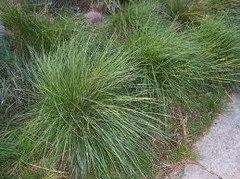
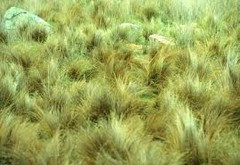
    Keep the slope and plant with a mix of tussocky grasses
  • 13 years ago
    We have a waterfall on a hill like this one. It winds 30' down, the hill is 14' high. At the bottom is a pool that has a swimming pool filter and pump and is grounded. The hill that was impossible to mow became a gorgeous focal point. We planted 3 holly trees at the top. Our recommendation is NOT TO USE HOLLY TREES anywhere near water. The hillside has beautiful azaleas, dogwood trees, 5000 plants in all, mostly pachysandra ground cover, some ligularia, and Autumn Joy. In the spring we plant wave petunias, verbena, and other ivy like plants.
  • 13 years ago
    Another photo of the waterfall
  • 13 years ago
    We also have as slope like that. Here is a budget friendly idea...Many good nurseries will offer their service of some landscape design for a very low fee ($200) as long as you buy the plants/materials from them. They also usually offer a discount on those plants (like 20% off.) You would be surprised how qualified many nursery workers are, it often a side job for them as they also do private landscape design. On another point, to be environmentally conscious, and the fact that you live in a very dry area AND CA is experiencing a drought...it would be very wise to plant in the Fall, you would then need to use less water to stabilize your new plants. I would definitely spend the time learning how to put in a drip system for your new plantings. (We did it, it is easy and saves money and water!) The best time to plant for the health of your plants, is Fall and it is also water wise. Good luck!
  • 13 years ago
    Sorry for the delay in my response - I've been away from the computer. Thanks everyone - what great ideas! I think I'm going to focus on maybe plating a few plants that are waiting to get a home, and look into at least oane baby wall....I'll use this time to think about all these ideas. I think it will turn out to be a combo. Stay tuned for a pic in a while. Oh, and I think I will end up putting that tree in there. It's going to be a hot one..... for any of you CA people, I just learned of this new (to me) tree: Chitalpa. It's a cross between two trees - to offer good shade and drought tolerant. :)
  • 13 years ago
    oh, and p.s. this is only one slope in our yard. On the other side of the property we've already designed that hill to be all sorts of CA natives and drought tolerant plants :) The bees and butterflies will LOVE it!
  • 13 years ago
    All those plants are already in - now we just need them to GROW!
  • 13 years ago
    I would recommend doing some terracing along the more difficult areas with mortar-less wall blocks. Check out www.belgard.biz for some wall solutions. These blocks are interlocking and you can do it yourself without a landscaper. Natural boulders work nice for wall, but they are extremely heavy and even landscapers would need heavy equipment to place boulders. Also research xeriscaping and use plantings recommended for dry, warm climates. You can use various colors of pebbles to add drama and reduce maintenance to you hillside as well.
  • 13 years ago
    Thanks for the heads up regarding the Chitalpa! I'll take a look at it for our zone. I just read a quick review of it and it seems ideal for the location we need a tree!
  • 13 years ago
    I have a mix of natives and non-natives in my yard - have fun with the birds of paradise, I have several mature ones and they are so reliably gorgeous. Chitalpa really requires well drained soil because it is a desert plant- your hillside isn't that kind of soil and you may have difficulty getting it established. If you have to pickaxe the hole open, put water into it and see if it is still standing or if it drains before you plant it. A fast growing drought tolerant tree is bottlebrush - it will deal with tough soils better and it gets tall - great red puffs - comes in bush form too so you can put masses near the back of the property to screen / give the eye some connection.
  • PRO
    13 years ago
    Multi level retaining walls , stairs and a water falls with a natural rook . Don,t forget the big O drainage pipe
  • PRO
    11 years ago

    This could be good spot for water fall

  • PRO
    11 years ago

    Last update by OP in 2013


  • 11 years ago

    please post the final results. i am very curious how it turned out.

  • 11 years ago

    So ironic you ask today.... we have in fact done some work on it but finally just yesterday came up with a final plan. :) the slope is the same at the moment but the lower section has cana and hibiscus growing nicely (to tie in the tropical look on the patio area more to left) and to block visual a little with up hill neighbors. To the right towards top of hill we planted a marina strawberry tree for shade on the house in the hot summer. Yes, we planted it too close to the retaining wall... on purpose but oh well - so far so good. We knocked down a little of the length of the upper retainer wall ( to walk around) and we just now mapped out that we will take the leap and cut into the lower white wall to add stairs to access the upper yards more quickly. We had a landscape designer come out for an hour consultation and agreed it needs access to the top. I've seen some nice meandering concrete stone steps look with retaining walls in various ways to hold back hill and at the top we'll build a small deck with seating under the new tree and maybe even a narrow rectangular fire pit. Results would be that we can move directly from the house/ kitchen area up the steps and into our yard - rather then out, then down steps then over through patio the up a longer flight of stairs and back over. :) it's going to take some time but we are excited. :)

  • 11 years ago

    Oh, and new irrigation is in and that horrible juniper is all gone :)

  • 11 years ago

    And that chain link fence has disappeared under a wonderful passion fruit vine - that produced a heavy amount of fruit already :)

  • 10 years ago
    The hillside is sliding. It's very steep. I cut the limbs off the old roots but have no idea what to do with it.
  • 10 years ago
    last modified: 10 years ago

    How do you want to USE the yard?

    My inclination would be to remove that lattice and open up the porch, build a deck one step below the porch and build a patio a few steps below that -- made with paving stones creating a circle, square or octagon shape around a dirt planting space about 6' wide for your shade tree and with small natural colored gravel between the paving stones and between the patio and the tree for water drainage.

    Building codes permitting, build a single high retaining wall at the bottom of the slope and bring in fill dirt to create as wide a level space as possible for your patio below your deck -- even if that means lowering the highest point as well as raising the lowest point.

  • 10 years ago

    Suez - this is the backyard from the back of the house I think. . what you are seeing above is their over the fence neighbor .. . usually the slopes belong to the guy below

    You can start your own post hulacookie, and we will follow you over.

  • 10 years ago

    If I do the hula on my way over, will she give me a cookie?! ;-)

  • 10 years ago
    My next project after the heat dies down is my hillside. I already have one stack of railroad ties at the base of my 16 foot slope.
    So I'm thinking another retaining wall and maybe a stairway. Lots of mulch and some new plants. I'd like to put in a new drip System to. I'm in California so I need something that will look good on the hillside I'd like something tropical looking. This hill runs the left side of my half acre lot.
  • 10 years ago

    hulacookie - I think you should start your own thread. A bit confusing cause this was started by someone else.....

Sponsored
Kuhns Contracting, Inc.
Average rating: 5 out of 5 stars26 Reviews
Central Ohio's Trusted Home Remodeler Specializing in Kitchens & Baths