Software
Houzz Logo Print
indiecook

Why is can lighting so complicated?

9 years ago
  • I've spent more time trying to figure out can lighting than my appliances, cabinetry, and countertops combined!

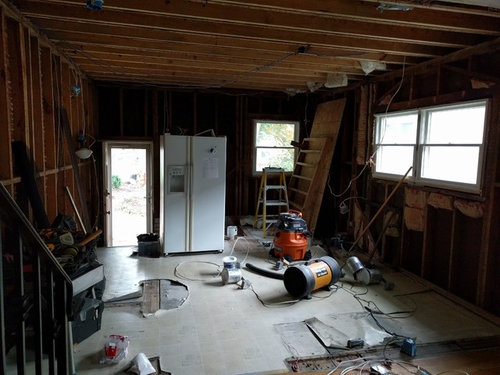
    Just starting on a down-to-the studs kitchen remodel with, as follows:

    • Cherry cabinetry w/ inset drawers/doors
    • Soapstone counter tops
    • Bluestar range&hood (36")
    • Bosch DW
    • Electrolux Fridge

I'm GCing the job. Demo is done (full 15 yard dumpster):

Including removing a number of walls. So onto lights... I've read the gold-standard advice post here -- very good stuff. Looking to do 4" cans about 4' apart 30" from wall to get the desired 35 lum/sqft. What I want in lighting:

  • 3000K color temp
  • 4" can
  • >90 CRI
  • Good dimming

Do I get a new construction can and a Cree bulb? Do I get a cree housing? what is an "LED Engine"? I'll only have about 6 can and have budgeted $800 for all of them so clearly the cree essentia is out of the question! Am I just as good off to go with a standard edison base fixture and a retrofit LED assembly? So confused.


Comments (32)

  • 9 years ago

    Following

  • 9 years ago

    I have these Lotus LED 4" gimbals installed in my hallway and they are fantastic. No cans needed. Dimmable with Lutron dimmers to about 10%. Great warm and bright light. Pro Lighting has a great price for these.

  • 9 years ago
    last modified: 9 years ago

    Light design is infuriating. You need the angle of the bulb/fixture for proper design, and that's usually very hard to find.

    Dimmers is the easy way out. Right now, I'm tempted.

  • 9 years ago
    last modified: 9 years ago

    Lighting is confusing.

    For recessed cans, you have two options and you are committed to going down one road or the other:

    1. New construction housing (get IC so you can sound insulate the ceiling) and then you can buy any led bulb you want. This option means that you will have "line" voltage (aka regular old 110v) running to the lights. Basically all the housings are pretty much the same and they are cheap. You buy whichever bulb you want and obviously you can change these in future as LED technology evolves or if you decide you prefer a different color temp etc. housing $15 or so, trims but pricier and for bulbs various prices but you can buy cheaper bulb now knowing prices will drop as quality improves. Housings are simply metal boxes --no advantage in overpaying

    2. Dedicated LED light fixtures--these come with the LED as part of the fixture so you are committed to that exact light source. some with high CRI Can get expensive. If a component breaks you have to hope the the company is still in business and making compatible parts since these aren't yet standardized: most are proprietary.

    I initially planned to get dedicated LED lights but after more research I'm leaning towards option 1 knowing I will be able to upgrade the bulbs to far better ones than I could buy now. I don't want to pay a premium for option 2 only to be boxed in. But I'd consider dedicated LED lights is if I had a space that was too shallow for the bulky housing.

    Let us know what you decide!

  • 9 years ago

    I put 8 cans on three separate zones in our small-ish 12 X 14 kitchen. We were going to use dimmers, but we're fine with it the way it is. When not doing any kitchen work, the small LED in the ceiling fan is fine for accent lighting. I bought cheap $7 cans, and $10 LED retro-fit units, and it all works fine, but we're not fussy.

  • 9 years ago

    Dimmers is the easy way out.

    Could you explain why you say this? I thought dimmers were just that, dimmers.... *confused*

  • 9 years ago
    last modified: 9 years ago

    Thanks so much for all of the input! Ironically enough the kitchen forum here has much better can lighting advice than the lighting forum. Odd.

    After relaxing a bit I've decided to go with Halo 4" new-construction IC housing and Cree DR4 series (SWMBO and I are still debating color temp) LED lights and Lutron dimmers. All available at the local HD.

    Of note, we are layering lights -- cans, a central flush-mount fixture, and pendants over peninsula.

  • 9 years ago
    last modified: 9 years ago

    Work surface task lighting needs to be placed so that you won't create a shadow on what you're doing. You can use a can spaced in front of the upper cabinet with a flood bulb. 30" is too far out. Under cab lights will help in some areas other than the sink and range. Post a layout with measurements for suggestions. Ambient lighting from a couple dimmed 6" cans in the middle could use regular size A19 led bulbs. Costco has dimmable(make sure)15w 100w equivalents for about $4 a piece. They throw a lot of light. Over 1000 lumens. Cans will show better than a flush-mount.

  • 9 years ago

    There are a couple things that worry me about the current LED units. One, they change constantly, so when one does eventually burn out, good luck finding a match. The first ones I installed are no longer available, and the replacements look different, both on and off. Secondly, they don't like lightning!

  • 9 years ago

    I'd personally steer clear of anything larger than 4". The future is smaller and less obtrusive. Unfortunately 3"are much more expensive right now.

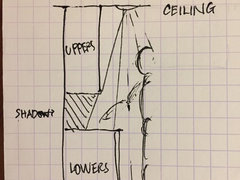
    Theres also very contradictory advice about location. There is not one perfect location in relation to the edge of the counter because it depends on ceiling height and also height cabinets are off counter etc. best way to optimize this is take graph paper and draw your cabinet height, ceiling heights, uppers, and place a person (average height or tallest person in house) in front of cabinets and make sure their head isn't casting a shadow right on the work area.

    If the light is over mid counter there might be glare (debated) but everything under the uppers is in shadow. Over the sink this isn't an issue so typically you'd center one light right over the sink . You can deal with under cabinet shadows with under cabinet lights. But...you are also casting a shadow near your feet so you might not see what is in the lower cabinets.

    As you move lights to the edge of the counter, more if it reaches under those upper cabinets onto the counter.

    When you move the lights away from the counter e.g. 6" out and beyond, the light can be behind you and thus your body might be casting a big shadow into the work area This is where ceiling height comes in--the higher the ceiling the less of an issue.

    Not to scale sketch here.


  • 9 years ago
    last modified: 9 years ago

    Another consideration in dimming is that good old incandescents get warmer as they dim, but LEDs generally don't--you just have less light of the same color temperature. I'm a fan of late evening, post-dinner ambiance, so I decided on "warm-dim" bulbs (I think from Philips?). They basically have two sets of LEDs in them, a cooler set that's in full force when you want bright light, along with a warmer set, so when you dim, the cooler set decreases and the warmer set comes into play. I think they're an excellent facsimile of what I like about incandescents with lower power usage.

  • 9 years ago

    Avatar, those sound great. My DH loves cool light, while I like it somewhat warmer. Those might be a good compromise- I'll have to look into them.

  • 9 years ago

    You can use a can spaced in front of the upper cabinet with a flood bulb. 30" is too far out.

    I think I've got the positioning of the cans -- I went 27" from the wall spaced 50" (or as close as framing will allow) on center. My ceiling height is 102" (I know, weird). I did the whole "light layering" -- cans, pendants, surface mount.


  • 9 years ago
    last modified: 9 years ago

    I have 50w halogen flood bulbs in cans with 3" diameter reflectors in 8' ceilings. My counters are 29" deep with 12-1/2" uppers. The center of the reflector is 19" from the wall. The work surface is lit without any shadows on what I'm doing. 27" would create more hand shadows on things. Especially if you have 24" counters. . . . . . .Enough secondary light hits the back wall and anything on the counter under the cabs. I can always turn on the two 6" can A19 leds in the center to use the ambient light to brighten things up. But that rarely happens. The task lighting kinda focusses my time in the kitchen area to go at the tasks at hand.

    I think manufacturers are just now getting the A19 100w equivalent led bulbs sorted out. That's the regular bulb everyone has lots of. I think a good halogen replacement is still coming along. So I'm waiting to change from halogen.

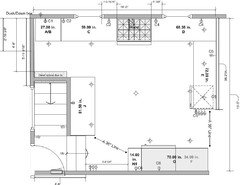
    I suggest you draw up and post your layout.

  • 9 years ago
    last modified: 9 years ago

    As requested:

    Notes:

    • I do not have any uppers. I will have two open shelves in front of each window on either side of the range.
    • The 27" A/B cabinet is full height.
    • "J" is on casters / moveable. The wall behind this is half-height.
    • The stairs lead to the basement. Moving them was simply NITB (not in the budget)
    • The "C" numbers indicate individual electrical circuits
    • I have cans / bulbs purchased but not installed.
  • PRO
    9 years ago

    I love the remodel cans. Rough in plenty of Romex, drywall, and cut in the lights after the cabinets are placed. Probably not as important on a job with no uppers, but when you're claustrophobic and lying on your belly in a hot Florida attic moving a regular can to bail out an electrician that couldn't find a pantry cabinet on a plan, you do everything you can to make sure it never happens again.

  • 9 years ago

    Joseph, the link's not working. :/

  • 9 years ago
    last modified: 9 years ago

    Sorry, beth--

    You SHOULD properly design lighting to have the correct lux level for the overhead lights and the correct lux level on the countertops for task lighting.

    You need to know bulb lumens, fixture/bulb angle, and distance from the ceiling to the counter and floor to get that right. The angle is hard to find. If you have this info, you can design a nice, even correct level of light with correct bulb spacing.

    Or you can just say "to heck with it" and slap a bunch of cans in the ceiling on a dimmer and stick task lighting where it feels good.

    Most people do #2.

  • 9 years ago

    Joseph, that is the funniest thing I've seen in a long time.

  • PRO
    9 years ago

    hahaha! Aw, that's a bummer.

  • 9 years ago

    Oh my gosh! Point well made Joseph.

  • 9 years ago

    Joseph -- where can I get those fixtures!!!!!

  • PRO
    9 years ago

    Plastic surgeon?

  • 9 years ago

    Well played my friend, well played.

  • 9 years ago

    lol

  • 9 years ago

    Too funny.

    But really, who could have predicted this result?

  • 9 years ago
    last modified: 9 years ago

    OK, let me start by saying that we've been thinking about remodeling our kitchen for years now. We thought it would happen "next year" for at least a couple of years now and it may or may not happen next year still. Dunno. We're dealing with a lot of stuff that needs to get done first.

    We've been going back and forth on lighting all this time, everything seems to have pros and cons and a lot of the options really locks us into installed hardware, which displeases me.

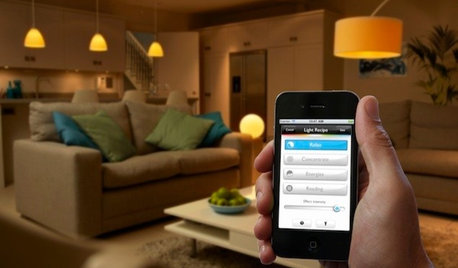
    Recently (2-3 weeks ago) however, the compact fluorescent bulbs on my porch burned out after many years of service. We live in an area which has loads of bugs during the warm part of the year, so we had some yellow "bug lights". They worked OK, but there were still some bugs anyway. And I didn't much care for the color it cast on the porch or that they looked dimmer than standard bulbs. Either way, it needed replacement, and, after some going back and forth and some thought, I decided to get the Philips Hue Color bulbs to play with and see what happened.

    I really liked them. I like that I can choose color and intensity, to vary according to need. I also liked that I can set them up to turn off when we leave the home and automatically turn on when we come back, although that has some glitches to be fixed depending on who left and came back (it is linked to your smartphone).

    So, I got another 4 bulbs for the living room to test and play with it for a while.

    This thing is rather addictive. I am really liking the freedom of choosing a different color white depending on if I'm watching TV, reading, just hanging out etc. Having even more fun with the different color "scenes", although that means that my original idea of using just the "white ambience" for the kitchen is probably not going to work. (Hue is offered in 3 tiers, I think: bulbs that are white and just dim, bulbs that dim and let you choose the color temp but are still white and the full color bulbs that do everything and the prices go up accordingly.)

    Either way, I think that simplifies the installation, because I won't need dimmers or anything special for the fixtures, and then I can choose the appropriate bulbs for each place/usage and even upgrade/downgrade the bulbs as we go along.

    I do encourage you to *test* them, though, because from what I've been seeing they are not for everyone, particularly from the perspective that if you want anything more than turn off/turn on (which brings them to around 2,700K "warm white" full brightness), you will need to either use your cell phone and/or ask an assistant (like Siri, Alexa, Google or Cortana) to carry some action. There are wireless switches that let you cycle thru some settings, but some people are more annoyed by the switches than using smartphones or assistants.

    But so far, I'm still resisting the urge to buy another 12 bulbs or so to put them in the dining room and kitchen even before remodeling and indulging in some pretty elaborate romantic scenes during dinners, so buyer beware... ;-)

    Philips hue LED bulbs and fixtures

  • 9 years ago

    When the power flickers, all the hue lights in your house go on full bright.

  • 9 years ago

    @Milly -- while that has not happened to us yet (power flickering), it does not surprise me, given that from the bulb's perspective, it was just turned off and then on.

    But it's a good thing to be forewarned about, thank you. I suppose it's also somewhat annoying, particularly if the lights were very dimmed before; on the other hand, it's hard to say there was a better way for them to behave -- someone complained about the lights turning on full bright every time to Philips sometime ago and was told it was for safety reasons, something to do with you don't wanna put them in the same state they were before powered off in case they were at 0% brightness or something. And it really has some merit, if I want to quickly clear the state of some bulbs, I can just turn the switch off and on -- I do that on the porch, if the lights are set to some color at 50% and people show up at the door, I just turn them off and on and they are full brightness, ready to go without having to deal with a smartphone or an assistant.

    I am told that the bulbs are also compatible with a lot of dimmers, so I suppose that would be an option for people who want a different behavior, or people who already have the dimmer switches. In my own case, I'd be using hue bulbs to *avoid* having to spend money on dimmer switches, because I know that some dimmer switches are not completely compatible with some electronic bulbs (CF or LED etc) and then either the switches, the bulbs or both start humming, which I find pretty annoying.

  • 9 years ago

    There is one brand that doesn't do this--I forget which now (so helpful, I know).

Sponsored
AIS Renovations
Average rating: 4.5 out of 5 stars15 Reviews
Custom Craftsmanship & Construction Solutions in Franklin County, Ohio