Software
Houzz Logo Print
tanyuu

Adding pond muck to clay soil?

9 years ago

There's an area of the garden that has been recently weeded and ready for plants from some fall sales. Problem is, even though it's next to a very healthy oak tree, it's hard clay, making it hard to even dig in, much less plant. No matter what, if I'm going to plant anything in it, I'm going to need to till and possibly amend it.

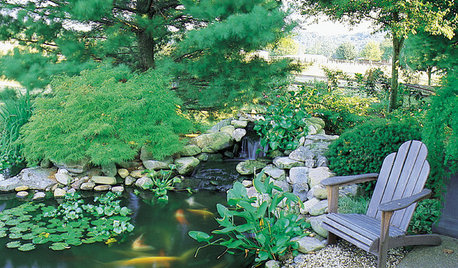
Nearby I have a man-made pond, complete with a pumped stream that runs downhill. Usually, when we ready it for the winter, we give it a good cleaning and just dump the black gunk downhill into the forest. Now, I'm wondering if I could possibly just dump it into this area and mix it in with shredded leaves and other fall goodies.

There's likely clay in the bottom of the pond due to a previous leak in the gutters, which sent a lot of clay into the pond when we had a lot of rain last spring. Aside from that, we're in an isolated area, and have not used any fertilizers or anything that could drain into the pond.

I've read about composting pond muck, and taking pond muck from natural ponds, but would this be a good idea to mix it in with clay?

Comments (15)

  • 9 years ago
    last modified: 9 years ago

    Pond muck might have pathogenic water molds in it. You don't want to amend soils that aren't going to be used as vegetable plots or annual bedding display areas anyway. Dig this area to loosen it for planting and establishment and plant without amending. Use sheets of plywood or place stepping stones to avoid compacting the soil and tracking it all over when planting. If you get started and then run into a bunch of oak roots do not mess with these. Cover the area with mulch and leave it unoccupied instead. Or get some well aerated soil, spread the shallowest possible layer of that and plant into it. Without disturbing the clay-like existing soil beneath.

    tanyuu thanked Embothrium
  • 9 years ago

    It wouldn't be my first choice. The best way to lighten or improve clay soil is to add coarse organic matter - almost finished but still chunky compost, shredded leaves, aged wood chips, etc. What you want is to open up the pore spaces in the clay and pond muck is not gonna do that!!

    I would save the nutrient rich muck for the compost or as a top dressing.

    tanyuu thanked gardengal48 (PNW Z8/9)
  • 9 years ago
    last modified: 9 years ago

    In my garden I added several different things to lighten too tight clay-silt-loam soil. Besides organic matter of finely chopped leaves, horse manure, local peat moss,and chopped crop residues, I added sand...lots of sand. It really, really worked.

    Trees nearby are death to most good gardening...both in roots and too much shade.

    tanyuu thanked wayne_5 zone 6a Central Indiana
  • 9 years ago

    Sand is seldom recommended to be added to clay to loosen. Unless one uses it in copious quantities - like at a 50% volume to the soil being worked - it is more likely to produce a cement-like consistency rather than adding to pore space and aggregation. IOW, the particle sizes are too small to be of benefit.

    tanyuu thanked gardengal48 (PNW Z8/9)
  • 9 years ago
    last modified: 9 years ago

    If there is no sand whatsoever present already - which of course is probably not usual - the 50% amount is where sand starts to change a clay-like soil. So since it often takes so much it can easily be overdone, resulting in the production of excessive drainage. Which causes recurring dryness and leaching. Something I've had happen myself, resulting in a sort of artificial barren.

    If a property has a normally diverse assortment of trees and shrubs etc. on it already that shows it is possible to plant and grow additional kinds without attempting to change the soil. The preferred method being to choose ones that are also adapted to the existing soil type. Rather than digging in a bunch* of organic matter that will decompose long before the life of a planting of long term kinds is over, resulting in the amended soil settling back into its original profile.

    *Organic content above 5% by volume is undesirable

    tanyuu thanked Embothrium
  • 9 years ago

    Silt loam soils likely have 25% sand already. It does NOT then take 50% volume more sand. I find that 3 inches of medium and coarse sand does the job of making a great working soil when also lots of good sources of organic matter are added also.

  • 9 years ago

    If you have a silt loam soil, then I fail to understand why you would want or need to add sand in the first place. A silty loam is pretty darn different from a clay based soil and that's what the OP is asking about. And it is NOT recommended to add sand to lighten a clay soil unless one is prepared to add a very large quantity. And it is never the first choice of amendments anyway - organic matter is.

  • 9 years ago

    The soil scientist at Purdue and Indiana State will tell any one willing to listen that adding sand to clay is not a good thing, unless the volume of sand is really high, like 50 percent.

    Silt loam soil likely have closer to 45 percent sand, not 25.

    This article by Linda Chalker-Scott has ben posted before but not read by many of the proponents of adding sand since it conflicts with their worldview.

    https://s3.wp.wsu.edu/uploads/sites/403/2015/03/soil-amendments-2.pdf

  • 9 years ago

    My inclination is to say one of two things:

    Either there is no way anyone can even begin to be able to help you based on the information provided,

    or you should re-read your own post and find the answer.

    So let's begin with the second. As stated, the problem is clay soil. You want to add clay to clay to solve the problem? But that's not the problem. Part of your garden is near a tree. that's the problem. So either you need to modify your culture practices or let the tree be...or...remove the tree. I'll assume for the sake of general principle you want to keep the tree.

    The first part of this gets into definitions and nuances. Supposedly, when people present a problem regarding soil issues, everyone has clay soil. And everyone assumes that means bad things. Your statement is that you want to add a material you describe as being clay to this. How is this going to help?

    I'm willing to bet a couple of things. More water and your issues of soil hardness start to go away. You don't have as much clay as you think, at least not to the point of being problematic. The tree is your bigger problem. More water. Or removal. or move the garden.

    tanyuu thanked waynedanielson
  • 9 years ago
    last modified: 9 years ago

    Thank you everyone for your advice! I'm going to avoid using the pond muck altogether.

    As for the tree, it's actually not a problem. I forgot to mention some things: first off, we live on a hill. The trunk of the oak tree is separated on three sides by a treated wood wall that follows the slope of the hillside around the tree.

    In terms of size, the tree's bottom is actually slightly lower than the basement, and it towers over our two story house. The bed we're developing is in one of the lower raised levels, so we'd probably have to really dig to hit any tree roots. As for shade, the canopy's high enough that a good amount of afternoon sun gets into this area.

    The problem with the soil sounds like it may have been our own doing. We'd weed and then do nothing with the area, which compounded the problem of the packed clay. Nothing to pack in moisture, a few hours of afternoon sun to bake it dry, and no plants to break up the soil.

    What we're going to do is add on top of the clay with various organic material, since a lot of the soil's eroded away (due to our weeding). We'll be adding fine mulch and shedded leaves on top to help keep in moisture, and limestone stepping stones to give us places to walk without compressing the soil back down.

    Thank you all again! You all went above and beyond to give me advice and ideas here. Maybe next spring I'll have photos to share in one of the other forums. :)

  • 9 years ago

    Back to silty loam soil. By definition, loam has a fair amount of clay. I have a fair amount of silt loam and some silty clay loam in the lower end of 2 gardens. The soil was fairly good to start with, but by adding sand and lots of organic matter, the soils are a joy to garden in...being 'lighter'

    tanyuu thanked wayne_5 zone 6a Central Indiana
  • 9 years ago

    How big is this pond? How much muck are we talking about? Is the pond lined with butyl or something? Or is it clay bottomed? If it's lined I would imagine that the muck is all organic rather than mineral. I have a tiny little lined pond and I just put the sludge on the compost heap.

    tanyuu thanked floral_uk z.8/9 SW UK
  • 9 years ago

    There is as much misunderstanding of what loam is as there is misunderstanding of topsoil. Loam is a soil type that is usually about 45 percent sand, 25 percent silt, 25 percent clay (not a fair amount) and 5 percent organic matter. As the writer of the article linked below says, "Loam is usually made of up half sand, one quarter silt, and one quarter clay. It is considered the best topsoil, as it allows enough water to be soaked into the ground to keep plants hydrated – and yet it still drains well enough that air can circulate."

    http://topsoilinfo.com/souvenir

    tanyuu thanked kimmq
  • 9 years ago
    last modified: 9 years ago

    floral_uk-

    I'm not sure of the exact measurements, but I roughly estimate it to be about 15 feet x20 feet, and about 25-30 inches deep depending on which level you're on. It's lined- might be be butyl or something like that.

    Good to know! I honestly need to start a compost bin up again.

Sponsored
Custom Home Works
Average rating: 4.6 out of 5 stars10 Reviews
Franklin County's Award-Winning Design, Build and Remodeling Expert