Software
Houzz Logo Print
whaas_5a

Why won't they thrive for you!

9 years ago
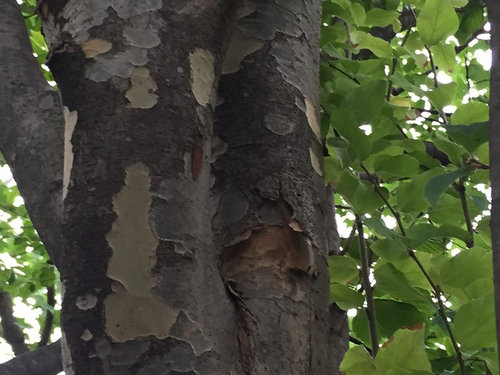
I came across this stunning Persian parrotia which served as a painful reminder that I can't but should be able to grow this species.

I tired Belle Tower and Vanessa twice.
All three died after 1 season.

Assuming zone and cultural preferences are in line are there any trees that just won't grow for you but should?

Acer triflorum is another one that I tried multiple times, yet Acer griseum is no problem!

Comments (19)

  • 9 years ago

    "after 1 season" - does that mean in winter?

    I would think only hardier provenances are going to be zone 5 hardy.

  • 9 years ago

    All the winters were closer to zone 6. The latest casualty, Belle Tower, never leafed out after an extraordinarily mild winter. Freeze thaws were abundant but I have extremely well drained soil.

    This species is commonly listed to zone 4. There has to be something with the soil type it just doesn't like.

    http://www.songsparrow.com/catalog/plantdetails.cfm?ID=2372&type=WOODY,&pagetype=plantdetails

  • 9 years ago
    last modified: 9 years ago

    Since they are both named selections, I'd be curious about the provenance and/or climate of the selector. I have an unnamed parrotia, purchased locally, that hasn't been bothered by anything whatsoever. Of course the coldest temperature it has seen is about -15F, and we do not get midwestern wind.

    whaas_5a thanked mad_gallica (z5 Eastern NY)
  • 9 years ago

    Species plant is my next stop!

  • 9 years ago
    last modified: 9 years ago

    Grafted specimens freezing at the graft union? Have you taken any steps to fight the alternating freezing and thawing, like deep mulching before hard frosts commence? The more details you can provide about the planting site conditions the more likely somebody here is to hit on what the problem might be.

    whaas_5a thanked Embothrium
  • 9 years ago

    I thought Parrotia were cutting grown for the most part...that's why so many in the trade lack the apical dominance of seedling grown trees? My un-named Parrotia has experienced at least -17F many times and showed no damage.

    whaas_5a thanked Smivies (Ontario - 5b)
  • 9 years ago
    last modified: 9 years ago

    For context I have and do successfully grow borderline Japanese Maples.

    Species plant (if I can find one) for a spring planting will be my last shot!
    The cultivars I tired where all in different years to boot.

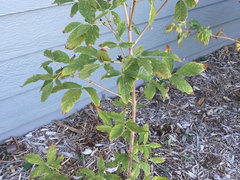
    Here is my third and final shot at a Acer triflorum. This one is a grafted cultivar.
    Showing promise as it still has leaves in October! It will be transplanted in about 3 years.

  • 9 years ago

    Mine is just partly orange now in USDA 8.

  • 9 years ago

    "Assuming zone and cultural preferences are in line are there any trees that just won't grow for you but should?"


    I dont know why, but I have failed at getting Halesia diptera to grow three times, even though they are supposed to be native here. Same with Sourwood, they are just too finicky.

    whaas_5a thanked alabamatreehugger 8b SW Alabama
  • 9 years ago

    I have never tried Parrotia, but I've had zero luck with Katsura. Several attempts -- 100% death. I've seen nice, healthy Katsura specimens within 70 miles south of me, so I don't think cold hardiness is the primary reason. A. griseum has also been a bust for me, but this one I believe to be lack of cold hardiness. I've got Nikko, Three-Flower, and Manchurian maples growing here, all of which seem to be fully hardy.

    whaas_5a thanked maackia
  • 9 years ago
    last modified: 9 years ago

    I'd agree zone 4 does seem like a stretch for Parrotia.

    Acer griseum is certainly one I've had many conversations with zone 5ers. In tough winters its going to die back. I can't imagine this plant thriving in zone 4 for more than 10 years. The hybrids seem much more robust. I have a younger Shaved Chocolate whose bark rivals any species A. griseum, although not as metallic. I also had a Molly Fordham that was extremely vigorous. I wish I could have dug it up from my last place.

    Cornus kousa is another one that has struggled for me on my sandy loam. I tired multiple cultivars with mediocre to poor results. Only a Wolf Eyes did well on a well drained clay. I currently have the species that "may" be showing some promise.

    Maackia, how do you like the Manchurian maple? Is it worth adding to a collection? I've read its fall color, habit and robustness is somewhat erratic. The info out there is somewhat limited though.

    Mainly why I stick with A. griseum and its hybrid for this type of look and fall color.

    I bet the Katsura may not like the sandy soils. They grow like weeds in well drained clays. I was just in Green Bay and surprised to see how large the specimens where for their age.


  • 9 years ago

    In the wild in at least part of its range sour-wood is pretty much limited to bedrock outcroppings. Heath family plants in general often are characteristic of particular soils or situations that have better aeration and drainage than what is the norm in a given locale. Or grow on sphagnum - which produces a non-muddy condition - even when occurring in flooded parts of wetlands.

  • 9 years ago
    last modified: 9 years ago

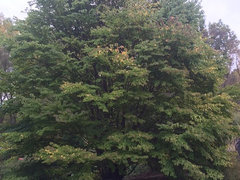
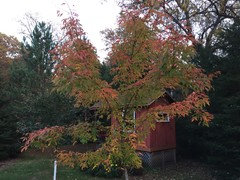
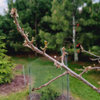
    The Manchurian Maple is doing reasonably well and has settled in nicely over the past few years. The form is not overly impresive, but if you squint at the picture you can see the makings of an elegant vase-shaped tree I’ve read about. Squint harder! Fall color is nice, flowers are lovely, and the foliage is pristine. I can’t say for sure it’s right for you, but I’m happy to have it. :)

  • 9 years ago

    "The form is not overly impresive, but if you squint at the picture you
    can see the makings of an elegant vase-shaped tree I’ve read about."

    Better than some maples I've seen!


  • 9 years ago

    If that fall color is typical then it doesn't matter!

  • 9 years ago

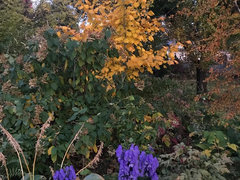
    While on the topic of thrives and oddball maples Acer tegmentosum ‘Joe Witt’. Thriver (yellow tree in back)

  • 9 years ago

    Whaas, I think the issue with Katsura is they have basically zero tolerance to dryness. Their native climate has a very reliable monsoon, unlike the unreliable, sometimes wet, sometimes dry summers of the East and Midwest.

    So they perform better in heavier soils that don’t dry as quickly.

  • 9 years ago

    maackia, very nice Manchurian maple w/the sweeping branches.