

Make up air and whole house ventilation
Anyone connecting the two? Especially with a heat recovery system?
Comments (41)
Milly Rey
Original Author8 years agoUnfortunately, not many in the remodel biz know about it here asa system. It's required, but they mostly install the cheapest thing in remodels because they're so leaky. :P
Related Professionals
Dothan Architects & Building Designers · Bartlesville Architects & Building Designers · San Antonio Architects & Building Designers · Dodge City Architects & Building Designers · Calgary Design-Build Firms · Toms River Home Builders · Dayton Home Builders · Clovis Home Builders · Austin Home Remodeling · Fort Worth Home Remodeling · Vicksburg Kitchen Remodelers · Athens Bathroom Remodelers · Rock Hill Custom Countertops · Hartford Custom Countertops · Portsmouth Custom Countertops 8 years ago
In a really tight house, you need makeup air when running the fan in the bathroom...
 8 years ago
I just inquired about the same thing last month. I was told you can't combine the two. So i had to spend $5,700 on a 600 cfm make-up-air unit for the rangetop which was painful to spend that much on. Then when the house is done I will have the blower test to find out about the standard house ventilation.
- 8 years agolast modified: 8 years ago
"For the range hood" - The short answer is no.
The hood exhaust must be separate from other exhaust systems, therefore you can not run it through an ERV/HRV meant for the rest of the house. The hot air from the hood would need to go through the ERV in order to preheat outside MUA. The exhaust duct for a range hood needs to be one smooth duct to avoid as much grease buildup as possible, and not cool down precipitously as to create condensation or coagulation of the grease, as it would through an ERV.
In mild climates, some of the MUA can come from the whole house mechanical ventilation system intake, and be distributed through the ductwork. However, that is limited by the ability of the furnace to heat the amount of air being brought in, and the velocity of air that can comfortably run through the ductwork. A high CFM range hood would need an additional source of MUA.
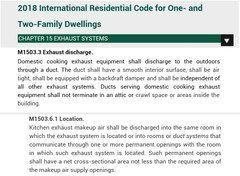
A MUA inlet (without doing the exact math) can be the same size as the exhaust duct 'ONLY IF' the inlet has a mechanical fan of the same CFM as the exhaust to push an equal amount of air into the house. A passive MUA inlet would need to be 4X or more the size of the exhaust duct in order to keep from pulling air through other cracks in the house, or back drafting other appliances or fireplaces, or bringing radon up from the ground.
Milly Rey
Original Author8 years agolast modified: 8 years agoI totally wasn't thinking with the heat recovery. That would be gross, wouldn't it?
Glad I am going with induction.
The smart bet would be two identical blowers hooked up to the same controller, wouldn't it? Why isn't this done???
The MUA should come into the room at floor levels, being colder than the range air, on the opposite wall, ideally, I am speculating. I have heard of people putting it on he ceiling next to their hoods and then pushing down the smoke!
Milly Rey
Original Author8 years agolast modified: 8 years agoArghhh. I went all the way through molecular weights of the products of combustion before my creaky brain realized I didn't know the temperature of the flue gas and I didn't calculate the rest of the air volume needed for combustion. Letting other people do the heavy brain lifting for me (it has been a VERY long time), natural gas plus the air needed to burn it should be 23 parts vs 1 part fuel. Calculating from a standard unit of 10k btu, that's just 222 cubic feet per hour or 3.7 per minute. General recommendations are 100 cfm per 10k btu based on commercial gas ranges. Sounds suspiciously neat.
Now I need to figure out typical food and steam gasses per 10k btu. I'm too old for this. My brain is melting at the steam tables. I can't remember jack.
Edge velocity is apparently crucial to capture efficiency, but I do want to figure the actual ventilation-to-actual stuff-you-want-to-remove ratio to see if the 75% recommendation for induction is based on anything real.
Of course, I can just install the stupid thing, cook, and open a window and let my nose and a cold mirror determine the real world extraction efficiencies before installing a MUA sized to my actual needs. But that would be too easy.
I should note that I don't fry in more than a couple of tablespoons of oil. And I mean ever. I hope to do the stuff that makes lots of fumes OUTSIDE.
- 8 years ago
We have a 1200 CFM kitchen blower in a tight ICF house. When it came time to have the MUA designed, I asked if it could be hooked into the HVAC system rather than a dedicated vent. The HVAC installer said that it wasn't a good idea since you would be dropping/increasing the temperature of the entire house when you use the kitchen hood vent. Instead, we have the blower controller hooked up to a baffle that opens in the dedicated MUA duct when the hood is in operation. The ERV is tied into the HVAC, which is independent from the MUA.
Milly Rey
Original Author8 years agolast modified: 8 years agoI have zones such that this isn't a challenge but the overall velocity means that a MUA unit will usually be much bigger than a whole house ventilation system.
4000!sqft heated and cooled with an average of 9' ceilings (I have a basement--house isn't really that big) gets you 36000 cubic feet. That's.5 air changes per hour at 1200 cfm. That's nuts.
Without air tempering, your kitchen is going to be miserable wth MUA dumped in locally at that rate.
According to most sources I actually only need 250-300 cfm. This doesn't usually require MUA by code, but it will in reality if the house gets tight. And there is the edge velocity/extraction efficiency to consider. I don't think the physics cares how much you're generating as far as that's concerned.
There are recirculating technologies with water vapor removal, which are theoretically ideal for an induction cooktop plus a SMALL local negative pressure. But I don't think they're available in residential models.
- 8 years ago
Good point about zones, as long as the zone controllers are closed when the HVAC isn't running. The kitchen hood would need to be tied into the kitchen level zone to open up returns which might be possible depending on your system.
Milly Rey
Original Author8 years agoIt will be--I would tie in the MUA downstream of the rest with a damper preventing reverse flow. But it's pretty pointless, except from a noise POV, if there is no tempering.
I think I going to have to leave a spot for the MUA and do some real world experiments.
I think the people paying $3k+ for MUA systems are probably getting full automatic tempering. Which means they have a second AC unit and a second heat unit that are really inefficient. Comfy, but major energy hog.
- 8 years ago
It will be interesting to see if this is possible. If you're downstream from the zone dampers, then you need to make sure the MUA is still tied into the trunk so the required flow isn't reduced. Also, what's going to happen if the HVAC blower is on and supplying the kitchen level AND your MUA is open since your kitchen hood is running? At high kitchen hood draw, will you be pulling too much air through the HVAC? At low hood draw will the HVAC blow outside through your MUA intake? Seems tricky to balance.
Milly Rey
Original Author8 years agoThe MUA would shut the reverse flow damper anyway. :). It's the only way. The overall zone will be large and connected--the rest of that level.
I will run wiring to two potential locations and then choose what's best when MUA is needed. According to most recommendations, that won't be until the house is tighter. If I DO need higher CFM, my hood will handle it, and the MUA will come sooner vs later. It's technically not okay to put in the system I found without MUA, but there aren't any being produced that have the features I need with lower max CFMs. I shouldn't ever need to crank it up that high. But in case the recommendations are wrong, I will have a fallback.
I hope the Germans get on residential recirculating hoods with water vapor removal!!!
- 8 years agolast modified: 8 years ago
"36000 cubic feet. That's.5 air changes per hour at 1200 cfm. That's nuts." - It is actually 1 air change every 30 minutes.
CF ÷ CF/M = M. ... 60M/H ÷ M = /H ... or 2/Hour
You definitely do not need the same CFM as a restaurant that has all burners going continuously all day.
I think I heard a reasonable guess of about 65 F/M (velocity) at the bottom of the hood (I have seen as low as 50 f/m velocity recommended by name brand hood companies for electric cooktops), but that is still ballpark math because if the hood is pyramid shaped, you get to that number eventually at some distance above the stove inside the hood even with a 100 cfm fan. So, it then depends on how high the hood is, which is actually inversely proportional to the rest of the formula. IE, the closer the bottom of the hood is to the stove, the less CFM required.
Not to mention, most constants that you try to plug into a formula are just somebody else's guess, or at best, the product of experimentation designed to skew the norm, and find the worst possible scenario.
- 8 years ago
I agree that 1200 CFM does seem like overkill for a residential house, but the blower is on a variable dial that won't often be turned up all the way. The range top has both a griddle and charbroiler which tends to make a bigger mess than pot and pan cooking. Since this is my house and not a restaurant, access to a high CFM will allow me to cook with less likelyhood of escaping grease particles coating my entire kitchen. It's not all stainless like a commercial kitchen, and much more tedious to clean. Also since my house has a tighter envelope then a a commercial kitchen and we're dealing with indoor living air quality, I would rather dump exterior air into the kitchen than have poor air quality circulate throughout the house. Lastly, the MUA duct outputs into the kitchen in the toekick of the cabinet that supports the range top. I'm not expecting a perfect laminar air envelope from the toekick up to the hood, but should we need to use the higher CFMs, at least it's all in close vicinity to the hood intake, maybe even creating a more localized air exchange. It's not a lab fume hood, but at least I'll never have to worry about smoking out the house.
Milly Rey
Original Author8 years agolast modified: 8 years agoSorry! My bad for doing it on my phone--didn't do the conversion right (1/2 vs 2/1).
Hence me not buying a professional gas range. I want to stir fry at high temp. So lots of BTUs are actually needed. With gas, I would be looking for a 35k burner.
Griddle and charbroiler are specifically thing you are supposed to have high CFM on. That's why I'm doing any of that OUTSIDE. :) But I don't do that often at all, so it works for me. I wasn't criticizing dazureus' choices for him/her, just musing aloud for my own house.
Milly Rey
Original Author8 years agoFred--that sound right, but capture efficiencies in studies are increased with distance from the hood up to 8' in professional kitchens. Convection current working for you?
- 8 years ago
"Griddle and charbroiler are specifically thing you are supposed to have high CFM on. That's why I'm doing any of that OUTSIDE. :) But I don't do that often at all, so it works for me. I wasn't criticizing dazureus' choices for him/her, just musing aloud for my own house."
No criticism taken, just regurgitating the reasoning I gave my wife on why I want to have a complex kitchen hood. We're thinking of installing a wok burner outside in the bbq area because I'm not confident 1200 CFMS could capture all the flying grease particles. Plus, it's hard to find an indoor range with the BTU output required for good Asian cooking. The Wolf we got puts out 20k BTU. A turkey fryer puts out about 30K BTU. Purpose built wok burners can put out 80k+ BTU, which would be awesome.  8 years ago
For those not familiar... The purpose of a range hood is to exhaust byproducts of gas combustion, steam, grease, and cooking odors. Keep in mind that it is far better to deal with odors, grease, and other stuff at the source. Any not captured and exhausted by the hood will disperse, making it much more difficult to exhaust.
There are three bits to a good range hood system: Capture, Contain, and Evacuate. These are fairly independent.
Based on my research:
Capture: The plum from cooking generally expands @ 2-3" / 1'. So, ideally you'd want the hood opening to extend at least that far beyond any cooking utensils. E.G., if the hood is 3' above the range top then its opening should extend at least 6" beyond any pans, griddles, grills, etc. If it is not captured it will not be exhausted. A higher CFM blower will not make up for too small a hood opening. Even if you're only using one single pan on a front burner you need the proper capture aperture — its plum won't magically flow differently just because it's a single pan in a residence. In a single pan scenario you may be able to get by with fewer CFM's but no a smaller capture area.
Contain: The plum has a much higher velocity and density than surrounding air so a lot of odor, steam, greasy air and other effluent will rise in to the hood. The hood needs sufficient cubic area within to contain the effluent until it can be exhausted.
Evacuate: The blower should produce enough effective CFM to evacuate any effluent that has been captured and contained in the hood. The key here is effective. A '600 CFM' hood that has a lot of bends and other elements in the ducting or that does not have sufficient make-up-air will perform at a much lower level. For example, our 600 CFM vent-a-hood actually only exhausts 480 cfm normally and 110 cfm if we turn off our MUA. For more on this google 'CFM static pressure' and 'fan curve'. Many elements add static pressure to the system and so decrease blower performance.
This all doesn't matter much for people who don't cook much. In our case though, we entertain a lot, cook a lot and we pan fry a lot. Pan frying and other cooking methods produce unpleasant odors that we don't want our guests to smell (nor do we). We don't want grease coating our kitchen. For this reason we are designing our hood closer to a commercial system.
Milly Rey
Original Author8 years agoThat's why I'm glad I'm going induction! With charbroiling outside, there are very few products of combustion. I also don't fry with much oil, and I think I have deep fried once in my life. I haven't had an operational hood in about 5 years, and I don't get grease build up, but the water vapor can be an issue, and of course there are other cooing compounds that aren't so great to breathe.
Seriously, the chemicals in a baking bread smell is bad for you. Everything that makes life nice seems to be bad!!!!
- 8 years ago
I have seen this sticker on hoods sold in California, which is not so coincidentally, the same place most of the other studies that say any type of cooking or food in general is bad for you comes from.

So, this whole exercise is a bit like jumping out of the frying pan and into the range hood.
Milly Rey
Original Author8 years agoLolol! That is amazing.
Sometimes, I just ignore things. Nitrates? Yeah, I'll avoid those. Advanced glycation end products? A world without aged cheese, browned chicken, carmelized onions, and crusty bread is not a world I want to live in.
- 8 years ago
Now, to Milly's excellent first post. What's needed is a single system/unit that efficiently manages air pressure and quality.
Today this is done with a bit of a kludge using an HRV/ERV to bring in fresh air which somewhat gets to quality and a separate MUA to inefficiently and quite poorly manage pressure. The inefficiencies in this are enormous. The MUA doesn't know what devices are blowing how much air out so it can't replace only that same amount. The HRV doesn't know when the MUA is pulling in fresh air so it continues to pull in fresh air even when not needed. Many exhausting devices like range hoods, bath fans, central vacs, and others exhaust air without recovering any of the expensive heat contained.
In even a semi-sealed home a bath fan or any other exhausting appliance may only exhaust at 10% efficiency if it's having to push against an inefficient duct system and worse, having to pull air in through an inefficient and convoluted system of hoped for cracks and a bit of 6" passive flex duct installed by an HVAC contractor who either has no clue about static pressure losses in ducting they create with tight bends and crimps or doesn't care.
A better system would at least combine the HRV/ERV and MUA in to a single and more efficient unit. This alone would be a significant improvement. Add in a controller that connects to each exhausting device so that it knows how much air is trying to be exhausted so that it can replace that same amount and we'd have a much more efficient system than we do today. It'd use less energy and exhausting devices would exhaust what they are intended to rather than much less.
Why this hasn't been done already is beyond me though perhaps not surprising for the US HVAC industry that is quite antiquated and resistant to any change. They're kind of like US auto companies that ignored what Asian manufacturers were doing and lost a huge chunk of marketshare and are seemingly doing it again by ignoring Tesla and the other companies who are way ahead on electric cars (though Chevy gets some credit for slowly doing something).
- 8 years agolast modified: 8 years ago
Why is someone that reads and writes like they are under the influence trying to discuss air quality? Even a 1200 cfm exhaust hood won't do any good AFTER you inhale. Your first post wasn't even on topic.
You can NOT run the exhaust from a range hood through an ERV/HRV of any significant efficiency without clogging it with grease and ending up with a fire hazard.
And, a good HRV system already matches intake and exhaust air for things like bathroom fans.
Also, realize that an efficient enough HRV that would be worthwhile to put in for a 1200 cfm exhaust would be about 4' x 5' x 7' in size.
If you want to match MUA and exhaust, just install an identical multi speed motor on the MUA... or better yet, get a hood with an infinitely variable DC motor, and a matching motor for MUA, and connect them via servo motor controllers.
It has been done, people just do not want to pay for it.
- 8 years agolast modified: 8 years ago
For further edification, the IRC did change the code language slightly so that it could make way for new developments, but consumers are not ready to pay for the R&D.
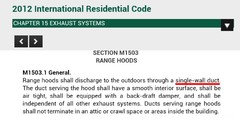
You can generally run "kitchen exhaust" through an ERV, just not exhaust from a hood or vent over or near a cooktop.
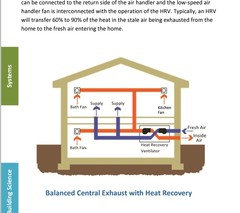
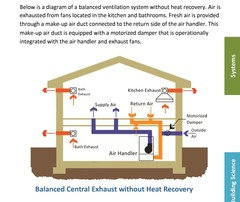
 PRO8 years agolast modified: 8 years ago
Good thread on often confusing topic. Here's advice based on our tight homes, my research and guidance from our energy rater (who has phd in mech engineering).
Be like Milly and go induction. This eliminates combustion exhaust and it's cool cooking surfaces creates less smoke and fumes.
Stay below 400 CFM for the cooktop exhaust vent. This eliminates code required need of having MUA supply which can be complicated and expensive. If that's not possible, size MUA intake the same size as exhaust duct. This makes it more likely that passive intake supply will get the job done without needing to add a fan to the MUA supply. Our energy rater half jokingly says to dump the MUA supply duct directly on the cook, as punishment for choosing a combustion cooktop or needlessly oversized cooktop exhaust vent.
Instead of fretting over exhaust > 400 CFM with accompanying MUA required details, focus on the vent hood capture area. The lower and wider the better.
For best performance follow advice from this Dr. Joe BSC article.
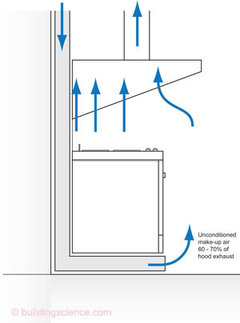
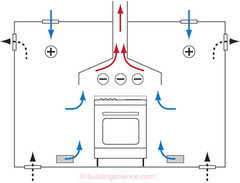
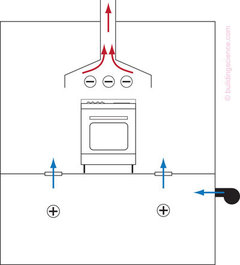
- 8 years ago
"Why is someone that reads and writes like they are under the influence trying to discuss air quality? Even a 1200 cfm exhaust hood won't do any good AFTER you inhale. Your first post wasn't even on topic.
Just to make sure we're all on the same page since the OP's purpose is MUA for a range hood. There is a lot of lack of understanding about range hoods. As I said, not a problem for people who don't cook much but can be a major problem for people who often use cooking methods that produce a lot of odor and grease laden effluent and don't want this coating their kitchen or offending their guests.
You can NOT run the exhaust from a range hood through an ERV of any significant efficiency without clogging it with grease and ending up with a fire hazard.Who said anything about running range hood exhaust through an ERV (or HRV)?
And, a good HRV system already matches intake and exhaust air for things like bathroom fans."Which HRV's match intake & exhaust for bath fans? The closest thing I'm aware of is Aldes but installations of that system have so far been problematic with complaints that it does not exhaust enough to keep mirrors clear of condensation. Otherwise, HRV's I'm familiar with are fixed balanced at commission and don't change as other exhausting devices like bath fans, range hoods, or vacuums are turned on or off.
- 8 years agolast modified: 8 years ago
@Springtime, good points.
Induction is far from a panacea. Many people who cook a lot, myself included, have a rather strong preference for gas. I've tried induction a few times and it's different enough that I simply don't care for it and being more limited on pans. Another issue is the EMF given off by induction. Digital thermometers, like the Thermopen, will not work correctly near an induction cooktop because of EMF. There are also health concerns about too much EMF exposure.
BTW, I know a couple of pro chef's who use gas at work and have an induction at home that they're quite happy with so induction is clearly not all bad.
Staying below 400 cfm may eliminate the code requirement but not necessarily the actual need. 400 cfm is a fair amount and you still need MUA of some sort.
"If that's not possible, size MUA intake the same size as exhaust duct. This makes it more likely that passive intake supply will get the job done without needing to add a fan to the MUA supply."
Where did you get this? Everything I've read is that in a tight house (< about 1.5 ACH50?) the recommendation is that a passive intake be a minimum 2-3x any active exhausts. Or just use an active MUA sized the same as active exhausts.
Agree completely about the criticalness of hood capture area.
Good link to Lstiburek. Interestingly, he proposed just the opposite of what this thread is talking about. He says that he's a fan of separate systems — E.G., what we're all doing already. What I think the OP asked about and several of us have likewise wondered about is combining the HRV & MUA systems to some extent or at least controlling them in a synchronous way. If we're sucking in 800 CFM of fresh air through MUA and exhausting 800 through a range hood, then do we still need an HRV pulling in and exhausting 200 cfm at the same time?
Milly Rey
Original Author8 years agolast modified: 8 years agoA HUGE problem with comfort--let's even throw other efficiency issues in the bin--is the fact that right now, your MUA choice are untempered or essentially adding a crappy, inefficient second heating and cooling system to your house.
That hurts my brain. Lol.
My vent hood will GO above 400 cfm because none of the good ones for 36" don't,but according to most sources, I will never need to turn it up that high. BUT according to tight house analysis, if I eventually get down around Passivhaus standards, MUA is needed above 50 cfm.
Also, guess who's converting all the fireplaces to sealed lp at some point? Lol.
And MUA should shut off the HRV.
- 8 years ago
There are likely always to be a lot of compromises. A goal of our house was passivehaus or near passivehaus. One issue we ran in to is that with US construction methods (wood vs EU's cement) the difference in standard construction and about 90% passivehaus is somewhat affordable. That last 10% is really expensive and you really can't come close to justifying it from a monetary standpoint with paybacks out 100 years.
Exhausting appliances was another issue. Our energy consultant is very big on condensing dryers and recirculating range hoods and similar. We've had condensing dryers in in Europe. My wife hates them. Europeans hate them (though more good natured than my wife). We're to have proper dryers that "dry in less than a day per load". This is a modern convenience that she was not willing to give in on.
As for the recirc range hood the solution from energy folks is induction and "just don't cook things that create grease or offensive smells". Neither are appealing options. We've used induction and don't like the way it cooks, how differently pans heat up, don't like being limited in pans, and don't like not being able to use any electronic thermometers like Thermopens. We have induction in Florida and make out OK for a couple of months per year but are always glad to be back to our gas range. We also don't want to be limited in what we cook. If the deal was to give up Wok cooking or something that'd be OK but everything that's greasy or has offensive smells? Not gonna happen. We'll have a good fully exhausting range hood.
She also wants for our bathroom and two guest baths that condensation clear, mirrors not fog and hair not do whatever undesired things hair does in high condensation environments. Condensing bath fans are quite expensive to buy and operate. Much cheaper to exhaust the air and bring in replacement air via MUA.
BTW, we currently have two MUA's with 10Kw heaters in them. These both feed in to the return duct at the furnace. The MUA's are set to heat the air to 44°f which is what the furnace mfr recommends as minimum. We've not had any comfort problems with this setup in summer or winter.
Milly Rey
Original Author8 years agolast modified: 8 years agoThe passivhaus standards are a bit...obtuse. Build a house super tight and then OVER ventilate it????
We are on geothermal. I will do heat recovery wth the ERV I will eventually need but no tempering. The MUA is at much higher rates than ERV.
I have a remodel, so I can't do smart passive solar techniques. I have lived in a passive solar house, and there is nothing like being able to have one part of the house at nearly 80 degrees with zero guilt when there are 3 feet of snow outside. When you get bone-cold after being outdoors, you can bake yourself like a lizard on a rock! Passive solar is also DEAD quiet.
My dryer is electric. But it's direct vent, and that's not changing!!!
I am getting U-.15-.18 windows (US measurements) with great air leakage ratings for the addition. The rest of the house was done on a tighter budget to U-.24, but some of these might change as she retrofit.
Walls to R-46. Ceiling only R-43 until the new roof, when it will go to 82. Floor will depend on where the duct work is! But will be at least R-30.
We are doing the Energy Star thermal bypass checklist, etc.
- 8 years agolast modified: 8 years ago
Obtuse is a good description. I'm a huge fan of the concept but we found actual implementation to be rather impractical. And baking a bit in the sun after shoveling is truly a great thing :-)
We're similar, doing Loewen triple glaze windows with U=0.13. Not quite as good as the U=0.06 of the German windows though.
We're meeting with the HVAC folks week after next to start finalizing some details. I think they're planning a small furnace/AC for the MUA. A bit of up-front cost but should pay for itself quickly compared to electric heat.
Getting a bit off-topic... What is your wall structure?
Milly Rey
Original Author8 years agolast modified: 8 years agoI am a bit hinky about fire, and the entire house rotting is a HUGE concern here (only a nut would try double wall with cellulose). So mine is 2x6 with ultra high R fiberglass interior, Zipwall sheathing, 2 2" foil faced polyiso, staggered seams, then 1.5" Roxul Comfortboard with furring strips. Windows outie to the foamboard.
Because my main heat and cooling is geothermal, I want to put all the load on that that's possible!!!!
I am staying with Okna. Their VT is really high for their U values. I'm just stepping up to triple pane and doing fixed and casement.
I will be retrofitting the rest of the house from insulation out, but it is all 2x4.
Roof will be roof-over-roof polyiso board.
I do have more window area than is really "green", but I am not to the point of the fake green LEED buildings with full glass walls!!!!
- 8 years ago
That sounds like a good wall and similar to what we'd planned to go with. This is a retrofit though? So you're ripping down to the 2x6 studs and then rebuilding up from there?
Milly Rey
Original Author8 years agoI doing an addition where most will be 2x6' and later there will be a retrofit that is on an existing 2x4 structure!
- PRO8 years agolast modified: 8 years ago
Induction's drawback of limited pan use, hardly matches the indoor air quality concerns. EMFs come nowhere close to the negative science on combustion gas.
400 CFM is overkill for most residential with proper vent hoods. All houses are different but our most recent project that tested 2x tighter than passive house minimum, passively vents a 12" exhaust with an 8" intake. The externally mounted 1000CFM fan exhausts ~ 750 at highest setting. Testing verified no need of added MUA fan to avoid backdrafting dryer and water heater. The quietness is striking and the flush-with-ceiling vent hood looks amazing given the cooktop's prominent interior peninsula location. Consider keeping cooktops to exterior walls so better performing vent hoods are less obtrusive and easily vented.
That house is average sized and some of our smaller homes having "leakier" ACH@50 rates probably would have a harder time with exhausts >400 based on their dryer and bath fan performance. Luckily those smaller homes used micro vent hoods or other vent hoods that stayed below 400. All our homes test less than 1.5 ACH@50 and two have been 2x tighter than passive house minimum.
It seems much of the North American high performance home movement has issues with passive house standard insulation and windows but not air leakage. I bet most energy smart builders would love to meet passive house level airtightness. It's less about costs and more about design and craftsmanship.
MUA for 50 CFM sounds unreasonable. An energy star rating or rater can measure how many CFM appliances are actually venting. I've come to realize that a rater is practically mandatory when commissioning ERV/HRVs and tight homes. I can appreciate adding MUA to other typical exhaust-only appliances (especially dryers) but agree with code that only kitchen vent hoods > 400 CFM require it.
I also agree with Dr Joe and seemingly most other experts that vent hood MUA systems be completely separate of HVAC or Outdoor Air Ventilation systems.
Milly Rey
Original Author8 years agolast modified: 8 years agoOkna windows have amazing air leakage numbers and good VT when lots of others don't. That's why I'm sticking with them. :)
50 CFM is borderline for most houses that meet the passivhaus guidelines, but the size of mine and the fact that it's going to bea gradual retrofit make needing it less likely.
Milly Rey
Original Author8 years agolast modified: 8 years agoBtw, I am a skeptical fan of Dr. Joe, as you called him. Lol. His plans work when you do them perfectly. Which few builders do. He had big areas of rot on his own house. Because it was done wrong! And of course he knew better. He just missed supervising that bit.
If using any kind of wood sheathing wasn't really dangerous here, I would be doing 2 layers of #15 felt rather than any newer technology. Anything less than 15 years old scares me. That's why I'm slapping T-1 11 completely over this addition for a while. If something goes wrong, at least the siding is cheap, and it buys me decision time. (Back of the house, only the birds and I and the forest preserve can see it).
My roofers did a beautiful job rebuilding a cricket that was engineered wrong in the first place. They used water and ice where they should and a nice stick down underlayment even though my roof was juuuust steep enough to skimp. They replaced the rotted sheathing that was a surprise discovery with some I ran out and bought and didn't even charge extra. They cleaned up MORE than the mess they made--they swept my entire decks and porches.
Then they tried to adhere my chimney flashing with caulk.
Vigilence, man.






Milly ReyOriginal Author