Software
Houzz Logo Print
unclemolewacker

Trees + Power poles/lines + Wind = Fire

9 years ago
last modified: 9 years ago
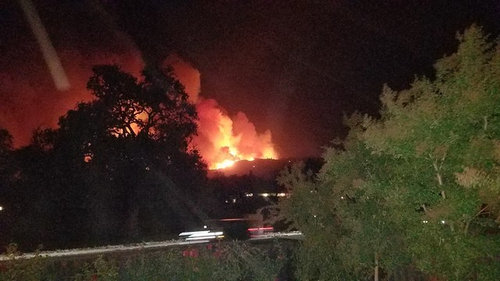
It is starting. The rumblings are already being heard about blame for the northern CA fires two weeks ago (still burning). The legal machines are winding up for a $$ battle.

I am fortunate as I dodged a bullet. But many of my neighbors did not and lost their homes and/or loved ones. My heart goes out to them and hope that the healing process begins.

As far as I know, NO official cause has been determined in any of the Napa-Sonoma fires. Early suspicions are high winds causing trees to topple onto transmission wires / power poles. Communities will be rebuilt. The winds will come again. Will we burn again?

Something must change. In my opinion, much more efforts are needed in burying the power lines. The technology exists to service it, it is pricey. But, so are 8400 homes; the lives priceless. Digging will take a long time. A shorter term solution is to aggressively cut back any trees close to power lines.

What do you think? Are you ready to really, - I mean REALLY hack back anything growing close to the power lines? If not, why not?

Atlas Peak - 10-8-2017 10:30pm

Comments (13)

  • 9 years ago

    I have heard that the reason that there has been a reluctance to bury power lines because of earthquake risk. I don't know if this is true.

  • 9 years ago

    As usual things should be done in moderation. In new neighborhoods install buried lines. Especially in Southern California you all are probably above the area's ability to support human life so if the price of new homes goes up, great. mkre exoensive new homes will also help maintain the value of your existing properties.

    Here people complained about the power company cutting back trees until the year of the power outages. So yeah, they'll get after it after a disaster.

    uncle molewacker z9b Danville CA (E.SF Bay) thanked toronado_3800
  • 9 years ago

    I have a friend in Santa Rosa. They're ok, but it made me think about myself, because our development backs up to a national forest. Did the houses in the tracts that burned have tile roofs? I think we have underground utilities. I don't see any poles around here, but there are lots of mesquite trees around.

    uncle molewacker z9b Danville CA (E.SF Bay) thanked Patti Sano
  • 9 years ago

    In Fountaingrove, one of the neighborhoods that burned, most were stucco with tile roofs

    uncle molewacker z9b Danville CA (E.SF Bay) thanked Sara Malone (Zone 9b)
  • 9 years ago

    Thank you.

  • 9 years ago

    The heat from wild fires is unimaginable. Melting steel and glass that take 2800d F to liquefy. That's why when watching a wildfire, things seem to explode into flames before the fire gets there. That's because combustible material ahead of the fire are heated above kindling temperatures before the flames even reach them.

    I worked with people at my job that were volunteer firefighters for years. I heard stories of large building fires (barns) where fire hoses were pointed directly into the flames and the water stream seemed to just disappear as the fire raged on.

    Those hoses delivered in excess of 500gpm.

    I think of those that tried to save their buildings using garden hoses (10-15gpm).

    But burying all power lines would be a huge undertaking, maybe even impossible in ravine and canyon areas with sensitive ecological factors figured in. Earthquakes could damage underground cement conduits causing long, expensive repair periods that most customers wouldn't tolerate.

    Because even if wires were all installed underground, the possibilities of something else causing the fire like a car accident, lightning strike or spark from machinery, would cause all the cost and effort become not effective in stopping anything.

    uncle molewacker z9b Danville CA (E.SF Bay) thanked User
  • 9 years ago

    Bill_minn - you are correct, the heat (and the seemingly floating burning red embers) is what impressed me most - - and had me scramble to get that much more water on the grounds & roof as they were landing. Once the fire gets close that heat is so intense, its game over. It does not matter what kind of materials are on your roof. I began to feel the hot winds. The winds shifted slightly and I dodged the bullet so to speak.

    I was referring to distribution lines being buried, the PDF is informative but really for the high capacity transmission lines - - I follow the reasons they should stay above. For the local lines, more could be buried and for the point of the Original Post, more needs to be done to manage the risk associated with high winds toppling trees onto the power lines - causing a failure, spark and associated devastation.

    My question remains: - are you - or are you going to push your neighbor(s) - into cutting all trees and vegetation away from power lines so as to mitigate that potential cause of fire? The amount of cut would be far greater than what is currently done from what I can see. I see so very many cables / lines strung through trees... and many older trees not far away that could potentially fall on those lines.

    The local power company is saying that they are out of the liability zone because the winds were so strong. The winds will re-occur. So why not properly specify the design of the power distribution lines and manage the risks of trees around them?

  • 9 years ago

    This strikes me as one of those situations where people made a wild, unsupported guess about what caused this fire, and based on that are going to hack down thousand upon thousands of ancient trees that gave their neighborhood character.

  • 9 years ago

    I was referring to distribution lines being buried, the PDF is informative but really for the high capacity transmission lines.

    You can't have one without the other. Distribution lines have transformers located on the same poles as the high voltage transmission lines. The high voltage transmission lines are connected to the input side of the transformer. distribution lines to the output side of the same transformer. Running distribution lines underground does not eliminate the umpteen million miles of poles & wires needed for transmission lines. It's the poles that toppled in the high winds causing the fires (see link below).

    http://www.mercurynews.com/2017/10/10/pge-power-lines-linked-to-wine-country-fires/

    "I see so very many cables / lines strung through trees... and many older trees not far away that could potentially fall on those lines".

    You're talking distribution lines on residential and commercial property here and that's because several species of trees, including the coastal oak trees are protected by law in California. Residents need permits and inspections even to just prune the branches.

    http://www.nytimes.com/2001/08/29/us/the-almost-untouchables-of-california.html

    BTW: I agree that distribution lines should be run underground, even though it is a more costly and inefficient way to transmit power.

    Most newer developments are doing just that. It's the older establishments that did it the 'old way' and updating those systems could be done but at a much higher cost and number of permits.

    uncle molewacker z9b Danville CA (E.SF Bay) thanked User
  • 9 years ago

    Around here, it is not uncommon to find trees one hundred or more feet tall. If one was to remove all vegetation that could potentially affect exposed power lines, a swath at least two hundred feet wide would have to be established.

  • 9 years ago
    last modified: 9 years ago

    yes, many neighborhoods with that situation. Would you cut them to make the area safe, or not. As I asked above: " Are you ready to really, - I mean REALLY hack back anything growing close to the power lines? If not, why not?"

  • 9 years ago

    This is way complicated. And specific to geographic areas.