Software
Houzz Logo Print
cowabunga1

Gas Water Heater Replacement- Connection issue

8 years ago
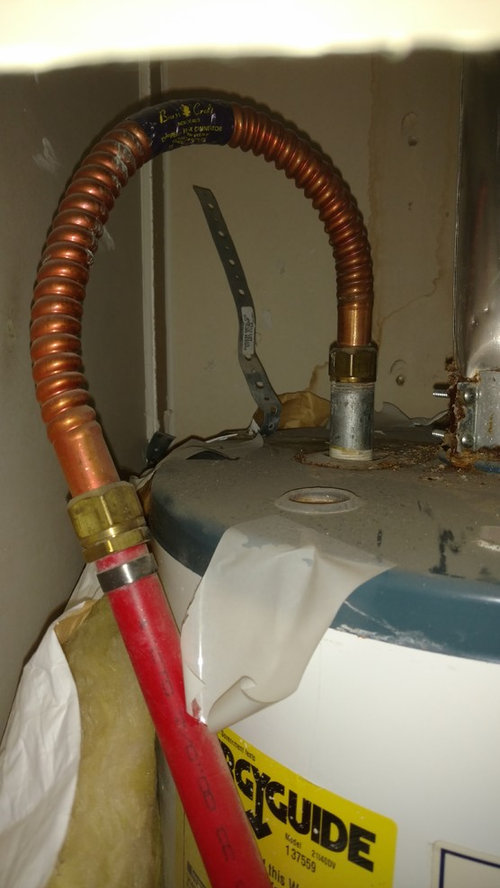
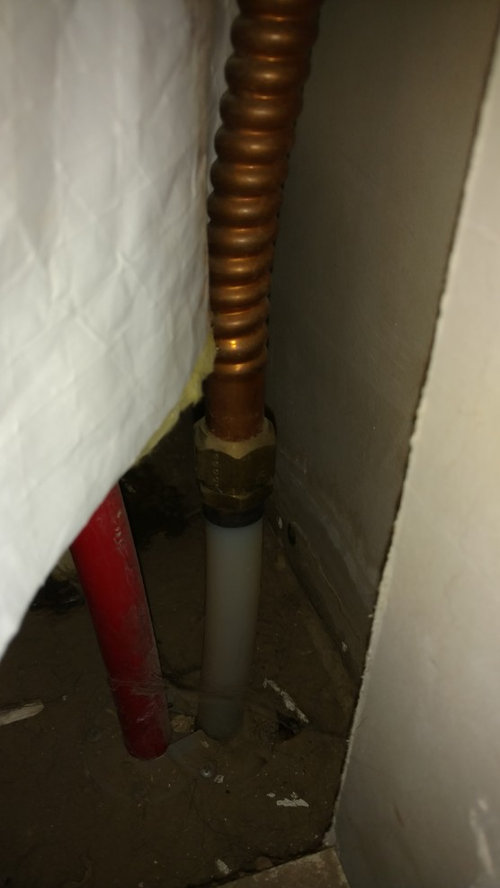
So as luck would have it I noticed the floor in the laundry room looking a little discolored over the last month. Well I figured it was from water infiltration from the washing machine having clogged outlet filter a couple of times over the last. No biggie... it gives the crappy vinyl linoleum/tile "character". Well I was installing some shelving and noted that the floor wasn't just discolored it was squishy. So I unscrewed the cover for the water heater and discovered that it was leaking. Not only leaking but has been leaking for probably months. Well gotta get it replaced. No biggie except the expense. Well I wanted to cover the bases but noticed that the current tank has the cold water inlet on the bottom of the unit. I also noticed the house line is PEX and missing a shut off valve. My dilemma is this: I am unsure what to use to run the cold water up and then into the new tank. It currently has a 3/4" copper flex on the inlet and outlet , with the outlet terminating into PEX near the top of the tank. I guess I also worry that the current tank looks to have an air intake going through the floor. I figure that I will make the screwed on cover a door now to allow easy access. Should I also put a vent in it to ensure safer air movement to the new tank? Thanks for the input.


Comments (6)

  • 8 years ago
    last modified: 8 years ago

    All those connections are 3/4tr" pipe threads. The place where you buy the heater will have everything you need to make connections,take measrments so you know how long they need to be. Righty-tighty and lefty-loosey.

  • 8 years ago

    PEX shuts off at the manifold. Don’t go getting creative here. Doesn’t sound like there’s enough on board here for that trip to the box store.

  • 8 years ago

    That's a new water heater?? The installation is crap. If it were mine I'd have shut off valves - and some hard copper. That workmanship is horrible.

  • 8 years ago
    last modified: 8 years ago

    The plumbing work quality is horrible. My recommendation would be to have a plumber install copper pipe running up from the PEX in the floor to a shutoff mounted high on the wall, or even on the joists above. An alternative is to use PEX to extend the pipes, and then use short copper pipes to connect to the valve and water heater. The short section of copper gives you something to use to strap and support the valve. Only the incoming cold line requires a shutoff, but its convenient to also be able to isolate the hot side if you need to work on the system.

    Then use the copper flex pipes (in your picture) to connect from the shutoff to the top of the tank. All of the pipe (except the flex sections) should be securely strapped to the wall and/or joists above.

    Gas water heater cabinets require a low and high air vent. However, if this is in a laundry room they usually just install a low and high vent in the door or in the wall. The vents need to be large enough to provide combustion air, and venting for the water heater when operating. Typical size is a 4" vent pipe (this is not the same pipe as the chimney pipe that runs out the top of the heater).

    Bruce

  • 8 years ago

    So UPC requires 18" of metal pipe connecting to the top of the water heater. The most workmanship way of doing that is to use solid copper, including a valve on the cold side, and then transition to your PEX. I'm not at all a fan of multiple transitions and flex lines. Keep your PEX 6 inches or more away from your vent.

  • 8 years ago
    last modified: 8 years ago

    "No biggies except the expense."

    Your current unit being a direct vent model (instead of plain atmospherically vented through a deflector and single pipe flue), I can see where the expense would be a biggie.

    "the current tank has the cold water inlet on the bottom of the unit..."

    Not sure what you meant by this. Did you mean that the cold water line runs through the drain valve (or where the drain valve should be) at the very bottom of the tank or did you mean that the cold water line goes into a port on the side of the water heater (maybe about 1/3 of the way up from the base)? The latter kind of side-port (if that is what you have) is a convenience for use with home heating systems. There is a strain of "contrarian self-proclaimed self-reliant" plumbers on the internet who like to use the side ports for all of the cold water feed because they think then that they do not ever need to worry about replacing the top port's mixing tube (aka "dip tube") when it wears out. (A long, long time ago in a glaxy far away back in the previous century, there were water heaters that had feeds into the bottom and did not have mixing tubes, at all.) If the cold water is fed into the drain valve, that was stupid. If that is what you have, then you will need to shut off the drain valve (hopefully they left that in place!) as well as the house water in order to disconnect the cold water line. You definitely want a shut-off valve on the cold water line. as others have said.

    "the current tank looks to have an air intake going through the floor."

    Again, not sure what you are describing. First question, do you know if your water heater's direct vent hookup is a double walled set-up that provides both air intake (through the outer pipe) and exhaust (through the inner pipe)? I can't tell from the photos. If it you have a full-on direct vent, you will not t need that hole in the floor, whatever it is.

    If the top duct/pipe it is solely for exhaust, does the "air intake going through the floor" look like the kind of thing used for an air return on a forced air heating system and is it ducted to the exterior of the house? Or is ducted into a crawl space? Either way, that might be why there was a cover installed rather than a door to the water heater compartment. Not suggesting that it was a good thing but it will complicate what you need to do to when installing a replacement water heater.