Software
Houzz Logo Print
upperbaygardener

honestly assessing Pinus strobus in the lower Mid-Atlantic

8 years ago
last modified: 8 years ago
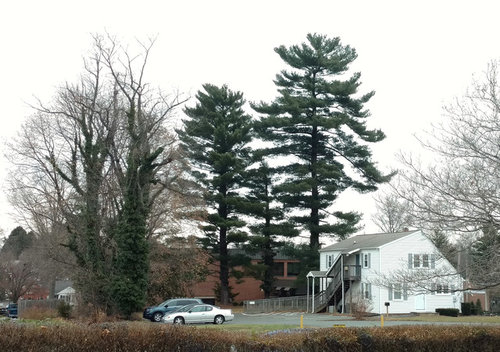
Ok, first of all, again have the oddest feeling I might have done a post along these lines before. If so, apologies. (wish Houzz had a summary page under our private-view profiles for "threads I've started" as some discussion forum software does). Because this question has been on my mind for years. White pine obviously remains one of the commonly planted conifers around here. But they don't seem to grow into respectable large specimens with the regularity of Picea abies, or even Cedrus atlantica.*

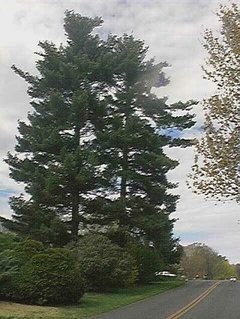
So I was over in Bel Air, MD, and spotted these:

And thought to myself, wow, those are perfect representatives of "about as good as you can expect from late-middle aged Pinus strobus in the region". It's much, much more common to see ones with busted up, wonky structure from having lost major branches due to heavy or sticky winter precip. Up in interior New England, most of the snow is probably powdery. Not here. There were some on the street I grew up on in Fairfax County, and when I saw them 4 or so years ago, after the big snows of the 2009-2011 time period, they looked absolutely awful. I had seen those trees grow up starting in the mid 1980s, so I knew they had once looked really good.

So, do we agree? Or are there plenty of large, healthy white pines that I'm just tuning out or something? Also, what about these? Possible a smart arborist has just been thinning them enough to handle the weather? I would happily have these in my garden, assuming they continued to look like this!

* - not that large Cedrus atlantica are common at all; but when you do see them, they still have a nice form.

Comments (24)

  • 8 years ago
    last modified: 8 years ago

    Those are about the nicest looking white pines I've ever seen. We have lots of them here as they are one of the common species that starts growing in old farmland. Many have split trunks since when they are open-grown there is an insect that damages the leader. Most have lost branches or even tops due to ice and heavy snow accompanied by wind, which we can get at any point in the cold months, though most years much of our winter snow is dry. And I wouldn't want them in a suburban yard since they drip sap on anything below - cars, patios and outdoor furniture, etc. To my mind, it's a great tree for large spaces, and the branch spacing makes it a favorite for the bald eagles and larger hawks that hunt from a perch, but not an ideal yard tree.

    UpperBayGardener (zone 7) thanked NHBabs z4b-5a NH
  • 8 years ago
    last modified: 8 years ago

    Nearby woods have scattered white pines over-topping the hardwoods and they're slowly getting eliminated by strong winds -- usually in March, and usually snap off about halfway up. Long term I'd say they'll be outdone by the oaks/maples/hickories. They are prb'ly in most situations (but not all) pioneer trees & not climax.

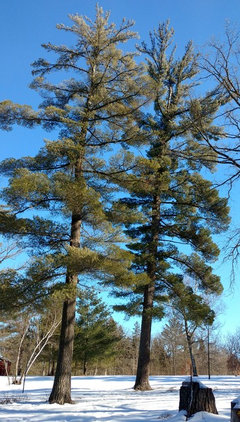
    That said, as davidrt shows, they can make beautiful specimen trees like these in Hagerstown, MD:

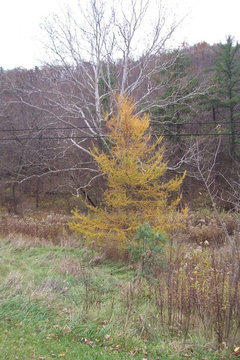
    Below are a few of the representative white pines in the woods near me, in the right background of the pic. Those pines are OK so far (Japanese larch in center):

    UpperBayGardener (zone 7) thanked bengz6westmd
  • 8 years ago

    I second everything NHBabs said, with the exception that where I grew up in southern CT, more of our snows were wet rather than dry.

    I once read that white pines dropped many limbs as they aged as a defense mechanism, much like palms lose fronds and tropical trees lose all but their trunks and main scaffold during hurricanes.

    There were lots of large old white pines growing up in CT. Most were open grown, and only retained very few limbs, the winds blew through them and there wasn't much to catch snow and ice. They would be called architectural or character trees. Trees as pristine as those in the OP were/are a rarity in the NE. I'd love to have a grove of such trees, as long as my house was far away, and nothing but grass and pine straw was beneath them.

    Where I live in TN white pine is not native, but is nearby and has been planted fairly extensively in the past few decades. It is rare to find really large ones here abouts, but they are common in east TN and north GA. Here they are VERY brittle, on a par with liriodendron, and suffer greatly in wet snow/ice but especially in summer thunderstorms. It's not uncommon to see them uprooted or snapped in half.


    UpperBayGardener (zone 7) thanked KennsWoods
  • 8 years ago
    last modified: 8 years ago

    Interesting! When I drove from Montreal, through VT and into the Pioneer Valley last year, I had a vague impression that when I did notice a white pine, it was better looking than what I was used to in the Mid-Atlantic. But that could have been a false impression. What is different is when you see them up there, they are relics in the forest succession, slowly being displaced oaks and maples. As noted by beng. Here of course, they are all planted.

    So, do we think these trees are some exceptional clone...or are just being taken good care of? Or just lucky?

  • 8 years ago

    My parents rented a cottage on a lake in southern NH when I was a kid, and when I reached my teens they spent the summer there and I would drive up on the weekends. Back then, I 91 was just a gleam in the road builder's eye, so I had to travel RT 10 (five, ten, and two-oh-two) through CT, on into MA and through the Pioneer Valley, to Brattleboro, and on into NH. You're comment brings back fond memories.

    To keep on topic, on one of those trips I was passing through Granby CT, just behind a thunderstorm. There was an old house in town, probably built around the Revolution, that was surrounded by white pines that looked to date back to that time, but probably didn't. Anyway, I always looked at the place when I passed, it was very attractive, and I especially liked the pines. As I approached the house there was lots of cars along the roadside, and flashing blue and red lights. People were standing in front of the house and looking up. I slowed to see what they were looking at. The house was a two story garrison colonial, and one of the large pines had been snapped in half by the storm. The crown and trunk had penetrated the roof, with a short section of the broken trunk protruding from a huge hole. That incident has stuck in my memory from all those years ago. The house was repaired, but if memory serves, the bottom half of the tree sans branches was left, possibly as a reminder of the incident.

    UpperBayGardener (zone 7) thanked KennsWoods
  • 8 years ago

    Interesting story. Maybe just not 'built to last' compared to some other trees. But OTOH, they were apparently coveted by the pre-revolutionary war British for building ship's masts.


  • 8 years ago

    White pines are meant to live in packs, where the outer trees protect the inner ones from wind. There are places in New England, like a small park outside Springfield, MA, where there is a grove of extremely old pines growing on a large, rocky outcrop. The soil (or lack thereof) is bad enough that deciduous climax trees have no interest in the site.

    UpperBayGardener (zone 7) thanked mad_gallica (z5 Eastern NY)
  • 8 years ago

    I have two in my front yard, and I WANT them to die, since my spousal unit won’t agree to cut them down otherwise...(There are other things I’d rather plant there).

    UpperBayGardener (zone 7) thanked hairmetal4ever
  • 8 years ago
    last modified: 8 years ago

    Davidrt28, those trees might just be lucky, or the trees to their left might be protecting them somewhat.

    I once saw an astonishing big white pine in Jefferson National Forest (VA) near my former place. It must've been "weeviled" when it started -- it had a mass of upright branches coming out from near the ground to 20' up. Probably a dozen massive trunks/branches, whatever you want to call them. All combined forming a massive crown.

    UpperBayGardener (zone 7) thanked bengz6westmd
  • 8 years ago

    "I have two in my front yard, and I WANT them to die, since my spousal unit won’t agree to cut them down otherwise...(There are other things I’d rather plant there)."

    I get that. I've got one in the back garden that has a deformed crown and has twice fallen apart during heavy, wet spring snows, the last of which occurred in 2014. It is not an especially attractive pine, and there are two other large and impressive P. strobus on the property. I'd like to remove this subpar pine to allow more direct sun and improve the growth of other trees I've planted. Unfortunately, my spouse is not on the same page. The conversation continues and I get the feeling she's coming around to my way of thinking, but maybe that's just wishful thinking.

    Those are gorgeous pines and every bit as nice as those you see around here. It looks like there's a grouping of three, and this has likely helped prevent them from being weeviled. It also looks like they've benefited from other surrounding trees, but without being crowded or excessively shaded. Whatever the reason(s), they've found themselves in a sweet spot. Nice find!

    UpperBayGardener (zone 7) thanked maackia
  • 8 years ago

    I wonder if there is some variation in the ability of the trees to hold up based on seed provenance. I notice a lot of white pines planted in the more southern Midwest struggle after about 20 years, and some planted in the Piedmont last even less. But you also find some huge specimens thriving as well. I wouldn't be surprised if a fair amount of the trees sold in the south and mid-Atlantic are actually sourced from New England or Upper Midwest locales, and the more local origin trees (if they still exist) would be better adapted to heavy wet snows and the different soil conditions.

    UpperBayGardener (zone 7) thanked pakersuga_z5b_z9a
  • 8 years ago

    Bill -- thanks for the video. I notice a big, dead one broke partway up -- that's exactly what happens around here.

    UpperBayGardener (zone 7) thanked bengz6westmd
  • 8 years ago

    Yes, I liked the video too. Would love to visit if I'm ever up there.

  • 8 years ago

    The SNA a two hour drive from my place and It's still on my to do list. Spring is the recommended time to visit there. Guessing the bugs get bad by summer. Let me know if you're in the area.

    We lose many pine trees from insects, the pine bark beetle for one, this seems to be aggravated by dry seasons we have regularly during the summer season which puts the trees under stress which the beetles like. This is a picture of some Pinus strobus at a city park outside of town. You can see the sickly crown needles at the top, possibly pine bud worm. It doesn't always kill the tree outright but can. Once the tree is dead, it usually rots about half way up first, then snaps off in a wind. These trees are on the way out. From what I know from their history, they are over 100 years old, possibly 150.

    UpperBayGardener (zone 7) thanked User
  • 8 years ago

    Both trees are leaning -- betcha w/the prevailing wind direction.

  • 8 years ago

    Yup, leaning from NW to SE.

    How did you know?

  • 8 years ago
    last modified: 8 years ago

    Bet that at some point a massive wind gust caught them both & pushed them leeward. Not unusual to see it on exposed, towering conifers.

  • 8 years ago
    last modified: 8 years ago

    I wonder if those pines in Bel Air, MD, will make it. LOTS of damage happening to Pinus strobus in the Mid-Atlantic region today.

    https://twitter.com/i/moments/969544479513436160

  • 8 years ago
    last modified: 8 years ago

    For years, I'd been meaning to take a picture of this very windswept looking white pine, to show how windy the Susquehanna River valley is where it broadens into the upper bay. Too late now! It was actually quite picturesque. A bit of a "krummholz" 30 ft. above sea level!

    Also, the I-95 bridge was closed earlier due to two tractor-trailers blowing over at the same time:

    UPDATE: http://www.baltimoresun.com/news/weather/bs-md-csx-20180303-story.html

  • 8 years ago

    Same here, david. Some nearby mountain roads were closed from fallen trees -- most often white pines. Also falling and breaking power & phone-lines.

    UpperBayGardener (zone 7) thanked bengz6westmd
  • 8 years ago

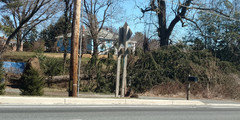
    Although white pines were by far the worst affected, other trees were not immune.

    I spotted this blown over Picea abies today, about 1/2 mile from where the traffic cam picture above was taken.

  • 8 years ago

    Wow. Rarely ever seen a Norway spruce uprooted. That one needs to be re-staked. :)


    To add, alot of branches & debris on the roads were from dead ashes. Wood dried out & brittle.

    UpperBayGardener (zone 7) thanked bengz6westmd
  • 8 years ago
    last modified: 8 years ago

    Lol...just need big enough stakes and she'll be good to go! A few of these should do: https://www.solidsignal.com/m/product.aspx?p=EZ30