

new construction need help with picking out windows
This spring my husband and I will be knocking down our current house an building a new modular home. I am looking for help with picking out window dimensions. We will be going with Anderson 200 series for windows. The modular company we went with based the design off of this house http://www.yankeebarnhomes.com/post-and-beam-project/moose-ridge-mountain-lodge/
We are getting rid of the huge prow window in the great room so the wall will not be angled out. We live in Massachusetts and want to have more of a modern farmhouse look. On the first blueprints smaller wide windows were drawn in but we want to have long narrow double hung and plan to use long narrow double hung in the great room with transom also. I need help on a size suggestion for first floor, second floor, and the great room.
Comments (79)
 8 years ago
Well, yes. And it's actually much easier to sick a lawyer ON someone for copyright infringement than it is to defend against it. So, you must ask yourself: Given that Yankee Barn Homes probably has a legal department, do I want to headache and expense of defending myself against such a suit? Given what the legal costs will be, even if you win - you lose.
That, and it's just wrong. Stealing intellectual property is still theft. PRO8 years ago
Please could we get back to the question. If this is going to be a problem it is up to the poster to deal with it but right now they just want to know about windows.First get the best windows you can afford and this question is best answered by your architect with drawings to show you the differences not us throwing out opinions.
Related Professionals
Lake Charles Architects & Building Designers · Los Angeles Architects & Building Designers · Edmonton Architects & Building Designers · Elgin Design-Build Firms · Omaha Design-Build Firms · Chambersburg Home Builders · York Home Builders · Hopkinsville General Contractors · Columbia General Contractors · Montgomery Home Remodeling · Wilmington Home Remodeling · Danville Home Remodeling · Burlington Home Remodeling · La Crosse Home Remodeling · Owensboro Interior Designers & Decorators PRO8 years ago
Hi Stacey,
I would like to address your original question. The lines of this house don't really seem to lend themselves to the look that I think you're going for, especially in the front elevation. Because of the porch and roof slope, you can't get tall windows in there. Having a column in the center of the two story rear elevation really impedes the design. Ideally one would want a large opening centered there. This house is more mountain cabin than modern coastal farmhouse.
Having said all that, I'm sorry to say that this does appear to be quite clearly a case of copyright infringement, no matter how many small changes you make. The responsibility may fall on the modular home company, not on you, but I think it's time for a redesign. https://www.archdaily.com/328870/the-10-things-you-must-know-about-architectural-copyrights
- 8 years ago
And therein lies the reason no one knowledgeable will respond to "the original question": People who make their living on their intellectual property are generally unwilling to aid and abet someone who is self-admittedly committing theft of same. Wil the OP get away with it? Probably. Does anybody have to HELP her? Nope.
- 8 years ago
Let's say the OP scraped her plans to build this house with this builder. She walks into the local architect's office, sits down and starts explaining what kind of home she wants. It should have 3 bedrooms and 2 baths, a loft, exposed beams, lots of windows, maybe a metal roof, sort of a lodge feel, etc. A month later she goes back and is presented with proposed drawings. How different could the new drawings possibly be from what she already has? Probably not much different. Therefore what you are saying is that in order to avoid being sued she needs to build a ranch, colonial or cape. The mere fact that she saw plans on line and showed them to her builder has forever foreclosed the possibility of building this style of home unless she busy plans from that company. The problem is that she has probably also looked at plans on line for similar homes from other companies. Isn't she also at risk of being sued by those companies as well? Does she need to pay them too? How many architects does she have to pay in order to protect herself from the possibility of legal action?
And if she does decide to build a cape ... she has probably looked at cape plans on line too. (OP if this is true, please please please dont tell us. :-)) Where does it end?
- 8 years ago
On the window question, 10 years ago when we built our previous house I asked the builder about Anderson 200 series windows and he said that he would not use them anymore because getting the the installation perfect was too hard. My impression was that getting them square and keeping them square with the normal movement of building materials was the problem. We went with the 400 series and were very happy with them. Good luck.
- 8 years agolast modified: 8 years ago
Stealing usually ends in a fine and probation for a first time offense if the miscreant shows remorse. If there is no remorse, and no attempt at restitution, then the fine gets bigger and jail time usually results.
Theft is theft. Blue collar or white collar. It's not like it wouldn't be really easy for the wronged party here to being a lawsuit should they desire to. Or just send an invoice for the cost of the product stolen. They do maintain a Houzz presence after all. It wouldn't be surprising if they knew about this thread and were biding their time with a legal response.
 PRO8 years ago
There is no malice intended in any of my comments. I am trying to save the OP (or anyone else unaware of copyright laws) from experiencing the agony of going through a court issued stop work order, possible in the middle of construction and wasting a lot of money.
ksc36's ill informed twisting of the OP's statement, proper copyright notice, and making false accusations of professional practice does more harm than good for everyone and exposes him/her for what they are. The OP's statement of where the design originated would make prosecution a cakewalk.
Weil Friedman Architects makes a very good suggestion and what I feel to be the OP's best path to take at this point for many reasons; it's time for a redesign.
- PRO8 years ago
"How many architects does she have to pay in order to protect herself from the possibility of legal action?"
One
 8 years ago
Yes copying a copy is copyright infringement. There was a case several years ago where a photographer posted their floral photo. Someone else came along and flipped the photo and called it their own. A third person went and flipped the copy and that's when the original photographer found out.
He sued both the guy who flipped the photo and the person who flipped it back and won damages from both
 8 years ago
Unfortunately we're not talking about pictures. We are talking about basic house designs that have been around for 100's of years. We're talking about a design that is available from multiple house design factories. We're talking about a simple house design that is very common in MA. It's nonprotectable, and even if it was it would be financially prohibitive to file a suit against a one off user....
July 26, 2016
11th Circ. Demolishes Another Home-Design Copyright Suit
An Eleventh Circuit panel ruled Tuesday that a major luxury homebuilder couldn’t sue a rival firm for copyright infringement for building similar-looking homes, reiterating that such architectural designs are entitled only to thin protection.
 8 years ago
ksc - the legal ruling in the case you cite rested on the fact that the two designs were not substantially similar. Can the same be said of the OP's house and the copyrighted plan? If they are in fact substantially similar, if a jury would see the two plans as being very close to the same, then, Houston, we have a problem. And that problem is compounded by the fact that the op is stating, clearly and in writing, that she is using a copyrighted design.
Aside from the legal issues, though, there is the simple moral issue of taking someone's copyrighted work and using it without paying for the privilege. People who produce DVD's, stream programs, draft house plans, expect to have their work paid for, regardless of whether it is published in hard copy or streamed on the net. There are always ways of getting around paying for it by pirating material, but that doesn't make it legal and it certainly doesn't make it right.
One thing this thread has shown very clearly, to me at least, is who the real vultures are. And it's not the people pointing out the legal and ethical issues here.
- PRO8 years agolast modified: 8 years ago
Unfortunately we're not talking about house designs that have been around for 100's of years, luxury homes, or a similar-looking home. We're talking about a design that is clearly copyrighted and the OP has clearly admitted copying it. If Yankee Barn Homes does take action, it does not matter if the OP (and/or the modular company) wins or loses the case, either way she will not enjoy the experience. And, encouraging her to continue on the path she is on could serve her great harm.
- 8 years ago
Whether one agrees with copyright law is irrelevant to the question of whether one is violating it. You don’t think it should be a violation to copy a plan when there are many other similar ones? Good to know, but a court wouldn’t care.
If the OP had looked at plans, gone to the architect for the modular home company, described general ideas she’d seen and liked, the approved a plan created by the architect for her, that would not be a violation. As others have said, this is a common house layout, so her plan might have a lot in common, but it wouldn’t be a copy. When she took a specific preexisting plan to the architect and said, “Design me this,” it was a violation. A subtle difference, but that’s often what law is all about.
It would also normally be hard to prove which happened (which is probably why it happens a lot). Except in this case the OP told us it was a deliberate copy (and doesn’t seem the least bit remorseful, sadly).
- 8 years agolast modified: 8 years ago
Mark- If there was a suit over this $999 house plan, and if the copyright holder won, what do you think the damages might be?
- 8 years agoksc - whether you think the floorplan isnt worthy of a copyright is irrelevant. It is copyrighted. So then, the only question is whether the new plan is for all intents a copy of the copyrighted one. The OP says it is. Which leaves your argument in a legal and ethical dead end.
 8 years ago
I think it was about 7-8 years ago (maybe more) we had a poster that built a Frank Betz home somewhere out East. Unfortunately her builder built it without a license. She and the builder were both successfully sued. She pleaded ignorance. It didn't matter. Does anyone else remember this?
 PRO8 years ago
When budgets are tight, I specify Anderson 100 series "fibertex" windows. Look good, energy efficient, and should hold up very well. As for the windows with angled tops, I hope window coverings are not essential.
- 8 years ago
Lane Williams Architects
Would you recommend Andersen 100 series over a decent vinyl window?
- 8 years ago
One thing this thread has highlighted, for me, is the divide between people who value architecture and the ones who just see it as boxes that one moves around to make a floor plan. This "floor plan" might be common, as most layouts will have beds, baths, a kitchen, a dining room, etc, but that's only part of a greater whole.
- 8 years ago
You can believe whatever fantasies you want. In the real world this is what you might expect:
"To find infringement, the appellate court explained, there must be wrongful copying. Not every portion or aspect of a copyrighted work is given copyright law’s protection. Copying those aspects of a work is not wrongful. In this case, the defendants copied only the unprotected elements of the architect’s designs. The court conducted a lengthy examination of the design and explained why most of the elements deserved no copyright protection. For instance, many of the similarities between the plans are a function of consumer expectations and standard house design generally. Since the design was for a colonial home, most of the elements are features of all colonial homes, such as the placement of the front door in the middle of the house."
- 8 years ago
"While other courts might make it less difficult for architects to prove copyright infringement, there are some lessons to be learned from these cases. First, proving infringement where the design is of a ‘standard’ house may be extremely difficult, and filing such a suit should be undertaken only after very careful consideration. If, on the other hand, the design is very novel, it would likely be much easier to convince a court an infringement has taken place. There must be an extensive and thorough analysis of what can be considered original and which of those original elements were copied or copied and modified."
https://www.constructionspecifier.com/copyrights-in-architectural-drawings-courts-make-it-tougher/
- 8 years ago
Mark- You need to learn the law. Poor Mr. Zalewski. It seems the judge didn't read "the thread" and not only threw out the case, but awarded the defendants costs.
" Not every portion or aspect of a copyrighted work is given copyright law's protection. Copying these aspects of a work is not wrongful, and thus not all copying is wrongful."
"Zalewski asserts that, in building the homes and customizing the designs, Defendants copied the overall size, shape, and silhouette of his designs as well as the placement of rooms, windows, doors, closets, stairs, and other architectural features. In addition to his copyright infringement claims, Zalewski asserts causes of action under the DMCA, which prohibits, among other things, “intentionally remov[ing] or alter[ing] any copyright management information.” 17 U.S.C. § 1202(b). - 8 years ago
ksc36 - all of your copyright arguments are irrelevant in this situation. Infringement is actually pretty easy to establish when the homeowner admits to having infringed on a copyrighted plan.
Now admittedly, if the homeowner is sued and loses, the fine for the infringement might be small potatoes - maybe something along the lines of paying the equivalent of the cost of the plans. But then there's the little matter of the homeowner's legal costs - and potentially, liability for the legal costs of the copyright holder as well.
And beyond all of that, we have the basic ethical issue. This isn't a case of someone coming up with a coincidentally similar floor plan; it's a clearly stated case of someone using an existing floor plan developed by someone else. In my world, taking work done by someone else and using it for your own purposes without paying for it is dishonest. Explain to me why it's not.
- 8 years agolast modified: 8 years ago
Of course they aren't irrelevant.
Why do you think Zalewski lost his suit?
"Defendants copied the overall size, shape, and silhouette of his designs as well as the placement of rooms, windows, doors, closets, stairs, and other architectural features"
Have you ever considered that some of these architects are "Stealing" common building design with their worthless and unenforceable copyrights? Remember, most of these cookie cutter houses are simply copies of existing design and paying the $39 to copyright them.
Lastly, if you read the thread, the OP hasn't even got a set of final plans. The only thing remotely unique about that house is the bow front(and that's a stretch) which the OP claimed was eliminated. So we have a simple A frame with a 12 pitch and 2 shed dormers with a 4.6 pitch. Plans for those are a dime a dozen on the net, nothing unique there...
- 8 years ago
Ksc36 - are you an attorney? If not, from where are you getting your claimed knowledge?
- PRO8 years ago
"Architects and artists have never been known for their critical thinking abilities."
Ksc - Can you see daylight??
- 8 years ago
Hi Kristin- No. I've been around this industry for many years.
My turn. Are you a thief? Do you store stolen property in an Idea Book?
Do you consider those pictures yours?
Are you going to copy some of these pictures in a construction project?
What percent of these pictures come from copyrighted plans?
What if you steal the only unique part of a copyrighted plan?
Should you be sued?
Interesting comment you just made considering your stash of 100's of other peoples property.....
And to answer your question below, no I don't believe it should be a violation to copy something that is considered standard, common, elements that deserve no copyright protection. And you are right, the courts don't seem to care.
"You don’t think it should be a violation to copy a plan when there are many other similar ones? Good to know, but a court wouldn’t care". - 8 years ago
The OP says this "I bought the specific plans drawn by the modular company we are working with."
If anyone is stealing, its the architect for the modular company.
The point that KSC makes that i think is most important is that simply copyrighting something does not mean that a court would ultimately agree that the copyright is enforceable. It's also possible that company put a copyright symbol on a plan that they have not actually registered.
 8 years ago
Being a contractor in a previous life I agree it is theft but has an easy solution . I found a plan on he internet that I wanted to build for my personal residence so I purchased the plan took it to my draftsman and engineer and made the changes I wanted. All you have ti do to solve your problem is buy the plan, it can't be that expensive. Believe me I got sued for copyright infringement once and although I won the case as it wasn't a copy it cost me a couple of hundred thousand to defend myself, even though I won it cost so much as the loser didn't pay my attorneys fees. Not worth it buy the plan.
- 8 years ago
ksc: you seem to have a penchant for badly-thought out analogies.
First example: comparing publishing something on the internet to dropping your wallet in a public park and then claiming theft a year later. The correct analogy would be more along the lines of having a stall at an open air market in the public park, with your wares on show. That it's a public place doesn't give anyone the right to grab your muffins or bananas or artwork and walk off without paying for it. And that something - music, a movie stream, a house plan - is advertised on the net doesn't give anyone the right to pirate it.
Second example: Houzz ideabooks as theft. Might I suggest you educate yourself by actually reading the Houzz Terms of Agreement?
Anyone who puts their photos into a Houzz article or onto the website is granting Houzz a lifetime license to use the photos in any way it sees fit, anytime, anywhere. And if Houzz chooses to create the Ideabook concept using the photos as content, that is entirely it's prerogative, and something it is licensed to do. So, to claim that the photos are "stolen" is nonsense.
Final point: still waiting for you to explain the ethics of this situation.
- 8 years ago
Without seeing the two plans side-by side, I don’t see how anyone can judge how similar they are. A is “based on” B would likely mean different things to different people. Our house is “based on” another one I saw online, in the sense that the bubble diagrams would look similar— the kitchen is in this corner, the upstairs is only over part of the house, etc.
But those who choose to assume the worst will do it anyway, so carry on. I just think the evidence is insufficient.
- 8 years ago
ksc - Less the hostility, I find those fascinating questions. I would actually be pretty annoyed if either my designer or architect proposed anything that’s a copy of something in my idea books. While those images are certainly helpful to give them an idea of likes and dislikes, I want their creativity, not a copy.
As to whether simply putting things in idea books is theft, a quick read of the Houzz Terms of Service shows it isn’t. Professionals who post content grant Houzz a pretty sweeping license to use the content, including sublicense it. Houzz in turn grants users a license to use content for personal (but not commercial) use. There are fascinating questions about the enforceability of TOS, but I think a court would find It reasonable to expect professionals to have read and agreed to them before posting their intellectual property on the site, so users with idea books for personal use should be in the clear. (Which is good, because as you noted, I, like others, have a lot :-) ).
i suspect the original poster is long gone, but Claire is right - buy the rights to the plan and move on. Hopefully the house will be everything you’ve hoped. Good luck!
- 8 years agoMark you’ve made your point over and over...as have those who disagree with you...on and on it goes.
- 8 years ago
Hey Mark, dontcha know that you posting the plans that were copied exactly from the Yankee Barns Homes next to the copy is fake news? Don't confuse us with facts.
- 8 years agolast modified: 8 years ago
Maybe you just have issues with the law. As the courts have ruled, there are only so many ways you can orient 5 rooms in a certain footprint. Save copyright laws for unique aspects of architecture, not interior partitions. Laws are different here than in 3rd world countries.
- 8 years ago
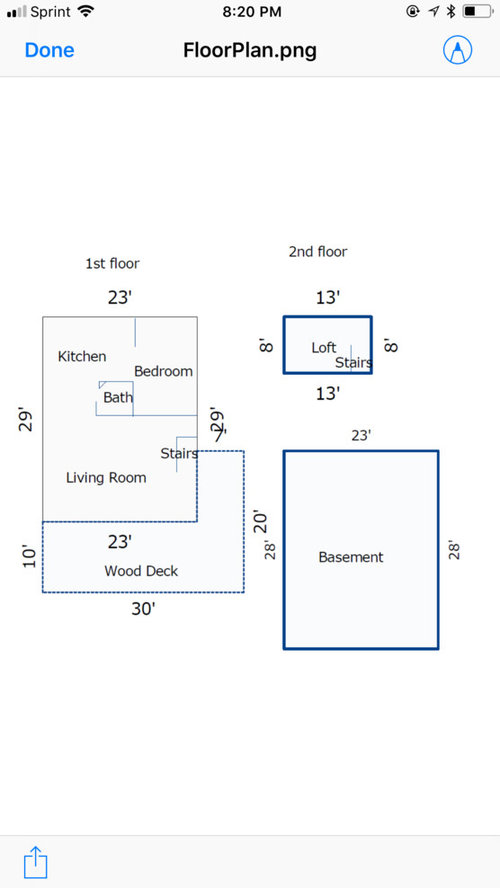
I'm not an architect, a construction attorney or an expert in copyright but come on. Both plans have 2 bathrooms, a bedroom and a kitchen on the first floor. Plus stairs to a loft. They both have the pointed (prow?) front which the OP said she wasn't doing. Given the number and type of rooms, how many different ways could a plan be devised that does not closely mimic the Yankee plan?
And the most distinctive part of the Yankee plan - the prow - is the part she isn't doing. The remainder is pretty basic.
I will say that Yankee Barn Homes has received more free exposure from this thread than they could ever generate on their own. They should be the one paying the OP.
- 8 years ago
In the OP.....
"We are getting rid of the huge prow window in the great room so the wall will not be angled out"
 PRO8 years ago
What a fantastic thread...forget what the OP said...just post and rock on with whatever perspective one may have...forget what the OP said.
What the OP said can't be important. It can't have anything to do with the fact that the OP left the building a long time ago...
Just keep on with everyone's perspective of what copyright of creative works means...
- 8 years ago
You know why criminals get caught thes days? They put it on Facebook. Same here. Put stealing on the forum with your real name so that the aggrieved party screenshots it all and make it cakewalk easy for their lawyers. Right there in black and white, and really easy for the subpoena to get served.
- 8 years ago
Its not the OP who will see legal issues...its the modular company who had their architect sign off on the plans that will get sued in the end. Even in Yankee Barn attempts to go after the OP, the OP can turn around and go after the modular company. Since it sounded like OP was already planning to change the plans and was in the early stages I doubt Yankee Barn would go after OP. At this point either the plans were changed heavily or OP could hire a contractor to finish off the inside of the house and avoid showing the town building department as much as possible. I doubt Yankee Barns legal team would waste funds to take someone to court over an online discussion board.
If OP had to pay for plans in the first place...its highly likely that the modular company contacted Yankee Barns architect and bought them. Its 2018 and with websites like this i doubt a modular company would risk it.
- PRO8 years ago
I think...I doubt...I thought...I suspect...She shoulda...She coulda...She woulda...highly likely...highly unlikely...sounds like...doesn't sound like...your lack of understanding...your lack of knowledge...it is...it isn't...it's her...it's the modular company...it's nobody...if...if...if
Got to be a strong contender for one of most Entertaining Threads of the Year!
- 8 years agolast modified: 8 years ago
I guess when architects and artists consider a few interior partitions "creative works ", entertainment turns to sadness. And then these "creative" types start giving legal advice that is worth less than their box of crayons...
- PRO8 years ago
kcs36 you have no idea about whom you are talking to here...and you have even less idea of copyright law applied to architecture or art.
As I said...one of the most entertaining threads of the year. So divorced from reality.
Just page up and look at what the OP said she did.











suezbell