Software
Houzz Logo Print
jeff_imming

Removing self-leveling

8 years ago
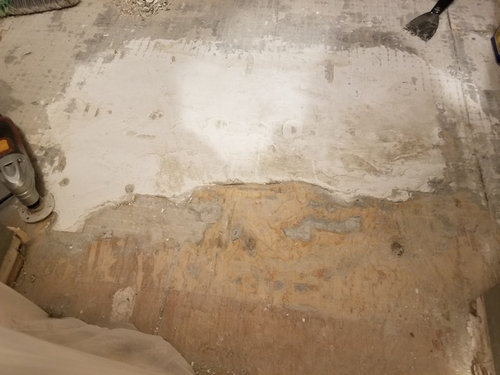
There's a patch of self-leveling/concrete I'm trying to remove. I'm not making much progress using a multitool with a carbide blade. Any chemicals or new tool help break it up better? I'd like to get it all the way down to the plywood subfloor. Any ideas or suggestions? Thanks!

Comments (27)

  • 8 years ago
    It may be easier to replace that area of subfloor entirely.
  • 8 years ago

    It's probably got additive in it so cutting plywood out might be easier than chipping out leveler. If it were do it or die,I'd use a hammer drill to make several holes then an electric 30lb chip hammer.

  • 8 years ago

    So what happens when you want to put down new flooring and then have to level the subfloor? What on earth is your goal here but makework?

  • 8 years ago

    Pull up the old subfloor and replace. Not worth the time and effort involved to save it. Sophie's question is a good one, why bother in the first place?

  • 8 years ago

    Thanks for the suggestions. I didn't think it would be a good idea to add another leveler on top of what is already there so I wanted to start at the subfloor. I would consider it but want to get it right the first time so I don't have to go back and redo it. Cutting out that section would be possible solution as well.

  • 8 years ago

    Fresh leveler will stick to dry leveler just as well as it will to plywood,maybe better.

  • PRO
    8 years ago
    last modified: 8 years ago

    Layering successive pours of leveler over wood substrate at this late point not so smart . If im liable for "doing it right" im first gonna need to know why you have removed flooring and look at the bigger picture. Dig into MFG specifications and understand deflection and bonding primers and bridging board seems please along with minimum thickness and feather edging

  • 8 years ago

    @ Jeff: What is your end goal for flooring? And yes, cutting out this section and popping in a new plywood can be done...but the solution needs to fit the floor you are going to lay.

  • PRO
    8 years ago

    If it's stuck that well, rough it up, prime it and add more leveler over the top as needed. Have you tried pounding on it with a regular hammer or a small sledge? There's a good chance that if you pound on it, the subfloor will flex causing the patch to crack and debond from the plywood underneath.

  • 8 years ago

    Sorry for not clarifying. I live on the second level of a condo and have a neighbor under me so there is some give in this original sub-floor which looks like basic plywood. I'm not sure how thick it is. I'm redoing my kitchen area and I think I'm going with a Shaw Luxury Vinyl Plank Tile system to go over the sub-floor. There is a bad spot where this self leveler is so I'd like to get it as level as possible. I decided not to go with ceramic tile because the grout was coming up originally and the clean up with be easier.

  • 4 years ago

    What did you end up doing here, and how did it go? I was just embarking on a similar journey in my house where the living room is half covered with self leveling conpound, but some of it is crumbly and theres something like chicken coop in it,


    I want to replace it all to create a suitable structure to put hardwood on top of, but unsure


  • 3 years ago

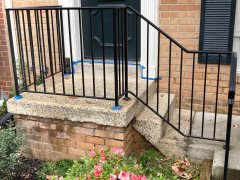
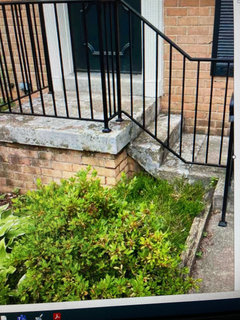
    I am having a similar situation except my self leveling compound is outside on my front stoop which is made of concrete aggregate and the issue is the the self leveling compound is down in the nooks and crannies of the aggregate. I have had success removing the self leveling compound with a wire brush on the end of my drill down to the aggregate. The problem is it doesn't get down in the nooks a crannies. I need some way to get it out of the nooks and crannies so I can restore the stoop to the natural aggregate. HELP! :-)

  • 3 years ago

    Rent a portable compressor and jackhammer rig,demo the front porch and start over from ground up doing it like you think it should have been to begin. One size fits all silver bullet solution. If you would like to stop mincing around like op and tell us the WHOLE STORY there's probably better solutions.

  • 3 years ago

    LOL LOL to the first part. The self leveling compound was on the stoop when I bought the home and about half the stoop (approx. 4' x 4' sq. and one step) still has the compound on it. What more of the whole story would you like to know?

  • PRO
    3 years ago

    It would help to know what your final goal is....

  • 3 years ago

    I would like to restore the stoop to the natural aggregate, thus removing all the compound

  • 3 years ago

    "What more of the whole story would you like to know?"


    For starters we should know why self leveling compound was applied to a portion but not whole porch. If you don't know then you need to have someone examine and figure it out because I sure can't without laying eyes on. I seriously doubt an expert could restore the effected area to original and almost certain internet buds can't tell an amateur how. You might ask yourself if you want it bad enough to do the entire porch if you want it to match.

  • 3 years ago

    The self leveling compound was applied to the entire stoop and step at one time to smooth it out so it could then be painted. Over the years some of the self leveling compound has worn and chipped off. I will see if I can get some pictures up loaded. Thanks for your time.

  • 3 years ago

    It's a shame the person who put leveler on doesn't have to try and clean it off now. This falls in the same category as quicky paint jobs slapped on under impulse then looking for simple ways to get it off when it begins peeling. I fear some over eager handy dandy created a problem that would challenge the best masons in town.

  • 3 years ago

    I believe it was professionally done because an elderly women lived in the home and it is neatly done. I, unfortunately am the one who has to get the remaining compound off. I am trying to find out how the professionals get it off. Thanks again

  • 3 years ago

    Professionals get it off with a gas powered concrete scarifier. You can rent one at most tool rental yards. After seeing one in action,you'll appreciate why it's a challenge to operate amidst the cloud of dust and flying debris.

  • 3 years ago

    I looked at a picture of the blades of a concrete scarifier and that might mess up my concrete aggregate. I can take the compound down to the aggregate. It is getting into the nooks and crannies that is the issue. I need some way to dissolve the compound that is in the nooks and crannies. I have found if it is wet you can get in the nooks and crannies with a brush and get some of it out.

  • 3 years ago

    "I have found if it is wet you can get in the nooks and crannies with a brush and get some of it out."


    That might be the key. Anything that is softened by water can be removed with a pressure washer.

  • 3 years ago

    I wonder if sand blasting would work? Ver messy but it might do the trick.

  • 3 years ago

    I am going to try pressure washing as the next step. Thanks all

  • 3 years ago

    Hi Folks, Job complete with power washing. I very fine stream took it up quite well. 1st After and 2nd Before pics. Thanks everyone for all the advise and input, I greatly appreciate it