Software
Houzz Logo Print
lastwaysleft

Drooping Fiddle Leaf Fig

8 years ago

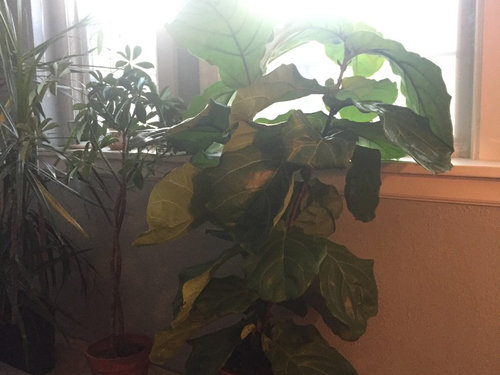
Hi all, I have a new fiddle leaf fig that I got for Christmas. I noticed today that the top leaves of one of the stalks are drooping but the soil is still moist. I pulled it out of its plastic nursery pot last weekend and put it in terra cotta. I disturbed the roots a bit but kept them moist during the process. I only minimally added new soil, which was about a 2-1-1 mix (like tapla's 5-1-1 but with less pine bark since I can't commit to watering multiple times a week). I didn't want to do a full repot in the dead of winter, but wanted to get it into a more porous container.

Any thoughts on what might be causing the drooping/drought response? My guess is too much water retention from watering it last weekend. This is a west facing window on a corner. I've measured footcandles from 200fc to over 1,000fc at points during the day. Obviously the lower leaves get less light, downside of a garden level apartment.

Thanks for any advice.

Comments (16)

  • 8 years ago

    It will recover soon from the change of pots if you avoid over-watering, but the leaves might or might not recover to their original spatial positions. Leaves of F lyrata and elastica both have a tendency to take or partially take 'a set' after they have gone through a period of wilt.

    Using ballast would have been helpful, as it can eliminate nearly ALL excess water retention when implemented to its best advantage.

    Al

    lastwaysleft thanked tapla (mid-Michigan, USDA z5b-6a)
  • 8 years ago

    Many thanks, Al. And thanks for all your posts on this forum. I've learned so much from you. :)

    I'll keep a close eye on watering and I did just use a crate to further bump the plant up so it gets more light on lower leaves. Do you think it would be a good idea to do a full repot/root prune in June, assuming the tree is looking good?

  • 8 years ago

    Hi again Al,

    It's been almost a week and my ficus is only getting droopier. I'm really not sure where I went wrong. Perhaps it was just shocked from being repotted while still acclimating to my apartment. I didn't do a full root prune but I did cut off some roots on the bottom of the root ball and loosen them before switching pots.

    I know there's a difference between plant time and people time. Would you just recommend waiting while providing the best cultural conditions possible? Or is there anything worth trying to perk the plant up?

    Thanks!

  • 8 years ago

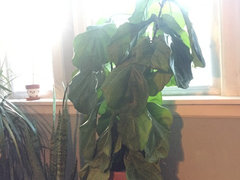
    Here's a photo for reference. The top of the soil is on the dry side but there's moisture further down.

  • 8 years ago

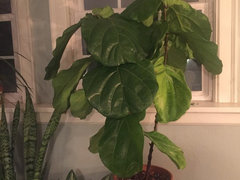
    Sorry for the multiple posts but I wanted to add that starting yesterday the lower leaves are turning yellow and beginning to brown and fall off. The plant seems to be in severe drought response, so I'm wondering if I should water even though it doesn't seem quite time yet.

  • 8 years ago
    last modified: 8 years ago

    I have no idea if this is relevant to your situation, but my understanding is that over watering can also trigger a drought response. Waterlogged soils can damage or kill roots by depriving them of the oxygen they need to survive. After that happens, the plant may be unable to support its current canopy with the roots it has left. So even if there is enough water available, the plant cannot absorb enough water. The plant can regrow roots and recover - but not if the over watering continues.

    lastwaysleft thanked User
  • 8 years ago

    Thanks illsstep - this is a new plant that is collapsing after a repot, so I doubt it's a response to overwatering. I'm guessing it was really stressed by the repot and is having a major drought response. I turned on an overhead fan for circulation and elevated it atop a radiator to hopefully increase the heat in roots to promote recovery. I won't water for now.

    Any additional advice from folks is very appreciated.

  • 8 years ago
    last modified: 8 years ago

    Um, just a warning: both of those things will increase the moisture demands on your plant. Increased air circulation will cause your plant to transpire more (lose more moisture out of the leaves), and most radiators dry the air out, which will also pull more moisture out of the leaves.

    If your plant is indeed suffering root damage from the repot or from recent over watering, this could stress it quite a bit more, as you are now asking its root system to provide even more water to keep up with the increased moisture loss from the leaves.

    lastwaysleft thanked User
  • 8 years ago

    Thanks for that. I guess I'll just put it back where it was and wait and see what happens.

  • 8 years ago
    last modified: 8 years ago

    As long as there was nothing phytotoxic introduced into the soil, your best bet is to keep it warm, keep humidity levels above 50% if you can, and make absolutely sure to avoid over-watering (because that does trigger a drought response and tosses a wet blanket on root function). It goes w/o saying that under-watering should be avoided as well.

    Using a 'tell'

    In many cases, we can judge whether or not a planting needs watering by hefting the pot. This is especially true if the pot is made from light material, like plastic, but doesn't work (as) well when the pot is made from heavier material like clay, or when the weight of the pot precludes grabbing it with one hand to judge its weight and gauge the need for water.

    Fingers stuck an inch or two into the soil work ok for shallow pots, but not for deep pots. Deep pots might have 3 or more inches of soil that feels totally dry, while the lower several inches of the soil is 100% saturated. Obviously, this type of situation cause the loss of a very notable degree of potential. Inexpensive watering meters don't even measure moisture levels, they measure electrical conductivity. Clean the tip and insert it into a cup of distilled water and witness the fact it reads 'DRY'.

    One very reliable method of checking a planting's need for water is using a 'tell'. You can use a bamboo skewer in a pinch, but a wooden dowel rod of about 5/16” (75-85mm) would work better. They usually come 48” (120cm) long and can usually be cut in half and serve as a pair. Sharpen all 4 ends in a pencil sharpener and slightly blunt the tip so it's about the diameter of the head on a pin. Push the tell deep into the soil. Don't worry, it won't harm the root system. If the plant is quite root-bound, you might need to try several places until you find one where you can push it all the way to the pot's bottom. Leave it a few seconds, then withdraw and inspect the tip for moisture. For most plantings, withhold water until the tell comes out dry or nearly so. If you see signs of wilting, adjust the interval between waterings so drought stress isn't a recurring issue.

    Al

    lastwaysleft thanked tapla (mid-Michigan, USDA z5b-6a)
  • 8 years ago

    Many thanks, Al! I set up a humidifier nearby. Do you think setting the plant elevated on top of a radiator would be beneficial with the humidifier nearby? Or as illsstep mentioned would it just increase the water stress for the plant? I've set struggling plants on overturned pots on radiators before and it seems to sometimes help.

  • 8 years ago
    last modified: 8 years ago

    Temperature, primarily, governs how excited gas/air molecules are. The higher the temperature, the more excited the molecules are. The greater the state of molecular excitement, the more potential there is for transfer of energy from air to water molecules. If enough energy is transfered, the molecules of water reach a velocity that allows them to 'overcome' water's tendency to stick to itself and they escape into the air. This is the principle employed when hand driers in restrooms were developed. The warmer the air and the more air there is moving across our hands (or across leaf surfaces), the faster and more efficiently our hands and leaves are dried. While the air currents created by a hot radiator don't move as fast as air from a hand drier, there is a current. As the air is warmed by the radiator, the molecules are excited and more energy is transferred. This creates more space between molecules, which means that a given volume of warm air is lighter than a given volume of cool/cold air, which is why warm air rises. A plant on a radiator has warm, moving air surrounding it, air that can absorb much more water than cooler surrounding air - not a good combination from the plant's POV.

    Al

    lastwaysleft thanked tapla (mid-Michigan, USDA z5b-6a)
  • 8 years ago

    Many thanks, Al and illsstep. Yesterday the plant dropped about 10 lower leaves that had begun to yellow. I've had a humidifier running nearby since Saturday. Perhaps it's my imagination but this morning it looked a bit less droopy. I guess time will tell. I'll post (hopefully happy) updates in the future.

  • 8 years ago
    last modified: 8 years ago

    Good news! It's perking up a little more every day. It lost over a dozen leaves in a short time, one stalk is more bare than the other. But it seems to be on the road to recovery.

  • 8 years ago

    That's good news! The hardest part of the growth period for houseplants in the northern hemisphere would be Dec through Mar, so things will be fairly slow until light levels improve. Let us know how things go and what care regimen you finally settle on, insofar as watering/ repotting/ pruning/ fertilizing, .....


    Al