

Are modern design wall mounted hot water radiators finicky?
Comments (47)
 8 years ago
Have you looked at runtal radiator? They also have a big selection of good looking radiators. Take a look at the column designs.
Are you installing a central AC system in your new home? If you are, are you opposed to a forced hot air system?
 8 years ago
Not a fan of boilers and hot water systems but vertical wall mounted radiators are (and have been for a long, long time) the standard in Europe. Not sure why they would suddenly become "finicky". He probably doesn't like anything based on hot water because of issues some years back with pipes and joints leaking (PEX).
Related Professionals
Tuscaloosa General Contractors · Hays General Contractors · Somerset General Contractors · Vicksburg General Contractors · York General Contractors · Knoxville General Contractors · Kankakee General Contractors · Alexandria General Contractors · Joplin Home Remodeling · San Antonio Home Remodeling · Escanaba Home Remodeling · Carlsbad Home Remodeling · Bronx Home Remodeling · Hannibal Bathroom Remodelers · Modesto Bathroom RemodelersS. W.
Original Author8 years agoIm not 100% against having a standard furnace but really want to do a boiler with rads. Up until now, I’ve always lived in homes with forced air. We are currently renting an 100+ year old house for a year - while we plan & build our new home. This old house has boiler heat & we have become totally hooked on it. I could go on & on with my reasons.
With no knowledge in this area, I’ve only had the internet as an information source. Runtal rads are pretty nice looking but Im really liking the ones that Hudson Reed sells. However, they are all wall mount. When my husband spoke to the company we plan to use for our heating & cooling, they advised against wall mount radiators. They suggested we install baseboard rads but i really do not want those. They said using wall mounted towel warmers are ok for heating small rooms but that wall mounted radiators made for large areas are not the way to go - difficult to install, finicky to operate & not a good heat source. Im wondering if we should change our while plans because of this one, very experienced, opinion.
I know some contractors refuse to use cement board siding & have very legit reasons, while other contractors love it & install it all the time. Is this the same situation with types of radiators? Or is opposition to wall mounted radiators how “everybody” feels?- 8 years ago
I have to agree a boiler with hot water radiators is the most comfortable and quietest heating system you can buy. But it comes at a more expensive cost. The problem becomes having the heating contractor install something which he has little experience. You have to find someone who really knows how to do a proper installation. I have been to many expensive homes in the NJ area and have yet to see a wall mounted radiator. This is a custom feature that is not very common.
I have no experience with wall mounted radiators, but I would think they would work differently than the cast iron radiators in the 100+ year old house you are renting. Do you know if it is a steam system? The heating characteristics of steam versus water are also different. This is a lot to think about before you make your final choices.
A well designed forced hot air system using a multi-stage variable speed furnace can also be very comfortable and quiet.
S. W.
Original Author8 years agoIts not a steam system but possibly was originally. ?? My brother in law told us the radiators in this house are not efficient b/c they are using hot water but were designed for steam.
These New Jersey houses you mentioned - could you possibly show me an example of what kind rads they have? Perhaps I am just not looking in the right places.
It might be that we do end up going with forced air but we are really hoping to find a radiator system that will work for us.- 8 years ago
I have not seen any wall mounted radiators in any model home in the NJ area. I can't even recall seeing a new home with a boiler and baseboard radiators. The trend in NJ is multiple high end furnaces with forced hot air systems.
Another possibility is a radiant floor system. There are have been several posts on this topic recently. But be prepared for the sticker shock.
S. W.
Original Author8 years agoOh i see Mike_Home. I misunderstood. I thougt you were saying you saw radiators that were not wall mounted. I know its not at all common to put radiators in new construction but its what we want to do. Because its not common, i am having difficulty finding good information. I am hoping someone with experience doing so stumbles on to this post. 8 years agowe've lived in homes with forced hot air, hw baseboard, and hw radiators ( in 1890 home). baseboard and radiators provide a much more comfortable warmth. forced hot air always felt quite dry. fwiw.
- 8 years agolast modified: 8 years ago
If you need AC, you will pay double the cost of a forced air heater/AC combination if you want radiators. You will still need an air handler and duct work. It’s not that big of an incremental add on to put in a gas furnace at that point. Whereas if you want radiators, you’re buying a whole secondary system that has to be designed and installed with manifolds and supply lines.
S. W.
Original Author8 years agoOur goal is to NOT have a forced air heating system. We will not install ductwork for air conditioning. We will use multi zone mini splits to cool.- 8 years ago
“Our goal is to NOT have a forced air heating system. We
will not install ductwork for air conditioning. We will use multi zone mini
splits to cool.”The system you’re looking for for 1-integrated system, is a
geothermal ‘liquid-to-water’ system with low-temperature hydronic emitters
(radiators) and strategically installed hydronic fan coil units (for AC) such
that with one central hydronic - non-forced
air system - you will have central heating with the radiators you like, central
cooling (and heating) with the hydronic fan coil units, zoning, as well as
pre-heating of your domestic hot water (DHW).I’ve installed them, they work (when properly designed &
installed), and clients love them.That’s what you’re asking for – but it’s not cheap!
IMPO
SR
 8 years agolast modified: 8 years ago
fsq4, you seem to always recommend ground source heat pumps. Are there houses, locations, or circumstances where that's a too expensive and uneconomical choice and you recommend something else?
- 8 years ago
Re: Whiplash
“We are building a new home & want to heat it with hot
water radiators… we have become totally hooked on it.”“Our goal is to NOT have a forced air heating system. We
will not install ductwork for air conditioning.”Can you suggest any other single, integrated system that uses hot water radiators and provides air-conditioning?
SR
- 8 years agolast modified: 8 years ago
Well, the OP can always hang some window AC’s to give it that authentic 1940’s renovated but not enough home ambiance. But he’ll need to remove them for winter to be able to open rhen for that again 1940’s renovated but not enough look.
Anyone building new and wanting the most comfortable heating system should be looking at hydrionic radiant floor heat. Not radiators. If they don’t mind spending for the double systems required anyway, they might as well actually do it right instead of using antique space wasting radiators.
- 8 years ago
fsq, the post right above yours, that you quote in your reply, says that they plan to cool using minisplits.
You didn't answer my question - do the circumstances matter or is your best recommendation always the same? - 8 years ago
I understand that hydronic floor heat may work even better than radiators, but I'm not sure how maintenance of the piping will work over the long term when it is embedded in a floor.
My radiators are plumbed with cast iron pipe that runs through the walls, with 1/2" feeder pipes coming from up the 1" pipes in the basement. Its very durable (cast iron), and if it does leak it is not that hard to open up sheetrock in a relatively small area and make a repair to one of the pipes.
I also really like the idea of in-floor hydronic heat, but I don't see any easy way to open up the middle of a floor and fix a bad section of pipe. Most descriptions I've seen for in-floor systems use PEX, which is durable and long-lasting; however, there could still be pipe failures or homeowner "accidents" that may create a leak. Is there some specific way it should be installed it that would make troubleshooting and repair easier?
Bruce
- 8 years agolast modified: 8 years ago
What repair? It’s put in under pressure with a gauge so you know right away if you have any issues. The only possible leaks are at joins, which are all above slab at a manifold. There are folks with 50 year old copper radiant heat, and yes, it’s develop snpinholes. Because copper and cast iron have those issues. PEX does not. It will last your great-grandchildren’s lifespan. And then some.
- 8 years agolast modified: 8 years ago
Re: Whiplash
I’m just providing the best solution based on what the
client wants. The OP probably doesn’t even know such a solution is possible.You haven’t answered my question either…
Re: Bruce
Just don’t drill, nail or bolt anything into the floor if
you’re not positive where the pipes are and don’t let the house go down below
freezing without some sort of antifreeze in the pipes and you’ll be OK.SR
S. W.
Original Author8 years agoI would like to thank everyone for taking the time to give their input in this conversation. Its still a good world we live in when so many people are willing to offer assistance to a stranger.
I would like to see if the original question could be reintroduced.
We do not want a forced air furnace.
We do not want in-floor heat.
We are not trying to find one system that both heats & cools.
We are just wondering if modern designed wall mounted radiators are really finicky.
Finicky to install? Finicky when operating?
If there is anyone who has any experience with these, your added input to this conversation would be greatly appreciated.- 8 years agolast modified: 8 years ago
Radiant heated floors turn the entire floor into a radiator. Thus no limitations on furniture placement. Thus no hot spots or cold spots. Radiant heated floors are BETTER than radiant heat from radiators, at a similar cost, and with less than a quarter of the fussiness and design issues of radiators.
- 8 years ago
I have no experience with radiant heat, but my perception is that it would not be as efficient as a radiator in a room that has a high pile carpet with a 5/8 inch padding.
I think the cost a radiant system would be significantly more than a radiator system. Perhaps those who have priced both in a recent new build can comment on this.
- 8 years ago
I, too, love the look of these Hudson reed radiators and found this thread trying to work out why more houses in the US don’t have radiators. I’m English, live on Long Island, and absolutely hate our forced hot air...respiratory issues, dryness, noise, the way the ducts make our basement basically dead space. I want to install radiators in my 100+ year old house. Fsq4cw’s answer seemed most helpful, or what I understood of it. It seems that finding an expert who has fitted these systems often is key. Good luck.
- 8 years ago
I have radiators in my 120 year old Long Island house, and I love them. However, a few years ago, I had a heating failure at a time that it was 8° outside and I was not home, so all my radiators froze (and broke). $25,000 to replace them all (including a few other minor plumbing repairs). Fortunately, no flooding, because I got back while they were still frozen.
- 8 years ago
@Shan Wen, I'd suggest you head over to Terry Love's plumbing forum and post your question in the Boiler forum (towards the bottom of the page).
- 8 years ago
Hi Shan Wen, in fora like this you sometimes have to put
up with people touting the solutions that they favor to get the information
that you want. It is just the nature of
the beast. Don’t get impatient and be
harsh with us; we are just human and trying to help you the best we can. Either
ignore it if you are positive that you know all the angles for your decision or
spend a few minutes to consider the possibility that you have missed something.First a word about conversion of steam rads to
hydronic. True, they won’t throw as much
heat because you can’t put as much heat into them. Less efficient in those terms, yes. Less
efficient in energy cost terms, not really unless you consider the electrical
costs to pump the water. That will be
more than offset by a more efficient boiler. You are not going to find a residential steam
boiler that is nearly as efficient as one for hot water can be. You
likely don’t need as much heat in a home that was converted anyway. Most people have installed insulation and
better windows and doors cutting heating needs by a factor of even 2.I think that this HVAC contractor is going to be a lot of
heartache for you. I don’t see how a
simple device like a hydronic rad can be finicky to operate. The exception might be if you are considering
installation of thermostatic bypass radiators.
If they don’t like these, how are they reacting to newfangled mini splits? I smell trouble in the nature of you getting
an oversized boiler little better than one that might have been installed in
1980, mismatched to inappropriate circulators and heat emitters with poorly
considered zoning and stupid plumbing.
Please run away. The terrylove
forum suggested above is a good one and so is heatinghelp.com, go to “the
wall”. Read up and ask questions to
educate yourself. There are lots of
hydronic experts in both places. The
whole system needs to be designed to work together including, probably the
domestic hot water source. There are
zealots there that will design your whole hydronic heating system for you. It is however a forum with the problems I
cited in the first paragraph. There are
a lot of choices to be made in today’s HVAC world for both cooling and heating.Continued:
- 8 years ago
For coupling emitters to a high efficiency boiler (you’ll
have gas?) Low temperature emitters are
best. Aluminum fin-tube < cast iron
< in floor radiant. Cost for the
system is the reverse order. You can mix
in different rooms with the proper design.
You want low temperature water for an efficient, condensing, modulating
boiler.Yes, hot air today is much better than yesteryear’s
systems. Variable fire furnaces and
variable speed blowers make a huge improvement.
You can’t really understand if you have not experienced them. I will add to that, leaky homes dry air in
the winter not forced air heating systems.
Imbalanced forced air systems make leaky home worse, however, turning
the HVAC blower into a power vent.Continued:
- 8 years ago
In floor radiant is probably most efficient due to two
factors, low temperature water and it puts the heat where you need it the
most. Radiators higher up on the wall
are not going to be as efficient as baseboard rads because it is warmer up
there. That means heat exchange is
reduced. It is simple physics. That
stated, highly insulated homes make the floor-ceiling temp differential much
lower so it might not be a significant issue.
Cast iron radiators put out heat differently than aluminum fin-tube
convectors. The former is more like
standing next to a fire, radiant heat.
The latter relies on air convection as the main heat transfer mechanism.Mini splits? I have 7 indoor units in 3 systems. I consider myself an expert. Yup, they are efficient and you can run one
or two and keep your home comfortable with a relatively small backup genset if
the electricity goes out.There is a lot of work to keep them clean in my home, but
I have an old home. The squirrel cages
are always getting fouled and soil collects all over the inside supporting mold
growth. I pull mine apart and clean the
coil in place. I clean the blower cage,
cover, nozzle assembly (drip tray/drain) and louvers out in the driveway. It
might be better in a new, tightly sealed home. There is a lot of what seems like black magic
legends to cleaning agents. I used the neutral to slightly alkaline pH cleaners
that pros use and use condensate drain tablets placed in effective locations to
control microbe growth.Costs to repair mini splits multiply because you have many
more moving parts. For example, I
replaced one blower motor ($140 after a lot of on line shopping) and there are
6 more that can go bad. I have three
outdoor blower motors, several sensors in each outdoor unit along with their
reversal valves and, of course three compressors…. With a conventional system, there is one of
each. Here is another thing to consider, in new, tightly sealed homes, you
probably want controlled air exchange with the outdoors. That can’t be done as well with mini splits
unless you are talking the minimally ducted units rather than the standard high
wall models. - 8 years ago
coopert123,
Lucky you. Long Island is probably one of the best places
in the country to find boiler/hydronic trades experts. Go to the fora that were suggested above. - 8 years ago
Usually a lurker but wanted to comment:
Have recently installed both Runtal and Buderus wall hung radiators for a hot water system and they are great. Don't understand what is meant by finicky. They are really quite simple devices.
Many reasons to say 'no' to baseboard beside the aesthetics; they make furniture placement a problem but most of all they typically need high temperature water to deliver the needed heat. Modern heating systems tend to be designed with condensing, modulating boilers that adjust the water temperature based on heat requirements (by measuring outside temp). Amazing comfort and great efficiency. Instead of cycling on/off the boiler is running most of the time, just adjusting the amount of energy needed to get the water to the correct temperature. Baseboard is no usually suitable for this approach to heating.
- 8 years ago
I don't see how wall panel radiation is any easier for interior design than baseboard. In some rooms baseboard might be easier to place than the wall panels. In some rooms a mix might be desirable.
There is a general correlation between water temperature needed and the metal used to make emitters. There is not a correlation between location, wall or at the juncture of wall and floor. Cast iron is effective at lower temperatures than old-fashioned fin-tube convectors. The latter depend on air convection and the stack effect in the convector. (As you can see there is not much opportunity to take advantage of a stack effect since the height is so short.) As air circulation drops off, that is a second effect that decreases output. Above 120 heat output vs. water temp is pretty linear. Below that not so and heat output drops off pretty rapidly. 120 is not even close to cool enough to get maximum condensing.
Cast iron emitters of any kind are generally more radiators than convectors and work better at lower temperatures. A mix of CI baseboard and CI wall panels should work pretty well on any given hydronic circuit at the same temp. Not so much for convectors.
Since there is more churn in emitter design than in the last century, probably largely to accommodate lower boiler temps, I advise checking out the specifics for many designs. Pick the ones that work best for you if your contractor can't help because they are stuck in the mud. Putting aside Shan Wen's preferences for a moment, and writing for others that might read this, radiant floor is best for low temp water.
I was looking for temperature curves for different type emitters and was not all that successful. I did run across some links that might be informative for a people contemplating build with hydronic or revising their hydronic heat:
The first is a good overview of condensing technology and how it affects what is outside of the boiler, like pipes and emitters:
John Siegenthaler has written lots of articles helpful to hydronic heating thinkers. Here are a couple of them with different intended audiences and scopes.
Engineering and practical examples - 8 years ago
@ionized_gw: thanks for that link on condensing boiler technology, it really cleared up a lot of questions I had in the back of my mind.
I have a place that is mostly cast iron radiators, with radiant floor heating in a few places (not my design) - gas-fired boiler. The radiant floor heating was mostly put in bathrooms and some rooms in basement, where we spend less time. I can say we love the heat feel overall, but if I were to make any changes, it would be to put radiant floor heating in the two rooms we use the most (in our case, kitchen and main living room). Having radiant floors in less frequently-used rooms and spaces seems a waste of money (although warm bathroom floor is pleasant, it's overkill).
Since (according to above) systems can be mixed, my comment is that it's really worth considering radiant floor heating at least for the most-used rooms - it is really very pleasant.
Usual caveats apply, notably I'm in a cold climate with no need for A/C, so my needs/preferences won't apply to some others.
- 8 years ago
Armoured, I think that if you made a survey, you'd find that a large majority of people would want radiant floor heat in the bath as their first priority. A lot of basements could use it too in my experience. They often have awfully cold floors and the area close to the floor. The disuse of the area changes that, of course. I think that radiant can be added relatively painlessly (except for he pain in the wallet) if the underside of the target floors are accessible. ) Of course the wallet pain is a lot greater if there is no ready access. No way I'd do it unless I hit the lottery or was doing a major reno.
I believe that radiant floor should be powered by water even cooler than CI rads if possible. You might see some increased efficiency if you have mixing valves to cool the water before it hits the radiant floor areas, or slow the water flow there. It might be good to place those areas last in the loop(s)/zone(s) too.
Modcons installed in old systems can be challenging. Lots of excess radiation helps and often results from envelope sealing and insulation in old homes. Sometimes homes that have been modified with several small zones benefit from recombining them to eliminate short cycling with the low mass boilers where lower efficiency cast iron boilers once sat.
Do you have a condensing boiler or are you considering one?
- 8 years agolast modified: 8 years ago
@ionized_gw, thanks.
I'm not disagreeing what other people would want, just saying that in my experience, radiant floor heat is really, really nice and I'd prioritize for highest-use rooms (for the expense). The rads are great, but those two rooms would be more comfortable with in-floor heating (difference not critical enough to change). Your point about basement floors is a good one.
I believe my set-up has a mixing valve for the radiant floor areas. Our boiler is not a condenser, but relatively new, and I'm not looking to replace anytime soon - nor any immediate plans for deep retrofit; I'm more accumulating knowledge and experience for decisions (way) down the road. I am doing ongoing minor 'envelope tightening' and maintenance (esp windows), and that has made a notable difference in a few places. In my location, gas is cheap enough (and the house reasonably insulated and new enough) that any big heating/insulation work wouldn't pay. Possible in future we would build, so knowledge accumulation will be useful down the road.
- 8 years ago
I see, armored. Invisible, exquisitely comfortable radiation is very nice, but comes at a price. Was this mix of heating modes done when the home was built or were there modifications?
Here are a some things to keep in your pocket if you have an eye on future condensing boiler installation. As already alluded to or covered in the links, don't ever take out any radiation if you can help it. Secondly, at heatinghelp.com (The Wall) and terry love.com, there are a lot of knowledgable and generous hydronics and boiler posters. Lastly, at least from a theoretical standpoint (ignoring cost of equipment), I really like the HTP Versaflame and Versahydro boilers. It is an elegant solution for replacement of a high mass iron boiler. I think that they can drop in, by even ignorant hands, and give good performance where other boilers, even installed with lots of modified piping, will not condense well due to system limitations that might require extensive mods. If you don't want DHW and space heat from one unit, and they have the capacity, I'd consider a Westinghouse WGR----076 series water heater. (WGR060NG076). It has a 3:1 turndown ratio vs 5:1, but for a little over $2000 bucks, if you can get away with 76 kBTU, you get really good bang for the buck. It is either built by HTP or made under license from them. Likely you can put in two of these, one for heat and one for DHW for the cost of any other boiler that will do both. If there is enough capacity in the Westinghouse, you could add a flat plate heat exchanger and indirect tank and use just one.
At today's nat gas prices, as you know, it is hard to justify replacing anything that works reasonably well.
- 8 years ago
@ionized, heating was done when constructed (about ten years ago). And I am looking at/following heating and house issues, likely more for future housing than big changes to this one. As you said, wouldn't make much sense to change what works now and is pretty recent. There may be other changes possible that would make more sense.
- 8 years ago
Funny, I'm having the same situation in San Francisco right now. (50% of house and both bathrooms to the studs remodel, removal of load bearing wall and seismic upgrade) My contractor suggested an in-floor radiant heating system. I don't like the idea of water tubes running in the ceiling over my first floor master suite, and I said so, but then the bid came in at $38,000 (1,700 sq ft house, but only 40,000 BTUH necessary as SF is rarely below 60 degrees) The forced air system (all new ducts, old asbestos covered ones were removed) came in at $12,000.
I suggested Runtal radiators (and in-floor radiant under my master suite only) but my contractor said his plumber/radiant heat sub said Runtals are too expensive. My contractor honestly doesn't know about Runtals but his sub recommended Haydon baseboards. This was a red flag - two completely different types of heat (convection vs. radiant), boilers, water pressure and frankly I find the baseboards very unattractive dust collectors.
I set up a spread sheet, computed square footage of each room, BTUH requirements of each room, placement or radiators, style (baseboard for office and guest room, but 4" R series for larger public rooms and a 6" baseboard under my kitchen island) color and water usage. (Runtals use 1 gallon of water for every 40 Ft. of internal tubing.) I calculated BTU requirement for a condensing boiler (40,000 BTU). One thing I did learn - Runtals use 1/4 of the water of Myson, so this justifies their higher price - you get it back in energy savings.
I'm pricing the system with a local distributor. This post has convinced me that I must now find someone with experience installing a complete Runtal system. I'm not paying a plumber $125 an hour (SF going rate) to "learn on the job."
- 8 years ago
My understanding is that boiler, pump and radiator reps often do a lot or all of the engineering calculations for boiler and radiator installations.
I must be missing something because I don't understand this at all"
Runtals use 1/4 of the water of Myson, so this justifies their higher price - you get it back in energy savings.
A btu is a btu. The boiler makes it, the structure looses it. How it gets to the room from the boiler has little effect on efficiency provided the return water is the same temperature. Even if you have to put 2 or three times the electricity into pumping with an inappropriate piping/pump and maybe radiator system, it won't make that much of an impact.
I can't say much about CI rad design with respect to internal water volume. Water carries the heat so flow has to be sufficient and transfer from water to metal and metal to room has to come out right. It really boils down to the rated heat output of the rad at a given temperature and the rate needs to maintain that given temperature.
Cast iron baseboard need not be any more of a dust collector than the higher mounted Runtal rads and has the advantage of putting the heat low where you need it most and heat transfer will be maximized.
Are you sure about that 40k calculation? Right now I am looking at heat loss calcs for a home about that size. It is 50 years old and, although the insulation and air sealing is excellent for a home of that vintage, it is only good overall. The calculation comes in at below 50k at a design temp of of 0F. My fuel use calculations, however, come up below 30k. I put more faith in the latter since there is guesswork involved in the energy rater's estimate..
The walls have insulation blown in, The ceiling is filled to over the joists and there are double pane windows. Exterior doors are good.
S. W.
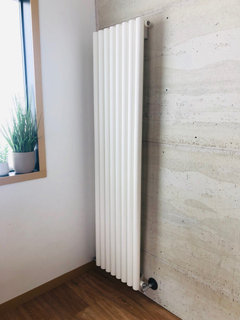
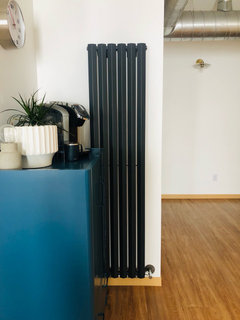
Original Author6 years agoI went ahead with my proposed radiator plan & used Rads from Hudson Reed. We are so pleased with them. We have lived in our new home for nearly one year & are going through our second Minnesota winter. We moved in during the winter months of 2019. Everything about them is wonderful - the quality of heat, the looks, the ease of diy installation & operation. Thank you to everyone who took the time to give me their thoughts.
S. W.
Original Author6 years agoAppearance was the only factor that led me to Hudson Reed. The variety of design and color is amazing. As a side note: the staff is incredible - very knowledgeable and customer service oriented. I would highly recommend them.
- 6 years ago
We just finished installing out Myson radiators in a new side addition. We used their column radiators, since they seemed to be the closest visual match to our old cast iron radiators. https://www.houseneeds.com/heating/hydronic-radiators/myson-column-radiator-3-column-12-sections-3566-btu-12-3060
The quality of these radiators is great, and they have a beautiful finish. I've only found a couple of caveats to be aware of. They do not have the mass of cast iron radiators, so they cool off faster. However, our new addition is much better insulated than the rest of the house, so this does not seem to cause any issues with keeping the room warm.
Also, make sure you pay attention to the downrating BTU chart if you are running your boiler at lower temperatures that are typical for cast iron radiators (e.g., mine run at a max of 140 degrees). When you see a rating of 2500 BTU for a Myson radiator that assumes you are running a 180 degree system, which is more typical of baseboard hot water heat.
Bruce
- 5 years ago
I also live in NOVA, which company installed your radiators and performs your boiler work? It is difficult to find a good contractor for boilers/hydronics here.
- 5 years ago
I live in the SF Bay Area and have wanted to use wall hung radiators to heat the house. I can DIY installation of the radiators and piping (copper or pex) as sub floor access is easy from the full basement. However I need a control, boiler and piping design. I don't think there are any contractors in the area that are experienced in this style of heating. Any ideas where I can find a system design for 1800 sf house?
- 5 years ago
Do not use COASTAL PLUMBING AND HEATING INC. (Bobbie Knowles) $50K for a 1750 sf house and I'm cold in winter. He plumbed the living room radiators so the water would come from the ceiling - big problem, the radiators would have been upside down! I called Runtal in Boston and they said NO! Then he wanted MORE money to plumb the radiators correctly. A year later 3 radiators still not installed, (COVID partly to blame). When I feel safe I'm contacting Pacific Radiant Heat & Construction to finish the job. (all I can do about Costal is sue my contractor) They also gave a bid ($5K less - my contractor had worked with Coastal before and pushed me to go with them) AND he knew about radiators.
Pacific Radiant Heat & ConstructionCa Lic # 952071
1039 Goettingen St
San Francisco, Ca 94134
Office 415-378-4334 Fax 415-468-1471
S. W.
Original Author2 years agoSame. We did end up going with them and I couldn’t be happier. We ordered ours from Hudson Reed in the UK. They arrived 2 days after ordering. I absolutely love the look, the heat they give out and having a “thing” on the wall that gives off heat. We live in Minnesota and coming inside from the cold - there’s nothing quite like having a radiator to go hug on.






Elmer J Fudd