Software
Houzz Logo Print
agmay

Island countertop dilemma

8 years ago

I want hardworking surfaces in 13x18' L-shaped kitchen with 4x7' island. Serious cooking, not just for show. Considering quartz or granite for perimeter, wood on island because it's warm to the touch for seating/dining. Is it a mistake to go with wood? Too much maintainence?

Comments (18)

  • 8 years ago
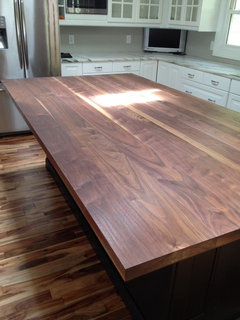
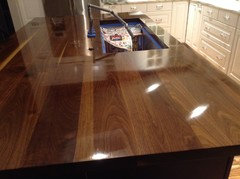
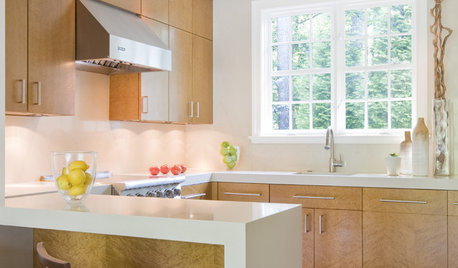
    Here's my kitchen... island top and waterfall edge is solid walnut. My hubby designed and built all of the cabinetry and the island top and I finished it with Waterlox because I wanted a waterproof finish with the prep sink in the island. I have a largish family (five kids aged 15-20 all still living at home) and we've always homeschooled, so my kitchen gets a lot of serious use all day. I've been living with the island for about 15 months now. (Disclaimer: I have sanded down and refinished the island once already, but it was because the first time I used the Waterlox it didn't cure properly... I was getting massive marks/scratches in the finish from the slightest pressure. I have not had that problem at all since I did it the second time. I knew it wasn't going to cure properly the first time, but my hubby was trying to rush the process and wouldn't listen to me, LOL! Now he believes me since I MADE him re-sand it so I could apply it all over again and he sees the difference now that it cured properly.)
    Now... it IS more maintenance than my brushed granite perimeter counters, but it's not a ridiculous amount in my opinion. It does show minor scratches here and there... so you have to be ok with a little bit of patina. I use cutting boards all of the time on it. I also have some silicon mats that I can easily pull out if I'm setting things down on it and I'm afraid people might carelessly slide those things around if they have rough bottoms on the containers. I have trivets for anything hot... but my stovetop is so massive that I tend to serve all hot items straight from that instead of placing it on the island. One annoying thing I discovered is that if you set something like a hot pizza box straight onto the wood the cardboard sticks to the finish. I mean, it comes right up with a little wood cleaner and a bit of elbow grease, but i was horrified the first time it happened. Now I always set down a dishcloth under pizza boxes. ;) (and I don't like anyone setting damp junk mail directly on it either, same thing happens and sometimes the ink transfers... again, it always comes up with a cleaning, but it's still a bit of a hassle that I prefer to prevent.) Otherwise, I use Method wood cleaner on it most every evening. I can easily wipe it down with a damp rag or sponge in between. Water beads right up. Oh! I cannot use bleach products on it at all... not because of the wood per say, but because of the Waterlox finish... it doesn't react well to bleach, it gets cloudy. I know because we have Waterlox covered wood counters in two of our bathrooms and one of them got a little bleach on it. It doesn't affect performance, just the looks, so I keep bleach out of my kitchen and those bathrooms now.
    So basically, I treat it like laminate countertops... I don't cut on it, and I don't set hot stuff on it. I also treat it like a wood kitchen table, we use placemats where we sit at the island and I clean it nightly with a wood cleaner. We love how it looks and it's very comfortable to sit at. Still more maintenance that my granite but I don't exactly baby it either. Hope that helps!
  • 8 years ago
    We have an L shaped kitchen with a butcher block island and laminate countertops. We are actually planning to swap and do butcher block counters and a stone island. We’ve found that 95% of meal prep, eating, mail sorting, etc happens on the island because it’s just nicer to use a wide island looking in than it is to use a counter facing a wall. As a result, the island gets the most abuse and is the least abuse-proof.
    Now, we’ve never sealed it with Waterlox which might be part of the problem, but we do use an oil butcher block sealer occasionally. But what really gets to me is that you can’t use anything to really sanitize the wood. I use soap and water and then wipe it dry with a paper towel and even that is pretty harsh. So it makes things like scooping out yogurt or cutting onions pretty stressful- one slip and you’ve got a smelly thing soaking into your counter. Plus we have to use coasters, trivets, placemats, and cutting boards which is just a lot of clutter to store.
  • 8 years ago
    last modified: 8 years ago

    It depends.

    Wood counters are amazing, and they bring a warmth into the kitchen that other countertops can’t. But you have to weigh the pros and cons, and decide what you can live with.

    A product that coats (like Waterlox) is going to be more durable. The downside is that it’s not always foodsafe, so you can’t use the counter as an actual prep area, for things like rolling out dough. Waterlox can also change color as time goes by: I’ve seen things that have seriously ambered over the years. And, as skmom mentioned, it absolutely needs to be cured, and it’s a pretty smelly process. I’m not sure I’d want to do it in a house I was living in.

    An oiled butcher block is food safe, but can be damaged by standing water, stained with food coloring, cut with a knife, etc. It’s meant to be used/abused as a living prep surface, so if those things bother you, it’s not for you. And, while it can be sanded down, it will rarely look like an unblemished surface.

    Personally, I love the patina that happens with real wood. My dream would be to find a worktable that had been used for decades, and build a kitchen around it.

    (For disclosure, I had both types of wood counters in my last house: oiled on the island, and sealed on the perimeter. We did quartz in the new house. My husband was over being paranoid, and since he cleans the kitchen 75% of the time, he got the final say. Not that we ever had issues in the other house, mind you, and we have 4 kids!)

  • 8 years ago
    One correction... Waterlox IS foodsafe... except for those who have tree nut allergies. ;)
  • 8 years ago

    “They soon determined that on wood surfaces, bacteria such as Salmonella quickly disappeared from the cutting board surfaces, even surfaces that had many knife cuts. Plastic, however, especially plastic with grooves from knife use, tended to harbor the bacteria over time.”

    From here: http://www.akitchen.com/blog/2013/11/22/on-cutting-boards-plastic-vs-wood-you-may-be-surprised/

  • 8 years ago

    Sorry, yes. Waterlox is foodsafe, however many of the other popular kitchen counter finishes are not, like polyurethane. I unfairly lumped them all together.

  • 8 years ago

    Well, guess I can offer a cheap-o perspective. Our carpenter glued up two pieces of oak ikea butcherblock (not sure it really qualifies as butcher, it looks like it more or less) to make us about a 5’ square island. I sanded It and finished it with tung oil. That was 10 years ago. I use cutting boards, but other than that, we use it heavily, and I never worried (at that price it can easily be replaced). I wipe it down with Lysol Clorox wipes when it needs it...and was just thinking maybe it could use another sanding and coat of oil. But it really looks fine and works really hard. Trivets or a placemat for hot stuff. It’s a very light color, whatever it’s natural color is. (It does not hold a candle to skmoms gorgeous furniture like island.)

  • 8 years ago

    Bbtrix WOW what a beautiful island you have! I love that look and am on the fence myself. May I ask if or how many times you've had to sand/refinish to keep it looking that nice over 3.5 years? Maybe a closeup? I don't mind a kitchen surface with a patina if it ages well =). Thank you, and what a nice kitchen overall, well done!

  • 8 years ago
    last modified: 8 years ago

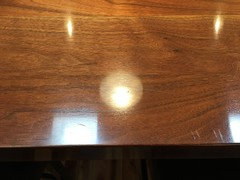
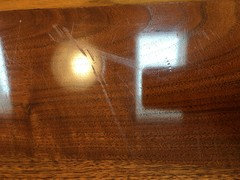
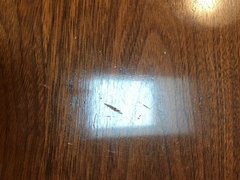
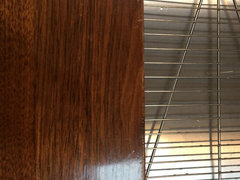
    I’ve never sanded/refinished at all. There are several spots that I can touch up and may do this spring if they don’t settle down. The shallow scratches fade with time but I should work on the few deaper ones. The thing is, you have to have light hit it just right to see the scratches, just like marble etching. I have some ambering, but expected that, especially with two large skylights over it.

    This one is where the toddler sits. He’s made gouges with his fork.

    Where my DH had dragged serving dishes. These will lessen over time because they are shallow.

    DH did this using a paper plate as a cutting board! Duh!
    The sink edge.

    This is the wood the day it is was delivered.

    And the day I completed the Waterlox process.

    There is a technique for repairing scratches without doing the whole top. I’ll likely do that once it warms up so I can have adequate ventilation and air exchange which is essential for the curing process.

  • 8 years ago

    Thank you! Those scratches are so minor, very impressed with how your island has held up. Great, professional job you did with that finish, thanks for sharing.

  • PRO
    8 years ago

    If I had a wood island, I would just oil the butcher block so I could use it and not have to be careful. The Waterloos looks great, but I would feel as if I were cooking on the dining room table, and you said you do SERIOUS cooking. Old butcher block develops a wonderful patina over the years and always looks good in the kitchen or someone who truly cooks.

  • 8 years ago

    The issue with oiling I've heard is the oil residue getting on things you place on th counter. Think papers, clothes, etc.

  • 8 years ago

    Earlier I suggested the OP search GW because this has been discussed for years and there is a wealth of info on choices and pros and cons. Her decision needs to be based on knowledge and what will work for her, not our opinions. I don’t agree with the comment that with an oiled wood you would not have to be careful. Wood is wood and will scratch. Finishes give protection of varying degrees.

    I am a serious cook, from scratch nearly daily. I have a huge sink in my island and zero water damage. I do 90% of my prep at the island. Just want you to know my experience, that I’ve enjoyed this workhorse with very minimal care and maintenance. And I personally love the look and feel.

  • 8 years ago

    When the counter is new, you oil it frequently. We would put the oil on right before bed, leave it overnight, and let it soak in. So, yeah, if you laid something on it during that time frame, it would get oily.

    We started out oiling it once a month or so. After a few months, we dropped down to every 2-3 months. After about a year, we only needed to do it once a year.

  • PRO
    8 years ago

    I did what Gennifer did - no oil residue at all now, and yes, papers are often on it.

  • 8 years ago
    Wow, I'm with bbtrix... uh... I AM a serious cook and I cook in large quantities most every day. Yes, we order the occasional pizza, but the vast majority of my cooking is from scratch. (I have health issues and my body can't handle processed food or food additives, so even if my family has some processed food, I still need to have food from scratch for every meal.) I have no issues with an oiled wood top, that is perfect for some applications. I did not think it was a great application for a wood top with a sink in it. Anyways, I have had the same results with shallow scratches in the Waterlox often becoming less noticeable with a little time. I have also had success with spot treating scratches with Waterlox. You give it a little sanding if needed, and then you give it light coats in the area, kind of feathering it out (I prefer to use a small foam brush) and do that in layers, allowing it to cure about 24 hours between layers until it looks good and even again. Don't glop it on in one spot like my hubby tried to do. Sigh. I still need to sand that down a bit and fix that area. God bless my hubby... he's an amazing woodworker UNTIL it comes to applying any kind of finish with a brush. Sigh. He needs to stop trying and just leave that part to me, LOL! But it's true, you only see the imperfections at certain angles when the light is just right.
  • 8 years ago

    So much helpful info, thanks!