Software
Houzz Logo Print
futuredriven

Georgia Red Clay Soil...What should we do?

8 years ago
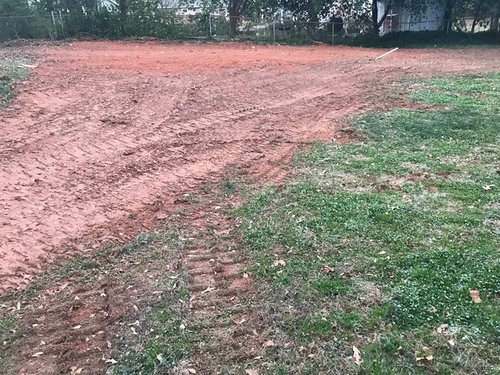
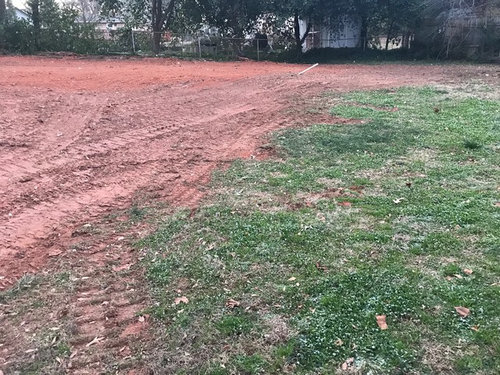
DH and I just purchased a fixer upper home. When we purchased it there was a really bad makeshift shed in the back with all types of illegal (electrical/gas) lines running to it. Anyway we had that taken care of, the shed demolished, and the yard graded. When we did this the top layer of the grass was taken off and now we have a yard full of red clay. We were told to put down fescue seed and it would take off. Well its been unusually cold with a lot of rain in Atlanta. We are just getting decent temperatures. Needless to say the seed didn't take and I'm pretty sure the last big rain washed it all away. This was over 6-8 week period. We went to visit the house and you could see red clay water running down our street (from our back yard). We have gotten quotes for sod (6 palettes for about $3000). This really was not in our budget. Does everyone think sod is the best route to go? We have a 65 pound poodle mix and he can't go in this back yard until we have some coverage over this clay. We move in this weekend. What do you suggest? We can take him out in the front yard for about a month but anything longer than that will be to long.... Help!


These pictures do not do it justice. This is the thickest clay dirt I have ever seen. After it rains it takes about 3 days of dry weather for the clay to dry out.


Comments (17)

  • 8 years ago

    I would have put wheat straw over the seed.That would have helped with wash away and you could at least walk on it with out it being messy.Since its really thick like you said I would put the wheat straw a little thicker.They sell wheat straw bales at home depot. Hope that helps

  • 8 years ago

    What do you think about hydroseed?

  • 8 years ago

    If you want grass. Pennington makes a great 'one step' grass seed. I used it this fall to take care of some spots. The recommendation is about 1 cup of mix per 2 sq.ft. This worked better than great. The next time I'll do it 1 cup per 4 sq.ft. It's a bit expensive, but if you can keep it moist I think it's about foolproof. Right now it's thick and luxurious. I'm waiting to see how it handles the summer.

  • 8 years ago

    What kind of sod were they quoting?

    Fescue is going to look like "mess" in the summer months if it even takes off at all. Just too hot and humid down here. You may get away with using it if you get good afternoon shade. You will need to overseed often to keep it halfway thick. Wheat straw helps with the washing away of seed.


    Do it right, bring in a bunch of top soil and conditioner and till it in. Then plant what you want. You are going to have to keep the dog off of it for awhile while it is establishing.

  • 8 years ago
    Yes if you redo grass seed put wheat straw over it. I would add clover to the mix too
  • 8 years ago

    Goodness, 500 a pallet for any grass is robbery. I paid about 150 a pallet for celebration Bermuda & that stuff would solve your problem within a month if you can keep it watered. It grows like crazy

  • 8 years ago

    OMG... not Bermuda, that stuff creeps constantly. I have it in the front and I'm thinking of uprooting it and replacing it. I have fescue on the side and back... maybe I'll use it on the front too. I'm really tired of pulling the grass out of my flower and herb beds.

  • 8 years ago

    You are just throwing money away on grass seed,especially for our hot temps, red clay soil and humidity.Ive seen few homes with nice fescue yards but those homes have alot of shade and a irrigation system.Bermuda thrives in the our area.Doesnt like shade.Some bermuda types tolerate shade more,like the celebration variety reeljake mentioned.

  • 8 years ago

    Bermuda or Zoysia are the only two grass varieties I would consider for GA.


  • 7 years ago

    Dog. Zoysia.

  • 7 years ago
    Thank you everyone we are still trying to figure this one out. My husband has put down fescue seed in our front and back yard and we have hired a monthly lawn care service, but the clay soil is still an issue. We don’t get a lot of shade in our back yard but now instead of the exposed clay soil we have a ton of weeds. Any suggestions?
  • 7 years ago

    Right now, the weeds are what is holding the soil in place. You might want to leave them (mowing if needed) until the time to put out new seeds comes back around. That next chance is in early spring -- for metro-Atlanta it is in March.


    If you are totally set on Fescue, UGA Cooperative Extension has published information about growing a Tall Fescue lawn from seed in Georgia:

    http://caes2.caes.uga.edu/commodities/turfgrass/georgiaturf/Articles/Misc/Seeding_TF_Lawns.pdf


    UGA Extension's lawn care calendar for Fescue may be helpful when the lawn is more established. The calendar shows "when to do what" for a Fescue lawn in Georgia:

    http://extension.uga.edu/content/dam/extension-county-offices/forsyth-county/anr/TallFescueLawnCalendar.pdf

    Clemson University Extension publications also have some helpful information, with regard to other parts of the lawn problem.


    Try these:

    https://hgic.clemson.edu/factsheet/selecting-a-lawn-grass/

    https://hgic.clemson.edu/factsheet/lawn-establishment/


    After reading the bits of information that seem like what you need, consider calling your local Cooperative Extension office to talk with an actual, knowledgeable person. The consultation is a free service.


    If you decide to call or visit your Extension office for assistance, take some photos of your lawn with you (or be ready to email them to the person who helps you). Also, be prepared to share the steps you've taken so far to get the lawn established. You will get the best help if you bring complete information.


    You can even take samples of the weeds to the office, to have them identified and to get information about how and when to get rid of them.


    I hope some of this is helpful!


    -Amy

    A list of all Georgia Extension office by county is here: http://extension.uga.edu/county-offices.html

  • 7 years ago

    When did you plant the fescue seed? This should have been a good looking lawn by October if you planted the seed in September. Fall is always the best time of year to plant a cool season turf grass. Having said that, with the Earth warming, the Atlanta area is moving from the transition zone to the southern or warm zone. If you wanted to plan for the future, then going with a hybrid bermuda (not the weed-like common varieties), St Augustine, or some of the zoysias might be a better approach. Those go down as sod and can be applied any time of year.

    Before you spend a lot of money trying to fix the clay soil, I strongly suggest you get a really good soil test to verify the salt values and the total exchange capacity. It often happens that people believe they have clay soil because it cracks and holds moisture like you would expect modeling clay to do. But if your soil has a low TEC and high magnesium content, it will act very much like clay. The repair for clay soil is different than the repair for high magnesium, so you need to know what you have to fix it right. The $25 test from Logan Labs in Ohio is a great test to answer these questions. They will email you the results in a week. Then you can post the results here and get a read from the forum members.

    I would not do anything but mow the weeds until mid April. By then a new crop of summer annual weeds will have bolted, and you can spray those out. Something like Weed-b-Gon will take care of the broadleaf weeds leaving you with grass and grassy weeds. Then you can evaluate what you have left. Whatever you have left should be mowed at the mower's highest setting to encourage the fescue growth and discourage bermuda growth.

    If you get a chance look around at TIF 419 hybrid bermuda. It has been THE choice of contractors since the late 1960s which has caused the price to fall down to about $50 per pallet. In this case, "contractor grade" bermuda is one of the finest turfgrasses you can get. As has been mentioned it does not grow in the shade, so on the north side of buildings, fences and shrubs it will thin out and fail. But on the south side, it's great. If you decide to renovate with a southern or warm season turf, let us know for more tips on preparing the soil. These sod type southern lawns can be put down in the spring very successfully, but prepping is important. Here's one tip: NEVER rototill in preparation for grass.

    Here is some general lawn care advice gleaned from this and other forums over the past 19 years. This is in order of importance.

    Water deep and infrequently. Deep means 1 inch all at one time every time you water. Infrequently changes depending on the temperature. For the winter and until the temperature gets into the 70s, you should water no more often than once a month. If it rains then stretch out the interval. With temps steadily in the 70s, you can deep water once every 3 weeks. With temps in the 80s, move up to once every 2 weeks. With temps in the 90s, you should water once per week. The purpose of deep watering is to get water deeper into the soil which encourages the roots to grow down to get moisture and nutrients deeper in the soil. If you have been told you need to water every day, that is absolutely incorrect. Daily watering, besides encouraging short roots, also promotes weed seed germination.

    Mulch mow at your mower's highest setting. This also encourages the roots to grow deeper to support more foliage above the surface. Taller grass looks nicer and helps to shade out any weed seedlings that might germinate. There are three grass type exceptions to mowing high. Those are bermuda, centipede, and creeping bentgrass. Those should be mowed at the mower's lowest setting.

    Fertilizer: If you fertilize with chemical fertilizer, make your first application on Memorial Day. Don't get tempted by the TV commercials in February selling Scott's 5-step program. Your grass does not need any fertilizer until May. Apply again on Labor Day and again around Thanksgiving or after the grass stops growing. If you want to use an organic approach, I would apply alfalfa pellets at a rate of 15-20 pounds per 1,000 square feet 3 weeks prior to your last freeze date, then Memorial Day, 4th of July, Labor Day, and Thanksgiving. If you opt for the chemical program, I would still make at least one application of organics per year to help keep your soil healthy. You could use compost, but it takes 700 pounds of compost to equal the nutritional value of 15 pounds of alfalfa. Plus the 700 pounds would smother the grass, so don't do that.

    As I mentioned those are listed in order of importance. Proper watering is far more important than proper mowing and much, MUCH more important than fertilizing. I would say it is 70%, 20%, and 10% if I was totaling the value of the three. Once you get the watering, mowing, and fertilizer down, most of the lawn issues will go away. If you should get a disease or insects, then write back here to help get it diagnosed and find a solution.

    One more consideration, if your poodle wears a path in the turf, you might consider using mulch along the path.

  • 7 years ago

    I will tell you my GA red clay story, maybe it will help..it probably won't fit your timeline but it's worth knowing...I had an area outside of our fence line that was covered with kudzu (another ridiculous GA problem) I had it professionally excavated. the roots for that stuff were literally 3ft into the ground and as big as a garden hose..anyhoo...after that was all removed...I covered an area I wanted to use for future garden spot with anything I could get my hands on..old cardboard boxes, newspaper, I went through the neighborhood regularly collecting bags of leaves..and when I was done, it was probably about 8 inches tall or so..I left it for about a year...(or at least a full season, I don't remember exactly). Pre mulching..you could not put a shovel into this stuff...after it had all decomposed..it was black and beautiful and so easy to work with.

  • 7 years ago

    ps: check with your city to see if they have a recycling program or a mulch thing..I got a dump truck full of stuff from Perry, Ga from the fairgrounds, FREE and they load it..it comes from the municipal green collections and the animal waste from the fairgrounds. that stuff is amazing.

  • 7 years ago

    Excellent posts, rjinga. The best way to prepare a yard for a lawn is to go back 6 months and apply several inches of mulch.