Software
Houzz Logo Print
roseseek

2018 First Burrito results

8 years ago
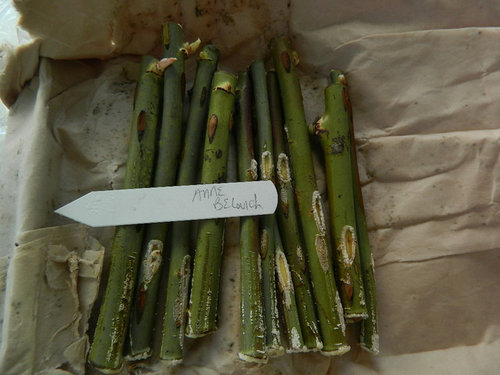
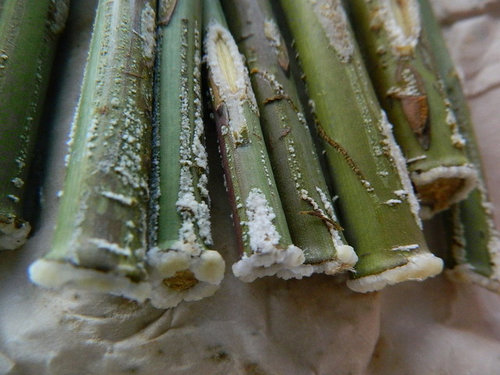
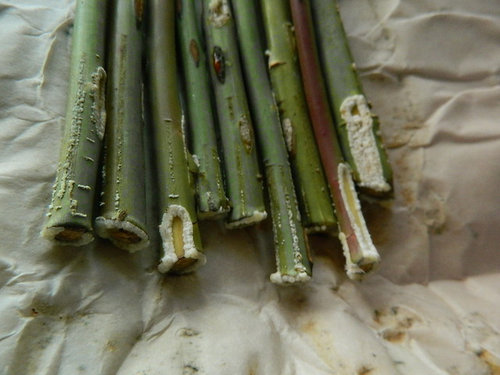
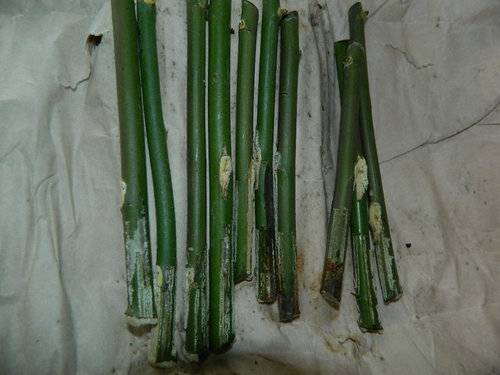
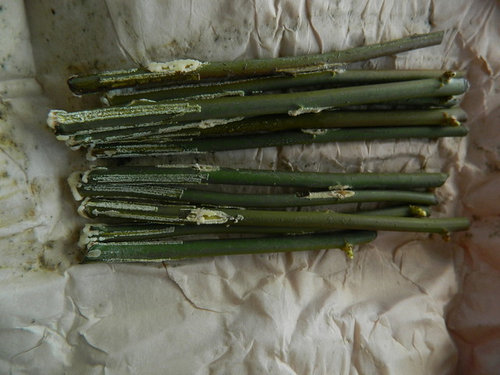
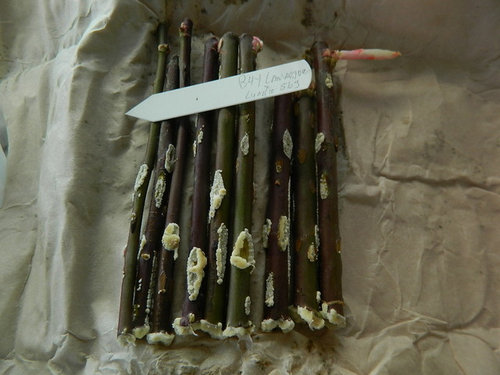
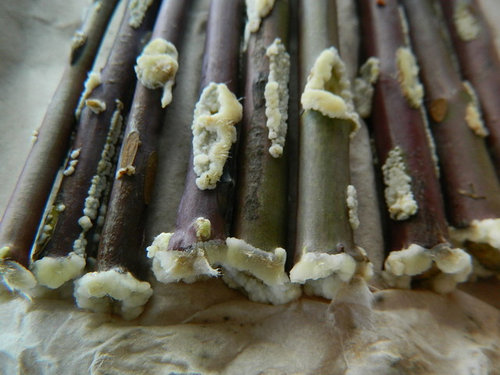
I didn't know what to expect with the lack of "winter" and rains. I wrapped what I wished to use for root stocks and allowed three weeks instead of the usual two, in hopes that might give them more time to develop the callus I desired. It appears to have succeeded! These are all seedlings, so they should be RMV free and safe to bud on.


Anne Belovich, a Wichurana type rambler seedling I raised which should make quite a good stock.


A Banksiae lutescens seedling. They use Banksiae whips as standard stocks in China. We also use Fortuniana here, but it demands more heat than I can provide to push scions.


(Blue for You X Lamarque) X (Lynnie X Basye's Amphidiploid 86-3) seedling. Sturdy, thick canes which root well and grow well own root. Why not?


They're all planted in bands as deeply as their length and the depth of the bands permit. I will watch for roots and top growth to determine when to raise their planting height to permit them to keep developing. Hopefully, they should be able to be budded this summer.

Comments (14)

  • 8 years ago

    Thank you, good! I haven't wrapped any whips for standards this year. I still have seven, nearly four foot whips I wrapped last year, growing in five gallon cans I will bud this summer. They are all long canes from some of my more vigorous seedlings, so they are also RMV free. I only use Miracle Gro Moisture Control Potting Soil. Though it can be foggy and damp, when the sun comes out and the winds blow, everything dries completely out in a day. The moisture control potting soil helps carry them through between waterings. I added a great deal of perlite to the potting soil to pot the bands so they can't rot. It may not be best for other areas, but for here, it's the best.

  • 8 years ago

    Ooh, that is so exciting. Those are some really nice looking canes. Did you make those cuts further up the canes, or are they callusing where you removed thorns?

  • 8 years ago

    In the budding instructions I've read, they only bud one scion node per rootstock. I'm not sure if I'm asking this right but...out of curiosity, do you ever graft more than one scion bud (2-3 of the same variety) on a rootstock? If so, do you graft them staggered or all around at the same height? I read that the standard (tree) roses have more than one grafted scion for a rounded look.

  • 8 years ago

    Wow! I am constantly impressed with what others accomplish..makes me want to try it! I think its above my skill level at this point, but I will continue to follow your successes! Lady Banks is a huge glorious beast in our neck of the woods. Good choice.

  • 8 years ago

    Hi, Mad, thank you! I removed prickles and I did scarify (scrape through the bark to expose cambium) them in hopes of increasing callus and rooting. With these, that worked. It hasn't previously. Yes, traditionally they use one scion per stock for bushes. Often standards do have two, sometimes three buds so it more easily creates a balanced, rounded head. I've not had much success in budding multiple buds all at the same height and getting them tied in properly, so mine are usually staggered. I've written before about a Baby Faurax standard I budded back in 1994 on a three foot whip of Cardinal Hume. I inserted four buds and all four took. That was a pretty standard! I gave it to a rose friend in Santa Clarita when I moved three years ago and she still grows it. The maximum number of buds I have put into a whip is 17. I had one whip available and buds of something I wanted became available, so I budded them every inch and a half or so, in hopes several would take. Unfortunately, the material wasn't sent properly (literal mud in the bag instead of damp paper) and none took, but it is possible to bud along a cane, separate and root the individual sections once the buds take. Ralph Moore did it all the time and it can work, particularly under mist.

    Thanks, Gagalzone8! I think you might surprise yourself! It takes far less "skill" than "practice"!

  • 8 years ago

    That's amazing Roseseek, thanks for explaining the multi-scion grafting. I haven't tried grafting yet, but I have a couple extra rooted climber cuttings I might try budding on, just to see if takes.

    I look forward to your updates on this project!


  • 8 years ago

    This is fascinating... thanks for posting.

  • 8 years ago

    You're welcome! I'm glad they are of interest and "inspiration"!

  • 6 years ago

    Update?

  • 6 years ago

    They rooted and have been trapped in gallon cans. I budded very few of them for a variety of reasons. We had almost no heat to make anything push. My "get up and go, got up and went", so no "projects" were accomplished and little else happened. We shall see how 2020 goes. Thanks for asking, though and happy Thanksgiving!


  • 6 years ago

    Thanks for the quick reply and Happy Thanksgiving to you!!! I'm going to borrow that expression in the future! : )) I do have another quick question, however that I asked in another thread,but didn't really get any answer. I read about it on the Hybridizers forum so I'm curious. How do you ensure roots once you have callus? Do you put more Rootone on them before planting. I've had poor success at this point of the game, especially as the weather cooled down. I'm not actually using the Burrito method at the moment, but am referring to cuttings that callous. Sometimes I go to repot as they look rooted, but I find only callous. Should I just stick them back in or apply more stimulant? What about those that have incipient roots?


  • 6 years ago

    Thank you and you're welcome! Be my guest. I believe that's an old southern expression, at least I remember hearing all the "old southerners" of my childhood repeating it. I don't know of an easy, sure-fire answer to your question. Some cuttings are destined to simply hit that callus stage and remain there until they die. Others seem to push past it with more heat. I don't think more rooting hormone would help because that is what is supposed to stimulate it to form what it has formed. You can't get roots without callus. My best suggestion is just to keep the cutting happy until it does something. Perhaps, if you can, supply the 70 F bottom heat from the heating cables used in rooting set ups? That seems logical to me at this moment. I've had more of them hit that terminal callus stage here where there is MUCH less heat than I did back where the heat was year-round. Perhaps that bottom heat is the answer? It would be nice having an answer for SOMETHING, wouldn't it? Good luck!


  • 6 years ago

    It's always impressed me how many good traits can be inherited from 'Blue For You', one may think that the odd coloring would come with some compromises, but it really seems to be that one-in-a-million variety!

Sponsored
Industry Leading Landscape Contractors in Franklin County, Ohio