Software
Houzz Logo Print
hairmetal4ever

When do you start tomatoes?

8 years ago
last modified: 8 years ago

I’ve read about people in similar climates to mine already starting tomatoes. I don’t plant tomatoes before May 1 (I had scattered frost May 9 last year). I started mine around Mar 28 and they were HUGE by planting time, as big or bigger than the ones you’d buy locally. So five weeks is all I really needed, despite the “6-8 weeks” often recommended.

What do you do?

Comments (20)

  • 8 years ago

    I'm leaning towards March 17 here but may put it off another week if winter is lingering still. I'll probably be planting out April 28.

  • PRO
    8 years ago

    I tend to start starting mine about the middle of March, but can stop starting seed up to the end of March. Any earlier and they really do get unruly before planting in the ground time. But I like to really take the full 6-8 weeks.
    I do have the habit of potting up though. Most nurseries sell in the little 6 packs or singly in 3 inch pots- I take the extra couple of weeks with a last repot in a 5 inch pot to grow out a bit more before putting them in the ground. And account for a few of those days at seed starting time. I've found the last potting up time also gives me time in case I need it to
    hold off for that extra week or not before putting into the ground. Sometimes weather or life happens but the tomatoes don't suffer for it. I used to sometimes lose tomatoes in 3 inch pots due to circumstances, but I've almost never lost a tomato since I've started taking the time to do the last pot up.
    I also have the habit of using small greenhouses- the 4 shelf kind that comes with a plastic cover, nothing fancy. For that last hardening off time- or if for some reason the forecast looks too nasty, I just keep my greenhouses zipped open or shut as needed- and also have frost cloth handy so I can really wrap a whole greenhouse if I have to. If the plants are getting tall, easy enough to remove an above shelf if I must.

    I've also found that looking up each tomato for days to harvest does count. Sometimes the difference between a couple tomatoes is a DIFFERENCE. Like Celebrity is 65 day, but Roman Candle is 90 day. That's the difference between starting seed closer to the 6 week mark, or the 8 week mark.


  • 8 years ago
    last modified: 8 years ago

    Hairmetal your timing is similar to mine, start seeds 3/25 to plant half outside usually around 5/10 weather permitting, and repot the other half to stagger plant as it warms up (these are back ups in case of a surprise freeze). I do cheat and buy 2 extra early mature plants in mid April from the nursery and put these out as sacrificial plants, or get lucky with ripe late June tomatoes. Generally July 4th is like clockwork for the 1st ripe tomato here.....sadly the early lettuce is gone by then, those 2 never meet up unless it's in the fall.

  • 8 years ago

    I started my tomato/pepper seeds last week. My plan this year is to transplant from seed trays, up to 4" pots, then finally up to 7 gallon grow bags that I'll set outside in early May. The advantage of growing in grow bags instead of the ground is that they can be temporarily moved to my small greenhouse or the garage overnight if there are a few too-cold nights in the forecast. But it takes enough space under a light setup and/or in a greenhouse/sunroom to nurse them that long.

    Things grow a little better in the ground than they do in grow bags, but I only have so much ground garden space so I save that for other stuff since tomatoes and peppers do OK in bags.

    I'm also gonna drive some 2x2 stakes into the ground garden this year, string some rope between them, and drape a sheet of plastic over during cold stretches to create a poor man's hoop house to start the other veggies a few weeks sooner.

  • 8 years ago
    last modified: 8 years ago

    I'll be starting my tomato plants early next week. March 6 is my target date for planting seeds to be ready to transplant into the garden six weeks later, with protection, on my frost-free date (90% probability of no more freezing temps) of April 17.

    If we're still having cold, windy dry fronts and soil temps are still below 55F at that time, this seed starting date allows me to keep them another two weeks or so without the seedlings getting too overgrown.

    I don't use a light set up. They spend every daylight hour above 40F in an outdoor cold frame, so in warmer, sunnier springs they grow faster than in cooler, cloudier springs which seems to get them ready when the soil is warm enough for them to grow. And I do pot up as needed.

  • 8 years ago

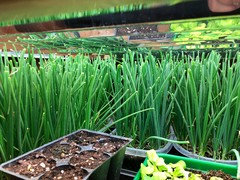
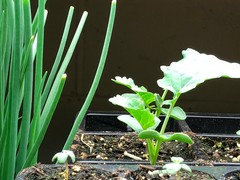
    Part of my issue is there isn’t enough room under my grow lights with the broccoli, romaine lettuce, and onion seedlings. I HOPE (weather permitting) to have those out by March 20, freeing up the space.

  • 8 years ago

    Bit crowded under the grow light right now.


  • 8 years ago

    hairmetal4ever, when did you start those onions? I *wish* I have ever gotten onions that big starting from seed.


  • PRO
    8 years ago

    Yep, 6-8 weeks. When seeds can have weeks difference between their maturity dates, it happens. This year I happen to be growing all 80-90 with one 75 day tomatoes, so I started out a bit earlier and started them all at once. I've had years when I've had 90, 75, and 55 day tomatoes and staggered starting seed accordingly.

    I used to plant more mainstream tomatoes with generally earlier dates when I lived elsewhere. But now I grow a variety of different uncommon tomatoes every year, so I have to pay mind to those maturity dates more. It makes a huge difference out in the garden.


  • 8 years ago

    Some tomato seedlings also grow faster than others. Cherry tomatoes and Big Beef are some examples. I will be starting these a week later than the rest of my various OP slicers.

  • 8 years ago

    I start on March 28 for May 7-10 plant out.

  • 8 years ago
    last modified: 8 years ago

    I started mine on March 9th for putting out in May sometime, likely about 5/15. I've had best luck planting at that time for most warm weather crops due to no frost, soil warmed properly, temperatures, weather, etc. I could probably get away with a planting in late April, but it's a bit risky still because light frosts and cool temps tend to linger a little bit into May.

    You could say it's a bit early to start seed, but because we keep our house fairly cool our tomatoes take a couple weeks to germinate at least, normally. And I raise mine in my low tunnel greenhouse contraption so they grow a little slower than under a light :)

  • 8 years ago
    last modified: 8 years ago

    Again, you keep the seedlings warm, and tomatoes will grow like crazy. How do I manage to keep them at 80F and plant out in 3-4 weeks? I use no heaters. I have them a few inches under a double T8 bulb in a converted garage. When the garage is cool, I throw a cover over the whole thing. Blanket, old tablecloth, whatever. By adjusting the cover, it's easy to maintain a temp of 80F inside, with the bulbs doing the heating. No, fluorescents don't get hot, but they get warm, and it's enough warmth to make things toasty if you have a little insulation.

    Remove the cover a few days before plantout to let them adjust to cooler temps.

    Plantout times are meaningless if you don't consider the temperature you have your seedlings growing at.

  • 8 years ago

    Interesting, Dan. Ours are usually about 1-2 ft. tall at plant-out. We used to use a grow light, but this year I've been experimenting with my low tunnel. Keeps most crops around 70-80 F inside during the day with proper care, and at night it can freeze inside, so I don't start warm weather crops until now, when freezes cold enough to freeze the inside of the tunnel are a bit rarer than February. Plus, the temperature is consistently in the 40-50's outside, no below freezing spells!! Night time temperatures for warm weather crops are still a little bit of a challenge, but I'm experimenting with some water mass heat sources, radiating heat, etc. It'll be fun with tomatoes this year.

  • 8 years ago

    If one wants, or needs, only a few it should be fairly simple stagger planting of a few six packs. Put the first one outside at about the 50% safe date. If this fails put a second planting outside. However, most people want more than six plants and this quickly becomes bothersome with increased volumes.

  • 8 years ago

    I'm not sure why you want 1-2 foot tall plants for plant-out. Plants will do better in the ground under sun than under lights, so I'd want to get them in the ground as early as possible. My seedlings are in 4-inch pots, so I'd need much larger pots, and I'd need a few rafts of lights to light up the same number of very large plants.

    Though I have to assume if your growing season is very short, there is an advantage in planting out near-mature plants.


  • 8 years ago
    last modified: 8 years ago

    Dan, if I were starting under lights, I wouldn't let them get so big, as the amount of space needed wouldn't be worth it, but I'm growing completely with natural lighting in my greenhouse, so space isn't really an issue for me once they get that big. Our season is not really what I would consider short either, generally May through the first part of Oct., sometimes longer, sometimes shorter, for warm weather crops. Just depends. We've starting them earlier and put them out big, and also starting some later, putting them out small. I like the earlier start putting them out big personally, and it has proved the best results so far in our trials to fight blight, because the plants are bigger and better able to fight it. Blight is a real issue in our garden. Trying a regular spraying schedule this year.

    Keep in mind as well that my plants tend to grow a little slower in the greenhouse than under lights. Its all a bit of an experiment this year. Thus, I have started a tiny bit earlier than we have in previous years.

  • 8 years ago

    Ah, that makes sense. If it's all natural light, then you aren't using up lamp room by letting them get big. Interesting observation that larger plants are more immune to blight.

  • 8 years ago

    Dan, I think it's more of the plants started earlier being ahead, thus getting bigger before it hits. I probably should have phrased that better. Though I do wonder if bigger plants also have a more developed "immune system" of sorts, having more leaves to photosynthesize, having stood the weather, etc.