Software
Houzz Logo Print
petenjude151

Spring is Sprung

Meteorologists tell us 1 March is the start of their Spring, so in the next few days those of my cacti and succulents that have been overwintering in cold frames will be coming out and into the fresh air and undiluted sun. Most are Mexican desert cacti. I have been taking a few pics.

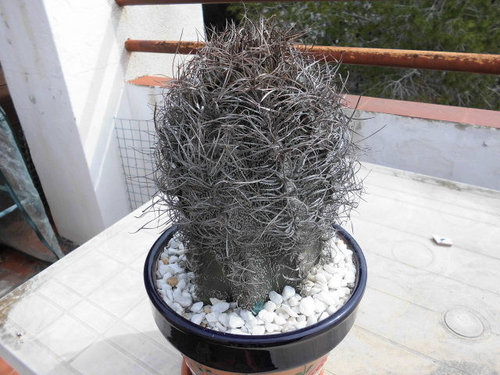
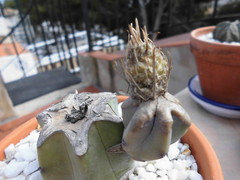
Astrophytum capricorne - came in the car when I moved to Spain in 2001. In 2011 it was very badly eaten away by rot, just the top inch was salvageable, but since then it has recovered and regrown very well.


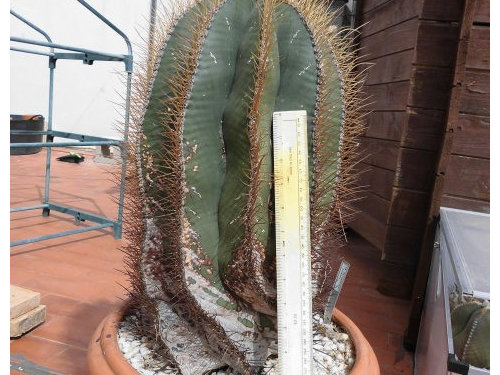
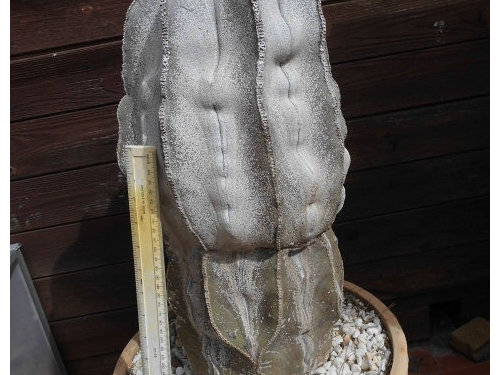
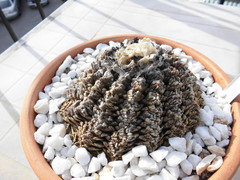
My two largest cacti are A. ornatum (getting well corked at the base) and A. myriostigma. Again these were two of the first settlers.


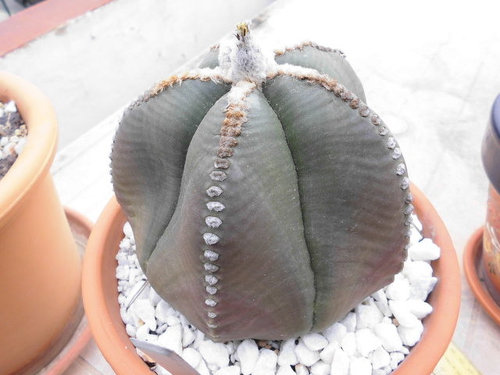
Another astro, A. myriostigma var. nudum (no flecks). Sown in 2012, this is the largest cactus that I have grown from seed.


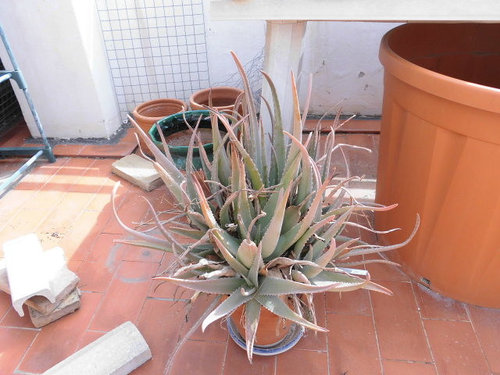
My Aloe vera, which is now once again totally potbound. I have cut it back twice already, but it keeps on growing. Bought locally in 2004.


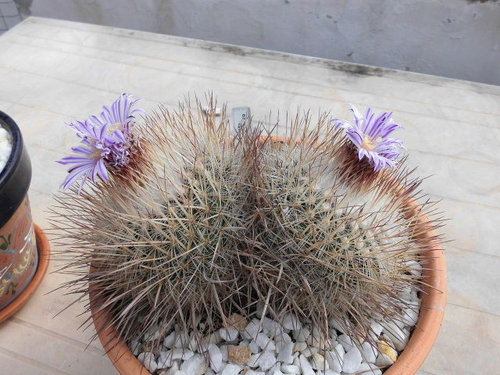
My double headed Stenocactus vaupelianus, with flowers on both heads. Bought from Kakteen Haage (Germany) in 2012.


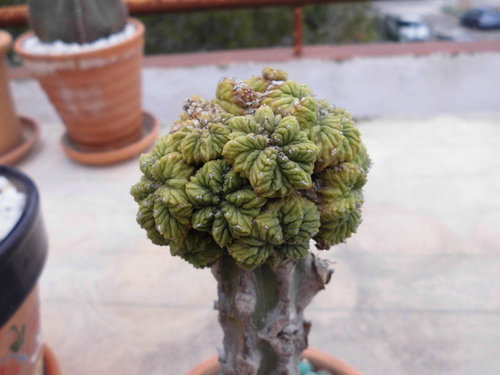
Aztekium ritteri, grafted, got it off evilBay in 2011, it has never flowered and is a Slooooow grower.

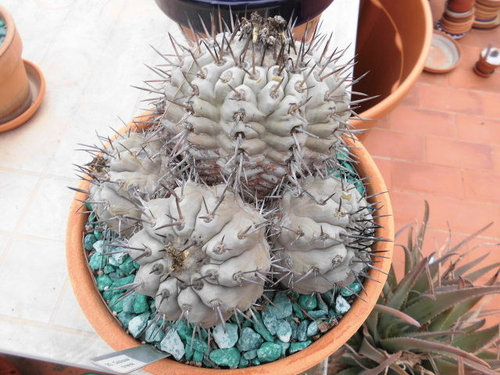
From Chile, Copiapoa cinerea. People on evilBay have been asking huge amounts for this species - yours for a grand !! Came with me in 2001 and since then has slowly acquired three offsets.

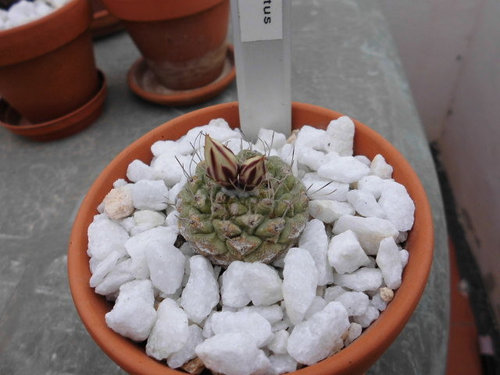
Strombocactus disciformis, acquired as a small seedling in 2017, about to flower for the first time.


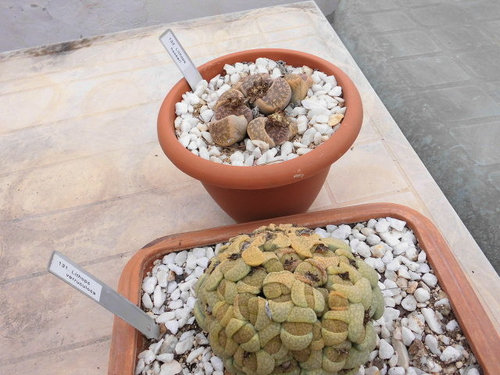
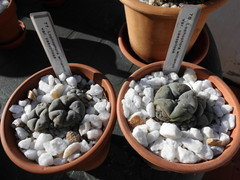
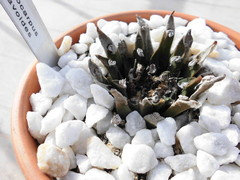
A couple of Lithops, L. hookeri & L. verruculosa. Both shedding their old leaves at the moment, so looking a bit scruffy. I claim bragging rights for the clump, I have never seen another quite like that anywhere else.


I have reached the picture limit for a single post - will continue shortly.


Comments (21)

  • 8 years ago
    beautiful plants! I've never heard "evilbay" pretty funny!


    SpanishFly - (Mediterranean) thanked Laura F (z9FL)
  • 8 years ago
    Awesome Plants!

    SpanishFly - (Mediterranean) thanked aloebot
  • 8 years ago
    Continuing with this thread. Toumeya papyracantha is rarely found in collections, being regarded as difficult, almost impossible on its own roots. My example is grafted, but you can´t see the join, acquired it in 2014. Its papery spines give it camouflage amongst the New Mexico grasses amongst which it resides.


    Epithelantha micromeris - (with a collection of striking fruits) and a pair of Cumarinia odorata. The latter is not common in collections, I had to raise these from seed. Lovely long, black, hooked spines. Acquired in 2016 and 2014 respectively.


    Euphorbia symmetrica & Acharagma roseanum. Bought in 2004 and 2017


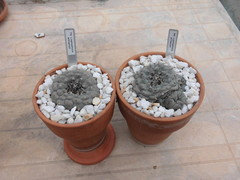
    Two of my large assortment of Lophophora williamsii - I get lots of seed from this species, which I send to naughty boys and girls in the US and those few other places where it is illegal. The right hand one self seeded in 2007, the other I bought from Cactus Plaza (Holland) in 2012.

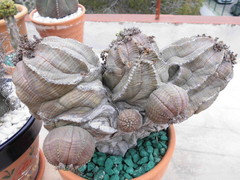
    My ugliest plant, Euphorbia obesa - it was quite handsome when it came here in the car, but has grown into a lumpy mostruosa form over the years.

    Turbinicarpus beguinni - bought from Kakteen Haage in 2011, has grown well since.


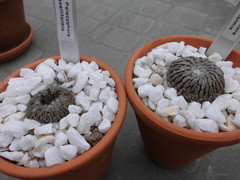
    A pair of Pelecyphora aselliformis, acquired from Cactus Plaza in 2012.


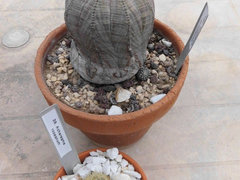
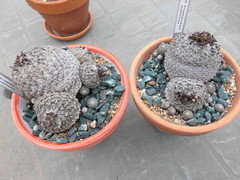
    And a pair of Encephalocarpus strobiliformis, with their sprouts. The most readily self-seeding species in my collection, but I have never seen a fruit or a seed. A mystery. From Aristocacti (UK) in 2006.


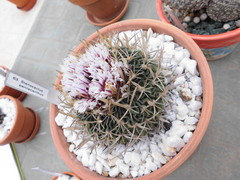
    Stenocactus pentacanthus - with fading flowers. From Kakteen Haage in 2012

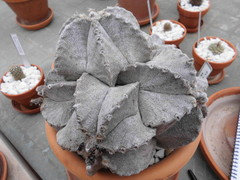
    Astrophytum coahuilense - the original stem is totally obscured by the offsets that grew from around the growing point. Cactus Plaza 2010


    Reached the picture limit again.


  • 8 years ago
    last modified: 8 years ago
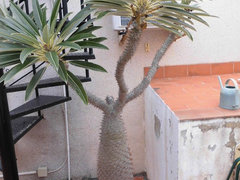
    Pachypodium lamerei - the largest of my succulents - 20 years ago this was growing on the windowsill in my mother´s bathroom.
    I will start to empty another cold frame tomorrow.


  • 8 years ago
    What a terrific bunch of plants you shared!! Thanks.

    (Was at Haage back in the nineties and still remember the enormous Echinocacti grussonii)

    SpanishFly - (Mediterranean) thanked hablu
  • 8 years ago
    Thanks everyone for your kind words.

  • 8 years ago
    last modified: 8 years ago
    SF, you have a beautiful collection! Amazing job with them. They're all so unique that I'm not sure which one I like the best. The only one that I could probably successfully keep is your pachypodium.

    SpanishFly - (Mediterranean) thanked isde02(zone5b)
  • 8 years ago
    Fantastic collection. I really appreciate you taking the time to post this. I looked at every one. Very interesting. I look forward to more.
    SpanishFly - (Mediterranean) thanked Jeff (5b)
  • 8 years ago

    Plants I have never seen in my life,they are great!! Thanks for sharing.

    SpanishFly - (Mediterranean) thanked ssk22 Ohio 5b
  • 8 years ago
    last modified: 8 years ago

    On with cold frame 2. A pair of Lophophora williamsii var. caespitosa. From Succulent corner (Belgium) in 2016. Never flowered, not grown a lot - I don´t have a lot of success with this variety, but thought I would get a couple more in.

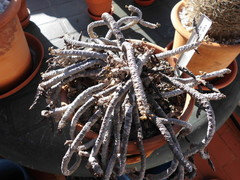
    Euphorbia ambovombensis - - from Uhlig Kakteen (Germany), 2004


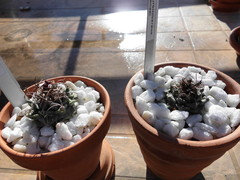
    A pair of Turbinicarpus alonsoi - these are siblings, their parents passed on. Named after Alonso Garcia, the 14 year old Mexican boy who discovered them.


    Aztekium valdezii - the most recently discovered of this genus, this grafted specimen flowers several times throughout the season. It came from the Czech republic in 2015, but I fear (to my shame) that it may be the progeny of illegally collected plants.


    Turbinicarpus pseudopectinatus - from ARS (Germany) 2016 - about to produce its first ever flowers.

    Strombocactus pulcherrrimus - a second member of this previously monotypic genus discovered recently. I paid a fortune for this sprout from Uhlig Kakteen in 2017. So glad it has survived the winter.

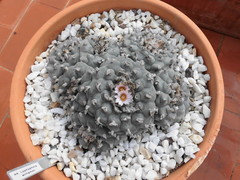
    The next plants are all Lophophora williamsii - the type - I have a lot of this species. I collect seed and send it to growers all over the world.

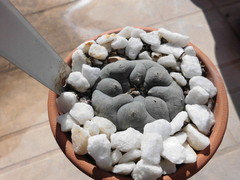
    This one was grown from seed in 2012, but the tiny seedling developed rot - I cut it back to sound flesh, and it recovered and become a lovely triple header.

    This loph came in the car in 2001, flowered regularly but never pupped - but in 2014 started to form a second growing point and has become a bifurcated specimen.


    I am excited about this loph - it has developed an ovoid form and the growing point has become elongated. Is it going to develop into a cristata - where the growth is from a line rather than a point - I hardly dare hope !? Bought from Cactus plaza in 2012.


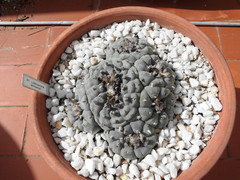
    One of my larger lophs - produced a few pups which have grown well and now making a bit of a clump. One of the original settlers.

    Photo limit reached - back very soon

  • 8 years ago
    last modified: 8 years ago

    Continuing ...

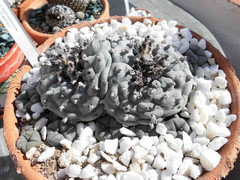
    My largest Lophophora williamsii - a good clump - if I could get this into the US or better still Oz - I would make a fortune.


    And finally from this cold frame - the rest of my lophs - I think I will not bore anyone further with rank and number, just a group pic.

    I will start emptying cold frame 3 tomorrow...

  • 8 years ago

    Your plants are amazing!

    SpanishFly - (Mediterranean) thanked Ermione_Greece(z9)
  • 8 years ago

    Fabulous plants! I actually think your ugliest plant is beautiful :-)

    SpanishFly - (Mediterranean) thanked stupidlazydog CT zone 5b/6a
  • 8 years ago

    Yes I rather like that one too, although it is ugly. A bit like Mrs Fly.

  • 8 years ago

    Thanks for all the likes, people - more to come!!


  • 8 years ago

    Hi aloebot - I will have a look at that caudex tomorrow - if there is one. It would be nice to know that the A. valdezii were legal. And yes, I love to grow the more difficult plants. If it is dry, I will start to empty cold frame 3 tomorrow. Again, thanks so much for your interest and useful comments. Regards Fly

  • 8 years ago

    aloebot - I took a pic of the caudex - never really noticed it before, but it is nice and plump.


  • 8 years ago

    OK today I made a start on emptying cold frame 3.

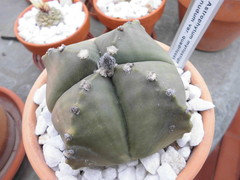
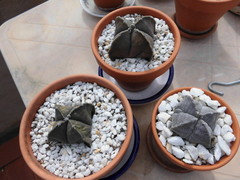
    Astrophytum myriostigma var. nudum var. quadricostata - the ´Bishop´s cap´ cactus - because of its four ribs - this one is also without flecks. A. myriostigma sprouts generally have five ribs and there is a tendency for this form to return to that norm, but it seems pretty stable so far. Sown from seed that I traded in 2013, and its genes have got about, which I will demonstrate later.


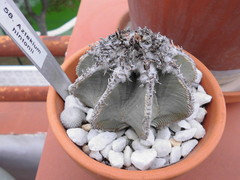
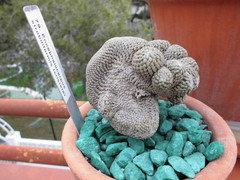
    Astrophytum asterias - this one has developed a mushroom shape, which I have seen in one or two pics. From Aristocacti (UK) 2009.


    Aztekium hintonii - an Aztekium on its own roots, very slow grower but flowers regularly. Discovered only in 1991. An Epithelantha micromeris sprout has hitched a ride.


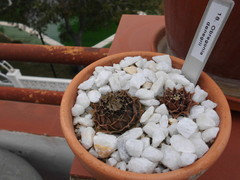
    A pair of Obregonia denegrii - sown from seed in 2013. I find these are sensitive to the Spanish sun, and I have to put them in a shaded spot.


    Encephalocarpus stribiliformis var. cristata - a grafted cristate - from Hungary in 2014.


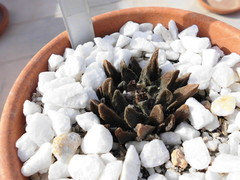
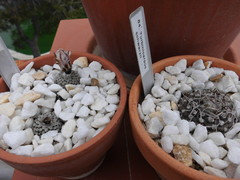
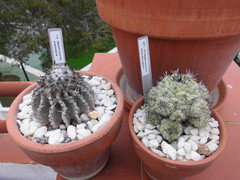
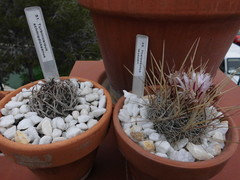
    Turbinicarpus valdezianus - which I have just missed flowering - and T. schwarzii. From Aristocacti 2014 and ARS (Germany) 2016 respectively.


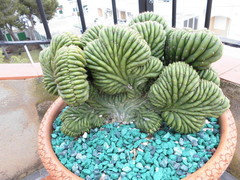
    One that is too big to fit into a cold frame, Trichocereus pachanoi var. cristata. From Succulent corner (Belgium) 2016.


    One that is not common in collections, Geohintonia mexicana - a new monotypic genus discovered in 1991 by George Hinton. In habitat it grows high on cliffs made of pure gypsum in the state of Nuevo Leon. From Aristocacti 2011

    And with it, Ortegocactus macdougalli - another monotypic genus also uncommon in collections. From Hungary 2014.


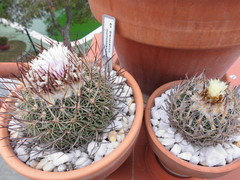
    A pair of Stenocacti in flower, S. multicostatus & S. kellerianus. Characterised by their wavy ribs. Both came from Kakteen Haage 2012.


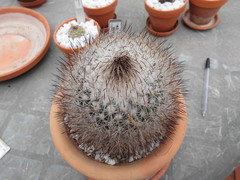
    Turbinicarpus schmiedickeanus from Kakteen Haage 2011. Alongside spiky Thelocactus lausseri from ARS 2016.


    Just cold frame 4 to go now.

  • 8 years ago

    This morning just been sorting out some waifs and strays - duplicates, self seeded sprouts and others that haven´t been given a card and label.

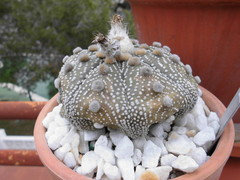
    Here´s some self seeded Astrophytums, the genes of my Bishops´ cap - 4 ribs - have been involved here - two are nudum, no flecks, the other clearly with flecks. So I can guess at which was the other parent.


    And a graft I made last season, Toumeya papyracantha, on the offset of a Blue myrtle. We are advised to graft onto young, fast growing stock and the offset certainly was. Glad it survived the winter.


  • 8 years ago

    And this afternoon I emptied all the slow growing Ariocarpus from the last cold frame.

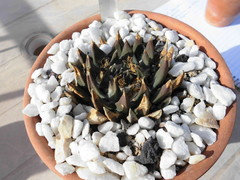
    Ariocarpus fissuratus - about 20 years old now, came to Spain in the car in 2001.


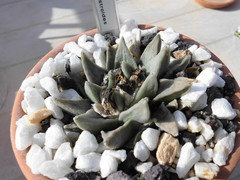
    A. agavoides from Cactus Plaza 2010.


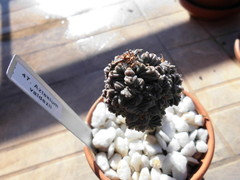
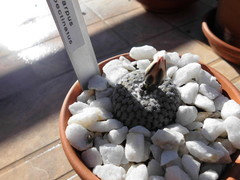
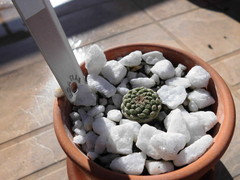
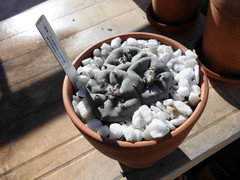
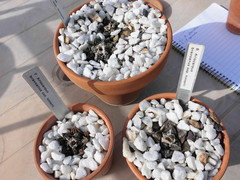
    These three are all A. bravoanus ssp. hintonii, the larger being a parent of the other two, from Uhlig kakteen 2007. A. bravoanus is the most recently discovered species of this genus.


    A. trigonus, from Cactus Plaza 2012. The browning at the tubercle tips is normal for this species.


    A. retusus scaphastroides, Aristocacti, 2014.


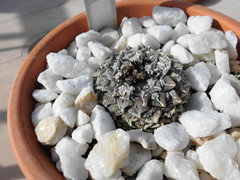
    A. kotschoubeyanus, a very slow grower, Aristocacti 2006.


    A. scaphirostris, from Peyote Garden (UK) 2006. Only found on one or two hillsides in a single valley in Nuevo Leon, where conditions are so harsh it is often the only plant resident.


    And that´s all for the moment folks - thanks for all the Likes and kind comments.