

Pruning Basics - Q & A Format
Virtually all living plants need to be healthy in order to appeal to the eye. In addition, some plants require a controlling hand to make sure their growth habit, which is altered by container culture and indoor settings, isn't degraded to the point the eye appeal we all want is nowhere to be found. Pruning and pinching are tools that every grower can benefit from if they tend plants that respond to those ministrations.
You can use pruning and pinching to take and keep control over your plant's growth habit and appearance. You can use it to promote health, reduce the likelihood of insects and diseases, increase back-budding, change the direction in which a branch or stem/trunk is growing, and make your plants as full as they can possibly be within the limits imposed by cultural conditions, many of which the grower can control. You can even use pruning and pinching to balance or control energy flow in the plant, common practice in the art of bonsai, but very under-utilized by other hobby growers, and even by professional growers. Fortunately, it's not a difficult concept to understand and use to your advantage.
As a bonsai practitioner of somewhere near 30 years, all forms of pruning have become so familiar to me as to be virtually reflexive. If you have questions related to pruning the top (above ground parts) of of your plants, this would be a good place to ask.
Al
Comments (79)
 7 years ago
Thank you for the responses. Al, that picture is very inspiring!
1. Determining the level of 1st truncating cut and its effect on internode space:
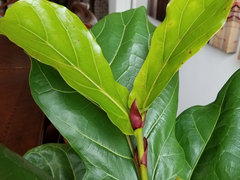
Waiting until desired overall height is reached and then truncating all existing stems at a height equal to 2/3 of desired height may lead to fewer proximal leaves on these stems (even though it will result in stronger/ thicker main trunk and any stems under that cut). True? Is this why you recommend to truncate at 2/3 height? How do I balance both- get a strong stem (does not require stake for support) and ensure a fuller look (does not look like a stick figure) ?
Also, how does the result of truncating a trunk/stem with bark vary from one without?2. Determining when and how to train branches (future stems):
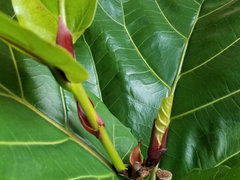
If I decide to train the current shoot with 2 leaves to grow horizontally, I will likely have to train the 2nd and 3rd shoots as well. Is there a way to tell if the 3rd shoot will grow soon or is dead- it has not kept pace with the remaining two?I am considering tying the tender branches with wire gauze (the fiber mesh used in first aid kits) to the wooden stake (which is currently lower than the bifurcation to avoid damage or obstruction and was waiting for all 3 buds to open up before raising it higher up). Is there a window period (or set of conditions) where the risk of snapping is considerably less if attempted carefully by a beginner?
Does phototropism play a more significant role in directional growth of younger branches? Should I be rotating the plant more often now? What is your preferred method for training young branches (assuming bonsai techniques described above need to be adjusted for younger plants with new growth)?With opposing growth from upcoming second branch, will the skew on the central axis (recently caused by growth of first branch) correct itself?
Thanks so much!
- 7 years ago
Hi Ferdinan!
Could you explain what you meant by having more options if trees are allowed to grow wild? Did you mean specifically for what I am trying to achieve? Also, did your comment (today's cut will be gone next year) refer to precision cut and good healing results of using the right tools or to the futility in making cuts this year vs another? Thank you for the clarification.
Related Professionals
Erie Landscape Architects & Landscape Designers · Oxnard Landscape Architects & Landscape Designers · San Luis Obispo Landscape Architects & Landscape Designers · Everett Landscape Architects & Landscape Designers · Belleville Landscape Contractors · Gary Landscape Contractors · Manhattan Landscape Contractors · Bowling Green Interior Designers & Decorators · St. Louis Interior Designers & Decorators · Canton Interior Designers & Decorators · Green Bay Interior Designers & Decorators · Phoenix Interior Designers & Decorators · Yuba City Interior Designers & Decorators · Great Falls Interior Designers & Decorators · Kalispell Interior Designers & Decorators- 7 years ago
Al, I forgot to provide clarification for the question in previous comment:
What can be done to preferentially thicken/strengthen the trunk and stems under the truncating cut, prior to cutting (for eg. pinching above the cut and delaying the cut)?
tapla (mid-Michigan, USDA z5b-6a)
Original Author7 years agoF said: I think leaving the tree grow wild for awhile gives you more options; what will you wire,what do you cut. No question that letting the tree grow wild is good from the standpoint of vitality, but letting the tree go too long is bound to be counterproductive on a number of levels, some of which are vitality, root health due to root congestion and soil compaction, lost growth/developmental potential ...... If you decide to give a tree its head an allow it to grow unencumbered, it should have been recently root pruned and repotted. If you end up allowing a tree w/tight roots it's head, you end up with a lot of opportunities, few of which are good when compared to a tree in a pot where roots have room to run. Reason: tight roots promotes growth at branch tips near apices (growing tips). When this occurs, it's hard to "chase" foliage back closer to the trunk via selective pruning. Consistently pinching a plant that isn't root-bound, OTOH, doesn't significantly slow development, and it guarantees more good pruning options that promote ramification/taper in ascending branch orders.
I usually break off anything growing off the bottom of a horizontal branch, That wouldn't fit the description of a tree growing "wild", though. If I'm building a first order branch, I want natural movement, so sometimes I'll pinch back to a leaf or bud facing upward, and sometimes the opposite. If I'm in full ramification mode, I'll usually opt for keeping the upward facing buds. There are special clippers that will make a cut disappear after time-concave cutters,that is.
I've heard the tree needs to be cut above the node so this is surgury, If you prune anywhere along a branch, wouldn't the pruning cut be both above (distal to) and below (proximal to) a Node? ;-) annever had an infection though.
My advice is let it gr awhile.have fun and long term sculpture is now I think is it.
Most the cuts you make today may be gone next year - They might not be easily noticeable, but they won't be gone. Every wound a tree receives will be permanently recorded such that its story can be read until the tissues that contain the wound are breaking down to a nearly unrecognizable mishmash of old decomposing cells. The old wound's walls will be recorded in dead tissues, and the growth that occurs after the wounding took place will be obvious if time is taken to take the tree apart.
You'll note I didn't really argue against what you said - I just expanded and fleshed things out a bit.
From what Nita said:Waiting until desired overall height is reached and then truncating all existing stems at a height equal to 2/3 of desired height may lead to fewer proximal leaves on these stems (even though it will result in stronger/ thicker main trunk and any stems under that cut). True? The more foliage you can leave on a tree, the faster it will increase in mass and the thicker the trunk will be. Is this why you recommend to truncate at 2/3 height? No. A rough rule of thumb would be a trunk approximately 2/3 of the trees o/a ht from soil line, and a leafy canopy occupying the upper 1/3 of the o/a ht from soil line. This is a generality - one of those rules/guidelines you should at least know before you break it. The art of bonsai is full of rules and proportions anyone can use as a general guide from which beautiful trees can be made. Knowing when to break the rules and turn what has the potential to be a serious flaw into a feature is an art in itself. How do I balance both- get a strong stem (does not require stake for support) and ensure a fuller look (does not look like a stick figure) ? Your tree, because of it's tight internodes, tends strongly toward being self supporting, and, your tree is no different than my trees in that they're going to go through that "stick figure" phase - just how it is.
Also, how does the result of truncating a trunk/stem with bark vary from one without? It doesn't.2. Determining when and how to train branches (future stems):
If I decide to train the current shoot with 2 leaves to grow horizontally, I will likely have to train the 2nd and 3rd shoots as well. Is there a way to tell if the 3rd shoot will grow soon or is dead- it has not kept pace with the remaining two?I am considering tying the tender branches with wire gauze (the fiber mesh used in first aid kits) to the wooden stake (which is currently lower than the bifurcation to avoid damage or obstruction and was waiting for all 3 buds to open up before raising it higher up). Is there a window period (or set of conditions) where the risk of snapping is considerably less if attempted carefully by a beginner? My head's swimming in confusion. These questions must be related to a central theme that I'm not able to home in on.
Does phototropism play a more significant role in directional growth of younger branches? More significant role than what? It plays a significant role, yes. Should I be rotating the plant more often now? Yes. What is your preferred method for training young branches (assuming bonsai techniques described above need to be adjusted for younger plants with new growth)? Question pretty broad. I generally concentrate on the bottom branches first. When your tree is apically dominant, growing a top is no problem. You can develop a top anytime, usually with ease. Keeping the lower branches strong by holding back the top through pruning seems to work the best for bonsai and all potted trees that exhibit apical dominance.With opposing growth from upcoming second branch, will the skew on the central axis (recently caused by growth of first branch) correct itself? Not sure what you mean by "skew". if you pinch as I described, and select branches the location of which is reasonably symmetrical and not quite perfect, any small amount of disproportion and unsymmetrical tendencies serves to naturalize the tree.
Thanks so much! My pleasure.
Al 7 years ago
I was trying to say...not what you understood.
I've redirected the growth patterns often enough I end up removing previous cuts aalltogetheer .
Sorry, if I fix that I'll have to retype it.
Good
tapla (mid-Michigan, USDA z5b-6a)
Original Author7 years agolast modified: 7 years agoThat's a normal part of maintenance pruning. When you cut back to younger growth that occurred as a result of the plant's response to pruning or pinching, you're bound to remove a significant fraction of old pruning cuts. How many old pruning cuts might have been removed from these trees?
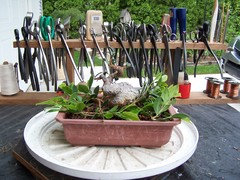
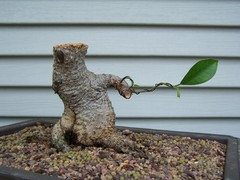
Al- 7 years ago
Hi Al,
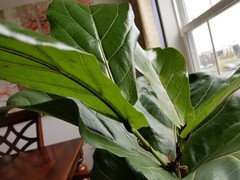
This is how my tree tip looks now. Both branches are of equal thickness (almost).You had previously suggested to train both branches (as codominant leaders) to grow horizontally.
Since I want one central leader and would like to train one of the two branches to grow vertically, could you please explain why this might not be a good idea?
Is the taller branch going to be my best candidate for training vertically?
How should the technique and timing of my pruning vary in order to achieve varying girths in future?
I want the central leader to thicken and the other branch to maintain its current thickness.
Should I wait until June to prune the horizontal branch when I prune the central leader? Should I pinch/prune/pluck leaves only before June for this branch?Thank you for your continued patience.
tapla (mid-Michigan, USDA z5b-6a)
Original Author7 years agolast modified: 7 years agoYou had previously suggested to train both branches (as codominant leaders) to grow horizontally. I remember reading something upthread that caused me to believe you misread or misinterpreted something I said about the direction codominant leaders should grow. They should be at somewhere between 30-60* to a horizontal line in the same plane as the branch and intersecting the trunk at their base.
Since I want one central leader and would like to train one of the two branches to grow vertically, could you please explain why this might not be a good idea? How tall the tree is now compared to the ht at which you want to maintain the tree has much to do with how you should prune it, so I'd want to withhold advice until I know that, or, if you've already mentioned it, until you refresh my memory.
Is the taller branch going to be my best candidate for training vertically? Not necessarily. Absent the ability to guide the branch into the position you favor, you should choose the branch closest to the attitude you prefer.
How should the technique and timing of my pruning vary in order to achieve varying girths in future? A)If you have a heavy branch toward the top of the tree, you simply keep it pruned back to 1 or 2 leaves until the other branches below it are heavier than the one you're restraining. B) If a branch low on the tree is considerably thinner than several branches above it, first consider if it can at some point be removed w/o messing up the appearance of the composition. If you feel it's necessary to what you have envisioned for the tree, you have little choice but to restrain and particularly thin the foliage on all the branches above it.
Here, I should note that it's going to be very difficult for any grower to produce an attractive, natural-looking F lyrata w/o some sacrifices in the tree's appearance along the way. NOT doing anything to the tree that impacts 'pretty' is sure to end up less pretty by the day once the distractions start to reveal themselves. Maybe you should just start a pinching regimen for a few years, then really get after the tree with a hard-pruning to correct the problems it will develop without structural guidance?
I want the central leader to thicken and the other branch to maintain its current thickness. That's not going to happen, as thickening is a byproduct of growth. As long as a tree is increasing its bio-mass, it's going to thicken. What you CAN do is restrict how many leaves you allow on the branch you wish would remain static in girth and let the leader grow wild (unencumbered by pruning). That will cause thickening in the central leader - you can always shorten the tree whenever you want.
As a bonsai practitioner, I look at today's tree and plot a course to my vision the tree 5-10 years from now, but I often deviate from that course if I see something better than what I first envisioned.
Should I wait until June to prune the horizontal branch when I prune the central leader? No, if it has 2 or more leaves, do it now.Should I pinch/prune/pluck leaves only before June for this branch? I don't understand the question.
Thank you for your continued patience. My pleasure.
Al
- 7 years agolast modified: 7 years ago
Hi Al,
A height of about 7 ft from ground (6 ft from soil line) is ideal. Originally, I envisioned a tree that looks like this :
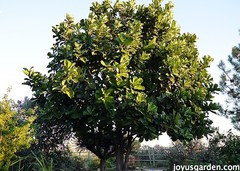
Soon after, I realized that in order to achieve a container bonsai version of above pic at overall height of 6 ft, my plant would have to lose its large (11x10") leaves; which was not acceptable.Below are common shapes and structures I found online with comments (stick figure appearance in my understanding = sharply angled branches, few proximal leaves on branches, lack of progressive decrease in diameter of branches, no terminal leaves):
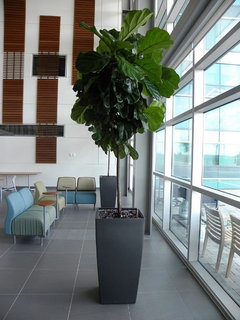
lollipop appearance- not desirable- seek longer branches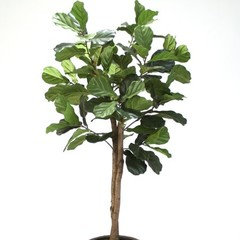
3D branching- desirable; less proximal leaves- not desirable; no progressive thinning of branches- not desirable; lacks desired fullness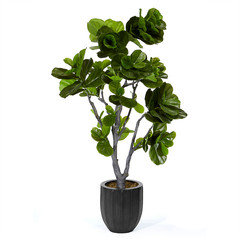
progressive branching- desirable; terminal leaves- desirable; progressive leaf size- desirable; not sure if this is image of a live plant nor of the variety I own.Since I want to maintain current large leaf size (11x10"), have relatively short height (6'), limit container size to 15", have branches at different levels (height on trunk), planes (facing directions), and angles (acute vs obtuse on trunk), I am wondering if my expectations are impossible to achieve. Please let me know.
Current dimensions:
Trunk measures 28" from soil line to the bifurcation point. The distal 4" lean towards one of the branches and away from central axis (previously referred to as skew).
Primary branch #1 (referred as vertical branch/central leader in previous post) measures 4" to its tip. Its base makes 40 degree angle to the trunk (50 deg to horizontal line). It has 2 leaves that measure approx. (10x 7").
Primary branch #2 (referred as horizontal branch in previous post) measures 2" to its tip. Its base makes 45 degree angle. It has 2 leaves that are younger and smaller (8x6, 10x6).
I am happy to truncate as advised and not concerned about how the tree appears during the process.
My concern with letting both primary branches to grow as codominant leaders is that they originate at the same height on trunk (to a lesser extent also that they are on the same side-120 deg apart; 3rd bud seems dead/dormant). Even if back budding offers multiple angles and planes in the form of secondary and tertiary branches, I will not have any taller primary branches (higher level on trunk) nor would I have a sizeable length in trunk that I can keep bare for a tree-like appearance.
I hope that you find this message less confusing. Once I have some confidence that my above reasoning/plan is feasible, I would like further clarification on pruning of primary branch #2 (removing foliage- I described this as "pluck leave only" in my own words).
Thank you!
 7 years ago
Pruning of non-weeping Japanese maples after the growing season, when to do it? I have green, red and Katsura. Should I post pictures? Here or in a new thread?
 7 years agoAl,
The link to the scissors you posted is dead. Can you point me (and the rest of us) in the right direction? Here is what Stone Lantern has for Koyo products, are your preferred bud scissors in here?
https://www.stonelantern.com/category_s/108.htm?searching=Y&sort=13&cat=108&show=100&page=1
What do you use for the next size up when pruning something woody, or thicker material than buds? I'm currently using a small pair of cheap snips for buds and small tasks. Not great they are basic and I want to upgrade.
My go to for larger than that would be ARS hand pruners I fell in love with when I worked as an Arborist: https://www.arscorporation.jp/product/detail-index.html?id=275 7 years agolast modified: 7 years ago
Looks like the product vanished from Stone Lantern. I think Al bought it all :)) The other link I posted is very similar to the Koyo product. I have it and very useful. https://miniature-bonsai.com/collections/nobuichi-tools/products/nobuichi-bud-trimming-shears According to Al they are the same.
Many in our bonsai club use this one: https://www.amazon.com/Fiskars-190520-1001-Titanium-Micro-Tip-Scissors/dp/B00114TK46/ and they seem to be happy with it too.
Look into 8 inch concave cutters and shears for thicker branches. Concave cutters are good for branches and leaves a very clean cut. Koyo has a bunch and they see to be decent quality. You have treat these precision tools well and understand their limitations too. Avoid the bonsai aesthetics line of tools they especially anything that is supposed to have a sharp edge. They are cheap and crappy. Koyo is pretty decent and I do not know much about their Roshi line of tools.
There are many bonsai tool makers/suppliers. Top of the line is Masakuni and they are out of my reach. Joshua Roth is a good source too with more reasonable prices. I have a few stainless steel versions from Tian Bonsai and I am quite happy with those. They have three grades: Beginner, Intermediate and Masters. I have the Master's grade but they will probably be considered Intermediate grade compared to say Joshua Roth or Kaneshin.
ARS pruners are good quality stuff. I have a 7inch Okatsune pruner for general pruning. It is extremely sharp and good for small hands. My wife likes it a lot. The 8inch version is a bit larger for her but is more powerful.
tapla (mid-Michigan, USDA z5b-6a)
Original Author7 years agoSorry for being slow to get back to the thread. Had some eye surgery Friday and I can't see much because of the salve that goes in my eyes 4X/day. Feeling better today, though.
Nita asks: Since I want to maintain current large leaf size (11x10"), have relatively short height (6'), limit container size to 15", have branches at different levels (height on trunk), planes (facing directions), and angles (acute vs obtuse on trunk), I am wondering if my expectations are impossible to achieve. Please let me know. To a certain degree, you're going to run up against a couple of traits common to all containerized trees, that being the more leaves there are on the tree, the smaller those leaves will be, and the greater the root congestion, the smaller leaves will be for any given species. This is due in part to the fact that the size of leaves on Ficus tend to grow larger with each successive leaf that occurs as the branch extends. Your expectations aren't difficult to achieve so long as you don't expect to be able to achieve your goal within the span of a year or two. To me, it sounds like you want a tree with 2-3 trunks arising at about a 60* angles to the horizon at or immediately above the soil line, and a few branches at roughly the same attitude so you get a nice multi-stemmed shrubby appearance. In order to achieve that end, you'll need to pinch the low growth you'll be keeping as branches, and thin the top regularly so the interior and low branching get enough sun that the tree doesn't shed the branches because they aren't carrying their weight.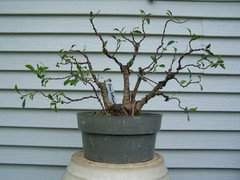
This is a Ficus retusa "melon seed" I acquired in Aug of '16. This is it's first styling. It had so much foliage on it that everything was growing at the tips of longish branches. Below, is what it looked like in summer of '17 after a second pruning.
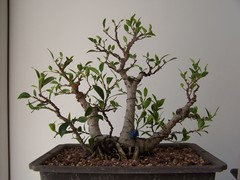
You can sort of see I'm working toward a dome of foliage above about 7 trunks.I'm thinking you want something like this except you want a couple of first order branches growing off the main trunk, and the bottom 1/3 of the height eventually bare of foliage?
If you look at the braces, you can see how you can 'set' your branch angles at whatever angle you choose. This is a technique widely utilized in bonsai, but bonsai practitioners everywhere would be pleased to know it was being put to use by growers interested in taking control over how their plants grow. Note the back-budding all over the plant only a few days after pruning.
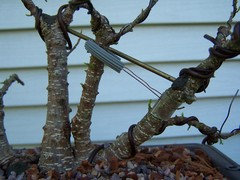
There is little doubt you/we can do whatever you want if you have the patience, but the best way to approach things is to show me what we're working with and where you want to end up.Val - Best to prune your maples in the fall - you'll get less (sap) bleeding that way. Bleeding doesn't hurt the tree, but it can attract unwanted insects and encourage herbivory by animals that enjoy the sweet sap. Pinching can be extremely important and should be a regular part of maple care. It's pretty near a certainty that following budbreak, there will be a short internode followed by a pair of buds at the end of that internode, followed by an exceedingly long internode that you can avoid by pinching as soon as the center branch distal to the first pair of buds can be snipped off with a pair of scissors.
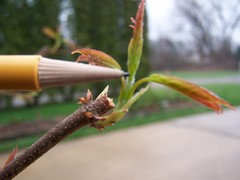
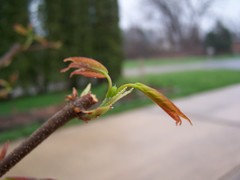
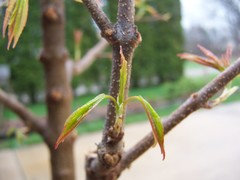
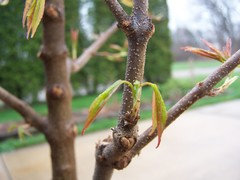
Notice that maples are programmed to grow buds in pairs on opposite sides of the branch, each set roughly 90* to the last. This means that every node ends up being a trifurcation (3 branches, the base of which all emanate from a common point on the branch. Notice how I have eliminated all the trifurcations in favor of bifurcations - the 'y' of a slingshot instead of the 3 branches of a trident. See the difference below in the sketch I drew to help jade growers keep their plants' appearance more on the airy side, rather than congested, as would be their natural habit.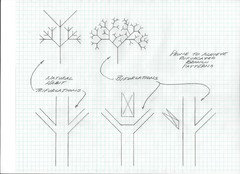
TG - When I followed this link: https://www.stonelantern.com/Bonsai_Bud_Shears_Koyo_6_inches_p/t109.htm, it said they were out of stock. I looked for at least a half hour, but couldn't find them anywhere else, so if you want a pair, you'll need to look harder than I, or wait for Stone Lantern to get them back.I have a really old pair of Felco bypass secateurs that I wore out over the years. I replaced them with a pair of #103 - 7-1/4" and a #104 - 8" bypass secateurs by Okatsune. I've been using them for more than 10 years and plan to sharpen them for the first time this spring .... and I'm really particular about keeping tools as sharp as I can get them. I guess the important thing is how they fit your hand.
Good luck!Al
- 7 years agoAl, Thank you!
I was looking at Okatsune as well. I can't find what steel they use so I was hesitant. Glad to hear you enjoy and trust them.
Are Kaneshin also good quality? They make both Blue steel and White steel versions.
I wish someone in the Boston area stocked tools so I could put some in my hands and see what I do and do not like. Any suggestions? - 7 years ago
Join a bonsai club if you have one in your area. Most members will be happy to let you try their tools. A quick search on google resulted in this nursery and supply place close to Boston: https://www.nebonsai.com/
Apparently Okatsune is the same as Tobisho: https://www.amazon.com/Tobisho-Pruning-Shears-Bracket-Bonsai/dp/B00IIOWXDC which is Hitachi YCS-3 steel. As I understand the difference is that Tobisho is still handmade and Okatsune is mass manufactured. Hardness scale is 60-61. The edges are extremely sharp. It has an ingenious latch lock that can operated one handed. Very simple and very effective design.
Some members in our club swear by Kaneshin tools. I have briefly used them and they feel very good. Our club tools are a mixture of tools from various sources including Masakuni. And boy those Masakuni tools are superb.
tapla (mid-Michigan, USDA z5b-6a)
Original Author7 years agoThanks - both eyes are black and blue (mostly black) half-way to my chin, and the entire white part of one eye is blood red, & lots of swelling. Strangely though. I didn't need anything at all for post-op pain. My lower lids had a sag in them, which made tears want to leak out of my eyes whenever they felt like it - PITA when looking down and/or working on trees. They put some implants in the lid and it already seems much better. Just some minor irritation from the internal stitches and looking like a coon that just stepped out of a horror movie.
Kaneshin targets the upscale market of tools. While I don't have any of that brand (or maybe I do and just don't know it), there wouldn't be any reason I wouldn't buy them if I hadn't just recently replaced all my workhorse tools with Masakuni brand. As I was looking at the Kaneshin tools, I discovered that they make a pair of scissorsjust like the ones I recommended for fine work. They do go on sale with regularity at Stone Lantern, though, at 25-30% off, so you should be able to find them there if you can wait until their stock is replenished.
FWIW - the Okatsune secateurs rate 60-61 on the Rockwell scale.
A good place to start for more on bonsai in the Boston area. You could also call the Too bad Suthin (sue-tin) has retired to be a grandpa (see the last reference in the guide).
Al- 7 years ago
Al, why did you go and do that? :) Glad youre OK, and what a pain, but this too shall pass.
Thank you for the link. I have heard good things about both brands (Kaneshin and Okatsune), and they seem similarly priced (I get great shipping rates from Asia due to my line of work). It's a tough decision and comes down to what steel is used. I can't find much about Koyo and Okatsune steels though.
I want an all around scissor that I can prune leaves from FLF, deadhead Amaryllis, take pieces off succulent, remove Sansevieria leaves, etc. Are these the scissors I want? It would be great if I could reach into the interiors of something like Euphorbia milii and Aglaia odorata to make pruning cuts. At the same time, removing young Jade leaves is something I also hope to accomplish with this tool. Something that compliments my collection of hand snips.
Masakuni have to wait, I dont have the budget. I am in favor of a buy it once, own it for life mentality.
I will begin reading the Boston link now.
Any travel plans to this area in 2019? Do you accept wayward men showing up at your door for a day or two of learning? - 7 years ago
Those small trimming scissors are for very fine work like trimming very young buds and tiny shoots. They do not have the leverage or strength to cut anything thicker/harder. There is really no one tool that can do it all. You will be better of with a regular 8 inch concave cutter and shears. Those are more like general purpose tools in bonsai. Concave cutter is for branches and shears for everything else. All other types of tool perform specialized tasks.
Kaneshin is the only one I know that discloses details of their tools, process and materials. A decent quality tool should last you a very long time provided you take care of them and do not abuse them. Serious bonsaists like Al will use their tools more times in a day than I would use in a week or a month. So I have opted for the middle of the line. If I used mine like Al I would probably need to sharpen them lot more frequently than I normally do. And most of the specialized tools are not easy to sharpen.
- 7 years ago
ToC THANK YOU!!!
I've been to NE Bonsai, they are about 45 mins away and they have a huge property. Five greenhouses if I recall? It's my only Bonsai nursery reference, and it's worth the drive
Im torn on what style pruners/scissors to get. The Okatsune 206 and 207 were recommended by the folks at Stone Lantern. I found the European Okatsune website to list the steel and hardness! The Koneshin speak to me as well, especially the Blue steel versions and even more so if they are Blue #2 or Blue Super! I got into knife steels when I bought a high quality folder and subsequent japanese kitchen knives. Now I wait and spend my money smartly, and have the product hopefully for a lifetime to pass down to the little ones.
What do you think of these for everyday use on a variety of houseplants? Not specifically Bonsai per se. https://www.okatsune-europe.com/en/thinning-shears-snips/thinning-shears-okatsune-207-heavy-duty.htm
The Kaneshin still have my attention, but nothing I want is in stock. He replied and said he would email me tomorrow with more information, I will wait to hear from him again, before purchasing anything. Here is what I like there: https://kaneshin.shop2.multilingualcart.com/goods_en_jpy_701.html
Here are all their scissorshttps://kaneshin.shop2.multilingualcart.com/index_en_jpy_7-160.html
tapla (mid-Michigan, USDA z5b-6a)
Original Author7 years agoI want an all around scissor that I can prune leaves from FLF, deadhead Amaryllis, take pieces off succulent, remove Sansevieria leaves, etc. Are these the scissors I want? No. You want something with a little more backbone for that; and for sappy trees like ficus, or Euphorbia, you'll want a pair of stainless scissors you can toss in the dishwasher to get the sap off that accumulates quickly. Spritz with Goo-Gone and wash 'em clean. I buy these a dozen at a time, and just leave them out in the weather on the grow benches all summer long. They're no good for heavy or precision work, but very handy for me to have a pair of scissors close at hand when I see something I need to correct. For all around use - something like this would be a good choice.The guys who run American Bonsai are a class act and easy to work with.
I sometimes travel east in the spring to attend the Mid-Atlantic Spring (Bonsai) Festival, but not this year. I'll have some free time once I get my business sold and retire, and I do get a lot of tree/plant company, so if you're in the area ......Al
- 7 years ago
Good stuff, more questions....
The American Bonsai get mixed reviews, and i'd rather something from Japan. That being said, the scissors you linked to - Does Okatsune, or Koyo have a similar pair? I have a bunch of cheap stainless curved pruners already, Ill grab a set of those straight guys as well for the sappy Euphorbia, etc.
They seem similar to this pair of Kaneshin, am I right?
How do I get a hold of you aside from here? If I get some free weekdays this spring around May or June i'd love to swing out and shadow you. Help out where I can and hopefully learn a thing or two. - 7 years ago
American Bonsai tools are pretty good and the people are good too. 5-year no question warranty is the best in the industry. I saw them at the Rochester bonsai show last Sept. They had all their tools on a table and allowed people to play with them. I bought a carving hook type thing - very sharp and ergonomic. Also got a conical diamond grit sharpening tool - which makes it lot easier to touch up the edges of the curved tools. I would not hesitate to buy more tools when the need arises. Plus they have a bunch of other quite interesting stuff on their website.
Those Stone Lantern green scissors are quite handy. I have 4 of them. Curious sale they are having now. If you buy the bunch of six it comes to $35 after discount (30% discount) but if you select six individual ones you get a 40% discount and comes to $32.
- 7 years ago
ToC - Again, Thank you!
The more I think about this, and hear from you and Al, the more I realize I probably just need some high quality, strong, straight tipped snips for my needs. And it seems like they should be stainless. The Kaneshin and Koyo are stainless, Okatsune are not.
I prefer to buy one quality tool and own it, not several throw aways. So the cheap snips don't interest me much.
I'm really leaning toward one of these, any feelings? They seem close to what Al suggested and made in Japan with Japanese steel, which is important to me. - 7 years ago
You were right, I love the scissors style most! The straight tipped snips are gorgeous, but they open too far to be comfortable to use repeatedly and they lack the length to get into tight spots.
Looking forward to having these for decades and hopefully handing them down someday.
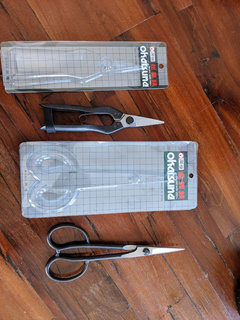
- 7 years ago
Are you keeping both or just the bottom one. I am told that the bottom one is good for trimming softer green material. For harder lignified material it is not as suitable. Let us know how they fare.
- 7 years agoBottom only. If I need some straight tipped snips for heavier cuts, I have options. These wouldn't be my choice for straight tipped snips as the handles open too wide and aren't adventageous to extended comfortable use
- 7 years ago
I presume you already know this. You are not supposed to be opening them too wide - means you are going to open so that a small portion of the tip is only used for trimming. If you need to open wider to accommodate anything larger then you need a larger/longer tool or a different tool. That tool probably is suitable for up to 1/8 inch soft twigs for precision jobs.
tapla (mid-Michigan, USDA z5b-6a) thanked tropicofcancer (6b SW-PA) - 7 years ago
I've spent a few thousand hours with snips in my hands, I get the basic gist of it. :)
These open too wide, as if the spring is too strong, or more likely, there is no stop in there to keep them from opening this wide. It makes grabbing them difficult, and requires a constant pressure to keep them in your hands. I can see fatigue setting in quickly if these were used in a production pruning environment, or even more than a few trees. They are beautiful and the metal used is that of which you don't usually see in pruning tools.
The Okatsune 206 are all I need for now. Maybe a pair of small scissors later and if I get into Bonsai some other specialty tools. But for the plants I care for both indoors and out, the scissors and multiple mass produced snips by ARS and others will be perfect! - 7 years ago
Al, I am sorry to hear you had to go through this surgery. I hope you recover fast! I myself got into a car accident last Friday, broken collarbone and nose. I have been away from home as a result and wasn't able to pull up the plastic bag covers that were set up around my trees at home and it got very, very cold. I hope they'll be okay. Will be able to go home tomorrow morning.
So if I should have done the pruning of my maples in the Fall, I will do it now then. I will get a few pics to share with marks on them where I think I will cut. Hopefully I can get some advice on them. For now from reading all the treads I gather that I should cut last year's growth minus one internode from the parent branch, provided it is somewhat short. This rule should be broken if the material to cut is lower in the tree as those branches are harder to grow. All material that is crossing or growing inwards should be gone. About 1/3 of the top should be removed. So I'll go from there.
Best,
Valtapla (mid-Michigan, USDA z5b-6a) thanked val rie (7a - NJ) tapla (mid-Michigan, USDA z5b-6a)
Original Author7 years agoI've owned a set of the Okatsune shears for a good number of years, but they've seen precious little use. The reason? My focus is a tree with an underlying structure sound enough to build on, and shearing, as opposed to pruning, might look good to the unpracticed eye, but it creates problems in branch structure that take time to correct when it's time to start focusing on fine ramification. For instance, if you shear your trees in more or less the shape that best compliments the trunkline, you'll soon find out that the tree has put a LOT of energy into branching near branch ends and the top of apically dominant trees. This means that you end up with very awkwardly heavy branches in the top of the tree, thin, sickly branches toward the bottom of the branching structure, + a lot of reverse taper (branches fatter at the tips than where they attach to the lower order branch or trunk) and large clusters of branches originating from the same point on the lower order branch. Pruning, allows the grower to transition smoothly into the fine ramification process. Shearing, forces you to put everything on hold while you fix the defects, which might take 2-5 years, depending on the tree.
Those are my personal thoughts, YMMV, but if you continue to work with the same trees in pots for years and years, bonsai or not, at some point you'll likely stop thinking about pleasing yourself with a tree that looks good but has serious design flaws. I have no idea, at this point in my life, who will end up with my trees when I can no longer care for them, but I'm working toward ensuring that whoever ends up being their care giver can see that the tree is, or has some serious potential to be a top quality bonsai. To the best of my ability, I do what is right for the tree - sort of like raising kids. You can do what's best for them when they're young, which is never going to be today's road most traveled, or let them grow wild with little or no attention, and let someone else figure out how to straighten them out once, for all intents/purposes, they've past beyond your formative care.
Val - Ohhh! Really sorry to learn of the accident and that you're pretty banged up. At least I was fortunate enough that the mayhem visited on me was planned and controlled. I promise I'll remember to say a prayer at bedtime that your Drs are all wise, your recovery short, and that there are no lasting scars - physical or otherwise. I just had my bottom eyelids lifted because tears would pool in my eyes and blur vision unexpectedly, or drip down my face at the most opportune moments. Sigh - it didn't work, so we'll see what's next.
Let's look at your tree when you're home and up to it.
Al- 7 years agoAl
This post is something I preached in the green industry for years. Shearing is my least favorite method of reducing foliage in a plant. You need to prune, not shear/trim. Have some forethought as to what your actions today are going to look like a year or two from now.
If you shear enough, pretty soon you're left with an eggshell plant - thin layer of growth, just at the edges and nowhere green to prune back to internally. Sure, that's not a major issue with a tropical, you can make some topping cuts and it will bud out. Is that the healthiest choice for the plant though? Probably not. But, try that on a deciduous hardwood or a Conifer that goes dormant up in our zones and you're going to get major die back, wounds that won't CODIT, and a plant that looks beat to hell.
Truth be told, I wanted the Kaneshin scissors. I'm not able to put them in my hands and try them, and shipping back to Japan isn't easy/cheap! Okatsune was the next company with he most transparency as to where they are made, what steel is used and thier HRC.tapla (mid-Michigan, USDA z5b-6a) thanked Treegeek Z6a (Boston) tapla (mid-Michigan, USDA z5b-6a)
Original Author7 years ago..... noted your reference to the late Dr Shigo's work (CODIT).
Al
- tapla (mid-Michigan, USDA z5b-6a) thanked Treegeek Z6a (Boston)
- 7 years ago
If I am understanding what you are writing here -
Pinching/tip pruning is non damaging if done anytime of the year. Major pruning work is best left to be done during the height of growing season (May to June for us northern hemisphere folks) to allow the plant to recover best. Is this a fair statement, and safe practice?
I read where you said this wouldn't apply to a deciduous woody plant, such as used in Bonsai. What about a tropical/sub tropical woody plant? Do these rules apply to them? - 7 years ago
Hey All!
Al, sorry to hear that the eye problem rectification did not go 100% as planned and that you might still need some work done on them. I wish you success and after any new surgeries, a speedy recovery. My girlfriend had an orbital fracture under her eye from that same car accident so she is empathizing with you.I have taken a few pictures of my deciduous trees and I would like to try and get some advice on pruning them, I will put them in the "Let's talk pruning" thread here:
https://www.houzz.com/discussions/lets-talk-pruning-dsvw-vd~5488874
Cheers!
Val tapla (mid-Michigan, USDA z5b-6a)
Original Author7 years agolast modified: 7 years agoIf I am understanding what you are writing here - pinching/tip pruning is non damaging if done anytime of the year.
Major pruning work is best left to be done during the height of
growing season (May to June for us northern hemisphere folks) to allow
the plant to recover best. Is this a fair statement, and safe practice?I read where you said this wouldn't apply to a deciduous woody
plant, such as used in Bonsai. There is always going to be a small loss of mass the tree has already 'paid for' in terms of energy outlay, but consider: If you let a potted plant extend to several feet, like we often see in images here, in order to bring it back in bounds, we must remove a large amount of mass before we can even start on fine ramification (branch and leaf density - fullness). If you pinch religiously, your plants will ALWAYS be full, once you've initially pinched several branches. If every branch is allowed to grow 3 leaves, then is pinched back to 2 leaves, we lose 1 leaf and no additive growth (thickening) as you would when cutting back costly, long/thick branches you don't want or need. Too, if you start pinching very young plants early, your control of the plants growth habit and appearance is virtually complete.If you have temperate trees in pots, they should go dormant in late fall/early winter. Do heavy pruning then, or in spring before buds move. I let most temperate trees have their big spring push before pinching back to a couple of leaves per branch. From there forward, I follow the pattern of waiting for 3 leaves, then pinching back to 2, as it conserves the tree's energy.
Prune maples in fall so they don't bleed in spring, not because the bleeding is a setback, but because it attracts insects & birds that can damage the tree. Pinching maples should be done early in spring and repeated as necessary. You'll find that info and images upthread.
What about a tropical/sub tropical woody
plant? Do these rules apply to them? They get heavy pruning in the summer (June) and pinching thereafter until fall. From fall until next June, let them grow wild. You CAN pinch if you like, but to keep them full & compact, you'll need to remove all winter growth back to short internodes come summer. If you pinch in the winter and get new branches in leaf axils behind the pinch, they'll have looong internodes that will need to be removed to preserve the tree's ramification, but if you remove them, where's the back-budding going to come from? Better to let branches extend all winter, then in summer cut them back to the short internodes. You'll get new branches in leaf axils then, in summer, so the internodes will be very short - just what you want. If your trees are really healthy, you can start experimenting with directing the tree's energy flow and forcing back-budding by defoliating selectively.Al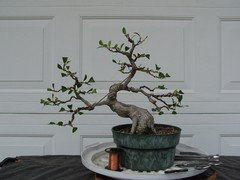
tapla (mid-Michigan, USDA z5b-6a)
Original Author7 years agoHi, Val - thanks for the good wishes! I'll have a look at the other thread after I finish getting dinner ready.
Al
 7 years agolast modified: 7 years ago
Hello, I'm preparing to do some pruning but I'm unsure of how 'hard' of a prune is too hard. Lots of my plants suffered over the dark Illinois winter and I'm hoping to get them back in tip top shape.
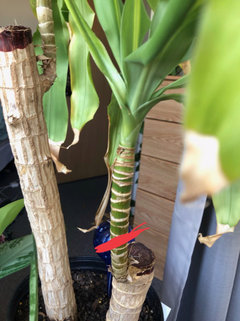
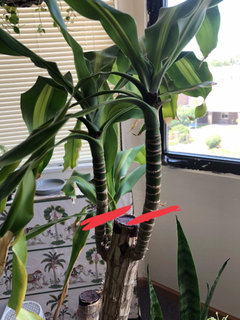
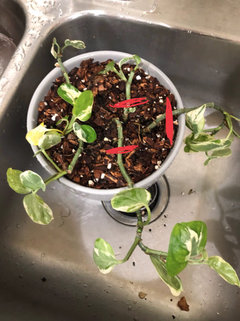
I have a Dracena corn plant and I'd like to remove a full crown (or all three if the plant can handle that). How likely is a plant to sprout new buds after losing large amounts of foliage. Additionally some of my vining plants lost older leaves and left behind barren stems. I'm curious about what would happen if I removed foliage at the points I've marked in the photos. Would a leafless stem die back or produce new leaves? Is it better to leave a leaf or two when pruning?
Also, I've previously only rooted plants in water. Would cuttings take well if placed directly in 5-1-1? (my 5-1-1 mix is pictured with the lanky pothos)
I would appreciate feed back!
(Most plants are in within 0 to 6 feet of a West facing bay window with moderate light early in the day and strong light in the afternoon/ early evening. I have been hesitant about transporting them to my balcony, also west facing, because I tend to forget to water anything out there)
tapla (mid-Michigan, USDA z5b-6a)
Original Author7 years agoFor conifers and plants teetering between healthy/unhealthy, it's not a good idea to remove all foliage or even all foliage from a single branch. Sometimes they're too tired to push new growth so the branch is shed or the entire organism collapses. OTOH, if the plant is in a state of high vitality and just happily humming along, it's going to be really hard to kill it by pruning. Pruning actually rejuvenates plants considerably because you have a root system in place capable of supporting whatever volume of top mass the plant had before the pruning exercise. Plants are efficient by Mother Nature's design, so their natural tendency is to balance the volume of roots to shoots by shedding or by suspending growth until whatever part of the plant was pruned 'catches up' with what wasn't pruned. If you prune roots, your plant will shed top mass or suspend growth of top mass until the roots can support what's already there and what's about to emerge. If you prune the top/branch ends, the plant will back-bud strongly (if it's healthy) and some roots will die off until a balance is reached between roots:shoots. The whole thing works better for almost all houseplants if you undertake heavy pruning of roots or top mass in summer when plants should be at the highest level of vitality in their growth cycle and their ability to make food (photosynthesize - plants make their own food by capturing the sun's energy and storing it in carbohydrates, fats, other bio-compounds) is at/near peak because days are longest and photo load (sunshine) is most intense..
I have a Dracena corn plant and I'd like to remove a full crown (or all three if the plant can handle that). How likely is a plant to sprout new buds after losing large amounts of foliage. As long as you're careful not to over-water, you can be about 100% sure the plant will back-bud, but there is no telling how enthusiastically the back-budding will be. They're reasonably healthy insofar as pruning goes, but not as healthy as I'm sure you'd like them to be. The healthier the plant, the more enthusiastic the response. Your options are, A) remove the growing tip(s) of the cane(s) - back-budding will occur at nodes currently supporting leaves or proximal to any foliage - no way to tell, but the response to pruning is greatest immediately proximal to the pruning cut. B) Cut through the second order of a/the cane(s) wherever you chose. Back-budding will occur from the bare second order canes or even on the stem/trunk. If you do this, it would look best if you don't prune at the same ht. Top cane should be tallest, middle - med ht, lowest - shortest. C) Cut through the main stem anywhere and root the propagule that creates. Important: clean up the end of the propagule with a razor-sharp sterile tool. I use a sharper-than-a-scalpal grafting knife to clean up the basal end of all propagules. The little tag ends of torn tissue are where rot gets its start, and rooting cuttings is essentially a race between the plant making a vascular connection between new roots and existing vasculature before rot organisms clog the plumbing and make that impossible. D) You can remove the existing cane(s) and the main stems will back-bud. Additionally some of my vining plants lost older leaves and left behind barren stems. I'm curious about what would happen if I removed foliage at the points I've marked in the photos. Would a leafless stem die back or produce new leaves? Is it better to leave a leaf or two when pruning? The pathos will back-bud from nodes proximal to your pruning cut whether they currently support foliage or not, but you can think of making your pruning cuts such that some foliage is left on each branch/vine as insurance, even though it's not necessary in this case. Again, don't over-water. It's best to do your pruning when the plant is about to need water (both plants). Then, you can keep the soil damp with a spritzer, but try to avoid spritzing the stem or foliage. Spritz only enough to keep the top of the soil damp/ damp/moist are the operational words here.Also, I've previously only rooted plants in water. Would cuttings take well if placed directly in 5-1-1? (my 5-1-1 mix is pictured with the lanky pothos). Water might be easier for those who are intimidated by better methods, but it's definitely not the best method.You can use 5:1:1 if you wish. I use gritty mix for nearly everything I propagate, other than for small air layers. For that, I use New Zealand sphagnum moss. When you propagate, use a pot deeper than you think you need and keep the basal end of the cutting well above the pot bottom. If the soil you're using supports perched water, you surely do not want the basal end of the cutting immersed in it. Gas exchange between the cutting and soil pores is essential, so having the basal end immersed in the perched water table would be shooting yourself in the foot.
Al
- 7 years ago
Thanks for the generous information, Al! I've transitioned most of my plants into 5-1-1 (easier for me to source those materials rather than the gritty mix and I still have the ingredients from last season) so I understand the value of a well draining soil. I worked on a number of my smaller plants today and got many into 5-1-1 and also pruned others and placed the cutting directly into 5-1-1 with the original plant and then watered. I'm excited to see if they take and I'm eager to see how my plants respond to pruning.
I would describe my dracaena as chugging along. It certainly isn't meeting its full potential, but it isn't dying either. After your feedback I feel fairly confident it can handle a hard prune as described, and I'm going to attempt option C.
Thank you again for your detailed response.
- 3 years ago
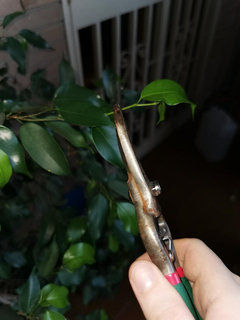
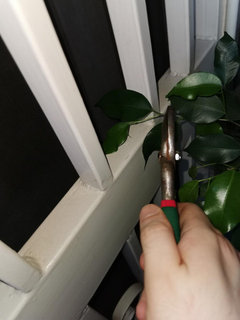
I would like to be sure that I understood how to pinch a ficus benjamin correctly. Remove 1-2 leaves + a shoot? Is it correct to pinch as shown in these photos?
- 3 years ago
I would like to be sure that I understood how to pinch a ficus benjamin correctly. Remove 1-2 leaves + a shoot? Is it correct to pinch as shown in these photos?
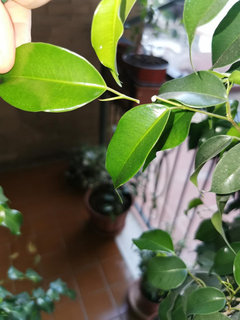
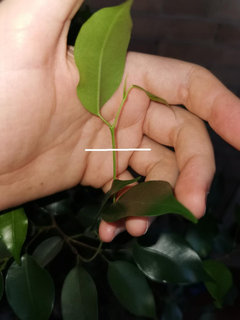
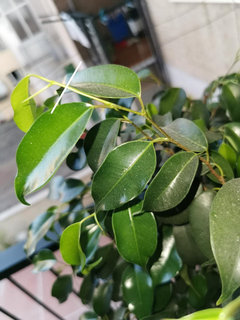
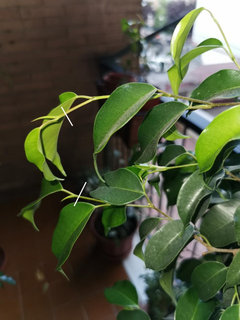
tapla (mid-Michigan, USDA z5b-6a)
Original Author3 years agoPinch so you leave only 2 leaves on every branch. Initially, you might have 6 or more leaves on a branch and it gets pinched back to 2 leaves. After the initial pinching, wait until the 3rd leaf on any branch is starting to open, then pinch back to 2 leaves.
If you pinch back to 2 leaves on a branch, odds are 100% the most distal leaf will produce a new branch in the leaf axil and about 95% you'll get a new branch in the axils of both leaves.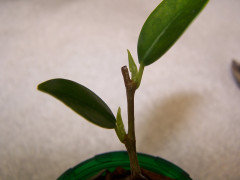
So the cutting above has been pinched back to 2 leaves and has produced a new branch in the axil of both leaves. When the 3rd leaf starts to open on the new branches you can see, I'll pinch those back to 2 leaves again and I'll have 4 branches, then 8, then 16, 32, 64, .... . Also, whenever a new branch occurs in the axil of a mature leaf, about the time the new branch gets to the stage you see in the picture, you can remove the mature leaf by cutting through the petiole with a pair of scissors. That reduces the plants food supply and ensures shorter internodes and smaller leaves. Remember, we don't worship growth for its own sake. Strategically removing leaves is how we balance the tree's energy flow and allow light and air movement into the middle of the canopy .... a lesson for another time
If you were to pinch a branch with 6 leaves back to say 4 leaves, the probability of getting new branches in the axils of all 4 leaves drops dramatically - maybe to 30%. That's because the new branches will have an apical meristem where the growth regulator that suppresses lateral branching (auxin) is synthesized. So as the end 2 leaves produce branches, they might also produce enough auxin to suppress the branches in the axils of the 2 proximal leaves.
Also, down the road you're going to want to be pruning the top hard with regularity. Ensuing there are a lot of branches close to the main trunk you can cut back to makes pruning far easier.
Al- 8 months ago
@tapla (mid-Michigan, USDA z5b-6a)
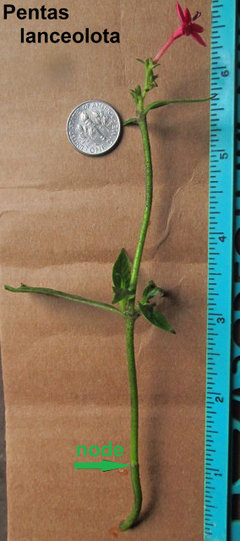
Al, please advise on trimming this for rooting.
Cuttings of this cultivar always have had low success rate.
Slow, whether to succeed or to fail.
tapla (mid-Michigan, USDA z5b-6a)
Original Author8 months agoWith a clean, sharp blade (no scissors or secateurs) sever the cutting somewhere between the lowest nod with leaves and the node above. Sever the basal end of the cutting with a cut 1/4-1/2" below the node the arrow points to. Remove all leaves at the first node except for those emerging at the very tip of the 2 new branches that are forming. Root in coarse perlite (rinsed) or a mix of grit or perlite with milled sphagnum moss or seed starting mix. Keep under bright light out of wind or drafts, but be cautious about putting the cutting too close to lights that produce lots of heat as the cutting won't be able to keep up with moisture lost to transpiration.
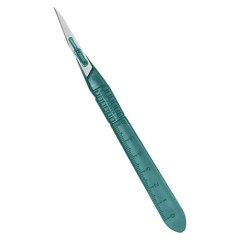
I use disposable scalpels for trimming all final propagule cuts. Ragged edges damaged by dull tools or tools that crush (scissors etc) is usually where the rot that spoils cutting success starts.
Al
- 8 months ago
Got it, thanks.
Ragged edges : I knew to avoid them on the end that will be in medium; I take it that it matters also on the end that will be in air.
tapla (mid-Michigan, USDA z5b-6a)
Original Author8 months agoNo - only on the basal end. The only reason it would be an issue above the soil line would be if it was in a humidity chamber or subjected to very high R/H levels.
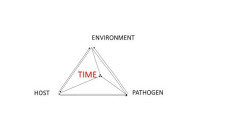
Plant pathologists often describe the disease process using a 4-sided figure called the disease tetrahedron (think “pyramid – 3 sides + the bottom”). Each side of the tetrahedron represents an essential part of the infection process. There must be a virulent pathogen (capable of infecting the plant) that is genetically capable of recognizing its host. Either the environment must be conducive to the development of the pathogen, or the pathogen must be able to stress/weaken the plant. The 4th requirement is the time required for diseases to develop and spread. Whenever conditions are such that any one (or more) of the 4 requirements is missing from the equation, there is no immediate threat.
Since the best medicines are prophylactic, the grower who makes sure plants are healthy and not stressed is ahead of the game. Biotic diseases are better able to overcome the natural defenses of plants weakened by stress that occurs when the plant is forced to deal with cultural conditions near or beyond the limits the plant is genetically programmed to deal with.Circling back to the disease tetrahedron, we can see compost that contains the virulent inoculum provides 2 of the 4 essential sides needed for a disease to develop – environment and inoculum. Time, the third essential side will not likely be on the side of the grower, so you can't use that to your advantage. We know there will be potential hosts, but not whether or not the hosts will be susceptible to the pathogen, or weak enough for the pathogen to infect the host.
Al
- 8 months agolast modified: 8 months ago
That's great.
In fact I do sometimes cover with humidity chamber (inverted plastic jar; leaving air gap).
Just now I read that medium should be sterilized in oven. I think that sterilization would be negated; to greater or lesser extent depending on the irrigation water applied.
tapla (mid-Michigan, USDA z5b-6a) thanked four (9B near 9A)  7 months agolast modified: 7 months ago
Tapla, I see here that there was some advice about pruning that I missed before I tried it on my Jade Tree last month. I didn't wait until the growing season. I did get decent regrowth when I added a grow light. I just didn't get it as low on the trunk and branches as I wanted. I'm considering pruning it again on 3 branches to attempt to trigger growth lower down. I assume you'd say wait to the growing season, which is a couple of months away. I haven't been fertilizing it and plan to start in March. When I do prune it again, I wonder if you could share where you would make cuts?
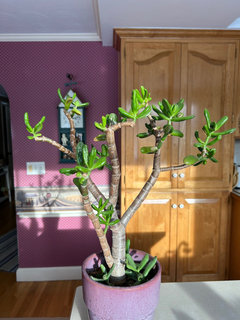
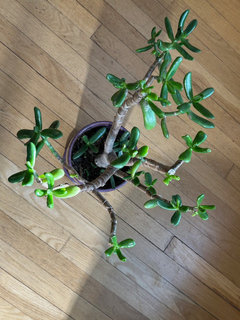
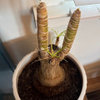
Here is one area low on the trunk where there is some growth starting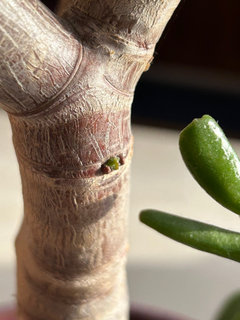
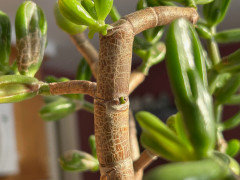
I was thinking of taking off that part of the branch that has gone horizontal.And wondering why that leaf on the left is starting to look like the trunk?









Rockdale (RI Z6)