Software
Houzz Logo Print
sanntain

Granite counter crack vs vein

8 years ago
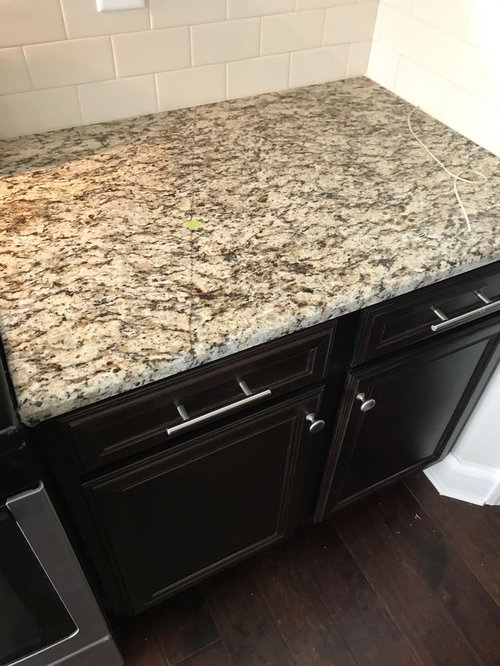
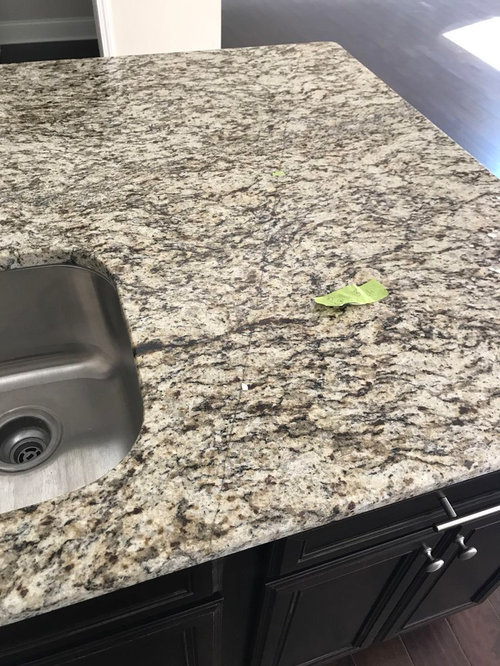
Just installed a granite countertop in a new house, but it has giant lines running through. The builder has been dismissive and insists it’s natural veining since it’s smooth, but it looks like a crack to me. Anyone else think it’s crack? And any advice on what I can do?


It’s a crack!
It’s a natural vein

Comments (9)

  • 8 years ago

    Natural veining are usually not straight line, and similar lines appear on the stone. Cracks usually are straighter lines.

    San thanked wytt65
  • PRO
    8 years ago
    last modified: 8 years ago

    With the caveat that I'm judging from internet pictures:

    For that to be unnatural, you'd have to be able to feel it, the fabricator did an amazingly excellent job of color matching, and he had to break and repair two, not just one, piece of your job. All highly unlikely.

    I got a call from a new homeowner regarding a rust streak through their new island. I told them there was nothing to do but replace and I'd say the same to you. Were I your builder, that would all be on your dime.

    San thanked Joseph Corlett, LLC
  • 8 years ago
    I’m just a homeowner, but one who always defers to Joseph’s expertise. I agree that it’s probably natural. When I was selecting granite the one I wanted had a similar diagonal vein that ran through the entire slab. There was nothing wrong with it; it simply wasn’t what I wanted and there was no way to fabricate around it. My fabricator located several slabs of the same granite, sent pictures, and I was able to personally examine slabs at several wholesalers. If your builder simply gave you a choice of granites without the ability to pick your slabs I think your only recourse will be on your dime. That said, I think it will be far less noticeable once you have your things in the kitchen. Also, your fabricator put the vein in a relatively inconspicuous spot (as opposed to the center of an island, etc). I know you’re disappointed now but I’d suggest living with it for awhile; I think you’ll find it’s okay.
    San thanked Lisa SW
  • 8 years ago
    last modified: 8 years ago

    Seen it a million times. That is a natural vein. A lot of the gold granites have long brown veins in them. They aren’t usually sold as first choice slabs though. They are usually sold to the folks who have the $30 a square little square samples and don’t allow the viewing or selection of the slabs.

    Putting up a poll to solicit the mass ignorant knee jerk response that the fabricator is always wrong and out to cheat you is pretty irresponsible. Only a hand full of people on this site are actually qualified to answer your questions. And none of them voted that it’s a crack. Because it isn’t.

  • PRO
    8 years ago
    last modified: 8 years ago

    Its could be either, if it was a vein

    a) it would not run as a solid line across the counter

    b) the veins run right to left on your material.

    c) it may be 1% a vein, though this would mean it would be "C" or "D" grade material as it hard to see in detail. need a much larger file size to see the stone structure detail.

    d) did they make you aware it had a vein in it like this when you ordered it.

    e) we do not use any or see any of this type of material normally as it is not premium stone.


    So our opinion it is a crack

    San thanked Quartz - Stone Care, Cleaning & Repair Experts
  • 8 years ago

    Sophie Wheeler, your tone is not helpful. Insults generally do not help people understand a topic any better.

    That's not a vein. Here's why: A vein is an injection of material. It adds minerals to the stone. It has some width to it, even if it's skinny. A vein can be any color, but it's often white (quartz or calcite), or it can be rusty colored, from iron-rich minerals carried by groundwater.

    A vein can have any orientation. It does not necessarily have to follow the grain of the stone. A vein can form around the same time the stone forms, like an offshoot of magma at the edges of a magma chamber. Or veins can form long after the stone formed, such as when the stone fractures underground and then the fractures are filled up by minerals carried in groundwater.


    In your case, the vein has no width. No material has been added. There is not an injection of any material. So it's a crack. It could be natural or it could be something that happened after the stone was quarried. If the stone has several cracks that run along the same orientation, then it's probably natural.


    Natural or not, you want to make sure the stone won't break. By far, the most vulnerable time for the slab is fabrication and installation. If it breaks during that time, it's the fabricator's problem, not yours. Once the stone is installed, it's probably not going anywhere. Cracks of all types (natural or not) can be repaired and made strong and nearly invisible by a skilled repair-er.


    My suggestion is to live with it for a little while, and if it really bothers you then you can look into getting it repaired. Sorry to hear that your builder is dismissive - that's no fun! At the very least you need to be heard.


    Hope that helps!


    San thanked karin_mt
  • PRO
    San thanked Quartz - Stone Care, Cleaning & Repair Experts
  • 8 years ago

    Y’all don’t have experience with the cheap seconds or thirds gold blocks sold to the bottom of the barrel fabricators evidently. I’ve seen a lot of it in this region. Long brown lines squiggling their way through the whole lot. No break in the material. Totally smooth, no fingernail catching either. No crack was ever that smooth.