edit note: As usual, I intend to post excerpts from these Landscape Messages for general information. I know it's from Massachusetts but other New England states should have similar conditions. Go to the links for further details.
-Claire
''''''''''''''''''''''''''''''''''''''''''''''''''''''''''''''''''''''''''''''''''''''''''''''''''''''''''''''''''''''''''''''''''''''''''''''''''
Landscape Message: Mar 23, 2018
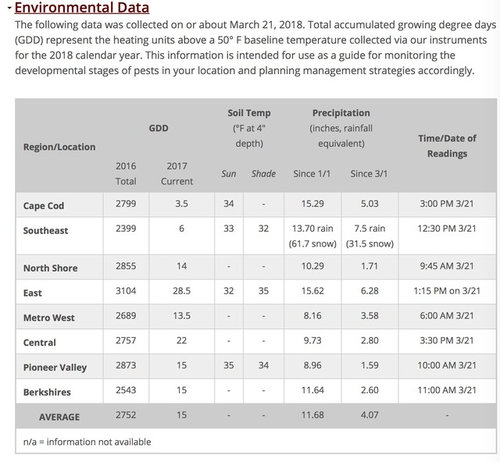
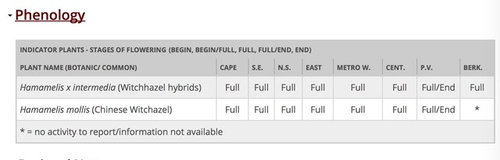
UMass Extension's Landscape Message is an educational newsletter intended to inform and guide Massachusetts Green Industry professionals in the management of our collective landscape. Detailed reports from scouts and Extension specialists on growing conditions, pest activity, and cultural practices for the management of woody ornamentals, trees, and turf are regular features. The following issue has been updated to provide timely management information and the latest regional news and environmental data.
Welcome to the 2018 season! The Landscape Message will be updated bi-weekly in March. The next message will be posted on April 6. To receive immediate notification when the next Landscape Message update is posted, be sure to join our e-mail list.
''''''''''''''''''''''''''''''''''''''''''''''''''''''''''''''''''''''''''''''''''''''''''''''''''''''''''''''''''''''''''''''''''''''''''''''''''
''''''''''''''''''''''''''''''''''''''''''''''''''''''''''''''''''''''''''''''''''''''''''''''''''''''''''''''''''''''''''''''''''''''''''''''''''
Winter Moth: (Operophtera brumata) The winter moth population is at a record low! The 2018 outlook concerning winter moth caterpillar population numbers in Massachusetts is very positive for those of you in the eastern areas of the state accustomed to dealing with damaging populations of this insect. Dr. Joseph Elkinton, Professor of Environmental Conservation at the University of Massachusetts, Amherst, MA, has excellent news: data from his lab’s research locations in eastern Massachusetts suggest that this invasive pest’s population size is at an all-time low. In fact, the 2017 winter moth population was the lowest they have seen since studying and working toward the biological control of this insect for the past 13 years. The populations of winter moth are so low in Massachusetts at this time, that Dr. Elkinton’s lab and scouts for UMass Extension’s Landscape Message are having a very difficult (to impossible) time locating winter moth eggs to monitor egg color change, development, and hatch for the 2018 season. Heather Faubert, with the University of Rhode Island, reports far fewer winter moth eggs present at the locations she typically monitors. To date (as of 3/21/18) she has not reported winter moth egg color change or hatch at her locations in Rhode Island, Connecticut, or the two sites she has in Massachusetts.
''''''''''''''''''''''''''''''''''''''''''''''''''''''''''''''''''''''''''''''''''''''''''''''''''''''''''''''''''''''''''''''''''''''''''''''''''
Gypsy Moth:(Lymantria dispar) The outlook for the 2018 season in regard to gypsy moth is significantly better than it would have been if Entomophaga maimaiga didn’t outbreak in the gypsy moth caterpillar population in late June of 2017. At that time, many dead caterpillars were seen hanging from tree trunks and branches, killed by the fungus, which was aided by the wet spring weather earlier in the year. Need a reminder of what that looked like? Go to: https://ag.umass.edu/landscape/news/gypsy-moth-caterpillars-dying-across-massachusetts. Unfortunately, prior to the fungal epizootic, gypsy moth caterpillars were able to defoliate over 923,000 acres across Massachusetts in 2017, according to the MA Department of Conservation and Recreation. For a map of where this occurred, visit: https://www.mass.gov/guides/gypsy-moth-in-massachusetts
''''''''''''''''''''''''''''''''''''''''''''''''''''''''''''''''''''''''''''''''''''''''''''''''''''''''''''''''''''''''''''''''''''''''''''''''''
A note about Tick Awareness: deer ticks (Ixodes scapularis), the American dog tick (Dermacentor variabilis), and the lone star tick (Amblyomma americanum) are all found throughout Massachusetts. Each can carry their own complement of diseases. Anyone working in tick habitats (wood-line areas, forested areas, and landscaped areas with ground cover) should check themselves regularly for ticks while practicing preventative measures. Have a tick and need it tested? Visit the web page of the UMass Laboratory of Medical Zoology (https://www.tickreport.com/(link is external)) and click on the red Test a Tick button for more information.












Related Professionals
Concord Landscape Architects & Landscape Designers · Olean Landscape Architects & Landscape Designers · Los Angeles Landscape Architects & Landscape Designers · Mobile Landscape Contractors · Frederick Landscape Contractors · Rock Hill Landscape Contractors · Utica Landscape Contractors · Phoenix Landscape Contractors · Great Bend Tile and Stone Contractors · Gaithersburg Tile and Stone Contractors · Fredericksburg Tile and Stone Contractors · Fort Dodge Tile and Stone Contractors · Bemidji Tile and Stone Contractors · Evanston Tile and Stone Contractors · Lagrange Tile and Stone Contractors