Software
Houzz Logo Print
bre_ayers

Pruning a full grown spotty Photinia

8 years ago

HI all. Appreciate any and all help :)

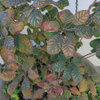
My family just moved into a home in N. Texas in August that came with an awesome hedge of full grown red tipped Photinia in the back yard that provides awesome screening. There are 8 full grown Photinias spaced about five feet from the next! All are about 20 feet tall. These as you can imagine are totally neglected and I noticed this Spring falling leaves and red spots that grow to brown spots with white centers - fungus I'm afraid! So far, I've pruned some dead branches and raked up leaves. Now I'm hoping to prune to thin in hopes of saving the poor plants. Some of the trunks are 8 inches in diameter, some of the bushes have 8-9 trunks a piece, some trunks have grown together. It really is a shame they're such beautiful plants!

SO...

I assume I should take out some of the bushes entirely. Which would give each one more like 10 feet distance before the next? On the bushes that have multiple trunks which should I leave? The bigger trunks or the smaller? Those that have grown together? Those that have smooth bark (I've noticed some have rougher bark, what causes this?) I like the idea of them being more tree like, and I'm not pruning to reduce height or create a bush. So, of the trunks that I cut, I'm thinking I'll cut all the way to the ground.

Is this the wrong time of year to prune? Am I too late? Will the pruning kill the bushes as they seem to already have a touch of fungus....

So many questions....this is very much an overwhelming project! I'm not even sure if the branches I do cut I can get out of the tree as it's so high! They're all raised up on a retaining wall and back right up against our back fence and hang over into the neighbors yard!


Thanks everybody! I'll try to post some pictures...


Comments (6)

  • 8 years ago

  • 8 years ago

  • 8 years ago
    last modified: 8 years ago

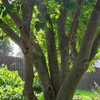
    In the views of the plant bases there are a lot of stems close together. And some crossing ones. However this is a hedge planting, and not a row of separated specimens intended to stand out from one another visually, have specimen tree style structure with attractively organized branching.

    And if you are seeing a spotting that appears to be causing premature dropping, a resulting thin appearance cutting out sections to force production of new stems from lower down may actually result in a worsening of the problem. Due to new sprouts from cut stumps also being susceptible to infestation.

    This is what I had happen some years ago with an infested plant on Camano Island anyway. The kind of spotting (there is more than one) we have in my area is making these plants go bald, yours do not look nearly as badly afflicted. In fact a 'Birmingham' at the Seattle arboretum that was 26 ft. tall in 1994* was almost entirely bare when I walked near it recently, there being only a small number of dwarfed looking tufts of new leaves present.

    *Other Fraser photinia elsewhere in Seattle were over 34 ft. tall by 2005. And were still growing. Now, of course, most here have become gaunt and spotty. Or will do soon

  • 8 years ago

    I wanted to prune to thin, not to force new production. So you’re saying I should let it be? I’m afraid if I do, the lack of airflow will make what I think is potentially fungus worse..

  • 8 years ago
    last modified: 8 years ago

    I do realize that pruning will potential revitalize the bushes into new production, I suppose I could keep cutting out this new production as I do like the look of the barer trunks.

    Mine do have some areas that are bare, in the center of one is pretty much bare and one down low has a spot that has completely dropped it’s leaves.

    On the pictures I was trying to show the scaley trunks vs. the smooth trunks. And also how crowded the bases are. Each of the 8 bushes are this crowded at the base. Each bush is at least 20 ft tall with only 4 feet between each bush at its base. They were planted originally far too close together. Maybe if they were kept pruned and smaller the plant spacing would have been fine, but these things are huge!

    Maybe I don’t know what I’m talking about tho! Ive never had a massive Photinia hedge before :)

  • 8 years ago
    last modified: 8 years ago

    If the intention here is in fact a hedge or screen then density and solidity would normally be the main objectives. With the individual landscape element being the entire hedge, rather than each plant - each plant is a part of a whole, rather than a separate feature unto itself (specimen plant).

    If the height has become more than you want then go through and lower it at a uniform level, with spring being the preferred time to do this. Keeping in mind that if this is done the planting will then go about trying to restore its original size, have to be lowered again at some point in the future.