Software
Houzz Logo Print

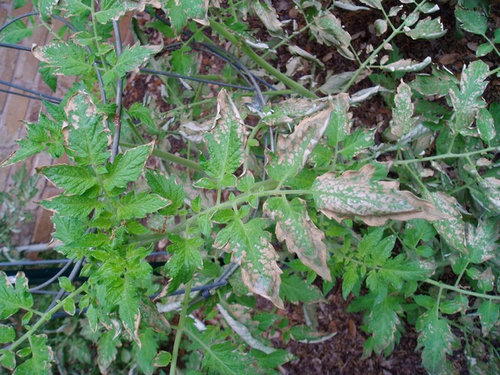
As of the last two days, my lush, green, bountiful tomato plants are getting wicked looking. Leaves turning partly brown. Now, three days ago, we had some really unusual weather, and temps went down to 39F. That was recorded a few blocks away. I might have a slightly colder microclimate, maybe, and got a freeze?

These plants are regularly sprayed with Daconil, so I'm doubting that a sudden onset of fungus is the cause. In any case, I really don't ever get fungus damage in spring.

Does this look like freeze damage? I've never frozen a tomato plant, so I really can't tell!

I know that wind and moisture can cause freezes on leaves with air temp above freezing. But with air temp seven degrees above freezing? I've exposed smaller plants to 35F air temp before, with no problems whatsoever. My working assumption is that if they don't freeze, they'll be OK. Yes, tomatoes certainly grow better with higher temps, but this is not a matter of poor growing.

If this is just freeze damage then, no sweat, they'll grow out of it.


Comments (9)

  • 8 years ago

    doesn't look like frost damage at all. frost damage plants turn dark green and wilt. like this or this. kind of looks like some chemical spray caused that.

  • 8 years ago

    I'd agree that it doesn't look like typical freeze damage. Both color and pattern of the damage is wrong for frost burn.

    Damage focused on leaf edges and tips is often from nitrogen burn but I trust you wouldn't have so heavily OD on nitrogen. So given the pattern, spray damage of some kind (sprays also focus damage on leaf edges and tips) would be my best guess as well. Any chance of a mixing error or sprayer contamination?

    I'd strip/trim off all the worst of the damage to encourage new growth that will hopefully not be damaged.

    Dave

  • 8 years ago

    Dang, as long as it doesn't spread, they should grow out of it quickly.

  • 8 years ago

    Was the Daconil an EC liquid? I doubt that Chlorothalonil itself would cause that injury but the carrier could easily burn leaves. I’ve had EC sprays that separate out after setting over winter and you need to shake the container vigorously before using. I’ve had Bravo, also Chlorothalonil, separate so badly that I had to add water and warm in a hot water bath.

  • 8 years ago
    last modified: 8 years ago

    Ouch. Thank you. I put two tablespoons of Daconil concentrate in two gallons of clean water and sprayed it on last weekend. Maybe I should have used less? Evidently the tomatoes didn't like that. Same Daconil I used last year, but with a different sprayer. Goodness knows what happened to that Daconil! I did also spray my Malabar spinach volunteers, as I eventually lost them to fungus last fall, and although right now those are all just one-inch seedlings, they look fine.

    I dug in a bit of ammonium nitrate when I planted the tomatoes out six weeks ago, but this happened just in the last few days.

    The freeze idea was looking even less likely, as all my freeze intolerant plants are doing just fine.

    Good idea to trim off the damaged foliage as that will certainly encourage new growth. There is lots of foliage that is unaffected, so I'm pretty sure the plants will be back to new in a few weeks. Just for grins, I also washed the plants down thoroughly.

    Howzat I'm killing my plants with fungicide???

    Barrie, you mean I may have not shaken the concentrate thoroughly before adding it to the water, and I ended up just spraying on a toxic dose of carrier? Not sure what an EC liquid is, but this Garden Tech concentrate is 30% Chlorothalonil. So if the stuff is 70% carrier, then if I don't shake it well, I'll only have a bit more concentrated carrier than I would otherwise.

  • 8 years ago

    That is chemical burn of some kind. Sometimes the liquid in the bottom of the sprayer is too concentrated.

    It should grow out of it.

  • 8 years ago
    last modified: 8 years ago

    The stuff was sprayed promptly after mixing in the sprayer. So mixing in the sprayer wasn't an issue. But I suspect I didn't shake the concentrate well, and that concentrate had been sitting on the shelf for 6 months. If Chlorothalonil floats on top of its carrier, then what I did was spray with a concentration that was three times the max recommended.

    There's a lesson here. Shake well.

    The extensive instructions on the product label say nothing about shaking or mixing of the concentrate. Interestingly, the instructions on Bravo 500SC Chlorothalonil concentrate include the words "slowly invert the container several times and add the required amount of BRAVO 500 to the sprayer", which is fuzzy-talk for mixing before adding, I guess?

  • 8 years ago

    Dan, EC (Emulsifiable Concentrate) is the most common formulation that spray materials are sold. Other contrasting formulations are flowables, wettable powders, dusts or granules. It appears that you are working with an EC.

    The Mid-Atlantic Vegetable Guide lists some general signs of deterioration of different types of pesticides and the ECs are notorious for separating( sludge or sediment forming) during storage. I never read about slowly inverting any product in a sprayer as you mentioned you read. I can only guess that aggressive shaking of the spray tank might cause splashing events even in a seemingly closed spray tank.

0