Software
Houzz Logo Print
nannerswolf

Soil Blocks are AMAZING


So I tried starting my veggies with soil blocks this year instead of peat pellets or yogurt cups and I am so glad I did. It has cut down the time spent on everything- especially watering. I've had a few people ask me about it so I'm going to lay out my experience with it so far in case other people find it helpful.


I read about them in one of Eliot Coleman's books and thought, "That doesn't sound plausible. The roots would all just grow into the other blocks like with peat pellets." Then there were a few youtube videos that showed it in action, I tend to plant a hyperbolic million seeds each year, as well as the fact that I spent WAY too much time bleaching my little plastic pots before refilling for the next season. Also I do not like spending money.


I bought the 3/4" blocker and the 2" blocker from Amazon as well as a bag of pre-made mix. I noticed that Eliot Coleman had a few different formulas for the mix and thought I'd buy the bag to see what I was aiming at. I did not like that mix at all. It had so many large chunky rock-like parts to it and I felt like half the time my blocks were falling apart because they were mostly made of gravel (probably not what was actually happening).


MOST IMPORTANTLY- Then I noticed that the instructions that came with the bag said that it would be better if I allowed the water to set in for a few hours at least. I am pretty sure that is the make it or break it information because regardless of the mix I've used, if I let it sit with the water added for a few hours (or a few days), it holds together very well. If I don't let it sit, the blocks look broken up and fall apart when I water the plant.


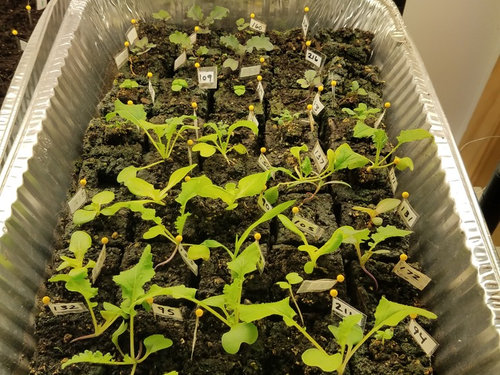
So I used the 2" forms and filled a few deeper disposable aluminum pans in rows, stuck them under my grow lights, and watered by just by pouring in the bottom of the pan, and let it go. I love watering this way because I can watch the water wick up the blocks and water just the right amount. With pots, I could bottom water the same way but it wasn't as easy to tell all the time that everyone had water where they needed it and also not as fun. :)

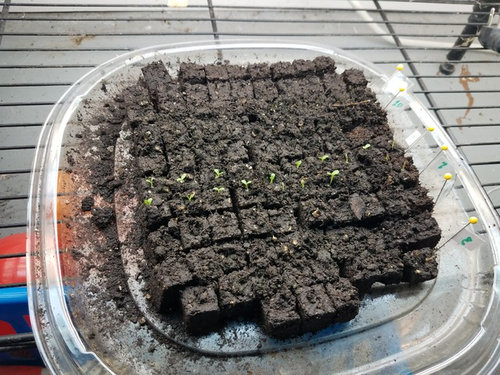
So after a few trial and errors, I started just using peat and vermiculite, wetting it, letting it sit for awhile, and using the blockers to make trays. I decided to try a few veggies that don't normally transplant well like beets, carrots, etc. I also decided to try some faster growers, etc. A lot of the recipes called for plant food in various forms to be added but I didn't think I wanted to add plant food to germinating seeds. I decided to go simple and see where that got me. My plants don't seem to have suffered that I can tell.


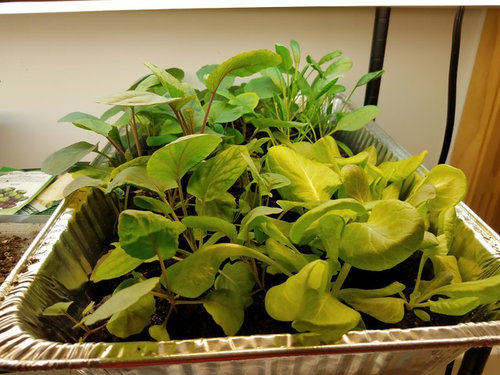
The lettuce isn't actually yellowing. It is just the picture. I had spinach, brussels sprouts, and lettuce in this one. The brussels sprouts had the most explorative roots and they didn't go into the neighboring blocks. Instead, they went under the neighboring blocks and were super easy to separate when I wanted to move them around a bit.


My basil and parsnips are going great guns. Some of them are planted a little close to the top because I didn't have my system down yet, but I figure they can be buried a little deeper when transplanted.


I have saved so much space on the shelves by being able to start so many slow growers in a small block! And the germination rates have been great (except on my parsnips which I am blaming on the parsnips. The carrots took twice as long to germinate as usual but most everything else has been great.).


I made a 4" block out of 4 cubes from my daughter's toys and the bottom of a milk carton. There were lots of plans on the internets for homemade versions because the 4" block is more expensive than all the others combined. Probably rightly so, but I don't have that kind of extra cash.


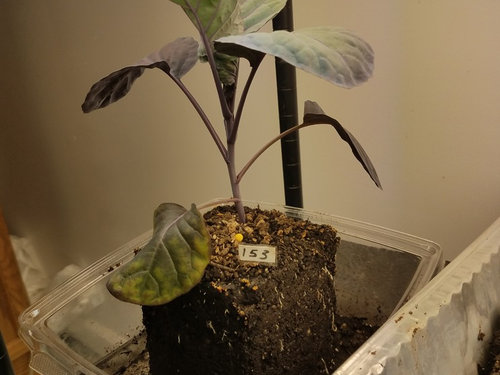
This is the brussels sprout that I was using as a prototype for my 4" form. It gives a good indication of how the roots go. They just kind of stop and the plant stays happy. Eliot Coleman is a genius.


I've transplanted the sugar snaps to my garden, as well as lettuce and spinach. I just put it in my unheated greenhouse for four or five days, then popped them right into the garden. Even with my impatient pushy gardening habits, there wasn't any visible transplant shock and everything has jumped right into growing.


I am so glad I decided to play around with this. Now I just need to find homes for 30 brussels sprouts that I started too soon, expecting this whole thing to fail. :)


Comments (19)

  • 8 years ago
    last modified: 8 years ago

    So the advantage is that you don't use cups? Not sure why it would save time on watering. You've got evaporation from all sizes, instead of just the top of a cup. Oh, but you immerse them in a puddle and water from the bottom? You can do that with cups as well.

  • 8 years ago

    soil blocks use less space then cups. they are easy to transplant. you can fit 50 of the 4" ones in a nursery tray making it easier to water then 50 cups.

  • 8 years ago

    Less space than rectangular cups? Nope.

  • 8 years ago

    rectangular cups?

  • 8 years ago

    They're called "inserts". Google "seedling inserts". Just about any seedling you get from the nursery are packaged this way. Presumably also because they can be packaged with little wasted space. All rectangular. Polystyrene. Much better than paper cups.

  • 8 years ago

    I have learned that soil blocks are favored by some because they don't have walls, so roots don't spiral around the inside of those walls. That way, when you plant them out, the roots are largely pointed outwards. That's an interesting idea that may have merit.

  • PRO
    8 years ago

    What size nursery trays are you using? I use the 1020 trays and it's not physically possible to put 50 4" cubes in those, in pots or not.

    Hannah Cbus (5b/6a) thanked beesneeds
  • 8 years ago

    https://www.growerssolution.com/page/GS/PROD/4square

    Many others available. It's true that tray inserts don't really come in 4-inch sizes. But you can stack these together like you stack blocks together.

  • PRO
    8 years ago

    I understand the size. I'm just not understanding how 50 fit in a tray. Like I use a lot of the 3x3" pots, but only 18 fit into a 1020 tray. I'd have to stack my plants on top of each other to get 50 in a tray.

  • 8 years ago

    You can fit as many of these in a tray as you can blocks. Well, almost. Rectangles are rectangles, and the walls are very thin.

  • PRO
    8 years ago

    Ok. I just I just don't get it. 50 4" blocks would be 800 square inches of area, and the trays are only 200 square inches of area. If it were 50 2" blocks I understand how that might fit into one tray because that tallies out to about 200 square inches of area.

    Even in the pics above, the aluminum tray looks like it has 2" blocks, not 4" blocks, and there are 45 in the tray.

  • 8 years ago
    last modified: 8 years ago

    I'm just saying that a 4" rectangular pot filled with soil will fit wherever a 4" rectangular block of soil will fit. That's all. I actually don't even use trays, so maybe I'm misunderstanding your question.

    But my original question was what, exactly, would soil blocks do for me that small rectangular pots of soil the same size won't? Those blocks are kinda cool, but ...

    Again, it would seem that there might be some advantages of soil blocks in rooting.

  • 8 years ago

    I haven't tried this - yet, but there are a few advantages. No plastic pots to sterilize or wash. Because there are no sides, air pruning takes place. Tree growers are taking up this method and growing their small starts in mesh-like pots because it prevents the tree from getting rootbound or potbound. It's important to soak the planting medium first because dry peat is hydrophobic, just like a hard dry sponge. Water will just run off when you first wet it.

    Hannah Cbus (5b/6a) thanked lgteacher
  • 8 years ago
    last modified: 8 years ago

    Well, if I'm going to start in sterile soil (yes, I sterilize all my soil I use for seedlings), sterilizing some pots is no big deal. It's about a bucket and some bleach. I never "wash". A much smaller deal, actually. But I agree, there is something to the proposition of not allowing a seedling to become pot-bound. Not completely clear what happens to the roots that spring out of the sides of the block. Do they stay alive, even? In a pot, all the roots stay alive.

  • 8 years ago

    after reading the posts about 50 4" blocks in a standard nursery tray being impossible i would have to agree. so maybe its 50 2" blocks. does that make more sense?


    Hannah Cbus (5b/6a) thanked randy41_1
  • 8 years ago

    Want to see 2" pots? Well, 1804's are 1.5" on a side. 606s and 804s are 2.35" on a side. But again, the question is exactly what benefits you get from lack of sides. It isn't really dense packing.

  • 8 years ago

    Upon reflection, regarding watering, I am sure it is saving me time but it might have more to do with the fact that everything is the same medium and consistency rather than strictly because they are soil blocks per say. I agree that it would make more sense that evaporation would be less due to plastic sides but perhaps because the blocks are so close together, it isn't making that much of a difference. I'm seed starting for my yard, my, mom's yard, and my aunt's yard (with a very limited budget) so I've been reusing any square or round pots I can get my hands on over the years. Historically, my trays of seed starts are not overly consistent in size or medium and that might have more to do with the faster, easier watering with soil blocks. If I had same size, same shape, same growing medium, that might make it the same speed as soil blocks. I just haven't had that experience to know for sure.

    On a side note, I really enjoy watering the soil blocks. It is more entertaining to be sure. :)

    Regarding what happens to the root pruning on the sides, I am thinking that they start growing again later when they meet soil after being transplanted. I am getting this idea based off of what the 3/4" block plants do when I stick them in the slots of the 2" blocks. I took one apart to check it out and there weren't any "stubs" that ended where the roots had stopped before transplanting. There were, however, many roots that went straight to the 2" block. This was after a few days (with my faster growing plants).

    Honestly, I am ridiculously focused on making sure I'm not killing any spiders when I bleach my pots so it takes me longer than it otherwise would. That is probably another reason this seems so much better to me.

    My peas, spinach, lettuce, and beets transplanted like a dream. I usually have at least some drooping, etc.


    Dave- I think you're right about some veggies being better than others. I don't think I'm going to use them for onions again. It worked way better in the old strawberry container I reused from the kitchen. Carrots are so far also not the best which is annoying because I would love an easy way to get them started earlier.

    Peanuts, on the other hand, are starting way better than I thought they would. I started them in 2" blocks but I think I'll have to transfer them to 4" pretty quickly.


  • 8 years ago

    Good points, Hannah. I guess it's just a matter of what works for you. I agree that evaporation may not be a big issue on the blocks because they're butted up against each other.

    Hannah Cbus (5b/6a) thanked daninthedirt (USDA 9a, HZ9, CentTX, Sunset z30, Cfa)