Software
Houzz Logo Print
hoganjr

Aerating???????

8 years ago

I have not aerated in years with fear I turn up those demon weed seeds just sitting waiting for an opportunity.


Ive used liquid ways to soften the soil like shampoo, humic acid.....etc. but not getting great results. I realize it takes time. I been applying for 3-4 yrs not and I still have areas of compaction.


what if I aerate now the do a pre emergent treatment?

Comments (22)

  • 8 years ago

    what kind of grass do you have?

  • 8 years ago

    I have an 80/20 blend. TTTF and 20% KBG. I’m not worried about your everyday broadleaf weed. The ones I fear are the grassy ones like Poa Triv,

  • 8 years ago

    Sports turf is a different animal than a homeowner's lawn so just because they do it doesn't mean the homeowner has to. Mainly it is done to break through a waxy build up of organics at the surface of a sandy soil. Golf courses are mostly sand.

    I'm not saying aeration is never needed, but just be sure you do it for the right reasons. What evidence do you have that says compaction? Is grass not growing in
    these places? Do you have a soil analysis? Too much magnesium will
    bind up your soil and make it seem compacted. Fix the soil chemistry to solve the problem instead of poking holes in the ground.

    Do you have thatch build up? If so, what is the cause? Pry up a cross section and look at the soil profile.

    So there are a couple of things you can do like that to help you make an informed decision.

  • 8 years ago

    The soil under any lawn will be compacted, if not now, then eventually. It is impossible to avoid. Rainfall, irrigation, foot traffic, mowing, raking, etc. - these all lead to compaction.

    I know some advocate the shampoo method but I have never found that to be the slightest bit helpful. I recommend if not annual aeration then every other year with a core aerator. IMO, it is the single best thing you can do to maintain/improve the health of an existing lawn.

  • 8 years ago

    ok , say Sports turf is another animal, how come every lawn service has an aerator too ?

  • 8 years ago

    Poa triv propagation is definitely a problem with core aeration. I would suggest organic based fertilizer in spring and early fall. I feel the worms definitely can mitigate compaction. Thatch will also be controlled. To boot, i haven't needed pre-emergent in 5 years and have zero crabgrass.

    hoganjr thanked mishmosh
  • 8 years ago

    Thanks mishmosh, I too use organic grains n milo. Been on it for years but I have an area that’s not very good as far as drainage goes n only some morning sun.

    Seems a lot more compacted than anywhere else. Grass is also a lot thinner

  • 8 years ago

    sounds like core aeration would do you well then. i think plenty of people aerate followed by pre-emergent.

    hoganjr thanked mishmosh
  • 8 years ago

    I have a feeling you're not going to be happy until you have aerated. I further have a feeling that you won't be happy after aerating, but at least you would have gotten this aeration thing out of your system.

    Daniel was right about the waxy coating leading to golf course aeration. They have journals and journals full of articles dealing with that problem. I believe the reason the lawn care professionals all advocate it and have the equipment is that the equipment pays for itself quickly at $250 a pop for aerating a customer's lawn. It's a cash cow and makes their boat payments every spring and fall.

    Gardengal said, The soil under any lawn will be compacted, if not now, then eventually.
    It is impossible to avoid. Rainfall, irrigation, foot traffic, mowing,
    raking, etc. - these all lead to compaction.

    She lives in the Pacific Northwest, but I'm sure she's not limited in her background to that area. Rainfall only compacts soil when it impacts the soil directly. If the rain drops can hit a plant first and then drip down a stem or off of a low leaf, that mitigates the soil compaction. Mother Nature tries to prevent that by allowing things to grow even in horrible soil. Irrigation only compacts soil when it hits bare soil or if the soggy soil is mechanically worked as described below. Foot traffic, mowing, raking, and etc., only compact the soil when it is soggy first. So while these activities "can" cause compaction, they don't automatically cause compaction. If the soil is firm, it just resists the forces and springs back.

    True soil compaction happens when something plunges into saturated soil driving out the air and allowing water to fill those air pockets. Clay and adobe bricks are made by a process which drives the air out of the mix. In nature it can happen near a livestock tank (ponds in Texas are called tanks). When the animals walk in, their hooves sink into the wet soil. When they remove their hooves to walk away, the muddy water fills in the holes. When the water recedes that remaining soil is compacted. It can also happen to a normal pasture when there are both livestock and a heavy, multi-day rain event. Livestock producers know to watch the weather for these event so they can move their animals to a sacrificial pasture which has already been pugged (farmer slang for soil ruined by compaction).

    The idea of using shampoo came from the golf course solution to use a very expensive liquid soap to break the waxy surface that forms on their grasses. Shampoo works much the same. Ground up peat moss tends to become hydrophobic, but shampoo works well to loosen it and allow water in. My wife has her own shampoo bottle for her veggie garden.

    But anyway, if you have not had any luck with it, give the mechanical aeration a try. Please take before, during, and after pictures in a month or two.

  • 8 years ago

    If the rain drops can hit a plant first and then drip down a stem or off of a low leaf, that mitigates the soil compaction

    I don't think that's quite right. If you take soil, put it in a pot and water it as gently as possible, you will see that it will settle/compact quickly. The simple act of water infiltrating through the soil causes compaction due to the force of gravity.

  • 8 years ago

    lawniac if you have fluffy soil you are correct. The first time you water fluffy soil it will settle. The second time you water it the soil will settle a little more. In fact if the soil started out fluffy from rototilling, the soil will shift and settle for three full years. What it is doing is assuming a new capillary structure with the minerals, organic particles, and microbes nudging up against each other into a permanent structure. Rototilling destroys that capillary structure. If the soil already has a structure where the particles are nestled up against other particles, then it doesn't settle any more without some mechanical vibration and lots of moisture.

  • 8 years ago

    I also live in the PNW. My lawn has improved a ton since I started aerating annually. Soil does get very compacted here. When it rains nearly every day in winter it becomes impossible to avoid ever walking on your lawn when wet. Unless you plan to stay inside for weeks. Lol. I’d venture to say most of us have patches of lawn we need to trod on in less than ideal conditions. To take out the garbage, go to the shed or compost or whatever. Aerating can be helpful if you find your lawn is struggling.

  • 8 years ago

    I live in the PNW and have no problem with Aerating from
    personal experience and professional experience.

    Aerating in Not just for compact soil. Even if your lawn
    doesn’t technically need it, it will almost always do more good than harm and
    any harm is temporary and the lawn will quickly recover and thrive, especially
    when following it with adding topdressing and overseeding.

    The healthy stand it encourages will outcompete any
    undesirable weeds that some claim as a reason not to do it. The worst reason I
    have ever heard of why not to aerate is because it may help someone make a boat
    payment. That is just wrong, mean, ludicrous and disrespectful.

    I would follow suggestions from someone with actual experience
    like gardengal48 (PNW Z8/9) vs. someone that copy and pastes the same talking
    points without any actual real-world experience with cool season grasses and
    the unique climate and soils of the PNW.

    Always check the work of those you look to for suggestions.

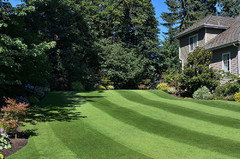
    Here is an example of my yard and I don’t hesitate to core
    aerate.

  • 8 years ago

    You can core areate manually for alot cheaper.Seen a guy on youtube who rented a aerator from home depot of $80 for 4 hours.Its a workout though

  • 8 years ago

    I would love it if someone would aerate only half their lawn and keep photo records of the differences between the two halves. This is a never ending argument. I'd guess that if your soil is not high in organics and does not have good structure, peds, then aerating helps. That is not to say that aerating if necessary for all soil types.

    I'd like to see a reference from the person who said that water that percolates through the leaves and into the soil causes compaction.

  • 8 years ago

    Soil compaction occurs any time there is any pressure or stress/weight applied to it. That is just a basic fact of soil science. And it really doesn't matter what kind of soil one is working with - the weight or pressure will compress or eliminate the pore spaces (voids) between the individual soil particles. Just happens faster with some soil types than others but it does happen eventually.

    An average rainfall has an impact pressure of 5-8 psi. (fwiw, a standing human male will exert a weight/pressure of 8 psi) Heavier rains will increase that; drizzles will lower it. Areas with frequent rainfalls will experience compaction from that activity. And blades of grass are not much of a deterrent. Also the wetter the soil is to begin with, the greater the impact of the rainfall as there is far less of an absorbency factor.

    This is pretty common knowledge for anyone that studied soil science or hydrology. Hard to argue with science :-))

  • 8 years ago
    last modified: 8 years ago

    @gardengal, you may well be 100% correct, but what I've read up around on the net as best I could does not support what you are saying. Saying something is common knowledge and anybody who doesn't know that is uneducated also isn't convincing. Again, I'm not saying you are wrong. It would just be nice to have one reference to actual science that proves that a thick stand of grass will not prevent compaction.

    Morpheus mentioned one time that he had work done in his back yard and trucks had to roll over his lawn to get there. He had ruts in the lawn but over time the soil rebounded because he had very good quality soil. Either he is kidding himself or there is more to the story.

    @pnw_ff: BTW, beautiful property and lawn!!

  • 8 years ago

    Heres that video if you want to watch it


  • 8 years ago

    I don't really have an army in this war any longer, but I will say that I haven't aerated in 16 years.

    Or, more accurately, I simply let the worms do my work for me. And most have seen photos of my lawn; anybody saying it's poor is blind.

    By comparison, my neighbor aerates every year and the lawn is terrible, simply because they aren't consistently following any recommendations. So it's not a cure-all for a bad soil, but might serve a purpose if the soil has been severely compacted by truck or other machines moving across it.

    Nature doesn't exactly supply core aeration machines to prairies and grassland, and those flourish without difficulty...because there are tiny machines called worms and beetles. Encourage those and things work out fine.

    hoganjr thanked User
  • 8 years ago

    "Nature doesn't exactly supply core aeration machines to prairies and grassland, and those flourish without difficulty."

    And prairies and grasslands are NOT the same as a cultivated turf grass lawn nor are they subject to the same sort of foot traffic and routine use of machinery as are lawns. Apples and oranges!!

  • 8 years ago

    You seem nice. And yeah, those buffalo that traipse over your front lawn twice every year in massive herds can be a real problem for soil compaction.

    Oh. Wait.

    I'm out. Toodles.