Software
Houzz Logo Print
jeholornis

Coontie cycad ("palm") help needed

Hello I'm moving a few of my coonties to spread them throughout the yard more.

A few of my plants had the thick-bulblike crown that I believe is called the caudex above ground when I bought them from a specialist grower, others had it underground. Does anyone know what the proper location is? Both survived this wet and relatively cool winter fine but since I'm moving them I want to do it right.

I'm mostly seeing pictures of them underground but maybe I should have them above ground for drainage since I use bark mulch?

Comments (11)

  • 8 years ago
    last modified: 8 years ago

    I thought there was a cycad forum... I scrolled through the C's to find it.. guess I should've realized it was PALMS and Cycads. Thank you! You sure sound like an expert to me haha

    I think since one was growing above ground I'm just going to keep that one above ground (area is decently sheltered so if having it exposed lowers hardiness that shouldnt be a problem). The other I let an inch or so above the soil per your suggestion and I also rinsed off the soil that was on the top.

    So for the mulch can it not touch even the edge of the caudex? Does there have to be bare soil circling around the plant? I thought you just had to keep the crown clear.

  • 8 years ago

    Coonties burn their foliage at about 18 degrees. The stems survive because they are underground, or under mulch for cover. If a stem is exposed during a freeze that is 16 or lower, the top can rot right off. It actually usually comes back over time, but that's a good 5 years or more. Most Caribbean and Mexican Zamias have contractile roots. That means they pull themselves down naturally. If you are planting in pure sand, it won't hurt to put the apex at or just below ground level. If you are in a wet, highly organic area, I'd keep it above. I've used coonties in about 600 landscapes and never had a problem with mulch, but I only used pine bark mulch when the homeowner insisted.

  • 8 years ago

    Plantsman56, thanks for your advice. Like I said, I'm not an expert.

    We hardly ever get below the mid-20s here in 9a. Last year, in Gainesville, we got down to about 22 for one night, but that was unusual. Our coonties usually die back in the winter and come back in the spring anyway, but not during a mild winter. My seedlings didn't even die back this winter, and they were left outside, up next to the house during the freeze.

  • 8 years ago

    We don't see it bad down here in Lakeland, but my location has had it down to 15 about 10 years ago on 1 thermometer, but I saw evidence of 14 or below in a non monitored area. In the 89 freeze where we had 17, I had containerized coontie die, along with Washingtonian palms and even small European fan palms. I've seen 13 days in the teens, so it does happen, just not very often. I know pays off Jax can be real bad, so its good to mention tolerances to the poster. And if anyone here has ANY cycad cultivation question in this forum, I am considered an expert by people around the world, am I'm glad to help.

  • 8 years ago

    I don't know why that area is so cold. I lived in Plant City in the late 80s and we had frost most mornings. I think that's just a cold spot.

  • 8 years ago

    I AM in a cold spot. On the first morning of our typical 2 day freeze events, I am the same temperature as down the street. On the second morning, when high pressure is near us, and the wind cuts out, and we have frost, I am 6 degrees colder than 1000 feet to the south. The 40 acres south of me rises about 15 feet in elevation. That means all the cold air that doesn't get moived by wind, rolls right into my nursery. That means when it is 23 down the street, I'm seeing 17. All the difference in the world with cycad leaves.

  • 8 years ago

    That's tough. I was in a cold spot on my farm in SC, almost a microclimate that just affected places within 1/4 mile on all sides. It was so frustrating when all my things would freeze and everyone down the road had theirs be fine. I lived there for 5 years and only got one crop of Santa Rosa plums, because every spring, the blooms would freeze off. Same thing with my citrus in North Port. I only had one or two years out of 14 that I got a decent crop of citrus. Every other year, the blooms froze or the fruit froze.

  • 8 years ago
    last modified: 8 years ago

    I'm in a place South of Jax that I havent seen actually be zone 9a in a while. Actually everyone here has old tropical hibiscus plants, many in exposed mailbox spots. So it sounds like they'll be okay a little exposed, they have evergreen hedges to their immediate North and South and are near the house so they're pretty sheltered.

    BTW thanks for your input I appreciate it. These are such slow-growing plants.. I'd hate to kill them by accident. I only use pine bark mulch (and leaf mulch from my trees) for aesthetic and environmental reasons so I'm not sure how it compares to the red-dyed cypress mulch that's more common here.

  • 8 years ago

    I have native coonties on my property. I just dig them up and bury them wherever I want. They are slow to come back, but eventually do. Actually, you can't hardly kill them. They have them in the medians of our small community and on the years the tops freeze, they mow them over. They have been around forever, so very tough.


  • 8 years ago

    Hi Jay,


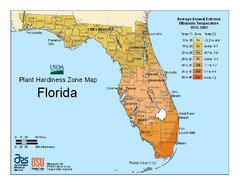
    Below is the current USDA Plant Hardiness Zone Map for Florida. All of Duval, Clay and St. Johns counties are considered Zone 9A. (It's too bad that they didn't use a more differentiated color-scheme.)


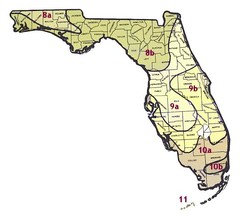
    Here (below) is the prior map, in case you are interested:


    Carol in Jacksonville, FL