Software
Houzz Logo Print
raginishah

Pyramid or insert range hood?

8 years ago

I’m not sure I have the terminology right but I am trying to decide between a pyramid hood and one that is hidden behind a cabinet (ie not under cabinet). I like the look of wood surrounds with a hidden vent/hood but our contractor would like us to go pyramid as he says the ones I like do not vent well. Our kitchen is 8’x10’, will be open to the dining/living rooms and have a 30” gas range. We cook often and use lots of spices so we want power but also quiet.

Does anyone have thoughts about the pyramid vs the inserted (if I’ve got that terminology right). And if so, which hoods make most sense for our configuration/appliance. Thanks!!

Comments (12)

  • 8 years ago
    last modified: 8 years ago

    You will pay more than double for a wood hood and insert than you will for a chimney hood. You have to buy cabinets too. And that gets to be very costly. With zero increase in effectivity for the money spent.

  • 8 years ago
    last modified: 8 years ago

    I agree with Sophie Wheeler. Also, a stainless steel hood is easier to clean than a wood surround. If you are cooking with spices that might include a colorful one like turmeric, I think you will appreciate that a stainless steel hood will wipe clean and not absorb any oils or colors the way a painted wood surround might.

    Make sure that you have a duct from the hood to the outside that is sized properly. The duct needs to be 8” in diameter, or 10” if the hood’s cfms will be 1000 or more. Don’t let the contractor tell you that “6” duct will be fine”. If the exhaust duct is too small, you will have more noise and less efficiency through no fault of the hood.

    Also, a pyramid or canopy shape is best. Don’t get a flat hood, even though they look cool. Flat hoods don’t capture the smoke and grease as well. Final tip is to try to get a hood with baffle filters, not mesh. You can find great deals at Costco, though those hoods tend to come and go. Also look at the ajmadison website which has handy sorting features.

  • 8 years ago
    last modified: 8 years ago

    That is an interesting alternate viewpoint Helen. It struck me that you said a stainless hood would be "honking" and dominant. My feeling is that a cabinetry surround is the more bulky look, with the thickness of wood, and usually some kind of raised panel or decorative millwork applied. Also a stainless hood can provide the eye some break from a wide row of uninterrupted upper cabinetry, especially in a larger kitchen. We all have different opinions and perceptions of that.

    I don't agree that a stainless hood is necessarily more contemporary - it depends on the hood's design, and there are so many out there. We have seen many traditional kitchens with stainless hoods. If you or the OP go on the Modern-Aire website, you will see all the possibilities of hood design available, both contemporary and traditional. If you want to go truly period, your hood surround would be plaster, and not wood cabinetry at all. People do opt for plaster surrounds to recapture that look.

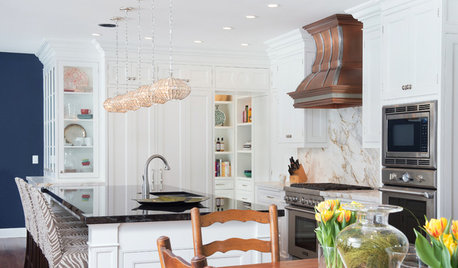
    Also, you mention the copper sink and that you wanted copper to be the design star. There are some stunning copper hoods available, real showstoppers, if you are interested. But they will be very expensive.

    The OP has not said what look she is going for. My advice was aiming more toward practicality given the OP's mention of cooking with spices, I also agree with Sophie that the cost of the hood surround, plus the liner/insert will be higher than buying a stainless steel hood. I was surprised that you did not find that. I suggest that if the OP is very interested in a cabinetry surround for her hood, she investigate the cost for her kitchen compared to a stainless hood.

  • 8 years ago

    freidajune: I was speaking only to my personal design choices. I have a small galley kitchen and a large stainless chimney hood would dominate that wall visually. It would be the only stainless except for the stainless trim on the wall oven which is subdued.

    I had considered a copper hood but my designer thought (and I agreed) that it would be too much as I am also doing a copper coved ceiling. We both thought the wood cabinet would be the quietest choice visually - but this is something on which it comes down to personal choices as there is no right or wrong way.

    I actually like stainless hoods in the right kitchen and they don't work only in contemporary kitchens but I didn't like one for my kitchen.

    I didn't find the hood insert itself to be more expensive than standard chimney stainless hoods but obviously there is a cost of cabinet factor that increases the total price as is true of all paneled appliances and as is true of opting for a wall oven and cooktop in lieu of a stove which I am also doing. I know that I am making more expensive choices but I am not borrowing money for this remodel nor am I dooming myself to sautéing cat food in my later years LOL. My kitchen is relatively small so although choices I am making might be more costly, the actual cost is probably in line with what a normal kitchen might cost.

  • 8 years ago

    Thank you all for the very detailed responses! You’ve all hit on our exact dilemma- style of kitchen which is traditonal vs. function of hood which will get heavy use. Helen, do you remember what insert you ended up buying? Also, do you have a picture of your hood with the cabinet surround? I’ve seen lots of photos online of course but would be helpful to have a real person’s example.


    friedajune, your information was very responsive to my concerns as well. I will look into the models at Costco and Modern Aire to see if I can find something traditional looking in stainless steel. If you have any favorites, I’d love to hear more.

  • 8 years ago
    last modified: 8 years ago

    I went with a Bosch because I am familiar with the brand and its reliability. I also liked the ease of taking off and putting back the filters since some of the other brands I researched were more cumbersome to remove and I am past the stage where I am clambering around my cabinets with a screw driver to remove a filter :-)

    I am not a vent expert as it's probably the appliance I did the least research on my own. One knowledgeable salesperson recommended the Best model. I did however consider the pros and cons of the various venting systems on a theoretical level and I am fine with my decision.

    My venting needs aren't as heavy as someone else since I am using over a 30" induction cooktop as I posted originally. However, there were larger and more powerful insert hoods so I don't understand why performance of an insert would be less if one got a larger more powerful hood.

    Also - and this is just anecdotal, I cooked A LOT and used a lot of spices including stuff like saffron and turmeric and never had particular issues with spices causing discoloration in the area surrounding my old stove. I also sautéed a lot although I didn't deep fry - and again, there weren't huge issues regarding surrounding areas - and this was with a completely ineffectual fan that was chiefly a noise maker rather than providing any kind of vent LOL so I can't imagine that my new vent will cause more issues than I had with essentially NO vent.

    I am still in the early stages of my remodel so I don't have pictures of how it will look installed in the cabinet.

    Function is very important to me so I try to strike a balance between function and form. At least to me, I liked the form of the cabinet insert for my particular kitchen and it didn't appear to have any less functionality than a stainless hood. The cost is probably higher because of the cabinet cost but it's not a huge expense in the scheme of things so that didn't factor into my decision since I could afford it without skimping in other areas.

  • 8 years ago

    Thank you Helen. This is super helpful.

  • 8 years ago
    Ragini S thanked opaone
  • 8 years ago

    Following. In addition to Ragini's concerns regarding design, I've been fretting about noise vs. enough CFM. We'll probably be getting a GE gas range. Based on previous posts by @kaseki on the appliances forum, I think I will need a 600CFM hood plus make-up air. Don't know if noise factor increases with CFM or not.

  • 8 years ago
    last modified: 8 years ago

    Noise is only tangentially related to CFM. Noise is caused by high velocity. 600 CFM in a large hood and duct will be rather quiet while the same 600 CFM in a small hood and duct will be quite noisy.

    Though somewhat counter-intuitive, a larger hood can function more effectively and quieter with lower CFM's than a smaller hood. This is one reason why hoods in open kitchen restaurants are much quieter than the consumer hoods in home kitchens.

  • 8 years ago

    A brief noise review:

    These sources of noise are ones that might be noticeable with a hood system, and have counterpart noises with active make-up air systems:

    • Fan blade turbulence noise

    • Duct turbulence noise

    • Baffle filter turbulence noise (also mesh filter turbulence noise)

    • Hood interior transition turbulence noise

    • Blower motor noises including unbalanced fan vibration

    These rules seem to apply in most circumstances:

    • The closer a noise source is to the cook, the louder it will be perceived to be

    • Higher frequency noises generated downstream from an in-line silencer will be attenuated

    • Blade tip turbulence noise will decrease for a given CFM the larger the fan diameter

    • Duct turbulence noise will decrease for a given CFM the larger the duct diameter (the lower the duct velocity), but duct velocity needs to be in a range that minimizes grease particulate condensation

    • Filter turbulence noise will always be present, but is usually insufficient to interfere with conversation

    • In a hood with a local blower, the blower noises will dominate the other noises

    So, the ideal configuration given a correctly sized hood aperture and duct system seems to be:

    • Use an external blower on the roof or side of the house, or an in-line blower distant from the hood

    • Use a silencer if it will fit between the blower and the hood

    • Set the duct size so the maximum flow rate velocity is around 1000 ft/min

    Such configurations seem to be filter noise limited and relatively quiet for residential use. In some cases, particularly where noise suppression is critical but room for a silencer is not available, a more commercial up-blast type external blower can be used, "geared" to operate at a desired flow rate less than its potential flow rate. An oversized residential blower that is just not turned up all the way might also do.