Software
Houzz Logo Print
hairmetal4ever

What weeds do you hate most?

8 years ago
last modified: 8 years ago

For me it’s wild violets (THEY REFUSE TO DIE) and Japanese Stiltgrass (easy enough to kill or yank but there is apparently a seedbank of millions in my Soil).

Comments (37)

  • 8 years ago

    This year its nutsedge. Popping up all through my newly formed mounded beds.


    Next year I am going to strongly consider plastic/weed fabric on the beds.

  • 8 years ago

    Bindweed. Like roaches, bindweed will outlast humanity.

  • 8 years ago

    Palm tree seedlings. Seriously. I can't ever get rid of them. Spurge runs a very close second.

  • 8 years ago

    Thistle, creeping jenny, crabgrass, and purslane. And thanks to some heavily contaminated "organic" hay that I used for mulch last year, it appears that ragweed - which was never an issue in my garden - will be added to my weed hate list. Thousands of ragweed seedlings in the garden as I write this. >:-(

  • 8 years ago

    dandelions. They have the ability to grow within the roots of plants. To eliminate them you have to dig up the plant and separate the dandelion root from the plant root.

  • 8 years ago

    Bermuda Grass, it's so stubborn it holds Bermuda together. Most other weeds can be hoed up, not this stuff, it's has many aliases but it's called "wiregrass" around here.

  • 8 years ago

    My two biggest enemies are mugwort and Bishop's weed, although they're not a huge problem in my vegetable beds. There it's mostly bindweed, which is a huge nuisance as well and seemingly impossible to remove.

  • 8 years ago

    All of them. But the biggest thorn in my side is that damned blackberry bush that the previous owner's planted that I am attempting to eradicate.

  • 8 years ago

    gigirambles, You have to be diligent with your pruning for a blackberry bush. We have one (planted on purpose) and my husband is charge of pruning it. They are really are a wild child that you have to keep under control.

  • 8 years ago

    functionthenlook - I have dug up as much of it as I can and am constantly out there pulling up or digging up any strays that show up. I have actually found strays coming up WAY across the yard. It truly is a wild child, I commend you for dealing with this on purpose. I hate that bush with a passion.

  • 8 years ago
    I think Bermuda grass was the worst I've ever encountered. I'm glad I don't have to deal with it anymore since I moved from Texas to Indiana.
    I planted wild violets on purpose... LOL!
  • 8 years ago

    Chickweed. Cannot get rid of it!

  • 8 years ago

    Thistle

  • 8 years ago
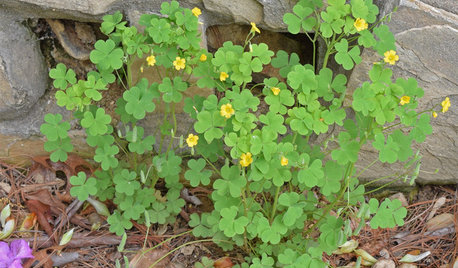
    Oxalis, horrible weed with bulbs, very difficult to get rid of once in your garden. Strangles everything
  • 8 years ago

    Hate isn't a word I'd apply to any plant, even weeds. They're just doing what nature has evolved them to do and many have only become a problem through human activity. On my allotment I might call Calystegia sepium and Circeae lutetiana a nuisance but I don't hate them. They are annoying, irritating, even exasperating, because their behaviour is inconsistent with my aims in the garden. But I can't hate them for that. To me dealing with weeds is part of gardening. To hate weeds is like a tennis player getting irate that someone keeps returning your shots. You just have to play what comes at you as best you can and enjoy the process. Or give up tennis (ie gardening).

  • 8 years ago

    Similar to zeedman - creeping jenny, purslane although this year I don't seem to have the usual crop. I think it might be bindweed that has a long white root that easily breaks when you try to dig it up so that you help multiply the weed. I recently went on a medicinal herb walk so now I feel guilty pulling up wild sorrel and some of the other weeds the herbalist loves. I told her she could come to my place to forage. Fortunately we are able to stay ahead of the Japanese knotweed that tries to grow along the road. I bet the town mower dropped bits of it from the huge masses of it down the road. I've heard several herbalists say it is used in the treatment of lyme disease. I had three large possibly mullein plants get started in one bed that had tomatoes in it last year. It was bad enough to dig those plants out but one big leaf had a small paper wasp nest started on the underside.

  • 8 years ago
    last modified: 8 years ago

    I'm with floral on this matter. I have a few weeds that can be a challenge from time to time, but the self-seeding arugula volunteers are much more bullish than many of them. I have a lot of oxalis, but its fresh, lemony taste is wonderful added to my salads. Wild violets are extremely persistent, but how fun to let the visiting children eat the pretty flowers. It's tough to do here in the heat of Tn., but dandelions in early spring just can't be beat for using in great grandma's Italian spring salad (and the memories it brings back :-). Creeping charlie puts a boost into composting winter's leftover browns. Bindweed is easy to control in the garden... in the hedgerow... not so much. Okay... I can't turn Bermuda grass into an island vacation lol, that stuff is just the pits...

  • 8 years ago
    last modified: 8 years ago

    I'm lucky to not have a big weed problem. I killed off with cardboard and tarps over the winter, and any left got hoed out or dug up, roots and all. Now I only get some occasional weeds from the yard spreading in, but it takes 5m a week to run through with the hoe. I use a lot of straw and grass clippings, but a trick to kill the weed seeds I accidentally found is to leave them in full sun, wet them down, and let them sit for a few weeks. They really heated up when I accidentally did that and I have hardly any weeds from them coming up as I have from straw in the past.

    A strategic plan to gain more garden space may be to let the straw bales heat up in a sunny spot in the yard....if you're lucky it'll kill all the grass underneath and leave you with the excuse to extend garden ;)

  • 8 years ago
    last modified: 8 years ago

    Anything that roots deeply. Weeds aren't much of a problem in my deeply mulched raised beds but over at a friends garden that I am using this year the weed seed bank is insane because he has neglected it for a few years and the weeds went to seed. I planted onions, corn, and a couple tomatoes this year and have had to spend over an hour a week weeding so far.

  • 8 years ago

    Good point Dan. Sometimes I use them as cover crops....always getting them before they go to seed, cutting them under the soil with a hoe, then chopping in a bit shallowly.

  • 8 years ago
    last modified: 8 years ago

    I should say that as I have an urban garden, weeds are really not a big issue for me. Most of what is growing around my beds, for a hundred yards in any direction, is lawn grass, and St. Augustine doesn't even seed.

  • 8 years ago

    I agree with Irene Morresey, oxalis. I spend many hours every year carefully digging it out, but it always comes back somehow. Second place goes to nutsedge.

  • 8 years ago
    last modified: 8 years ago

    I like weeds (although they are a pretty big issue in our garden—hence putting black plastic down over most of it; they do stop germinating when it gets past a certain temperature, though, or if the ground isn't watered), but probably our biggest challenge to remove is morning glory, followed by some kind of grass. Compared to those, our other weeds are pretty easy to deal with. Our most abundant weed is probably lambsquarter, though. It can be pretty much everywhere in large numbers, as long as it has enough water to sprout.

    Anyway, morning glory grows back easily from its white roots, it sets seeds, it strangles plants (and climbs them), it grows very quickly, it's a perennial, and the roots break easily. The roots can be very long and windy, too.

    The grass is easy to pull up when mature, but it pulls up a lot of soil, and it tends to grow right at the roots of plants like watermelon (so, you can't pull it up without damage, and it grows back quickly if you top it). It's difficult to pull up when young. Cantaloupes will shade it out, though.

    If I didn't have to worry about what other people thought, laws and stuff, I'd probably grow plenty of weeds on purpose, though.

  • 8 years ago
    last modified: 8 years ago

    Purslane, Canada Thistles, and vining milkweed.

  • 8 years ago
    last modified: 8 years ago

    wayne_5 We had a few years where we had a bunch of purslane. It was persistent, until last year, where we had hardly any for some unknown reason.

  • 8 years ago

    Kevin - As I read the Topic line and clicked, I instantly thought 'nutsedge' and when the full thread displayed I saw that you are about to start a battle with it too. I am so sorry. It is a war that can be won, but it takes persistence on your part. It is back breaking work.

    A true story: in 2009, the year my mother passed away and I began to work her garden, the nutsedge was so thick that I actually took my mower into the garden to mow it down. I also used "Sedgehammer" (I think that was the brand name at the time) to treat the areas where it was very thick. The problem with nutsedge is that the plant has a little nodule that resides underground even if you pull the grass above ground. So, pull away, and you'll get nowhere because the "nut" will just send up a new plant. For the next several years I spent many, many hours carefully hand digging out the nutsedge. You have to be careful to get the roots and that hard little nut that resides below ground. Eventually, over years, I got the upper hand and what was once a seemingly impossible job became possible. For the last about three years, I've had only a few clusters of the nut grass. A week or so I dug out three such clusters. A few days ago I realized that I have another one that needs attention. This weekend I will get that one. I wish I had pictures of the garden back then.

    It is possible, but it takes hard work! I am so sorry!

  • 8 years ago

    Portulaca

  • 8 years ago

    Maybe I should stop fighting the Purslane and just let it be a living mulch?

  • 8 years ago

    Purslane usually doesn't sprout if there is a decent mulch cover.

  • 8 years ago

    noki33, I tried that one year but I think it competed with adjacent veggies. I think I let it grow up around summer squash. I told my husband I need lots and lots of grass clippings for mulch. We started two new asparagus beds last year and right now they need some weeding. Harvest is done, I'll fertilize and mulch because I didn't keep our first asparagus bed weeded and although it still produces, it's a horrible weed patch. Oddly, I don't see much purslane this year in any of my beds.

  • 8 years ago

    Portulaca/purslane will definitely cover the ground but I wouldn't want to use it as a living mulch. Last year was my vegetable garden's first year and I had a small area of portulaca in it. I pulled most of it but left a small amount at the garden's edge...it makes a pretty flower and the leaves aren't objectionable, either. Well, this year it has sprouted and grown all over the 1500sf garden!!! It is an annual but re-seeds readily and and will easily root from cuttings/chopped up pieces. I did a wholesale weeding the other day (we've gotten a good bit of rain that has encouraged weeds and hindered getting in the garden)...spent about nine hours in the garden...very long day. Out of the weeds in the garden, 50% of them was portulaca. I had hoed the garden a month ago but this appeared to have only cultivated it and encouraged it to grow. It will smother most anything beneath it, the leaves are thick/fleshy and create a dense, low-laying canopy. The roots are hard to pull in dry ground without breaking the fleshy stems but fairly easy to pull up in moist ground.

    I was very surprised to see how it had spread all over the garden. I would not recommend it for any use, though some may find it useful in desert, dry, rocky gardens of flowers and plants, or maybe in an edible/permaculture landscape. It's a pretty plant but in my location, and in a vegetable garden, it seems to be a highly invasive plant.


  • 8 years ago

    In my veggie garden all weeds. In my lawn creeping Charlie. Weed B Gon seems to be the only thing that will kill it.

  • 8 years ago
    poison ivy. ugh.
  • 8 years ago
    last modified: 8 years ago

    itsmce - glad to hear its possible to get rid of nutsedge, even if its a PITA. I read somewhere that if you pull it up prior to having a certain number of leaves they don't develop the 'nut'...anyone know if theres any truth to that.

    Also - did you just throw the whole thing in the trash? I actually don't mind the grass itself so I had been tossing the remnants (nuts included) in my main garden path. I did read to not compost it as the nuts can survive all but the highest composting temperatures.

    I might need to give the sedgehammer a try too... there are a couple beds that are just completely overrun.

  • 8 years ago
    last modified: 8 years ago

    Kevin - My friend's garden where I am growing sweet corn this year has quite a bit of nasty nutsedge. It is amazing how fast it comes back if you don't get the nut out completely when pulling. At my old house I had quite a bit in the lawn and I had to treat it a few times with Sedgehammer to finally get rid of it all. It's pretty expensive stuff. You'll want to use a sticker/spreader with it.

  • 8 years ago

    Kevin - ABSOLUTELY throw those things in the trash. I don't even work at getting all the dirt off, as I might normally when pulling weeds. I don't want there to be any risk at all of the nut falling off and landing back in the ground. Good luck...and...I'm sorry.

Sponsored
Landscape Management Group
Average rating: 4.9 out of 5 stars33 Reviews
High Quality Landscaping Services in Columbus