Software
Houzz Logo Print
ksl871

dogwood leaves drooping for 3 weeks, please help

8 years ago
last modified: 8 years ago
Hi,

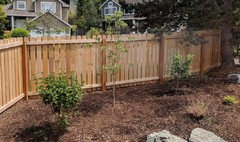
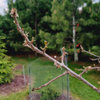
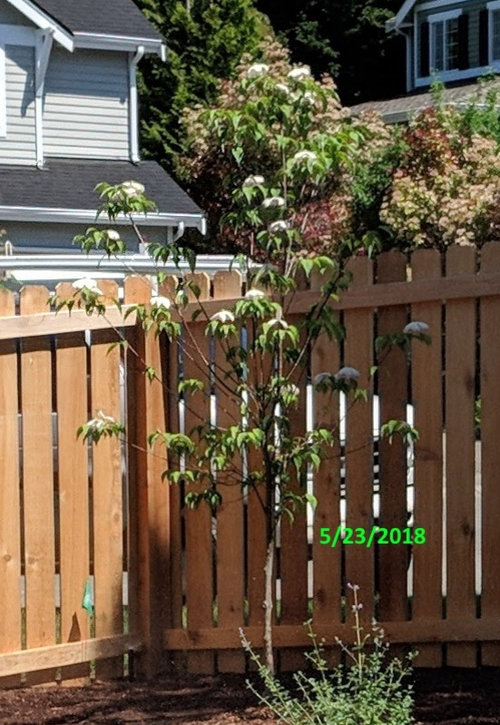
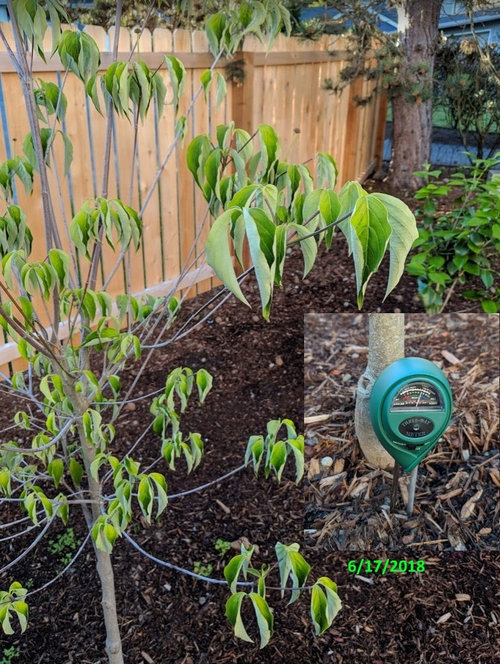
My dogwood tree was planted in mid march, and had been healthy, growing leaves/flowers, until about 3 weeks ago, some leaves started drooping:


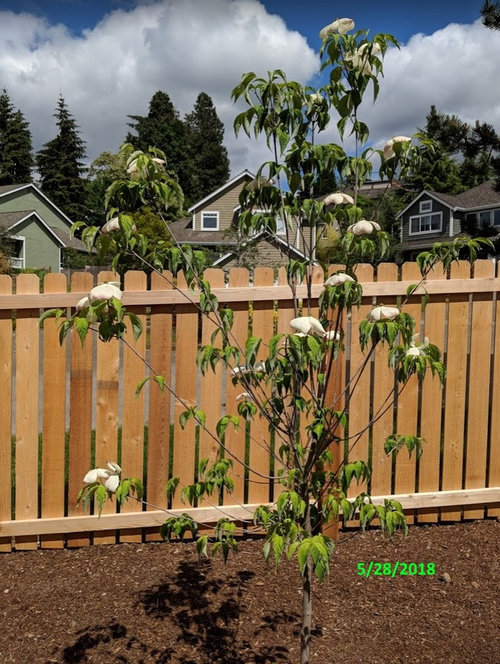
at first I thought I water too much so I stopped watering for a week, but the leaves just getting worse:


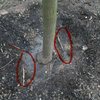
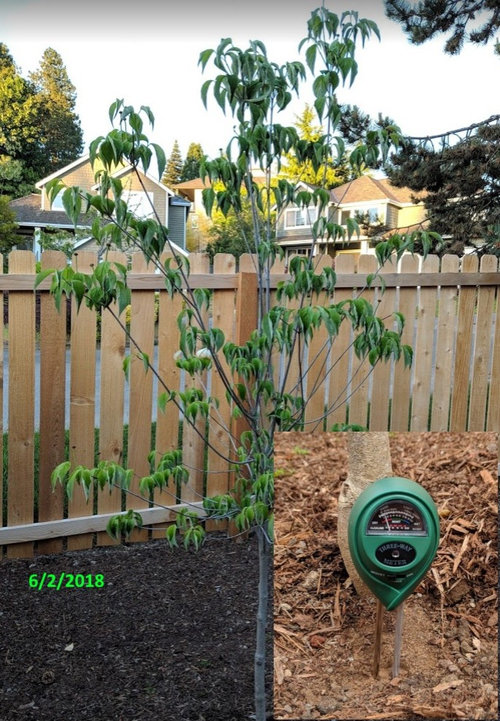
few days later I bought a moisture meter and found the soil is all dry:


so I begin watering and kept the soil in the Moist range, but 2 weeks in, the leaves still didn't show any sign of recovering:


I am wondering how long it would need to recover if the drooping was due to underwatering?

and is there anything I can do to save my dogwood tree? ex would it help to put some fertilizer?

any comment is appreciated,

thanks!

ps: I have a sprinkler installation around 5/23, but the trenches were not too close to the tree:


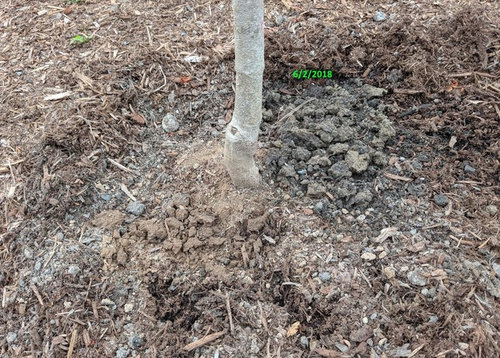
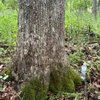
ps2: below is my soil when it's dry, not sure if it's clay soil:


Comments (35)

  • 8 years ago

    What have your temps been like? Dogwoods in full sun and in heat react that way....curling their leaves and letting them hang straight down. It's how they minimize transpiration and retain moisture.

    That soil does look pretty dry. Newly planted trees will need weekly deep watering throughout their first year in the ground when rainfall is insufficient.

    alex thanked gardengal48 (PNW Z8/9)
  • 8 years ago

    Apply a mulch to help regulate and stabilize soil conditions, be sure to keep moist at all times - including the inside of the original soil ball. Otherwise leaves of dogwoods in full sun locations often roll during hot weather.

    alex thanked Embothrium
  • 8 years ago

    @gardengal48 I am in seattle area, the avg temps for past few weeks were 50-70 degree

  • 8 years ago

    I'm in the same general area, so no, those temps are not hot enough to prompt a heat stress reaction :-) So it is more likely just transplant shock.....3 weeks is still a pretty short time for a new tree to get used to its new environment. Just keep it properly deeply hydrated and it will recover (although be prepared to see something similar when and if we do get hot later in the summer).

    Depending on rainfall, which hasn't been too significant since your planting, you may just want to leave the hose on a slow trickle for an hour or two when you do water to make sure the water penetrates slowly and deeply and the rootball and surrounding area is fully moistened. Can't tell you how often to do so, as that will vary with the soil, the temperature and what rainfall we do receive. But check at least weekly

    alex thanked gardengal48 (PNW Z8/9)
  • 8 years ago

    @gardengal48 thanks for the reply but it has been 3 months since the dogwood was transplanted and for the first 2 months, the dogwood was actually doing quite well, it went from no leaves to the current state and the leaves looked healthy. Only after 2 months did the leaves start drooping.

    I didn't do slow trickle for an hour or two though, I only water with normal flow for maybe 30 seconds every other day... I guess probably the water not penetrating is the reason?

  • 8 years ago
    last modified: 8 years ago
    When was the last time you stuck the meter in it? Even with the meter having been used you should probably poke around in the rootball and look at the soil, see if it is all moist throughout.

    And mulch all around the tree so the sun doesn't bake the soil near it.

    alex thanked Embothrium
  • 8 years ago

    30 sec is not enough.

    Create a low dike at the edge of the rootball, and fill it with water every day.

    Trees need a least 2 years of supplemental water to esablish well. The roots of your tree hasn't yet extended outward into the surrounding soil.


    alex thanked Jean
  • 8 years ago

    thank you all for the replies!

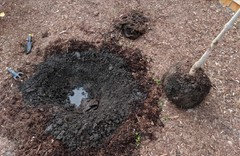
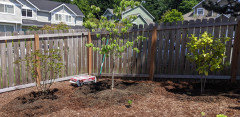
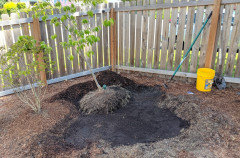
    so I dug a small hole with intention to find how dry the bottom of the rootball is, but to my surprise the meter said it's super wet, I then continued digging and found pieces of the burlap which were also soaking wet, so I decided to remove the whole tree, and lo and behold I found a little swamp at the bottom of the tree!

    it did rain pretty hard 4 days ago (6/13) maybe half inch, but the following 3 days are all sunny and up to 85 degree


    I am leaving the tree as in the picture for tonight, but what should I do here?


    does it means something wrong with my soil?


    and should my landscaper have removed the burlap?


    thanks!


  • 8 years ago

    review the link for some general information ..


    your plant is incredibly stressed .. fert is not a reaction to such ...


    ken

    https://sites.google.com/site/tnarboretum/Home/planting-a-tree-or-shrub

    alex thanked ken_adrian Adrian MI cold Z5
  • 8 years ago

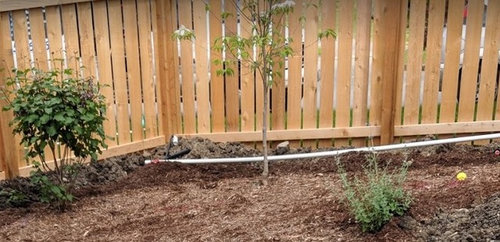
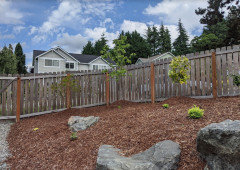
    In the first picture it looks as if the soil has been built up above the natural ground level since it covers the lower part of the fence boards. Is it possible that soil has been added on top of landscape fabric or plastic sheet? If you poke something down in the bottom of the planting hole does it hit an impermeable layer?

    alex thanked floral_uk z.8/9 SW UK
  • 8 years ago

    @floral_uk z.8/9 SW UK I poked the moisture meter down in the bottom but didn't hit anything, I don't think the soil is on top of landscape fabric or plastic sheet but one thing feels strange to me, I tried removing all water in the hole using paper cup, but few hours later the water came back, not as much as before, but you can still see a little water puddle.


    The tree is on a slight slope, is it possible that the returning water came from the uphill? I can see at the bottom of the slope the mulch is all wet (this is taken this morning 8am and the last watering is 5am yesterday, so it's been more than 24 hours, with 85 degree yesterday the surface should be all dry if it's flat I think)


    or could it be my sprinkler system has leakage?


    thanks!

  • 8 years ago

    You will need to investigate why the drainage is so slow in this area - high water table, irrigation leak or just heavy, poorly draining soil - and correct. If you just planted the tree back into a planting hole that routinely fills up with water (even when not raining) the tree is going to have issues and very likely will not survive. A dogwood will not grow in standing water!!

    Despite what may have been posted previously, this is NOT an issue that any sort of fertilization is going to correct. And until you can relocate the tree or determine what is causing the extremely slow drainage, I would be very careful about additional watering. Kinda like offering a drowning man a glass of water :-)

    alex thanked gardengal48 (PNW Z8/9)
  • 8 years ago

    "or could it be my sprinkler system has leakage?"

    Definitely a possibility and one that you need to check out.

    Water that stays in the planting hole is not what you want to be seeing.

    Moisture on the surface at 8 in the morning is not a great concern as water will wick up to the surface during the night, it may only mean that you have sufficient soil moisture.

    alex thanked User
  • 8 years ago

    my landscaper dropped by and determined it's because of the clay soil underneath, so he removed the clay soil and replaced it with 2 bags of 55qt potting mix (which I got from costco couple weeks back)


    Thanks everyone especially @gardengal48 (PNW Z8/9) for the replies, I really appreciate it


    Hopefully my dogwood can be healthy again, finger crossed!

  • 8 years ago

    I hope the landscaper followed the instructions I provided upthread about planting in clay soils. Otherwise, you have just replaced a small water filled planting hole with a larger, water filled planting hole!! Unless you can correct the drainage by elevating the planting, just removing the clay and replacing it with a potting mix will only aggravate the problem, not correct it.

    alex thanked gardengal48 (PNW Z8/9)
  • 8 years ago

    Yup, by digging a hole in clay, you're essentially creating a 'bath tub' in the ground. Then by filling is with soft spongy planting mix, you now have a container full of wet sloppy dirt where a plant basically drowns. No plant will survive for long in that environment.

    I'd do as gardengal suggests and plant the tree above grade using a mound system, that way, the trees roots will get the necessary air and moisture that roots need to flourish. And once the tree gets established, it will send out roots as far as it likes, to get as much water as it needs.

    Dogwood is a good choice for an area such as yours where conditions are a bit on the wet side. They like water, they just don't like being submerged in it.

    alex thanked User
  • 8 years ago
    last modified: 8 years ago
    looks like my landscaper didn't use the way recommended, I didn't see the tree planted above grade

    I'll discuss with my landscaper, thanks gardengal48 and Bill_minn_3b!

  • 8 years ago
    last modified: 8 years ago
    'landscaper' recommending that product for this situation? time for a new one

  • 6 years ago

    This is the best post I have ever found!! Thank you to all. We have the same problem with our Miss Satomi dogwood. Will try the planting technique.

  • 6 years ago

    Very interesting post, i am having same problem.

  • 6 years ago

    Same problem here! Help!!! Too much sun??? Too much early heat????

  • PRO
    6 years ago

    Alex - what happened to your Dogwood tree? Did it come back?

  • 6 years ago
    last modified: 6 years ago

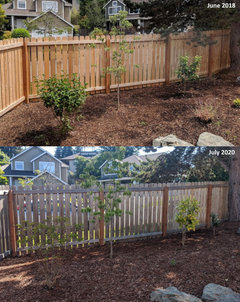
    @diamondblue Unfortunately two years later, my Dogwood is still not healthy. I thought I made a mound system but apparently I misunderstood and didn't do it right. The top of the root ball was only maybe 2 inches above grade, the majority of the root ball is still below grade.


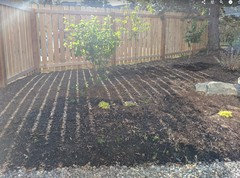
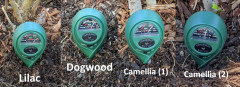
    Below is 2018 vs. 2020, the Dogwood's leaves are still drooping in the summer (the leaves looks fine in spring when it's small) and in fact the Lilac on the left and the Camellia(1) on the right are also suffering from the same drainage issue. The Lilac has sparse/small leaves and the Camellia has yellowish leaves (Note the smaller plant on the rightmost is also Camellia(2) and its leaves has healthy dark green color, which suggests the drainage is fine at the top of the slope)


    The drainage issue can be confirmed by the moisture meter (This is after two days good weather, 55-70 degree without rain. The tip of the meter is about 6 inches deep)


    I plan to redo it in the next couple days, this time I'll make sure I refill the hole and make the whole root ball above grade.

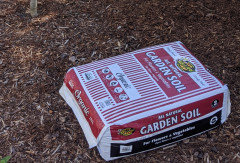
    Does anyone have recommendation on what soil I should use (to create the mound)? Can I use "Garden soil for Flowers & vegetables" as shown in below?


    Thanks!!

    cc @gardengal48 (PNW Z8/9) @User

    and thanks @Jo Kelly for reviving this thread!

  • 6 years ago

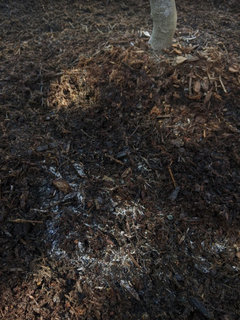
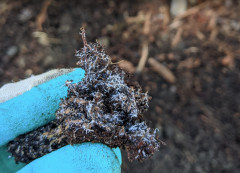
    btw, when I remove the mulch, I see white stuff that looks like mold or something, does anyone know what that is and is it normal? thanks!


  • 6 years ago

    Yup, that's mold. :-) Nature's way of decomposing dead wood. Shouldn't be a problem.


    You're right, in those conditions, you need to put the root ball almost on top of the ground and build a mound around it. By almost I mean you could put an indention in the ground few inches to help stabilize things. But if it stays that wet there's no use digging too deep, into the water because things will just drown.

    Eventually the roots will go down looking for moisture as they develop. So water the root ball but not too much, you don't want the root ball to dry out before the roots have a chance to establish themselves but you also don't want to drown them either.

    This first year will be the most critical and the second, not so much but by the third you could call it 'free range' and unless drought occurs, the trees/shrubs will take care of themselves.


    alex thanked User
  • 6 years ago

    I see a whole lot of things done wrong in the initial planting and also respectively disagree with much of the advice given here making the problem worse. Further more I believe you'll cause more problems digging up and replanting it, including killing the tree.

    Initial planting,

    problem 1: The burlap should have been removed, the ball given a water bath with a hose to remove most of the non-native soil from the exterior of the root ball and nudging out the roots and breaking up the ball a little, it won't harm the tree but don't cut them.

    Problem 2: Adding any non native soil is wrong, especially in clay soil. This will create a bathtub effect where the amended soil will quickly fill with water during a rain only to be held back by the slower draining native soil. (Could of happened from the soil in the root ball when you removed it the first time.) Also when the roots come in contact with the finely textured less aerated native soil they will circle, just as they do in a pot. Leaving the burlap on and adding better soils are myths creating more problems than they fix.

    I suggest finding out what you're planting the tree in. you've stated it's clay but at what level, light, heavy? The water meter won't tell you how well water percolates down, or the type of soil, and clay isn't bad to have with 20% clay considered the perfect amount.

    Before doing anything else do a percolation test and grade your soil with these two simple tests.

    Dig two holes where you did not disturb the soil outside the drip line of the tree. Go a foot down and six inches in diameter, fill with water and let it drain until empty. Then fill the hole up again with water than time how long it takes to percolates down and drain. If it takes more then 4 hours to empty you have a drainage problem, less then 4 hours, so so and 3 hours your drainage is fine. Also take a glass jar and fill it 1/4 full with the dirt from the bottom of the holes you dug. Fill with water, shake well and let stand until clear. It may take a day to a week to clear depending on the clay's particle size. This will show you the ratio of clay to silt and sand. Clay with be the top layer, silt the middle and sand at the bottom. for simplicity anything above 30% clay on the top is considered clay soil and the longer it takes to clear means smaller clay particle size and the worst clay to have.

    What I recommend at this point depends on the drainage. Good drainage and I would say let the tree be. Establishment will take longer but the roots will eventuality move out of it's artificial safe zone and the tree with be fine. Bad drainage based on the percolation test would require option 2, a berm, but I do not believe it is necessary.

    Removing the tree will be a challenge of its own. Dogwoods hate to be moved, and you will need to dig 8" to 12" on each side of the tree for every inch in trunk diameter. 1" requires a 16" to24" dig. Yours looks to be about 2" so a 32" to 48" dig is needed and I'm telling you now it isn't easy. You can try to see if the root ball is confined to a tight little safe zone by grabbing the trunk at chest high and moving it side to side. If its root bound it will fill loose, almost like you could pull it out if it hasn't anchored. After a year the roots should have grown at least to the branch spread and in another year twice the distance, also most water/nutrients for a dogwood come from the first 6" in the ground. Is it spongy by the tree when walking on the ground? Dogwoods have sallow roots and why they're so intolerant to drought/lack of water. Do the perk test, do the shake test, but IMO the tree will be fine by next year.


    alex thanked outpaientzero
  • 6 years ago

    @outpaientzero thanks for the detailed reply! however, I already did the replanting this morning... so.. let's see how it goes in the next couple months.. finger crossed


    btw, my Dogwood is about 1.5'' in trunk diameter and I did dig about 18'' each side. (36'' in diameter) The root is not deep (like you mentioned) so I was able to rotate it to the side, backfill, and rotate it back. The top of the root ball now is about 9'' above grade.


    Also to your question, it doesn't feel spongy by the tree when walking on the ground.


    And I'll do the two tests you mentioned to know more about the soil. Thanks for the reply!

  • 3 years ago

    Great thread. Is there an update? We planted a 15ft kousa this spring (800 lb root ball) It bloomed this May after being in the ground for about 3 weeks (But only near the top half of the tree). The leaves have started looking wilted and some look burned. Its not been hot but the tree is in full sun. It has been well watered but maybe overwatered. The soil is somewhat clay but I have not yet tested as suggested above. It is on a high point of the yard though, about 10 ft away from where a 100year old Elm tree used to be but had to be taken out earlier this winter.

  • 3 years ago

    It would have been better to start your own thread. And with photos. But chances are very good your tree is suffering from transplant shock. The situation may also be exacerbated by the clay soil as well as siting the tree in full sun. These are by nature woodland understory trees and appreciate at least partial shade.

  • 2 years ago

    Hi Kevin9408,


    what would have been option 2, in the case where the drainage is subpar? We are having an almost identical issue. Our entire yard is sloped, its mostly clay soil, and there may be a bathtub effect created by the better soils that our landscapers added when planting the dogwood. its been tbere about 9 months. What is the ”berm” option? i googled it and couldn’t decipher if you were suggesting a berm to keep the water out, or keep the water in, or what. it sounds like a thicker, more intentional version of the flying saucer shape described above.


    I’m currently performing the two tests you prescribed.


    @alex Alex, it would be great to hear if that solution worked for you!

  • 2 years ago

    Hi Kevin9408,

    what would have been option 2, in the case where the drainage is subpar? We are having an almost identical issue. Our entire yard is sloped, its mostly clay soil, and there may be a bathtub effect created by the better soils that our landscapers added when planting the dogwood. its been tbere about 9 months. What is the ”berm” option? i googled it and couldn’t decipher if you were suggesting a berm to keep the water out, or keep the water in, or what. It sounds like a thicker, deeper/higher, more intentional version of the flying saucer approach described above.


    I’m currently performing the two tests you prescribed.


    @alex Alex, it would be great to hear if that solution worked for you!

  • 2 years ago
    last modified: 2 years ago

    Abel, I'm kind of shooting the the dark under a 1/4 moon so you need to shine some light on the subject. Was the tree in burlap or grown in a container? Is the tree grafted or grown from seed? Who planted the tree and is the tree flare visible? Why are you concerned about drainage, do you see standing water a day after a rain fall and is the ground mussy?

    The medium may be to dry and not wet and you only need to check the top 4" of the ground to see it. I think Alex had standing water where his tree was planted. Dogwood roots grow 3 to 4 inches below the surface of the ground with no tap roots. Any roots planted deeper then 6" will die and new growth will come from the existing shallow roots still alive if there is a place they can move to. It's just the way dogwood's grow So the only 4" of top soil is all you need to worry about. So it's also possible it could it be lack of water in the top 4".

    Dogwoods can't and won't grow through heavy soil because their roots it's fairly weak at trying to push through anything, including burlap which may take decades to decay. I do not leave burlap on trees because it can constrict and delay root growth and cause girdling. Trees with strong roots can manage but dogwoods not well at all. If it was burlap cut it out 6" down. A dogwood root will grow just fine a foot deep in a big pot of fluffy soft oxygenated soil which is fine, but a dogwood pulled from pot that and shoved in a 12" hole will kill 3/4 of the roots, and at this point you get what you get because it's what they do.

    You say clay but is there any top soil 3" to 4" thick on top the clay? The remaining roots left alive in the top 4" will grow into this thin layer of top soil if there is any but planted on a slope means quicker runoff and more watering may be needed if the problem is dry soil. I'm guessing your leaves are wilting, turning color or dropping, It's because it's under a huge deal of stress. Water stress, nutrient stress and induced stress using what nutrients are available to grow new roots and somewhat common. More visual information is needed (pics), Any suckers? Prune them off but first see if the tree was grafted (rare) and check the graft point for a failure. Suckers will grow if the graft is failing just like an apple tree. Finally check the bottom trunk of the tree for it's flare, it could of been planted to deep, and if you used mulch around the base make sure it's not up against the trunk and pull it back.

    This is how dogwoods should be planted for future reference if this one dies planted in clay. Remove from burlap or pot and spread out the roots using a water hose to help. break up the soil where you want to plant it.the width of the roots and lay out the roots flat on top the clay and cover with a 3" inches of rich dirt/compost mix, mulch and keep it watered for life, they rely solely on surface water. Next start expanding the area above the clay with top soil so the roots have something to move into over the next couple years to follow the drip line. Your spot is not exactly It's natural habitat and needs to be catered and cared for to meet it's needs. If it's not clay spread out the roots, dig down the width of the roots 4" and lay it out and cover.

    I have a river birch with shallow roots and well out of it's natural habitat knowing this when I planted it. So every summer into late fall I need to water it constantly or it will die and the price I paid to have the tree where I wanted it.

  • 2 years ago

    Post is 5 years old.

  • 2 years ago

    Yeah it's 5 years old, so what's your point?