Software
Houzz Logo Print
opaone

Heating options for attached garage ?

8 years ago
last modified: 8 years ago

Our attached garage will be 24'x34'x9' with a slab floor and unconditioned storage in the roof truss attic above. Walls will be 2x6, likely spray foam. Two 9'w x 8'h insulated overhead garage doors. This is in MN.

This will not be used much for working on stuff so most of the winter time we'd likely keep it a fairly constant about 40°f. Warm enough for to melt snow & ice off the cars and be relatively comfortable for getting in/out of them. We will also have bicycles (that are used all year), dedicated frig & dedicated freezer, and likely some folding chair & table storage and other general storage. I might occasionally want to warm it up to 50-60°f to do something but that will be rare.


I believe the 3 best options are; forced air unit (Hot Dawg), in-floor hydronic radiant, and overhead IR radiant?


What would you do?


In-floor radiant is possibly not so effective in a drafty space with some cold air coming in around garage doors all of the time and a lot coming in when they open to go in/out? It'd also take a long time to warm up on the rare occasions when I would want to work out there though this is a minor concern.


??


Thanks,

Comments (25)

  • 8 years ago

    Will the house have natural gas? If so then that would be my first choice for fuel and heating. The forced air unit like the Hot Dawg should work well in a garage. If you are also like to provide cooling then a mini split would work, but that is a lot more money.

    Check the specifications on your refrigerator and freezer. They may not operate properly at 40 degrees. You may have to keep the temperature higher.


  • 8 years ago

    House HVAC, hot water and range are NG so no problem there.

    We will have a boiler for in-floor radiant in the lower level and bathrooms so the garage would then just be a tubing addition or at worst a slightly larger boiler though I'm still not sure in-floor is very effective in a northern garage. No plans for cooling the garage other than an exhaust fan.

    The frig & freezer (Frigidaire) have cold weather kits on them and are supposedly good to 12°f. Hope not to ever test that though.

  • 8 years ago

    One of the self contained ceiling mounted heaters like the Hot Dawg you mentioned sized for the space. The budget option is one of the wall mounted, ventless heaters and an inexpensive ceiling fan to move the air around. I did the latter in a 3-car workshop garage years back and it worked just fine. At the time I think the heater (maybe 30k BTU) was about $169 and the fan was a freebie from a friend. I easily work in shirt sleeves in the winter (Chicagoland) and you're not even looking for those temps.


  • 8 years ago

    A characteristic of radiant heating imbedded in concrete is their slow response time. In your case, that might be an advantage, because they won't cool down much when you the open the garage doors.

  • 8 years ago

    I am also in Minnesota. Our detached 27 x 27 garage is fully insulated. I use a 50,000 BTU natural gas unit heater that I bought from Grainger - hangs on the ceiling - it's power vented.

    I keep the garage at 50 all winter.

  • 8 years ago
    last modified: 8 years ago

    Sounds like these are the options:

    1. A unit like a Hot Dawg: Advantage is that it's relatively inexpensive, can respond quickly, isn't part of the main heating system. Could provide enough emergency heat to prevent freeze-up if main system failure.
    Disadvantages: heats the air... floor is still cold. Big temp swings.

    2. In floor radiant: Quiet, great for melting snow, etc. gets the heat on the floor where it's most needed.
    Disadvantages: Slow to respond, part of main boiler so main boiler has to be sized appropriately.


    For me.... If I wasn't running a shop out there I'd be tempted to use the radiant heat.
    If I was working out there often and need fast response, I'd go with the hot dawg.

  • 8 years ago

    I live in PA and in my garage I have an electric heater with a thermostat. It runs off of 220v. I keep my garage around 50 degrees in the winter. Snow and ice easily melt off my car. It's a simple unit and I don't think it costs much to operate. I love it! It was probably more costly for the electrician to run the line than the unit cost! Lol

  • 8 years ago

    You already have a lot of good points. This is all-new construction? What will you do with the melted ice and snow. You have a good floor drainage system planned? A problem with an in slab hydronic loop is that the return water will be very cold and the boiler might need protection to avoid heat exchanger damage. That is not insurmountable and is common. Going way back people with boilers that have cast iron heat exchangers did driveway snow melt with their only boilers. You may need a primary-secondary piping system for that. One overlooked option is a hydrocoil. If you have a high efficiency mod con that runs at low temperatures, you will need a relatively large coil, but that might not be a problem either. The thing I'd worry about most is the resulting oversizing of the boiler that this might entail if you really want enough heat to up the garage temp in very cold weather while keeping the rest of the house at normal temp. Keep in mind that the mod con at full fire loses its efficiency. Talk that aspect over carefully with your contractor if you consider using your boiler for this. For that reason, I'd consider a sealed, vented gas wall heater. If he area near the floor gets too cold, a paddle or other fan will help. If it were me, I would not worry much about the cold floor, shirt sleeves and warm, comfortable boots are not bad apparel in a MN winter, I think. In floor radiant can be efficient, you just need to install adequate insulation under the slab.

  • 8 years ago

    An interesting topic. I'd never before heard of heating a garage.

  • 8 years ago
    last modified: 8 years ago

    Thanks all. Sorry for the late response. This is new construction (http://bamasotan.us). We will have floor drains. There is foam insulation on the interior of the foundation walls and I believe 3-6" under the slab. We'll also have a detached garage where I'm allowed to work on stuff thus only infrequently needing to warm this up to working temps.

    Interesting how many people here keep their garage at 50°f. I wonder what the cost difference is between keeping it at 40° and 50°? 50° is actually a fairly comfortable work temp so that would largely eliminate having to ever warm it up.

    No mention of in-floor having difficulty maintaining temp when garage doors open/close and produce a rush of -20°f air. Not really an issue?

    I'm not as concerned with initial cost as total cost of ownership and energy efficiency. Higher initial cost with a 5-10 year payback is fine.

    Thanks,

  • 8 years ago
    last modified: 8 years ago

    opaone

    No heater will maintain temps when a 7'x16' door opens up and it's -20 outside - not to mention a large thermal mass drives in with ice and snow.

    A HotDawg will blast the area with hot air when that happens... the radiant heat will have the thermal mass of the concrete to help it recover quickly. Of the two, you will lose less heat out the door from the radiant heat because it doesn't have a blower.

    Efficiency is going to be determined by the boiler / heater. My guess is that your boiler will be more efficient than a hot dawg.

    The radiant will be on the floor - it will melt the ice and snow. You can often make a room more comfortable at a cooler temp with radiant floor heat.

  • 8 years ago

    How much residual heat in an ICE when fully warmed up? It might be a wash. The trouble with the thermal mass is that for occasional higher temp use, it might take hour, and a lot of fuel to warm it up. Then what will you do with the excess boiler capacity the other 99% of the time? I fear that the trade-off will be high efficiency 1% of the time and low efficiency, short cycling (with accelerated wear) boiler 99% of the time.

    Some people feel that it is better to keep the garage cold and frozen with all the halide salts coating the car thinking it slows corrosion. I don't know if that is a valid arguement. If the temp is closer to ambient, the ice and snow will fall off and partially refreeze on the slab so you can just push it out the door. Still, it would be nice to have heat to work on the car and other stuff out there. I'd worry about and consult with someone that knows about what kind of ventilation you need to get rid of all the moisture from water-coated vehicles coming in. I don't know if a well-sealed up building will handle it well.

  • 8 years ago

    To answer all your questions: I live in Minneapolis. I had a 27 x 27 garage built in 1997. It is 2x4 construction, and is insulated with fiberglass. It has a channel drain in the center of the garage. It has a metal, insulated 7 x 18 garage door. I use a 50k BTU, gas, unit heater, hung from the ceiling. The thermostat is set for 50 degrees.

    When you pull out a car, at -20 - it's cold for a few minutes, but the heater brings it back up to temp. I've always had new cars, and haven't experienced rust, nor rust on any tools.

    Nothing like getting into a warm car.

  • 8 years ago

    I know that a hot dawg or similar will heat the garage. I've worked in shops that use them. They can provide a lot of heat quickly and circulate it in a large open space. They generally don't cost much to install.

    The down side is generally the same as their up side... they blast the area with a lot of hot air and then turn off. The air at the ceiling stays warm, but down on the floor not so much.

    If you are looking for even, low heat that is cost effective the radiant will be worth exploring.

    To ionized_gw's point: Your HVAC contractor can tell you if you will run into issues with the boiler. My guess is that you will size the boiler for the additional capacity to maintain the garage @50F. I honestly don't know the state of the art for boilers these days - but my guess is they are variable input like the tankless water heaters are.


  • 8 years ago

    How much residual heat in an ICE when fully warmed up?

    Interesting thought. Our cars are both electric. Cabin heat s/b the same. I'm guessing that the engine of an ICE carries much more residual heat than the battery and motors of our cars though.


  • 8 years ago

    Your HVAC contractor can tell you if you will run into issues with the boiler.

    Perhaps. Or not. My experience with HVAC contractors is that most don't really understand stuff that well. They know what they are told — for A do B — but don't fully understand why, nor what to do if A is slightly different.

    Thus the value of forums.

  • 8 years ago

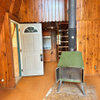
    I have a Reznor, 36,000 BTU Natural Gas heater for a 2-car attached garage. Outside vented and UL at rear in photo. We live in northern IL. The walls, ceiling and doors are insulated and have a thermo barrier on the concrete floor. Kept at 45 it’s comfortable to step into in stocking feet and easily warms for project work.

    An option for radiant heat was not available in my case


  • 8 years ago

    My BIL heats his garage in North Dakota with electric hydronic heat that is a separate zone from his living area hydronic heat. It required additional electric service to support the electric boiler, but seems to work well if you are willing to wait for the garage floor to heat up. He only had a choice of propane or electric boiler, since there was no NG in the area.

    Bruce

  • 8 years ago

    "My experience with HVAC contractors is that most don't really understand stuff that well."


    You need to find better hvac contractors. My experience with good ones is the exact opposite

  • 8 years ago

    I have had a natural gas forced air heater in my garage for a number of years. I typically only use it when I am going to be working in the garage for an extended period of time. In Michigan for the most part the garage never gets below freezing. Only on those very cold days where the temp is below 10 degrees.

    i can heat the garage air to 70 in just a short time. It takes time for the objects to warm up.

  • 8 years ago

    Depending on how your hydronic heating system is set up, adding the radiant in the garage could make a big impact on the remainder of the system. Garage, and even driveway snow melt systems are not unheard of, but I have no way of knowing how experienced local contractors may be. My understanding with hydronic is that the boiler, circulation pump, radiator,..., manufacturers often contribute to design. There are a lot of engineering calculations to be done. These days with efficient boilers, you will almost certainly want to go with a modulating/condensing boiler. That can be a high mass or low mass boiler. (Yes, Jake, they are variable fire.) My understand is that good hydronic folks are getting harder and harder to find all the time and many of the old-timers can't, or don't want to learn to design around low mass mod cons.

    Right now, you want to define how you want it done before you set your builder and contractors in motion, obviously. What do you want to do in this space. For my money, in an occasional workshop environment some temperature swing and a cold floor is not a big deal. Keep your insulated boots on if need be and shed the heavy coat and union suit. If you are going to move a big screen TV and a couch in there. It is another story.

    After that, what is the lifetime cost of the heating options? Direct vent wall furnaces operate, IIRC, at about 80%. They modulate for comfort and efficiency. The Hot Dawg (type) will match efficiency and do better, over 90% with the right model. but I don't think they modulate.. A properly designed hydronic in slab system will cost a lot more but with the right boiler set up properly, get to the high 90s in efficiency. The problem is the set up part.

    If the garage is a big part of the load when you crank it up, running in high fire can set efficiency back a great deal and you will be getting much lower than peak. If you size the boiler to be in lower fire with the total load, you get into too much on-off cycling with the remainder of the load in milder weather and get faster wear and lower efficiency.

    On the other hand, I get the feeling that this is a very large home as planned and maybe you should consider two staged boilers. that way you might get in excess of a 10-fold modulation range. The more I think about these things, the more I like the idea of HTPs high mass Versa boilers or the Westinghouse version of that in a water heater (WGR060NG076 series) for a lot of hydronic heating jobs.

    If you decide to go hydronic, for whatever reason, surf on over to terrylove.com and heatinghelp.com for boiler and other hydronic advice. There are lots of generous experts in both places.

  • 8 years ago

    ionized, thank you very much. Great info. Now to do some learning.

  • 8 years ago

    Have you thought about a radiant tube heater? Here is one found at Northern Tool.

    The benefit of it is similar to radiant in-floor heat. It warms objects and not the air.

    Or what about having both radiant and a hot-dawg gas heater. The radiant in-floor heat will keep things at a constant temp, and the hot-dawg will be used for quick heat-ups.

    You could use an on-demand water heater as the source for the in-floor heating.

    Just a couple of ideas to ponder.

  • 8 years ago
    last modified: 8 years ago

    Is an on-demand water heater cost effective compared to a storage type high efficiency water heater? The application seems like a weird paring, a low mass heater providing a very constant heat sink. It seems like the cost of the on-demand would be higher right out of the box, and I suspect that gas supply is going to cost a lot more too since a bigger line to the heater and maybe a larger service may be required.