Software
Houzz Logo Print
lindalana

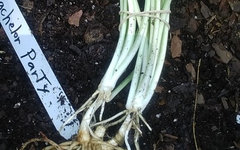
How deep to plant

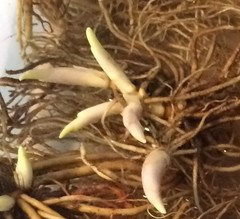
I ended up potting it kinda on a side....

Comments (18)

  • 8 years ago

  • 8 years ago

    Hmm, not sure if I am brave enough

  • 8 years ago

    Hopefully you will get more responses. :-)

    lindalana 5b Chicago thanked josephines167 z5 ON Canada
  • 8 years ago

    Am thinking I will cut one part off and try rooting it in the water. And plant second part whole sideways. At least one of them should survive...

  • 8 years ago

    It will be interesting to see what happens. A follow-up next year would be nice:)

  • 8 years ago
    last modified: 8 years ago

    I received some plants like that this year. Although, mine had more roots from the top eyes. I assumed it was from deep mulching. I planted them level with the top crown and they seem to be doing OK. Received the beginning of May

    and still looking good today.

    Guess we'll see how it looks next year.

    Edited: (My memory is fo $#!^). I think I've got the right plant, but everything from this order is still growing well and I know there were 1 or 2 others with similar deep eyes.

  • 8 years ago

    really jo... youve never seen it before.. so lets cut it up ... rotflmbo ...


    looks like a rhizome-type spreading hosta ... not all that rare ... but instead of being horizontal ... like it would be in mother earth ... i think its vertical for being in a pot ...


    i would tend to replant it exactly how it was in the pot ... unless its white like a leek ... from being buried down real low ... or is that a camera trick ...????


    whatever.. throw it in a ditch .. and let it figure itself out ... its a hosta ...


    get rid of the rubber band.. tape it up .. and plant it ... on some level.. this type will adjust itself to proper depth ... i would err toward shallow ...


    ken

  • 8 years ago

    Really, Ken and I’m glad I brought you so much hilarity. You amuse that easily? ;-)

    Yes, if it was mine I would cut it up - so what’s wrong with that?? To each his/her own. I did not instruct Lindalana to cut it, I merely opined on what I would do. Don’t knock anything until you’ve tried it yourself, Ken.... never too old to learn something new.


  • 8 years ago

    You amuse that easily? ;-)


    ==>>> yeah.. im pretty lonely ... all said and done ... ken

  • 8 years ago

    Not quite.... God Bless You, Ken. :-)

  • 8 years ago

    "Bachelor Party" needs to be added to Don Rawson's Rhizomatous Hostas List.

    -Babka

  • 8 years ago

    I see nothing in the first picture that hints at 'Batchelor Party' being rhizomatous....

    Pieter

  • 8 years ago
    last modified: 8 years ago

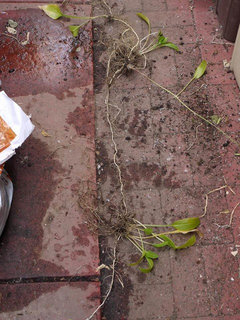
    This is what rhizomatous growth looks like, please note the new shoots at the nodal points on what looks like a stolon in the right top quadrant of the image.

    Pieter

  • 8 years ago

    Pieter, what is the name of your hosta? correct me, please, if I am mistaken as I usually defer to your knowledge but aren't those lateral/runner shoots stoloniferous growth? I thought Rhizomatous growth referred to presence of some type of rhizome.

    Do you recall a few years ago when I posted a thread regarding a small hosta 'Kifukurin Otome'? A discussion ensued on Rhizomatous hostas following the discovery of rhizomes (I called them little logs) in the root system. It was a learning curve for me as I had just assumed all hosta had the same type of mass root system.

  • 8 years ago
    last modified: 8 years ago

    Jo, that would be clausa. I took that out of the pot it was in when I started seeing shoots out of a drainage hole!

    I just lifted a quote from Don's website, which I maintain, and he quotes probably the world's foremost hosta authority, W. George Schmid:

    "The short answer is that all hostas are rhizomatous plants."

    "A rhizome is a horizontal stem of a plant found underground, sending out roots and shoots from its nodes. Rhizomes may also be referred to as creeping rootstalks. If a rhizome is composed of several rhizomatous, interconnected creeping roots, each piece may be able to give rise to new plants. This is a process known as vegetative reproduction and is used by gardeners to propagate hostas because the resulting plants are clones of the original plant. This process is called root (or rhizome) division. When digging different cultivars, the rhizome is often one contiguous mass, but it may also be a mass of smaller interconnected tubular rhizomes that look like a mass of stolons, but these are not stolons in the strict sense. "

    "A stolon is similar to a rhizome, but, unlike a rhizome which is the main stem of the plant, a stolon is a branch that sprouts from an existing stem, has long internodes, and generates new shoots at the end. In general, rhizomes have short internodes; they send out roots from the bottom of the nodes and new upward-growing shoots from the top of the nodes. It is also a method of reproduction for plants."

    "Stolons, on the other hand, are branches of the plant which grow at the soil surface or below ground and can form new plants at the ends or at the nodes. Stolons are often called runners. Imprecisely, they are stems that run atop or just under the ground; more specifically, a stolon is a horizontal shoot from a plant that grows on top of or below the soil surface with the ability to produce new clones of the same plant from buds at the tip."

    "Some hostas have differently shaped rhizomes depending on which parent species is involved. In the case of 'Golden Tiara', H. nakaiana was the parent. This species has a rhizome that has a fast growth rate and quickly makes spreading interconnected runners, forming one rhizome. This is still called a rhizome, but one that is sending out smaller, usually elongated parts of stem roots and shoots. H. sieboldii is another example, which has a non-contiguous looking, spreading rhizome connected together. Looking like stolons, they are not, but are elongated rhizomes that produce plants from the nodes. Such spreading rhizomes seen in hostas often have a fast growth rate."

    "Rhizomes often grow into very large contiguous masses and the center part of such rhizomes dies, while the still living parts of the rhizome form a ring-shaped plant. Gardeners often replace the dead center part with a living rhizome to maintain the huge plant as a single clump. Eventually the ring-shaped rhizome breaks up and forms a ring on non-connected plants, all with their own rhizome."

    Pieter

    lindalana 5b Chicago thanked Pieter zone 7/8 B.C.
  • 8 years ago

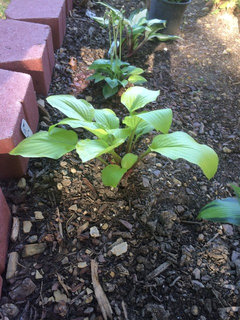
    Thank you for pics and suggestions! Learning about rhizomatous growth on hosta, will replant and see what happens.

  • 8 years ago

    Thank you, Pieter! Excellent information and a super compilation compared to the bits I found by googling. I also found the thread I was referring to...where I encountered rhizomes in my hosta. [Kifukurin rhizome[(https://www.houzz.com/discussions/surgery-on-kifukurin-otome-ki-dsvw-vd~2029127?n=23) including photo examples.

    lindalana 5b Chicago thanked josephines167 z5 ON Canada
Sponsored
High Point Cabinets
Average rating: 5 out of 5 stars21 Reviews
Columbus' Experienced Custom Cabinet Builder | 4x Best of Houzz Winner