Software
Houzz Logo Print
hzdeleted_24200779

Advice for best approach to making garden paths

8 years ago

I'm posting this on the Antique Roses and Roses forums as well as on other forums because, though perhaps some might consider it "OT",I think that some of you know the many challenges that I face in my wild garden in the woods here in Tuscany, Italy.

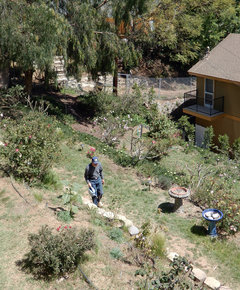
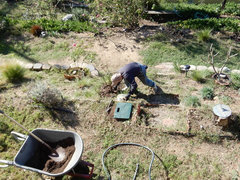
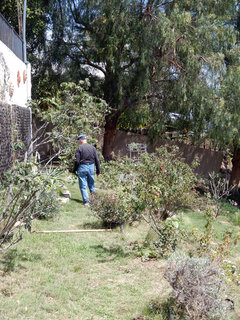
A brief description of the situation: My garden is a very steep landscape. Trucks , etc cannot arrive close to it to unload material such as mulch, sand and gravel, so I have to bag the stuff up on the main "driveway" (unpaved, flat road above garden) and carry it down with my small car (in summer, when it's dry) or by hand, with a wheel barrow. I do almost everything myself, not having the means nor the inclination for employing help (it would be so hard to find "the right sort of person", lol!). I've made this garden from scratch; it was abandoned, eroded land before, and has by now been cultivated by me for only about 20 years,with me learning as I go, so progress is slow. The garden is very large, way too big for one middle-aged woman to keep up with (what can I say? I'm stubborn!)

The weeds are out of control,and I think the whole situation would be much helped if I could manage to create decent garden paths that would be (relatively) weed-free. I see so many beautiful garden paths in photos posted here, and would like to hear some opinions as to what might be the best approach for tackling my difficult situation.

It seems to me I have 3 options. 1) solarize paths with plastic sheeting; sow with dwarf clover to create living mulch (but would it work in the long run?) The other 2 options seem vastly more difficult, but might be more effective in the long run 2) dig out paths, lay down sand (one site on Google says you need 3-4 inches of sand) ,lay down stones embedded in sand 3) dig out paths, lay down sand, make cement pavers. Options 2 or 3 would take a long time for me to complete, especially considering the vast ares to be covered, but I am looking for a solution that would require little in the way of future maintanence.

Obviously I'm asking a lot, but I think hearing other people's opinions will be very helpful, so thank you in advance.

Comments (27)

  • 8 years ago

    I saw a similarly difficult terrain in a gardeners world episode. They used tubes as like a chute to get mulch material from above to below. Is your drive higher than the beds?

    User thanked llailiall
  • PRO
    8 years ago

    Could you add a few examples of photos that show the areas, including surroundings, where you'd want to have paths? Also try to give examples of the grades you'd be facing where paths would go. (Shoot transverse to the slope while holding camera level.)

    When "weeds are out of control" I'd definitely be using glyphosate or other herbicide, in a backpack sprayer, so as to move the project forward without despair. The chemicals break down through the action of sunlight, weathering and the microbial action in a relatively short period of time.

    I didn't notice an option for the paths to be mulch only. Mulch paths are a common solution here in the US when one wants something quick, cheap and easy to maintain. Later, any portions of a path can be converted to upgraded hard surface if desired.

    User thanked Yardvaark
  • 8 years ago

    My wild garden path situation is much like yours, but in the temperate rain forest of the Appalachian mountains. The easiest thing to do is just weed whack/mow the paths as a regular maintenance chore during the growing season and not worry about weeds per se. Regular mowing will favor grasses and grass paths in a garden are perfectly fine.

    The main issue with my paths is that they are lumpy and sloped. Very few of them are level and as I get older it makes walking them more uncomfortable. I can fix the sloped ones with a pick, shovel and hard rake. The lumpy ones are due to the rocks below ground, decaying organic matter, winter freeze/thaw cycles and subsurface water moving through a natural drainage.

    My plan is to get a load of pea gravel to place on the lumpy paths to make them more flat and smoother. I can't put gravel on paths which are too steep of course. In this climate I expect the pea gravel will quickly be covered in weeds and I will go right back to weed whacking/mowing my newly smooth paths.

    User thanked Christopher CNC
  • 8 years ago

    We're a hillside, too. I think it used to be part of an orchard, so there were rudimentary terraces. Some years ago, a guy with a bobcat leveled out those terraces some, and DH has been building low walls to widen them. I don't know if this is anything remotely like your situation, tho.

    We are cursed with Bermuda grass -- and no amount of solarization can kill that stuff. So, DH weed-whacks every month or so to keep the grass down, and we can get to the roses and other plants that line the terraces.

    We used to have great access to the hillside, via an old Edison right-of-way, but a new, unpleasant neighbor has blocked that. So DH keeps a wheelbarrow, and a mower, down there, now.

    User thanked jerijen
  • PRO
    8 years ago

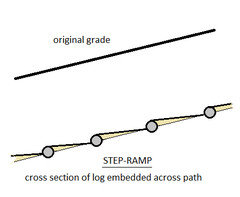
    A rudimentary set of "steps" called a step-ramp could help where ground is too steep for comfortable walking but not steep enough to require steps. It just requires some local log sections and a little reconfiguring of dirt, and some mulch.

    User thanked Yardvaark
  • 8 years ago
    last modified: 8 years ago

    Hi, bart! I don't know if my suggestions are great ones, but here's what we do: we have grass paths which we mow, sowing clover where the grass is thin or poor (miniature clover is a good idea). Paths that run along topographical lines, that is, that you need one leg longer than the other to walk comfortably, I make some effort to terrace, cutting out soil from the high side and shifting it to the low side, where I've laid logs held in place with short lengths of rebar as stakes, to keep the moved dirt in place. Is this making sense? I try to grow low hedges on both sides of the paths, mostly things like rosemary, lavender, and phlomis, to help keep the grass in the beds under control, but it's...oh, it's all pretty messy. I have steps in places in steep narrow paths, similar to Yardvaark's step-ramps, but of course you can't pass over them with a mower (a weed whacker, yes). All this is crude, but I do find that terraced paths like I've described, and steps, even rough ones, go a good way towards giving a garden a finished appearance, making it look like a garden.

    We don't have many places where there's rock close to the surface, so leveling can mostly be done with a heavy hoe. If your garden's scale is anything like ours, it would be difficult to bring in enough material to fill holes and uneven spots.

    P.S. I note that my solution sounds similar to Christopher C's.

    User thanked Melissa Northern Italy zone 8
  • 8 years ago

    Bart, do you want to be able to use a wheelbarrow on the paths? If so, my method is no good, but in a previous garden with a steep slope, I used some 4" by 2" wood and some wooden pegs. I had the 4 by 2 cut to the width of step I wanted, banged in the wooden pegs about 4" from the ends of that width and slotted the 4 by 2 behind it, then filled the cavity with dirt. Was very easy, and extremely satisfying!

    User thanked titian1 10b Sydney
  • 8 years ago

    Thank you all for your thoughtful replies. Hearing other people's opinions on the matter really does help me to contemplate the problem.

    I see that no one is actually supporting the idea of me doing this job of paving, lol. Llailiall's idea of a chute is brilliant, only the problem is that my "driveway"narrows and then makes a sharp curve on it's way to my garden; the chute would have to be extremely long. I wish I could provide photos, but don't have a camera; also I doubt that my skills would permit me to take a clearly "readable" photo. In any case, the main problem isn't the slope of the potential paths, it's getting materials down to the garden! Glysophates and all other poisons are totally off the table as far as I'm concerned. Mulched paths are indeed an option, though again I'm concerned about maintenance. Once I did actually get a lot of my paths mulched with wood chips, and it looked great, for a very brief time! My garden was attcked by badgers, and they tore it all up basically. And it was WAY too much work for me to do over again; also far, far too expensive. Sad to say, I haven't even been mulching the actual planted areas for many years; hopefully, when my health improves, I'll barter some roses for bales of old hay from a neighbour, and I'll be able to start a serious mulching program. As it is now, I rely on grass clippings, etc that neighbours are throwing out, plus whatever I can collect and cut from the garden itself, but that's just a drop in the bucket, considering the size of my garden. My guess is that the mulch wiould have to be replaced every year.

    Mowing (with a weed-wacker, of course) might be an option, too, but I would have to rely on my DH to do it; I can't make the thing start up, lol. But this has to be thought through carefully and will require careful preparation. There are so many rocks, etc, in the paths that make stumbling a real risk,especially for one who is not used to traversing them as I am. This is one reason why my mind keeps on returning to the idea of the "living mulch" on the paths...dwarf clover, or creeping thyme would not require mowing...

  • 8 years ago

    Again, I don't know how your ground is, but in my garden thyme has always gotten overwhelmed by grass (low-growing clover seems to hold its own). I know of no easy way to solve your problem; mowed grass paths are the simplest one I know, if not simple. Paving I think would be difficult to install, expensive, and would also require maintenance. I dream of a flock of geese to keep the grass down, but they'd no doubt bring their own set of problems. Grass is a living mulch, that's its advantage, but the annual grass that we get through the cooler seasons grows tall and has to be kept under control. I don't know whether you could find a low-growing, clumping, perennial grass adapted to your conditions--we actually have one like this here and there on our property, native--if you did, you could try to get it established, along with other low meadow types of plants like the miniature clover. It would a job, but so would anything else. I'm familiar with the badger problem, and for various reasons think mulch wouldn't be worth the expense and labor (I've had mulched paths before, in Washington). Rocks sound like they would have to be built around, with steps: we have to deal with this not in the big garden, but in the shade garden. If you find a solution you're happy with, by all means let us know! If you have a rocky terrain, actually the thyme might be worth trying. It's all clay down in the big garden, and thyme gets smothered there, but on rocks it might work.

    User thanked Melissa Northern Italy zone 8
  • 8 years ago
    last modified: 8 years ago

    Bart, I'll chime in with my support for the step ramp. It works well for state park trails, and I've included a few in hillside garden designs around here. As others mentioned, if you have trouble with grass (or other unwanteds) getting into the path, just line trim whatever is growing on the path, durable and intentional groundcovers plus invaders, once a month or whenever needed. A quick sheer and no seeding woes or other worries. In winter in the PNW, boots with very good traction are needed due to the combo of rain and slippery clay soil.

    I've also used a tube delivery system and it can deliver materials quickly and relatively easily but works best with a straight shot. Professional landscapers can literally blow the materials from a truck into inaccessible places. Carol

    User thanked portlandmysteryrose
  • 8 years ago

    I have several paths on the same kind of terrain you are working with, and have tried many of the approaches suggested here. I began with grass, because it was left from an all grass slope that was not safely mowable. Because the path is a switchback, following the edge of S-curves, the grass spilled over the lower edges. I trimmed the path itself with a battery-powered lightweight trimmer. I thought it would be more attractive and in keeping with the look to have a plant that naturally cascades on the sides. Of the plants I have auditioned for the role (including thymes), I have found sedum to be the most successful. It is dense enough to prevent weeds, can be walked on, and is easily moved and tucked into bare spots even in mid-summer.

    I use wood chips on a lot of paths but they are better in wooded settings, both aesthetically and functionally.

    For the sedum-edged path above, I have hauled buckets of gravel to spread on newspaper. I used pea gravel but I think the "Item 4" crushed gravel with fines in it would compact better meaning less weeds and easier to walk on.

    I will also mention the possibility of a bare dirt path. It didn't seem possible to me but a friend has them in his vegetable gardens. They get packed hard, and he uses a scuffle hoe to shave off weeds as they pop up. It is eminently practical and attractive.

    What we need for hauling on these hillsides is the double-bucket on a rod across the shoulder that you see in old pictures, like Jack and Jill went up the hill to fetch a pail of water. I'd love to know the name of it and if anyone has ever made or bought one!


    User thanked kitasei
  • 8 years ago
    last modified: 8 years ago

    I don't know where you buy these buckets on a yoke, but the Chinese workmen here in Brooklyn make them themselves out of those big construction buckets. I watched a workman across the street empty an entire dumpster singlehandedly one morning using one. I don't know what he used for the crosspiece. Probably just a piece of wood.

    User thanked monarda_gw
  • 8 years ago

    My hillside is much less steep than Jeri's, but I wanted it to be safe for my mom, so I made gentle switch backs so the grade was less. After the Debris Flow, the county has been dropping rocks off from the clean up and I made some low retaining walls with them, if your soil is not too sandy and you have some rocks, you might want to try that. I also have a wheel barrow/cart that has 4 wheels, I fill it with the free tree trimmer wood chips and haul them up the hill to spread. And since I cant use gas powered tools, I have a variety of Ryobi battery powered tools. It is too far from the house to run anything corded. And I have a tool shed at the bottom of the hill too because the thing I need is always at the top......

    User thanked Kippy
  • 8 years ago

    O thank you all so much! I have so much to say; I'll have to get back later. But you people are great; really getting my brain juices running...I'm SO glad I asked!!!

  • 8 years ago

    Once again, thanks all for helping me to think this through.

    Reflecting on this question, I've come up with 2 ideas.

    Sustainability is a priority. In 10 years, or 20, how often will I or my DH feel like going out there to keep the paths mowed? True, by that time I hope to have in part realized the dream of having the garden "finished" enough to be able to open it to the public, and also hope that perhaps city hall would be willing to pitch in a tiny bit with maintenance ( like sending a young person out there on occaision to do stuff like mowing!),but this whole thing has been born and raised under the aegis of the concept of "self-reliance",so I'm not counting on anything, lol. This factor makes me keep on returning to the idea of establishing a living mulch on the paths that won't require a great deal of weeding or mowing. I think it IS do-able, because one does see public plantings and the like of ground-covering ,low-growing shrubs that don't have to be mowed. The main problems would be 1) getting rid of the existing weeds 2)getting the desired plants in place more or less all at the same time, so the weeds will be challenged to grow back 3)doing the above in a way that I can afford, both in financial and physical terms ( I'm going to have my hip replaced; I have to start being more careful of my physique in future.So no buckets on a yoke, though I do love the idea!).

    Glysophates are totally off the table; that c##p is getting into groundwater, etc; people just have to STOP USING IT,IMO. I could see using garden-strength vinegar, which I have found for sale on Internet,though I want to run that by the Organic people' s forum to be sure that it's not too evil. Solarization of the paths still seems the best alternative (a combination of the two is what I'm thinking). I'm also thinking about biodegradable landscape "fabric"; I found one not-too expensive product that looks like plastic but is made of something like cornstarch https://www.gardenhome.it/vendita-accessori-agricoltura-biologica/621-telo-bio-pacciamatura-mater-bi-140-mt-x-100-mt . I would lay this down after the solarization process was completed (early autumn, I figure; this project would be for next year). Then, there are two alternatives. The first, most obvious one would be to buy a lot of steppable ground-cover plants, and cut holes in the mulch and plant them,more or less all at once. This could be expensive though,considering how much area I have to cover, and I also must be careful to use plants that I am sure will do well in my garden. I love the idea of creeping thyme, but 2 years ago I bought some different types of ground-covering plants, and none of the thyme survived. Perhaps my soil is too clay-ey,though I also don't think that the plants I purchased were of top quality, since I lost a rather high percentage of them, even of other varities. I could also dig up vinca from elsewhere in the garden and use that; it's not a steppable, but it sure is aggressive,and could help buy time for more desirable plants to establish (and, no, I'm not worried about it being too invasive and weed-like, because even if in nature it is so, it won't be like my present weeds that grow up to 8-9 feet tall !) Another option would be to first dig up soil from the paths, THEN apply the mulch. Then, re-distribute the dug-out soil over the paths, and sow them with dwarf clover seed. I may try both techniques on different paths to see which works best.

  • 8 years ago

    I’m pretty much on flat ground, so can’t add anything to help there, but I have been using the vinegar spray for weeds. I use the 20% mixed with orange oil, and a squirt of soap. It works great on annual weeds or freshly sprouted weeds, but not so great on perennial weeds with established root systems (it’s not a systemic). I have to hand pull my perennials; that’s the only way to control them here. If I don’t pull them, they just run along under the path & pop out on the other side. Now I dig out a gap trench along the edges of the path, which holds rainwater runoff and makes it easier to pull any escapee weeds, with no soil for them to anchor in, just mulch. We’ve had pretty good luck using old carpet & rugs for weedblock, too. I only use old carpet, never new (most of the yucky stuff has already off-gassed from old worn carpet) and not around edibles. Just to be safe, we used wool rugs around the fruit trees. I have to say the biology under the nylon carpet seemed fine, and flourishing. The wool rugs are great, because they are very dense and block the weeds well. Then we pile on about 5-6 inches of mulch. I did stone mulch in one area for drainage, and it’s worked well too. :-)

    User thanked Perma n’ Posies/9A FL
  • 8 years ago

    Oops—forgot to add that the vinegar breaks down quickly in sunlight, and we’ve checked the pH and no real change in the soil where we’ve sprayed.

    User thanked Perma n’ Posies/9A FL
  • 8 years ago

    Ditto on the old carpeting. Laid upside down, it works great to suppress weeds, gives a bit of traction and blends in reasonably well. Just be sure to tack it down so it doesn't slip underfoot. I have one piece that has been in place for 14 years and is still minimizing weeds

    User thanked bluesanne
  • 8 years ago

    Too bad I don't have any old carpet...I wonder if it might be worthwhile to BUY some,at one of those stores that sells old stuff? maybe, if I could find some that's real cheap.

    The vinegar sounds like a winning idea; after all, the plan is to get rid of the weeds pretty thoroughly before I start planting up the paths; I gather that the technique of solarizing involves that you cook the area under plastic, then cultivate and water the soil, then wait 2 weeks and remove by hand any weeds that sprout,so I take for granted that I'll have to do a lot of hand-weeding at first. Afterwards,the vinegar would help keep me somewhat on top of the situation. I love the idea of the trenches; that would be very good on my slope where rain run-off can be intense.

    Any thought on the vinca idea? It seems to me that though it does have a down side, it might be the only surely affordable way to begin the planting-up of the paths. And it's very aggressivity would be something of a guarentee of it's ability to give the weeds a run for their money...

  • 8 years ago

    Freecycle & Craigslist (free stuff) are a good place to find carpet too. (I find cheap wool rugs at Goodwill, etc.). I check Craigslist regularly, and am amazed at what I’ve gotten for my garden for free. It does require some way to haul it, but my son and his friend have just started a hauling business, so cheap college kids might be a great resource, too. Also advertised on Craigslist. :-)

    I’ve got vinca that self-sows; it does spread fast, but is also easy to pull up and control, unlike my nemesis, Mexican petunia. I think I’ll be digging that stuff up all the way up to the day I die. And they sell it in nurseries!!

    User thanked Perma n’ Posies/9A FL
  • 8 years ago

    I'm here in Tuscany, Italy; alas, no Craig's list. But there are Goodwill-type stores,and I will be checking that out.

    Vinca doesn't seem to me to be that bad of a citizen, either,though recently there was a thread about how to get rid of vinca. The more I think about it, the better it seems. I could have hundreds of plants at no cost,and I know for sure that it will grow in my garden. It would be a way of buying myself time...

  • 8 years ago

    Vinca is a trip hazard. Its long tangled stems form mounds that can end up a foot high. If you’re using it as a walkable path I would recommend very thick stepping stones (ie rocks with a fairly flat top side) that rise above it. Forget a wheelbarrow.

    User thanked HU-710370148
  • 8 years ago

    Vinca has the defects of its virtues, as the French say: its ruggedness is paired with a mad invasiveness. I wouldn't let it free in a garden. Also it doesn't seem dense or low-growing enough to made a decent ground cover.

    User thanked Melissa Northern Italy zone 8
  • 8 years ago

    Wow, I did not realize Bart—-Tuscany! How fantastic! I also have a friend whose neighbor installs carpet, and would bring her the old stuff when they replaced it with new carpet—maybe that route could yield some materials? :-)

    User thanked Perma n’ Posies/9A FL
  • 8 years ago
    Don’t do the carpet!

    Dad had that great idea. Unfortunately between the fibers being plastic and the backing, I have pulled out tons of it. And it is only not slipper with the backing side up.
  • 8 years ago

    Bart, I agree that Vinca on a path is an accident waiting to happen. Super stringy, tangly and great murder mystery material.

    If you want a slightly more expensive but more long term solution, I'd go with crushed rock (NOT pea gravel) and edge the path with some kind of hardscape material--bricks, recycled concrete, etc. The crushed rock will need to be amended over the stretch of time but not completely replaced. The hardscape edging will mostly hold the path material in place. Chunks of broken concrete work well and are cheap and usually free. They can, with safety precautions, be sledge hammered into smaller chunks. Sometimes construction companies will drop a pile of concrete at a homeowner's lot. It saves the company dump and recycling fees.

    You can combine the crushed rocks and edging with switchbacks and log inserts or other "steps" in the steeper areas. If the grade isn't super dicey and the path is wide enough, a wheel barrow or garden cart can fairly easily traverse this kind of path. I've installed paths like this on pretty steep terrain and maintained the gardens and paths following installation. Prior to the installation of a path, one Portland West Hills slope was so steep that I slid down it on my belly during a particularly saturated winter, fingers digging a trail like cat claws on curtains all the looooong way down to the bottom of the incline! Carol

    User thanked portlandmysteryrose
Sponsored
AIS Renovations
Average rating: 4.5 out of 5 stars15 Reviews
Custom Craftsmanship & Construction Solutions in Franklin County, Ohio