Software
Houzz Logo Print
turkey2

BM paint color close to Dunn Edwards "Midnight Spruce"

8 years ago
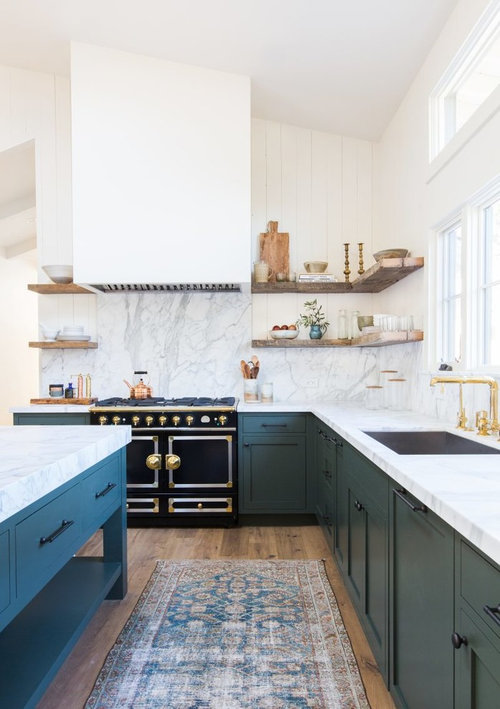
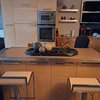
I am obsessed with Dunn Edwards "Midnight Spruce" as seen in this gorgeous kitchen. (I think) We don't have this paint line in Canada and my cabinet company is limited to Benjamin Moore. Do any of you geniuses know a close match?

Thanks!


Comments (15)

  • 8 years ago

    Most paint companies can computer match other paint brands ...the colors are mixed with formulas

  • PRO
    8 years ago

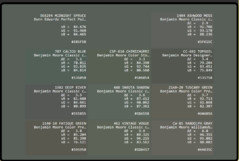
    Here are the closest colors. BenM really doesn't have anything close. The Delta E number tells you how close of a match the color is - less than 1.0 is usually acceptable. Of course, the lower the Delta E the better.

    I'd get online and order a paint chip from DE and give it to your cabinet company to match.

    turkey2 thanked Lori A. Sawaya
  • 8 years ago
    Lori-what you do is nothing short of amazing!
  • PRO
    8 years ago
    last modified: 8 years ago

    lol! Seriously, if you understand hue, value, chroma and LRV you can rule the world (or it makes it appear as tho you know what you're doing when it comes to all things color).

    Either way it's fun.

  • 8 years ago

    Thank You! Very helpful and kind!!!!


  • PRO
    8 years ago

    Also look at Sherwin Williams Riverway. I think it’s close. Not sure about how close it is with Lori’s numbers though. We recently did a kitchen with that, and it’s gorgeous!


    Island Style · More Info

  • PRO
    8 years ago
    last modified: 8 years ago

    Lori, does this site match by formula or by “eyeball”?

    I know the brothers behind My Perfect Color. Jason and Dana Shaw. (altho we haven't spoken in years)

    They own a large Benjamin Moore/Hunter Douglas retail store in New Jersey and My Perfect Color is their online business.

    You would have to call My Perfect Color and ask if they rely on computer matching alone or if they have colorists to qualify color matches.

    It's a great question to ask!

    A little bit about formulas and computer matches...

    Paint stores can buy libraries of paint color data values - they can actually choose which brands. Some stores have every brand available while others select what they consider "top" brands. Of course, the more brands you include the more expensive the library is to purchase.

    These libraries of colors that the stores use are available from different vendors.

    Where the libraries come from is the vendors get fandecks and scan/measure the colors with spectrophotometers according to color measurement standards.

    The result is spectral data for each paint color.

    They take the spectral data and transform it mathematically into various color data value formats. Most notably, CIE L*a*b*.

    The CIE L*a*b* value is essentially the color's DNA, or fingerprint.

    That's the data value that's used to find color matches and compare how well they match.

    How well they match is qualified using a Delta E scale. As I pointed out above.

    Whenever there is a post on here about paint color formulas - how to use individual colorants to define a color, or tweak them by 25%, 50% etc., I'm sitting here at The Land of Color rolling my eyes and trying not to bang my head on my keyboard.

    Because conversations about formulas and individual colorants are stupid.

    And I can tell you why it's stupid...... and a waste of time.

    The formula is not the genesis of the paint color.

    The formula is just a recipe of ingredients that alter and change each other as they are blended; their individual characteristics literally get blended away into the base and each other.

    Rendering the formula, the list of individual colorants, useless.

    The CIE L*a*b* value is what is used to figure out everything about a paint color -- including the formula.

    There isn't a team of elves with a special 'gift for color' and extra-special artistic talents somewhere in an annex to Santa's workshop tinkering with colorants and creating thousands of paint colors manually using their little elfin' eyeballs.

    The question no one asks -- but needs to -- is where do the paint color formulas come from?

    And the answer is CIE L*a*b* values.

    If you have the CIE L*a*b* value for a paint color, you can manage color like a boss and figure out a bunch of stuff.

    Like a hue/value/chroma notation.

    Which is why I say if you understand hue/value/chroma and LRV you can rule the world. (the world of color).

    I call hue, value, chroma and LRV The Four Pillars of Color.

    But it's the formula, not the CIE L*a*b* value or hue/value/chroma notation, that's stuck on to the side of every paint can.

    So, that's why people glom on to the formula and why so many believe there is some secret code to decipher in the formula - some kind of code that's going to describe and define the paint color.

    And, again, the ultimate *code* that defines and describes a paint color is the CIE L*a*b* value.

    The "undertones" bullsh1t is just as stupid if not stupider than believing there's a *code* to crack with the colorants and formula. There is a more direct and much easier path.

    If you want to truly master color, then learn how we measure and quantify how we see and experience color.

    Stepping down off my soap box now.

  • PRO
    8 years ago
    last modified: 8 years ago

    Wow, Lori, I'd say stay on that soap box!

    I've read your blog in the Land of Color, and can use Easy RGB and your Color Strategist Color Wheel to find where on the wheel a color is found, which is the hue portion of the color's DNA, correct? Which parts of the CIE L*a*b* give the chroma, LRV and value portions?

  • PRO
    8 years ago
    last modified: 8 years ago

    Which parts of the CIE L*a*b* give the chroma, LRV and value portions?

    It doesn't directly.

    It's a mathematical interpolation that involves look up tables.

    Because the Munsell system was created manually by eye so all the colors in the atlas were perceptually uniformly equidistant.

    So, while it is a straightforward process, you need to understand the color spaces and systems involved. Like, frontwards, backwards and sideways - thoroughly understand it. Because it doesn't take much to thro the entire process off track, incite a domino effect thru the process resulting in notations that are whackadoodle.

    Which is why I only talk about how to use my color wheel to find hue families via hue angles.

    Also, because bloggers and "color experts" out there typically take real color concepts like this (LRV and metamerism are good examples) and completely hack it up into a hot mess of ridiculousness.

    With regard to LRV, the harm done has minimal impact - it's just LRV, light and dark.

    However, effed up hue/value/chroma notations are no small matter, impact would be much bigger.

  • PRO
    8 years ago

    Good greif if I wanted to read a book on color I would buy one. All she wants to know is if there is a BM color close to what she likes. I would also suggeest you check out C2 for colors I use them all the time just because I love their colors and they are in Canada

  • 7 years ago
    Hi, I was wondering if OP found a satisfactory match for the Midnight Spruce color? I am in the same boat - love the color, but have no access to Dunn Edwards paint!
  • 6 years ago

    Behr black evergreen

  • 4 years ago

    I'm looking to match F.B.wevet to a dunn edwards. Does anyone have a suggestion?

  • PRO
    4 years ago

    Try Cool December (DEW 383), Igloo (DEW 379), or White Picket Fence (DET 648). None of them are perfect, but one of them may work.