Software
Houzz Logo Print
kirigamist

Problems repotting a cactus

8 years ago
So I thought I'd repot a cactus today. I had repotted it once before but rather badly, before I had sourced ingredients for an appropriate substrate, and when I knew even less than I do now.
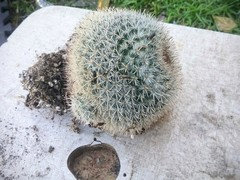
When I removed it from the pot and removed the mix I found a solid little pot-shaped mass of perlite and what is probably peat. It must have outgrown that pot a long time ago.
It seems impossible to remove the mass around the roots without harming them, it really is very hard and solid. In fact I have already caused some damage with a bamboo skewer, and there is plenty left. Any advice on the best way to remove it would be great. I assume it is better to avoid getting it wet. It would, however, dry pretty fast. It's windy and dry here ATM.

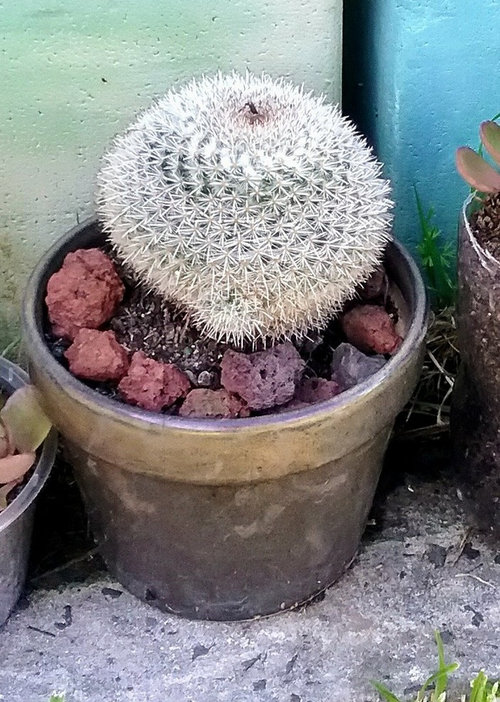
Unfortunately I didn't think to take photos until it was too dark, but i can take some tomorrow. Here is a bad (cropped) photo of it taken in May:


I think it's a mammillaria? If anyone can ID it that would be grand. I adopted it when I found it dumped by neighbours that moved out (people are weird)

Also, it occurred to me (too late) that it might not be the best time to repot a cactus, because it's winter here. However it's not actually very cold, so maybe it's okay. Here is a link to the weekly forecast, in case it matters http://www.bom.gov.au/nsw/forecasts/wollongong.shtml

Thanks!

Comments (12)

  • 8 years ago

    You also can surely dip the root ball in water to loosen the soil as long as you don't do it for hours. Just check how loose it gets every 5-10 minutes or so. Then you can dry the roots thoroughly on a paper towel, and let air dry before repotting. As Stefan said, no watering for a while after repotting

    Cheap Shoots thanked Alain (Pacifica, CA;10a)
  • 8 years ago

    I agree to soak root ball in tepid water. You might try “combing” with a plastic fork. Let dry on a paper towel for a few minutes after cleaning roots.

    Cheap Shoots thanked socks
  • 8 years ago

    I think you should consider cutting the mass out. How much of the roots would you lose, anyway?

    Cheap Shoots thanked Rob Blomquist
  • 8 years ago

    Rob, no. Its not an orchid. Cacti roots arent cut, unless there is a serious issue. But often those serious issues are fatal anyway, and the plants dont survive much

    Cheap Shoots thanked Stefan
  • 8 years ago
    last modified: 8 years ago

    Thank you all very much. I returned to work on 'the mass' today, here it is before I started:

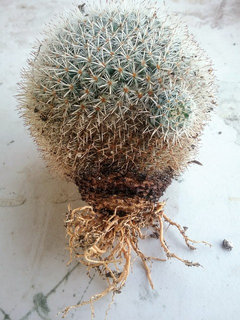
    I had to soak the roots to remove the stuff, and it was still pretty painstaking. Without the water the roots just broke off with the peat, which was pretty rock-hard. Perhaps this means the roots are in a bad way? It took a long time, I had to remove it fragment by fragment even with the soaking, I did not like to soak too long.
    Here it is now:

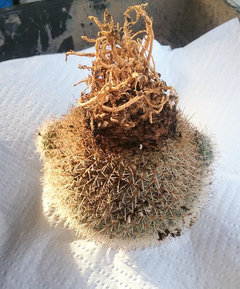
    Looks like a little hairy spiny monster here, very undignified, upside-down, drying off:

    I think there are still little peaty fragments around the roots that I ran out of time to remove today. Just how thoroughly do I need to clean them off?

    I am concerned the darkness around the base might be rot or the beginning of it. It certainly has some 'give' though i'm not sure there's anymore squishiness than the other parts of the cactus, because I can't feel them with my finger in the same way because of the spines. If it is rot, is there anything I can actually do about it, aside from keeping it dry?

    I did get rid of some of the crap stuck in the spines after this, though there's some more left to remove. Any tips for getting stuff out of cactus spines? I used a stiff paint brush.

    Funny, I was given one of those silly cacti glued into it's pot and that was actually easier to deal with than this. I really understand why some people hate peat so much now, assuming that is what it was, of course. Maybe it was actually originally planted in some unholy mixture of dirt, perlite and glue : /

    Thanks again!

  • 8 years ago
    last modified: 8 years ago

    Looks fine, I would not try to clean the roots more than that. The brown part at the base is ok too as long as it's not soft. You can plant it with aa good cactus soil (that does not have peat in it) mixed 50/50 with pumice or perlite. You can plant your cactus low to cover the brown parts or add a layer of gravel as dressing. Don't water for a week. I clean the dirt and pumice/perlite around spines using a wood skewer.


    EDIT: Just realized you are downunder so it's winter, Protect you cactus from direct sun for a couple of weeks but most of all from cold nights and winter rain. Cold and humidity is best combo for rot, most of all on stressed plant

    Cheap Shoots thanked Alain (Pacifica, CA;10a)
  • 8 years ago

    Thank you Alain.

    I was planning to make my own mix with what i have: perlite, Scoria, decomposed granite and maybe some organic element like bark fines? Any other suggestions for organic matter are welcome, or would it be best to leave it out entirely? I usually add some to my mixes, as I'm in a warm climate and all plants are outside all the time. But most of my plants are pretty easy/ common succulents and are probably a little more moisture tolerant than this cactus. I'll rinse and screen everything, of course.

    Unfortunately the cactus and succulent mix I have access to is prohibitively expensive, at least for the number of pots that I have. It doesn't contain peat, just composted bark and a 'wetting agent', which sounds a little dangerous to me!

    We are having a warm winter here, forecast this week doesn't get below 9c / 48f, and gets up to 23c / 73f. It can / could get colder than that but we never, ever get frost. No rain is forecast, we are in a bad drought here. And this is the windy season, humidity is low, everything is very dry. So, I assume it is okay for it to stay outside? I will put it under cover, in bright shade, just in case it does rain.

  • 8 years ago

    As Rina said, people have their own favorite mix. The great thing about the gritty mixture (for me, at least) is that I can tweak it for my climate or even specific plants.

    I like the mixture you have mentioned. I use turface instead of scoria (based solely on availability) and now I also leave out the bark fines. I found that in my humid climate with my wet summers, the bark breaks down into a compost that ends up holding too much water. So it has been better for me to just leave it out. I have to water more in the dry winters, but that works for me.

    Your cactus looks good and I think your gritty mix will look good with the plant, too.

    Good luck!

  • 8 years ago

    All good, as Crenda pointed there are many ways to make your mix. You got the weather on your side too, perfect for a good recovery!

    Cheers

  • 8 years ago

    Decomposed granite, Cheapshoots?? The mind boggles.

  • 8 years ago

    Thank you very much Crenda and Alain. I am still very much experimenting with mixes. I think I'll go for just inorganics for this plant, it seems safer. It can get really wet here, at any time of year. Annual rainfall is quite high, or at least it used to be.

    However I've been using some organic matter with most plants, many of the succulents I grow are very commonly grown in the ground around here without any special care (i can't afford to buy many plants) and seem a little more tolerant of moisture than many cacti and succulents. Of course my logic may be completely faulty, but my limited experience so far seems to confirm it.
    Any plants that are (locally) more unusual, like this cactus, I've been erring on the side of caution and use very little, if any, organic matter.

    Also, I have more than 100 small pots that are hung, mostly from vertical wire grids. Small hanging pots dry out really fast! They are also mostly protected from rain. So most of those plants get some organic matter, often a little bit more than I'll add to a terrestrial pot (I have plenty of those, too). But my cactus will not be hung.

    I gather it is possible to vary the water-retention in purely gritty mix by varying particle size? I'd like to learn more about that and experiment with eliminating OM entirely.

    Any opinions about my general strategy are appreciated. I have a lot of repotting to do!

    SpanishFly, yep, it's weird that stone is described as decomposed! I wish it didn't need quite so much rinsing and screening, but at least it's affordable.